

For electrical grounding and lightning protection, C11000 copper is the technical superior to 304 Stainless Steel. The primary factor is electrical conductivity: C11000 copper delivers 101% IACS min, while 304 Stainless Steel offers a mere 2% to 3% IACS. This massive difference means a copper grounding system can dissipate high-voltage fault currents into the earth with significantly lower impedance, preventing equipment damage and ensuring personnel safety. You can view our high-conductivity bar and rod inventory on the C11000 rod.
Why is the conductivity gap between C11000 and 304 SS a safety risk?
Grounding systems rely on low resistance to function effectively during a surge. Because c11000 material is is C110 pure copper, it allows for rapid electron flow. Stainless steel, an alloy of iron, chromium, and nickel, has a high internal resistance that generates heat when subjected to fault currents. If a grounding rod made of 304 SS is used as the primary conductor, the voltage drop across the rod could be high enough to cause arcing or fire.
While stainless steel is physically stronger, it is not an electrical material. For a detailed breakdown of the copper purity required for these safety systems, consult our chemical composition of C11000 alloy. For most industrial grid installations, the C110 copper vs C101 copper performance is the only metric that guarantees compliance with IEEE standards.
C11000 Copper vs. 304 Stainless Steel Electrical Data
| Property | C11000 (ETP Copper) | 304 Stainless Steel | Safety Impact |
| Electrical Conductivity | 101% IACS min | 2% to 3% IACS | Discharge speed |
| Electrical Resistivity | 0.0171 ohm·mm²/m | 0.720 ohm·mm²/m | Heat generation |
| Thermal Conductivity | 388 W/m·K | 16.2 W/m·K | Heat dissipation |
| Magnetic Permeability | 1.0 (Non-magnetic) | 1.02 (Paramagnetic) | Inductive interference |
| Melting Point | 1083 degrees Celsius | 1400 to 1450 degrees Celsius | Thermal stability |
How does soil corrosion affect C11000 vs. 304 Stainless Steel?
In buried applications, corrosion resistance is the second most critical factor. t2 copper has excellent natural resistance to most soil chemistries due to the formation of a stable cuprous oxide layer. However, in highly acidic or high-sulfur soils, copper can suffer from accelerated decay. This is where B2B buyers often consider 304 Stainless Steel, as it is highly resistant to many forms of chemical attack.
However, using 304 SS for grounding requires a much larger cross-sectional area to compensate for its poor conductivity, which often leads to higher installation costs. For most standard environments, C11000 copper bar remains the gold standard. If you are designing for high-stress mechanical environments where the rod must be driven deep into rocky soil, a copper-clad steel rod is often a better compromise than a solid stainless steel rod.
Physical and Mechanical Comparison
| Feature | C11000 Copper | 304 Stainless Steel |
| Tensile Strength | 240 to 300 MPa (H02) | 515 MPa min |
| Hardness (Rockwell B) | 45 to 55 HRB | 80 to 90 HRB |
| Ductility (Bending) | Excellent Bending | Fair (Spring-back issue) |
| Joining Method | Exothermic welding | Arc welding |
| Recyclability / Scrap | Very High Value | Moderate Value |
Balancing C11000 price against service life
From a procurement standpoint, the C11000 copper price is higher per kilogram than 304 Stainless Steel. However, for a grounding system, you must calculate the "Cost per Ampere of Capacity." Because copper carries 30 to 50 times more current than stainless steel for the same volume, a copper system is significantly more efficient and often smaller in scale.
Furthermore, exothermic welding-the standard for permanent grounding connections-works perfectly with electrolytic tough pitch copper but is difficult to perform on stainless steel due to the protective chromium oxide layer. This increases the labor and inspection costs for stainless steel systems.
FAQ:C11000 VS Stainless Steel Grounding
1. Is 304 Stainless Steel safe for lightning rods?
It is not recommended as the primary conductor. While it can handle the heat, its high resistance can lead to a "side-flash," where the lightning jumps to a nearby, more conductive path (like electrical wiring), causing an explosion or fire.
2. Can I use C11000 in high-sulfur soil?
In extremely "hot" or high-sulfur soils, copper can corrode. In these specific cases, we recommend using tinned c11000 material or specialized deoxidized grades to extend the service life of the grounding mat.
3. Why is copper-clad steel used instead of solid 304 SS?
Copper-clad steel provides the skin-effect conductivity of copper and the mechanical driving strength of steel. It is a more technically balanced solution for grounding than pure stainless steel.
4. Does 304 SS have a better ROI for long-term burial?
Only in very specific chemical environments where copper is unstable. For 95% of commercial and industrial sites, the conductivity benefits of t2 copper make it the lower-risk and higher-performance investment.
5. How do I verify the conductivity of a C11000 grounding bar?
You should use a micro-ohmmeter or eddy-current tester. A high-quality c11000 material will consistently show a reading at or above 101% IACS.
6. Can your factory provide custom-drilled grounding plates?
Yes. We maintain extensive stock in C11000 plates and bars and offer precision CNC drilling and water-jet cutting to meet your specific grounding grid blueprints. Contact us for a unified material and fabrication quote.
7. Do you also provide 304 Stainless Steel products?
Yes. While we are copper specialists, we recognize that certain structural or chemical environments require stainless steel. We also supply high-quality 304 and 316 stainless steel bars and plates. Please reach out to us via email for a comparative quote or combined shipment of both copper and steel materials.
Product Specifications & Range
| Product Category | Common Grades (Alloys) | Size Range (Dimensions) | Standards |
| Copper Rods | C11000, C12200, C10200, C14500 | Diameter: 3mm – 400mm<br>Shape: Round, Hexagonal, Square | ASTM B187, EN 12163 |
| Copper Tubes | C11000, C12200 (DHP), C10200 (OF), C27200 | OD: 2mm – 219mm<br>Wall Thickness: 0.2mm – 20mm | ASTM B280, EN 12735 |
| Copper Plates | C11000 (ETP), C10200, C12200 | Thickness: 0.1mm – 150mm<br>Width: Up to 2500mm | ASTM B152, DIN 1751 |
| Copper Wires | C11000, C10200, Brass Wire | Diameter: 0.05mm – 10.0mm<br>Form: Spool or Coil | ASTM B3, EN 13602 |
| Copper Strips | C11000, C12200, C26800 (Brass) | Thickness: 0.05mm – 3.0mm<br>Width: 5mm – 610mm | ASTM B19, EN 1652 |
Customization Note:
Custom Dimensions: We provide precision cutting and slitting services to meet your specific project requirements.
Tempers Available: Soft (O), Half-Hard (H02), Full Hard (H04), and Spring Hard (H08).
Surface Finish: Bright annealing, Polished, or Plated (Tin, Silver, Nickel) upon request.
Industrial-Grade Export Packaging
Maximum protection against oxidation, moisture, and transit damage.
1. Anti-Oxidation Protection
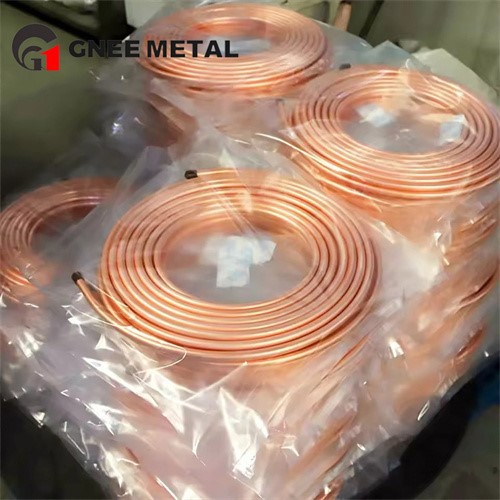
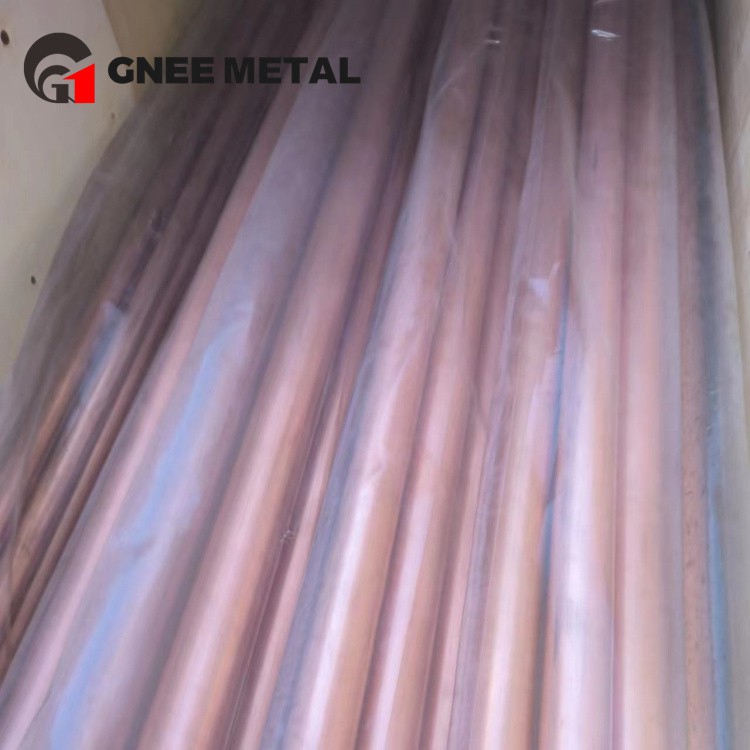
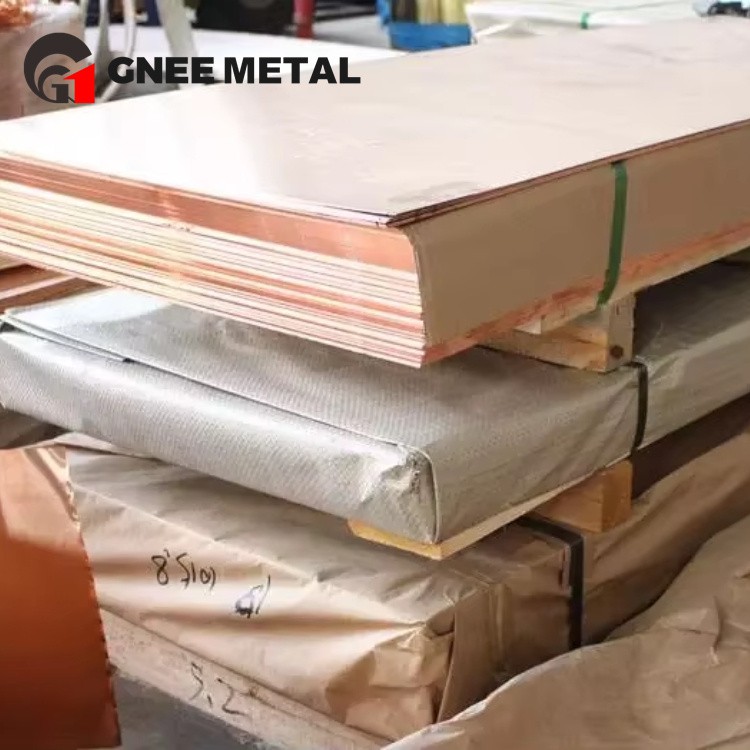
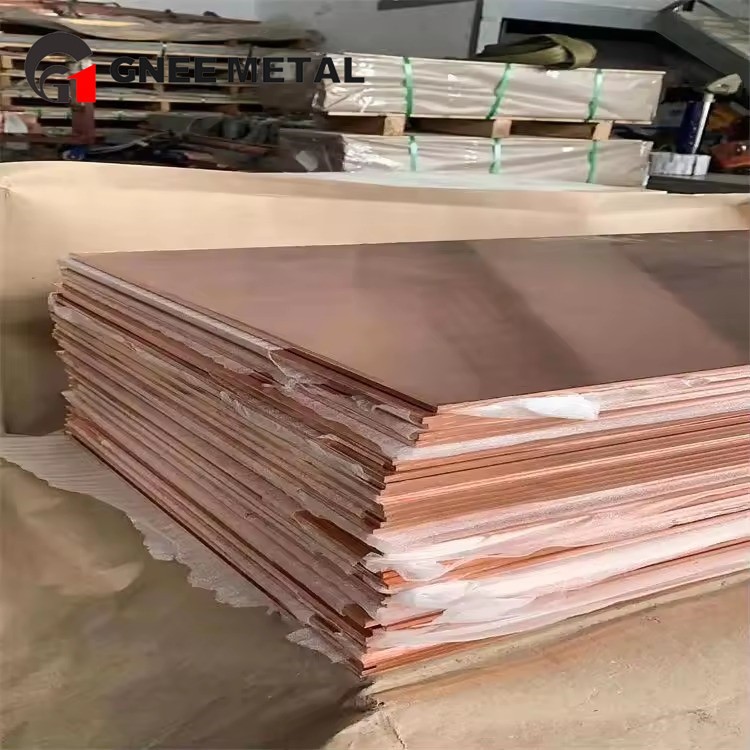
VCI Paper & Moisture-Proof Film: Every order is vacuum-sealed or wrapped in anti-corrosion materials to ensure the copper remains bright and tarnish-free during sea freight.
2. Reinforced Structural Support
Seaworthy Wooden Crates: We use reinforced, fumigation-free wooden cases (ISPM-15) and steel strapping for rods, tubes, and heavy plates to prevent bending or surface scratches.
3. Secure Handling & Loading
Forklift-Ready Pallets: All materials are secured on standardized export pallets for easy unloading and maximum stability in containers.
4. Clear Identification
Professional Labeling: Each package includes detailed labels with heat numbers, specifications, and net weight for efficient inventory management.

Advanced Manufacturing & Quality Control
1. Core Production Equipment
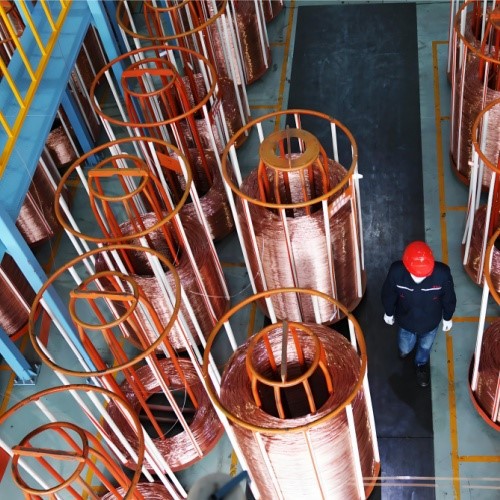
Up-casting & Continuous Casting Lines: Ensures high-purity oxygen-free copper rods and wires with uniform grain structure.
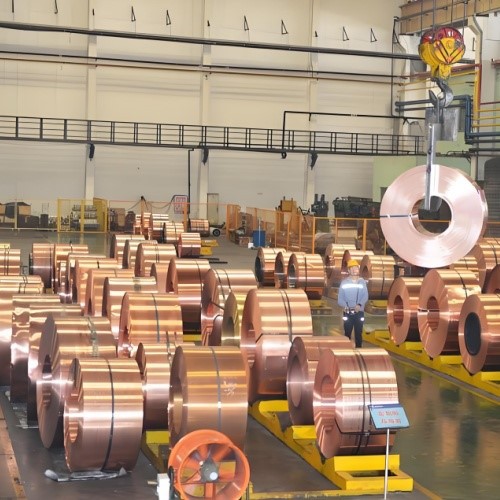
High-Precision Cold/Hot Rolling Mills: Automated thickness control for copper plates and strips with tolerances within ±0.01mm.
Large-Scale Extrusion & Drawing Machines: Capable of producing seamless copper tubes and rods in diverse diameters and shapes.
Atmospheric Controlled Annealing Furnaces: Bright annealing process to achieve specific tempers (Soft, Half-hard, Hard) without surface oxidation.
2. In-House Testing Center
Direct-Reading Spectrometers: Instant chemical composition analysis to guarantee Cu purity and precise alloying (Brass, Bronze, etc.).
Universal Tensile Testers: Verifying mechanical properties including tensile strength, elongation, and yield strength.
Eddy Current & Ultrasonic Testing: 100% non-destructive inspection for tubes and rods to detect internal cracks or flaws.
Conductivity & Hardness Testers: Ensuring electrical conductivity (IACS) and Vickers/Rockwell hardness meet international standards (ASTM, EN, DIN).



Get Fast Quote & Logistics Plan


