

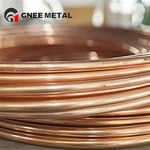
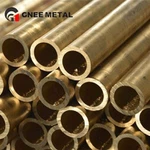
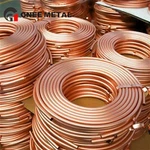
Heat Exchanger Tube
ASTM B111 Copper Tubes for Heat Exchangers
Manufacturer of seamless tubes for shell & tube heat exchangers, condensers and evaporators. Full range of ASTM B111 alloys — C12200, C44300, C68700, C70600, C71500, etc. Supplied with EN10204 3.1 mill test certificates and SGS third-party inspection.


100% Eddy Current Tested (ASTM E243)
Hydrostatic pressure tested
Full heat number traceability
Tight dimensional tolerance control

ASTM B111 / ASME SB111 compliant
Grades: C12200, C70600, C71500, C68700
EN10204 3.1 Mill Test Certificate
SGS / BV / TÜV inspection available

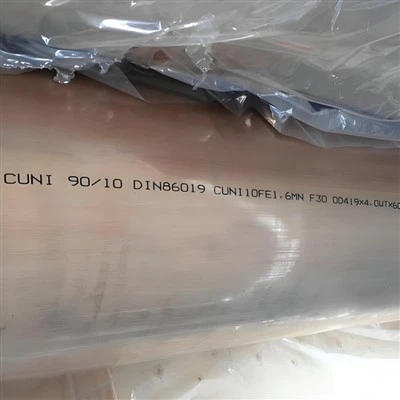

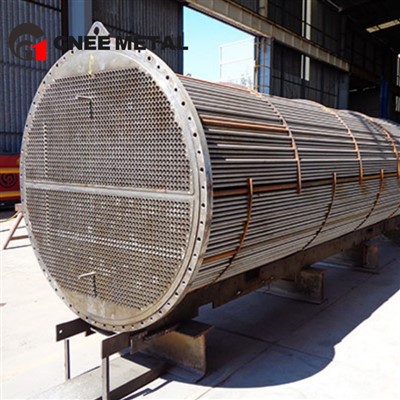


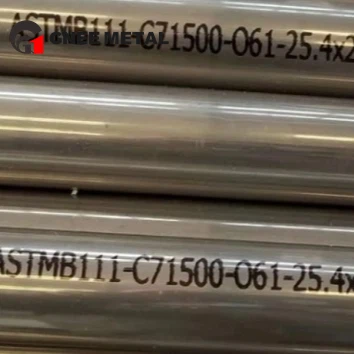
Copper Tubes for Heat Exchanger
| Item | Specification |
| Material Grade | C12200 (DHP), C70600 / C68700 (optional alloys),C44300 |
| Applicable Standards | ASTM B111 (Heat Exchanger & Condenser Tubes) |
| ASTM B75 / ASTM B280 (General / Refrigeration Tubes) | |
| EN 12735 / JIS H3300 (HVAC & Refrigeration equivalent) | |
| Product Type | Seamless copper tubes for heat exchangers, condensers, and industrial systems |
| Outer Diameter (OD) | 4 mm – 219 mm (custom sizes available) |
| Wall Thickness | 0.25 mm – 10 mm |
| Length | 1 m – 6 m standard / custom cut-to-length |
| Temper | Soft annealed / Light drawn / Hard drawn |
| Surface Condition | Bright / Clean / Pickled / Polished |
| Manufacturing Process | Seamless extrusion + cold drawing |
| Dimensional Tolerance | According to ASTM B111 / ASTM B280 |
| Straightness | ≤ 1 mm/m (typical) |
| Ovality | Controlled within ASTM tolerance |
| Testing | Eddy current testing (100%) / Hydrostatic test (optional per ASTM B111) |
| Mechanical Properties | Tensile strength, elongation per ASTM requirements |
| Thermal Conductivity | ≥ 330 W/m·K (C12200) |
| Corrosion Resistance | Suitable for seawater / industrial cooling systems (with alloy options) |
| Certification | ISO 9001 / SGS / BV / TUV / Mill Test Certificate EN 10204 3.1 |
Customer Visit & Project Reference – India
We successfully supplied ASTM B111 C68700 aluminum brass tubes to a customer in India for shell & tube condenser applications. During the project, the customer visited our facility for production inspection and quality verification. All tubes were manufactured in accordance with ASTM B111 requirements and delivered with complete Material Test Certificates (MTC), ensuring full heat number traceability and verified chemical and mechanical properties.
Download ASTM B111 C68700 MTC (PDF)
ASTM B111 C68700 MTC

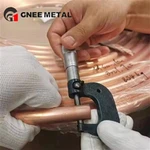
On-Site Inspection of C68700 Aluminum Brass Tubes by Customer

Request ASTM B111 Tube Pricing and MTC Samples
Why Copper Tubes?
Corrosion Resistance
Copper naturally forms a protective oxide film (Cu₂O) on its surface when exposed to water or air. This film is chemically stable in most environments — pH 6-9, chloride levels up to 200 ppm for pure copper, and up to 20,000 ppm for copper-nickel alloys.
Corrosion risks and our controls:
| Corrosion Type | Risk Conditions | Alloy Selection | Our Process Control |
|---|---|---|---|
| Pitting | Chlorides > 200 ppm (C12200), dissolved oxygen, sulfides | C70600/C71500 for seawater (up to 20,000 ppm Cl⁻) | Surface cleanliness ≤ 30 mg/m² oil residue — clean surface = complete oxide film formation |
| Stress Corrosion Cracking (SCC) | Ammonia + residual stress + tensile load | C68700 for ammonia-bearing environments | Full annealing eliminates residual stress — no stress = no SCC |
| Dezincification | High-temp water, acidic conditions, pH < 6 | C44300 (arsenic-inhibited), C68700 (aluminum-inhibited) | Alloy chemistry per ASTM B111 — As and Al content strictly controlled |
| Erosion Corrosion | Velocity > 2 m/s (C12200), turbulence, suspended solids | C70600/C71500 for high-velocity seawater (up to 3.5 m/s) | Grain size 0.03-0.06 mm — finer grains = stronger surface integrity |
Thermal Conductivity
Copper's thermal conductivity is 385 W/(m·K) — higher than any other common engineering metal except silver. Free electrons move through its crystal structure with almost no resistance.
Comparison of heat transfer efficiency:
| Material | Thermal Conductivity (W/m·K) | Key Advantage | Typical Application |
|---|---|---|---|
| C12200 Copper | 385 | Best heat transfer | HVAC, clean water |
| C44300 Admiralty Brass | 105 | Good thermal + cost-effective | Power plant condensers |
| C68700 Aluminum Brass | 100 | Ammonia & heat resistant | High-temp cooling water |
| C70600 CuNi90/10 | 45 | Seawater pitting resistant | Seawater cooling |
| C71500 CuNi70/30 | 29 | Maximum seawater corrosion resistance | Offshore, high-flow seawater |
How we ensure thermal performance:
| Factor | Impact on Heat Transfer | Our Control |
|---|---|---|
| Wall thickness | Directly affects thermal resistance — thicker wall = slower heat transfer | OD and WT tolerance per ASTM B111. We hold to your spec — no unnecessary wall thickness added. |
| Internal surface roughness | Smooth surface = lower fluid boundary layer resistance = better heat transfer | Internal surface roughness Ra ≤ 1.6 μm — less turbulence, lower friction, better flow. |
| Cleanliness | Oil or debris inside the tube acts as insulation — blocks heat transfer | Multi-stage degreasing. Oil residue ≤ 30 mg/m². Clean surface = full heat transfer. |
| Dimensional consistency | Inconsistent ID/OD causes uneven flow and localized hot spots | 100% dimensional inspection per batch. Every tube verified before packaging. |
Why copper tubes last longer:
Copper's corrosion resistance and thermal stability give it a service life significantly longer than most alternative materials in heat exchanger applications. The protective oxide film self-repairs when damaged, and copper's high creep resistance maintains dimensional stability under thermal cycling.
Service life comparison – by material:
| Material | Typical Service Life | Failure Mode | Key Limitation |
|---|---|---|---|
| Copper C12200 | 15-20 years | Pitting (aggressive water) | Requires clean water, pH 6-9 |
| Admiralty Brass C44300 | 10-15 years | Dezincification | High-temp or acidic water accelerates zinc leaching |
| Aluminum Brass C68700 | 8-12 years | Stress corrosion cracking | Ammonia + residual stress = SCC risk |
| CuNi90/10 C70600 | 10-12 years | Erosion corrosion | Velocity must stay below 3.5 m/s |
| CuNi70/30 C71500 | 12-15 years | Erosion corrosion | Higher cost, but handles velocity up to 4.5 m/s |
| Stainless Steel 304 | 5-8 years | Pitting / SCC | Chlorides attack passive film |
| Stainless Steel 316 | 8-12 years | Pitting / SCC | Better chloride resistance than 304, but still fails |
| Titanium | 20+ years | — | Excellent but expensive — 5-10x copper cost |
| Aluminum (3003) | 3-6 years | Pitting / Galvanic corrosion | Poor erosion resistance, requires water treatment |
Copper vs. Aluminum vs. Stainless Steel
| Parameter | Copper (C12200) | Aluminum (3003 / 6061) | Stainless Steel (304 / 316) |
|---|---|---|---|
| Thermal Conductivity (W/m·K) | 385 | 205-230 | ~16 |
| Corrosion Resistance | Excellent in freshwater, good in seawater (CuNi alloys) | Poor — pitting and galvanic corrosion in water | Good — but chloride pitting and SCC are common failure modes |
| Tensile Strength (MPa) | 220-250 | 110-150 | 500-700 |
| Ease of Fabrication | Excellent — easy to expand, bend, and weld | Good — but softer, prone to damage | Difficult — requires specialized tooling for tube expansion |
| Biofouling Resistance | Good — copper ions inhibit marine growth | Poor — biofouling buildup | Moderate |
| Cost | Moderate | Low | Moderate-High |
| Typical Service Life (Water Cooling) | 15-20 years | 3-6 years | 5-12 years (depends on chloride levels) |
Which one should you choose?
| Application | Recommended | Why |
|---|---|---|
| HVAC / Refrigeration | Copper C12200 | Highest thermal conductivity, easy to expand, proven 20-year life |
| Clean water cooling towers | Copper C12200 | Best thermal performance + corrosion resistance |
| Seawater cooling | Copper-nickel C70600/C71500 | Only copper-nickel resists pitting — aluminum fails, stainless pitting within 2-3 years |
| Power plant condensers | Admiralty C44300 or Aluminum Brass C68700 | Thermal + corrosion balance, handles treated cooling water |
| Low-cost, short-life equipment | Aluminum | Low initial cost — but expect replacement within 3-6 years |
| High-temperature, high-pressure, corrosive gas | Stainless Steel | When copper alloys cannot handle the specific chemical environment |
Discuss Your Heat Exchanger Application
Heat Exchanger Tube Standards
Global Standards Equivalents
| Material | UNS | EN | JIS | GB |
|---|---|---|---|---|
| Phosphorized Copper | C12200 | CW024A | C1220 | T2 |
| Admiralty Brass | C44300 | CW706R | C4430 | HSn70-1 |
| Aluminum Brass | C68700 | CW702R | C6870 | HAl77-2 |
| CuNi90/10 | C70600 | CW352H | C7060 | BFe10-1-1 |
| CuNi70/30 | C71500 | CW354H | C7150 | BFe30-1-1 |
All grades above comply with ASTM B111 / ASME SB-111 and EN 12451. Other standards (DIN, ISO, NBN) available upon request.
Alloy Selection Guide – By Application
| Application | Recommended Alloy | Key Property |
|---|---|---|
| HVAC / Refrigeration | C12200 | Highest thermal conductivity (385 W/m·K) |
| Power Plant Condensers | C44300 | Thermal + corrosion balance, cost-effective |
| High-Temp / Ammonia Cooling | C68700 | Ammonia and elevated temperature resistance |
| Seawater Cooling (low velocity) | C70600 | Pitting and biofouling resistance |
| Seawater Cooling (high velocity / offshore) | C71500 | Maximum seawater corrosion resistance |
Alloy Selection Guide – By Water Chemistry
| Water Condition | pH | Chloride (ppm) | Recommended Alloy |
|---|---|---|---|
| Clean freshwater, HVAC | 6-9 | < 200 | C12200 |
| Treated cooling water | 6-8 | 200-500 | C44300 |
| Brackish water, coastal | 7-8.5 | 500-5,000 | C68700 |
| Seawater, low velocity | 7.5-8.5 | 15,000-20,000 | C70600 |
| Seawater, high velocity | 7.5-8.5 | 15,000-20,000 | C71500 |
Heat Exchanger Tube Types We Supply

Seamless Tubes
No longitudinal weld seam — uniform wall thickness, no weak point
Common Applications: Shell & tube heat exchangers, power plant condensers, high-pressure systems, seawater cooling
Common Alloys: C12200, C44300, C68700, C70600, C71500

Straight Tubes
Most common form for heat exchanger fabrication — up to 30m length, plain or beveled ends
Common Applications: Shell & tube heat exchangers, condensers, evaporators
Common Alloys: C12200, C44300, C68700, C70600, C71500

U-Bend Tubes
Bent into U-shape — accommodates thermal expansion in shell & tube heat exchangers, stress-relieved after bending
Common Applications: Shell & tube heat exchangers, U-tube bundles
Common Alloys: C12200, C44300, C68700, C70600

Coiled Tubes
Continuous length wound on spools — for field installation and replacement
Common Applications: Field replacement bundles, on-site installation
Common Alloys: C12200

Finned Tubes
Integral low fins or high fins rolled from the tube wall — increases heat transfer surface area
Common Applications: Air-cooled heat exchangers, applications with low heat transfer coefficient on one side
Common Alloys: C12200, C44300, C68700

Inner-Grooved Tubes
Internal helical ribs — enhances turbulent flow, improves heat transfer efficiency vs. plain tubes
Common Applications: HVAC condensers and evaporators, refrigeration systems
Common Alloys: C12200
Heat Exchanger Copper Tube Dimensions and Tolerances
Heat exchanger copper tubes are available in a wide range of diameters, wall thicknesses and lengths to meet the requirements of condensers, evaporators, shell-and-tube heat exchangers and HVAC systems.
Standard Dimensions
| Outside Diameter (OD) | Wall Thickness (WT) | Standard Length |
|---|---|---|
| 6.35 mm (1/4") | 0.5–1.0 mm | Up to 6 m |
| 9.52 mm (3/8") | 0.6–1.2 mm | Up to 6 m |
| 12.70 mm (1/2") | 0.7–1.5 mm | Up to 6 m |
| 15.88 mm (5/8") | 0.7–1.65 mm | Up to 9 m |
| 19.05 mm (3/4") | 0.9–2.0 mm | Up to 12 m |
| 25.40 mm (1") | 1.0–2.5 mm | Up to 12 m |
| 31.75 mm (1-1/4") | 1.2–3.0 mm | Up to 15 m |
| 38.10 mm (1-1/2") | 1.2–3.0 mm | Up to 15 m |
| 50.80 mm (2") | 1.5–3.0 mm | Up to 18 m |
| 76.20 mm (3") | 2.0–3.5 mm | Up to 20 m |
Dimensional Tolerances
| Item | Tolerance |
| Outside Diameter | ±0.05 mm to ±0.15 mm |
| Wall Thickness | ±10% of nominal thickness |
| Length | +5 mm / -0 mm |
| Straightness | ≤1 mm per meter |
| Ovality | Within OD tolerance |
| Cut Squareness | ≤0.5 mm |
| Burr Height | ≤0.10 mm |
Typical Heat Exchanger Tube Sizes
| Application | Typical Size |
|---|---|
| Air Conditioning | 9.52 × 0.8 mm |
| Refrigeration | 12.7 × 1.0 mm |
| Oil Cooler | 15.88 × 1.0 mm |
| Surface Condenser | 19.05 × 1.24 mm |
| Shell and Tube Heat Exchanger | 19.05 × 1.65 mm |
| Power Plant Condenser | 22.22 × 1.24 mm |
| Seawater Condenser | 25.4 × 1.65 mm |
Custom Sizes Available
- Outside Diameter: 6 mm – 76 mm
- Wall Thickness: 0.5 mm – 3.5 mm
- Length: Up to 20 meters
- Metric and Imperial Sizes Available
- Cut-to-Length Service
- Tight Tolerance Manufacturing
Send us your drawing — we manufacture to your spec.
Surface Finish Options

| Surface Finish | Characteristics | Customer Benefits | Typical Applications |
| Bright Annealed (BA) | Smooth, clean and oxide-free surface | Better heat transfer efficiency and easier brazing | HVAC systems, refrigeration and general heat exchangers |
| Mill Finish | Natural metallic appearance | Cost-effective solution for standard applications | Condensers and industrial heat exchangers |
| Pickled and Cleaned | Removal of oxides and contaminants | Facilitates welding and tube expansion | Shell-and-tube heat exchangers |
| Polished Finish | Improved surface smoothness | Reduced fouling and pressure loss | Precision cooling equipment |
| Tin-Plated Finish | Enhanced corrosion resistance and solderability | Longer service life and improved joining performance | Marine and special applications |
| Protective Coating | Temporary protection during storage and transportation | Prevents oxidation and handling damage | Export projects and long-term storage |
Internal and External Surface Quality
- Clean and smooth inside and outside surfaces
- Free from harmful defects, cracks and laminations
- Low surface roughness for improved heat transfer efficiency
- No heavy oxide scale after annealing
- Suitable for tube expansion, bending and welding operations

Tube End Finishing
Special attention is given to tube end quality, which is often overlooked but critical for installation and leak prevention.
- Burr-free tube ends
- Square-cut ends
- Smooth inner edges
- Deburring treatment available
- Custom chamfering upon request
- Plastic end caps available for contamination prevention
Temper Conditions

| Temper Condition | Characteristics | Typical Applications |
| Annealed (Soft) | Fully heat-treated with maximum ductility | HVAC systems, refrigeration, general heat exchangers |
| Light Drawn (Half Hard) | Moderate strength with balanced ductility | Industrial heat exchangers, condensers, process cooling systems |
| Hard Drawn | High strength with lower ductility | High-pressure heat exchangers and specialized industrial systems |
Selection Guidance
Use Annealed (Soft) condition for tube expansion, bending and brazed joints.
Use Light Drawn condition when moderate pressure resistance and improved strength are required.
Use Hard Drawn condition where high strength is needed and forming is minimal.
Heat Exchanger Tube Design Considerations
| Design Factor | Key Considerations | Why It Matters |
| Tube Diameter Selection | Flow rate and heat transfer area | Determines heat transfer efficiency |
| Wall Thickness Selection | Pressure and corrosion allowance | Affects service life and safety |
| Pressure Rating | Working pressure and temperature | Prevents tube rupture |
| Flow Velocity Limits | Fluid speed | Reduces erosion corrosion |
| Fouling Factors | Water quality | Minimizes maintenance frequency |
| Tube Expansion | Tube-to-tubesheet joint | Improves leak tightness |
| Tube Support Spacing | Vibration conditions | Prevents mechanical damage |
| Tube Sheet Compatibility | Material compatibility | Avoids galvanic corrosion |
Key Design Recommendations
Select tube diameter based on required heat transfer capacity and allowable pressure drop.
Choose sufficient wall thickness to withstand operating pressure and corrosion allowance.
Maintain appropriate flow velocity to minimize erosion and vibration damage.
Consider fouling tendencies when selecting tube material and surface condition.
Ensure compatibility between tubes and tube sheets to avoid galvanic corrosion.
Proper tube support and expansion are essential for long-term sealing performance and operational reliability.
Typical Industry Applications and Projects

HVAC and Chiller Systems
Recommended Materials: C12200
Temper: Annealed (O60)
Surface Finish: Bright Annealed (BA)
Typical Sizes: 9.52×0.8 mm, 12.7×1.0 mm, 15.88×1.0 mm
Standards: ASTM B280, EN 12735, JIS H3300

Surface Condensers for Power Plants
Recommended Materials: C68700, C70600
Temper: Annealed, Light Drawn
Surface Finish: Mill Finish, Pickled and Cleaned
Typical Sizes: 19.05×1.24 mm, 22.22×1.24 mm, 25.40×1.65 mm
Standards: ASTM B111, ASME SB111, EN 12451

Shell-and-Tube Heat Exchangers
Recommended Materials: C12200, C68700
Temper: Annealed
Surface Finish: Bright Annealed, Mill Finish
Typical Sizes: 15.88×1.0 mm, 19.05×1.24 mm, 25.40×1.65 mm
Standards: ASTM B75, ASTM B111, EN 12451

Seawater Cooling Systems
Recommended Materials: C70600, C71500
Temper: Annealed
Surface Finish: Pickled and Cleaned
Typical Sizes: 19.05×1.24 mm, 22.22×1.24 mm, 25.40×1.65 mm
Standards: ASTM B111, ASME SB111

Offshore Platforms and Shipbuilding
Recommended Materials: C70600, C71500
Temper: Annealed
Surface Finish: Mill Finish
Typical Sizes: 19.05×1.65 mm, 25.40×1.65 mm
Standards: ASTM B111, MIL-T-16420

Petrochemical Processing Equipment
Recommended Materials: C68700, C70600
Temper: Annealed, Light Drawn
Surface Finish: Mill Finish, Pickled and Cleaned
Typical Sizes: 19.05×1.24 mm, 22.22×1.24 mm, 25.40×1.65 mm
Standards: ASTM B111, ASME SB111, EN 12451

Quality Assurance
Hydrostatic pressure testing for leakage safety
Controlled annealing for stable mechanical properties
Strict dimensional inspection (OD, WT, straightness)
Clean, burr-free tube ends for installation safety
Testing & Inspection


Inspection & Testing Methods
| Test Item | Purpose | Standard / Requirement |
|---|---|---|
| Chemical Composition Analysis | Verify alloy accuracy | Spectrometric PMI testing |
| Dimensional Inspection | Ensure OD, WT and length accuracy | ASTM / EN tolerance standards |
| Eddy Current Testing | Detect surface and subsurface defects | 100% full inspection |
| Hydrostatic / Pneumatic Test | Confirm pressure resistance and leak tightness | As per ASTM B111 / B280 |
| Mechanical Property Test | Verify strength and ductility | Tensile, hardness, elongation tests |
| Surface Inspection | Check surface condition and cleanliness | Visual + surface quality standards |
Inspection & Testing
- 100% Eddy Current Testing on all tubes
- Hydrostatic or pneumatic pressure testing before shipment
- Dimensional inspection (OD / wall thickness / ovality)
- Visual and surface inspection at every production stage
- Full traceability by heat number (Heat No.)
- Compliance with ASTM / EN / JIS standards
Quality Documentation
- Mill Test Certificate (EN 10204 3.1)
- Chemical Composition Report
- Mechanical Property Report
- Production batch traceability report
Request Test Reports (MTC / SGS / BV)
Packaging & Export


| Packaging Type | Description | Protection Purpose |
| Wooden Boxes | Fumigated export-grade wooden cases | Prevent mechanical damage during long-distance transport |
| Steel Bundles | Steel-strapped bundles with plastic wrapping | Ensure stability and easy handling |
| Plastic Bags (Inner Layer) | Moisture-resistant PE wrapping | Prevent oxidation and surface contamination |
| End Caps Protection | Plastic caps on both tube ends | Prevent internal contamination and mechanical damage |
| Waterproof Wrapping | Waterproof film covering entire bundle | Protect against humidity and seawater exposure |
Anti-Corrosion Protection
- Anti-oxidation oil coating (optional)
- Moisture-proof sealing for long sea shipments
- Desiccant bags inside packaging (upon request)
- Vacuum packing available for high-end applications
Quality Condition on Delivery
All tubes are delivered:
- Clean and dry
- Free from oxidation and contamination
- Straight and deformation-free
- Ready for immediate fabrication or installation
Production Equipment & Warehouse

Melting & Casting

Extrusion Press

Three-Roll Planetary Rolling Mill

Drawing Line

Annealing Furnaces

Cutting & Straightening
| Equipment | Function | Quality Impact |
| Cold Drawing Machines | Control outer diameter and wall thickness | Ensures dimensional accuracy and mechanical strength |
| Bright Annealing Furnaces | Heat treatment process | Improves ductility and forming performance |
| Straightening Machines | Tube straightness correction | Ensures installation precision and assembly fit |
| Eddy Current Testing Equipment | 100% non-destructive testing | Detects surface and internal defects |
| Hydrostatic Testing Units | Pressure resistance test | Ensures leak-free performance under working conditions |
| Cutting & End Finishing Machines | Tube cutting and deburring | Ensures safe installation and clean tube ends |
| Spectrometric Testing (PMI) | Chemical composition analysis | Ensures correct alloy grade and material consistency |

Warehouse & Storage
Separate storage for different alloys (C12200, C68700, C70600, C71500)
Indoor storage to prevent oxidation and moisture exposure
Clear labeling system for batch and heat number traceability
Ready-to-ship stock for standard sizes
Palletized storage for efficient loading and export handling
FAQ
What are heat exchanger copper tubes used for?
Heat exchanger copper tubes are used in HVAC systems, condensers, evaporators, shell-and-tube heat exchangers, power plants and marine cooling systems. They are selected based on thermal conductivity, corrosion resistance and operating pressure requirements.
How do I choose the right copper grade for my application?
Material selection depends on operating environment:
C12200 → Best for HVAC and refrigeration due to high thermal conductivity
C68700 → Suitable for condenser and industrial cooling with moderate corrosion resistance
C70600 / C71500 → Recommended for seawater and marine applications due to excellent corrosion resistance
Incorrect material selection can significantly reduce service life and increase maintenance cost.
What is the difference between ASTM B280 and ASTM B111?
ASTM B280 is used for air conditioning and refrigeration (ACR) copper tubes
ASTM B111 is used for heat exchanger and condenser tubes operating in industrial environments
Selecting the wrong standard may result in installation failure or non-compliance with project specifications.
Can copper tubes be used in seawater environments?
Standard copper (C12200) is not suitable for seawater due to corrosion risk. For seawater applications, CuNi alloys such as C70600 (90/10) and C71500 (70/30) are recommended because of their superior resistance to chloride corrosion and biofouling.
What delivery condition should I choose: annealed or hard drawn?
Annealed (Soft) → Recommended for tube expansion, bending and brazing
Light Drawn → Balanced strength and formability for industrial use
Hard Drawn → Used in applications requiring high strength and minimal forming
Incorrect temper selection can lead to cracking during installation.
What quality tests are performed before shipment?
Each tube undergoes strict quality control including:
100% Eddy Current Testing for defect detection
Hydrostatic or pneumatic pressure testing for leak integrity
Chemical composition verification (PMI testing)
Dimensional inspection for OD, WT and straightness
This ensures compliance with ASTM, EN and JIS standards.
Can you provide custom sizes and tolerances?
Yes. We supply standard and customized dimensions, including OD, wall thickness and length. Tight tolerance manufacturing is available for OEM and project-specific requirements.
What is EN10204 3.1 certificate?
EN10204 3.1 is a mill test certificate that provides verified chemical composition, mechanical properties and traceability by heat number. It is commonly required for industrial and EPC projects.
How is the product packaged for export?
Tubes are packed in seaworthy wooden cases or steel bundles with moisture protection, plastic end caps and waterproof wrapping to prevent corrosion and mechanical damage during transportation.
Are you a manufacturer or a trading company?
We are a manufacturing supplier specializing in heat exchanger copper tubes with integrated production, testing and warehouse systems. This ensures stable quality control, consistent delivery and full traceability for industrial projects.
What is the lead time for copper tubes?
Lead time depends on material grade, specification and order quantity. For standard sizes, production is typically fast due to ready raw materials and established manufacturing schedules.
Standard specifications: 2–4 weeks
Customized sizes or special alloys: 4–6 weeks
Project-based or bulk orders: subject to negotiation
Urgent orders can be supported based on production capacity and inventory availability.
Do you support OEM and project supply?
Yes. We fully support OEM manufacturing and project-based supply for heat exchanger copper tubes.We provide:
Customized dimensions (OD, WT, length)
Specific alloy grades based on project requirements
Private labeling and documentation support
Stable batch production for long-term projects
Consistent quality control across multiple shipments
Our supply system is designed for EPC contractors, OEM manufacturers and industrial project procurement.
Can you provide third-party inspection (SGS, BV, TUV)?
Yes. Third-party inspection is available upon request.We support inspection by internationally recognized agencies such as:
SGS
Bureau Veritas (BV)
TÜV Rheinland / TÜV SÜD
Inspection can cover:
Chemical composition verification
Dimensional inspection
Mechanical property testing
Visual and surface quality inspection
Packing and shipment verification
All inspection results are fully traceable to heat numbers (Heat No.) to ensure complete quality transparency.
Get Fast Response Within 12 Hours