

Copper Materials for Heat Exchangers
Heat exchangers are widely used in HVAC & refrigeration, power generation, marine engineering, chemical processing, oil & gas, food processing, and industrial cooling systems. Copper and copper alloys are commonly manufactured into tubes, plates, strips, rods, and wires for components such as condensers, evaporators, chillers, boilers, radiators, and oil coolers.
Customer Installation Video: This video comes from a recent customer project and captures the on-site installation of a copper tube heat exchanger.
Need Help Choosing the Right Copper Material?Get Expert Recommendation →
Heat Exchangers Selection Guide
Copper Material Selection by Heat Exchanger Type
Different heat exchanger designs operate under different temperatures, pressures, and working conditions. Choosing the appropriate copper alloy and product form is essential for achieving high heat transfer efficiency, corrosion resistance, and long service life. The table below provides a quick selection guide for the most common heat exchanger types.


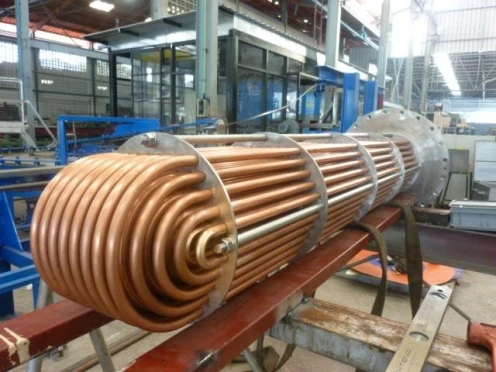

| Heat Exchanger Type | Typical Applications | Recommended Copper Product | Recommended Copper Grades | Why It Is Recommended |
|---|---|---|---|---|
| Shell & Tube Heat Exchanger | Power plants, chemical processing, marine cooling, petrochemical plants | Seamless Copper Tube | C68700, C70600, C44300, C12200 | Excellent corrosion resistance, high pressure capability, and reliable long-term heat transfer. |
| Plate Heat Exchanger | HVAC systems, food & beverage, pharmaceutical processing | Copper Plate | C12200, C11000 | High thermal conductivity, excellent flatness, and easy fabrication for plate assemblies. |
| Finned Tube Heat Exchanger | Air conditioners, condensers, radiators, heat pumps | Copper Tube + Copper Strip | C12200, C11000 | Copper tubes efficiently transfer refrigerant heat, while copper strips are used to manufacture cooling fins and increase heat exchange area. |
| Double Pipe Heat Exchanger | Small industrial cooling systems, hydraulic equipment | Seamless Copper Tube | C12200, C11000 | Cost-effective solution with excellent thermal conductivity and easy installation. |
| Air-Cooled Heat Exchanger | Power generation, oil & gas, industrial cooling | Copper Tube | C12200, C68700 | Provides efficient air-to-fluid heat transfer and reliable performance in outdoor environments. |
| U-Tube Heat Exchanger | Boilers, condensers, heat recovery systems | U-Bend Copper Tube | C12200, C68700, C70600 | Excellent bendability without sacrificing strength or corrosion resistance. |
| Spiral Heat Exchanger | Chemical processing, wastewater treatment | Copper Plate | C70600, C71500 | Superior resistance to aggressive chemicals and seawater while maintaining structural integrity. |
Quick Selection Guide
| If your application is... | Recommended Copper Product | Preferred Grade |
|---|---|---|
| General industrial heat exchanger | Seamless Copper Tube | C12200 |
| Power plant condenser | Seamless Copper Tube | C68700 |
| Marine or seawater heat exchanger | Copper Nickel Tube | C70600 / C71500 |
| HVAC & refrigeration heat exchanger | Copper Tube | C12200 |
| Food & pharmaceutical plate heat exchanger | Copper Plate | C12200 |
| High-corrosion chemical environment | Copper Nickel Tube / Plate | C71500 |
Not Sure Which Type Fits Your Project? Send Your Requirements
Copper Material Selection by Equipment Function
Different heat exchanger components operate under different temperatures, pressures, and cooling media. Selecting the right copper alloy helps improve heat transfer efficiency, corrosion resistance, and service life. The following guide recommends suitable copper materials based on the function of each heat exchange component.
| Equipment Function | Typical Working Medium | Recommended Product Form | Recommended Copper Grades | Why It Is Recommended |
|---|---|---|---|---|
| Condenser | Steam, seawater, cooling water | Seamless Copper Tube | C68700, C44300, C70600 | Excellent corrosion resistance and long service life in condenser applications, especially with seawater or brackish water. |
| Evaporator | Refrigerants, chilled water | Seamless Copper Tube | C12200, C11000 | Outstanding thermal conductivity and easy tube expansion, making it ideal for refrigeration and HVAC systems. |
| Oil Cooler | Hydraulic oil, lubricating oil | Copper Tube | C70600, C12200 | Good corrosion resistance and stable heat transfer under continuous oil cooling conditions. |
| Water Cooler | Fresh water, industrial cooling water | Copper Tube | C12200, C68700 | High thermal conductivity with good resistance to general industrial water environments. |
| Chiller | Refrigerants, chilled water | Copper Tube | C12200 | The preferred material for commercial and industrial chillers due to excellent heat transfer performance. |
| Boiler Heat Exchanger | Steam, hot water | Copper Tube | C44300, C68700 | Suitable for elevated temperatures and long-term operation with good mechanical strength. |
| Radiator | Engine coolant, glycol | Copper Tube + Copper Strip | C12200, C11000 | Copper tubes carry coolant while copper strips are commonly used to manufacture cooling fins for improved heat dissipation. |
| Heat Recovery Unit | Waste heat, exhaust gas | Copper Tube | C12200, C70600 | Excellent thermal efficiency for recovering waste heat in industrial systems. |
Quick Selection Guide
| If you are manufacturing... | Recommended Copper Grade | Recommended Product |
|---|---|---|
| HVAC Condenser | C12200 | Seamless Copper Tube |
| Power Plant Condenser | C68700 | Seamless Copper Tube |
| Marine Condenser | C70600 | Copper Nickel Tube |
| Refrigeration Evaporator | C12200 | Seamless Copper Tube |
| Industrial Oil Cooler | C70600 | Copper Tube |
| Commercial Chiller | C12200 | Copper Tube |
| Engine Radiator | C12200 + C11000 | Copper Tube + Copper Strip |
| Heat Recovery System | C12200 | Copper Tube |
Selection Tips
Choose C12200 for most HVAC, refrigeration, and general industrial heat exchangers.
Choose C68700 for condensers operating with cooling water or in power generation applications.
Choose C70600 when the equipment is exposed to seawater or other highly corrosive media.
Choose C44300 for steam condensers and boiler heat exchangers requiring reliable corrosion resistance.
Use Copper Strip together with Copper Tubes in finned heat exchangers and radiators to maximize heat transfer efficiency.
Copper Material Selection by Cooling Medium
The cooling medium has a significant impact on the performance and service life of heat exchanger materials. Different media vary in corrosion potential, operating temperature, and chemical composition. The following guide helps you select the most suitable copper alloy based on the working medium.
| Cooling Medium | Typical Applications | Recommended Product Form | Recommended Copper Grades | Why It Is Recommended |
|---|---|---|---|---|
| Fresh Water | HVAC systems, industrial cooling, heat pumps | Copper Tube | C12200, C11000 | High thermal conductivity, excellent cost-performance, and sufficient corrosion resistance for clean water systems. |
| Seawater | Marine heat exchangers, offshore platforms, ship condensers | Copper Nickel Tube | C70600, C71500 | Outstanding resistance to seawater corrosion, biofouling, and erosion. |
| Brackish Water | Coastal cooling systems, desalination plants | Copper Tube | C68700, C70600 | Better resistance to chloride-containing water than pure copper while maintaining good heat transfer. |
| Refrigerants (R410A, R32, R134a, etc.) | Air conditioners, refrigeration systems, chillers | Copper Tube | C12200 | Excellent formability, pressure resistance, and compatibility with common refrigerants. |
| Steam & Condensate | Boilers, steam condensers, heat recovery systems | Copper Tube | C44300, C68700 | Good corrosion resistance and stable performance under high-temperature steam conditions. |
| Cooling Water (Closed Loop) | Industrial cooling systems, process heat exchangers | Copper Tube | C12200, C68700 | Suitable for closed-loop systems with stable water quality and efficient heat transfer. |
| Industrial Process Fluids | Chemical processing, petrochemical plants | Copper Nickel Tube | C70600, C71500 | Excellent resistance to aggressive chemicals and demanding industrial environments. |
| Hydraulic & Lubricating Oil | Oil coolers, compressors, hydraulic equipment | Copper Tube | C12200, C70600 | Good thermal conductivity and reliable performance in continuous oil cooling applications. |
Quick Selection Guide
| If your cooling medium is... | Best Choice | Alternative |
|---|---|---|
| Fresh Water | C12200 | C11000 |
| Seawater | C70600 | C71500 |
| Brackish Water | C68700 | C70600 |
| Refrigerant | C12200 | C11000 |
| Steam | C44300 | C68700 |
| Industrial Cooling Water | C12200 | C68700 |
| Chemical Fluids | C71500 | C70600 |
| Hydraulic Oil | C12200 | C70600 |
Material Selection Tips
✔ Choose C12200 for most HVAC, refrigeration, and general industrial cooling applications using fresh water or refrigerants.
✔ Choose C68700 for cooling systems exposed to brackish water or circulating cooling water where enhanced corrosion resistance is required.
✔ Choose C70600 for seawater-cooled heat exchangers, marine condensers, and offshore equipment requiring excellent resistance to seawater corrosion.
✔ Choose C71500 for highly aggressive marine or chemical environments where maximum corrosion resistance and long service life are essential.
✔ Choose C44300 for steam condensers and boiler heat exchangers operating at elevated temperatures.
Need Material Selection Assistance?
Simply tell us:
✅ Cooling Medium
✅ Operating Temperature
✅ Working Pressure
✅ Required Size
We'll recommend the most suitable copper alloy within 24 hours.
Request Material Recommendation
Selecting the Right Copper Product Form for Heat Exchangers
Copper materials are available in different product forms to meet the manufacturing requirements of various heat exchanger designs. Each form serves a different function within the heat exchanger system, from heat transfer and structural support to machining and electrical connections.


| Product Form | Typical Function in Heat Exchangers | Recommended Copper Grades | Typical Applications | Key Advantages |
|---|---|---|---|---|
| Copper Tube | Primary heat transfer component | C12200, C11000, C68700, C70600, C71500 | Condensers, Evaporators, Chillers, Boilers, Oil Coolers, Shell & Tube Heat Exchangers | Excellent thermal conductivity, pressure resistance, corrosion resistance, and easy bending or expansion. |
| Copper Plate | Tube sheets, heat transfer plates, mounting plates | C12200, C11000, C68700 | Plate Heat Exchangers, Tube Sheets, End Plates | High strength, good flatness, excellent machinability, and reliable sealing performance. |
| Copper Rod | Machined connectors, fittings, valves, support components | C11000, C12200 | Connectors, Headers, Valve Components, Custom Machined Parts | Easy machining, high electrical and thermal conductivity, good mechanical strength. |
| Copper Strip | Cooling fins, heat dissipation components, brazing parts | C11000, C12200 | Finned Tube Heat Exchangers, Radiators, Air Conditioners | Thin, lightweight, excellent formability, and increased heat transfer surface area. |
| Copper Wire | Brazing, welding, electrical connections, sensors | Copper Brazing Alloys, C11000 | Heat Exchanger Assembly, Brazing, Electrical Connections | Reliable joining performance and excellent electrical conductivity. |
Quick Product Selection Guide
| If you need to... | Recommended Product |
|---|---|
| Build the main heat transfer channel | Copper Tube |
| Manufacture tube sheets or heat transfer plates | Copper Plate |
| Produce machined connectors or fittings | Copper Rod |
| Increase heat dissipation with cooling fins | Copper Strip |
| Perform brazing or electrical connections | Copper Wire |
Which Copper Product Should You Choose?
| Your Requirement | Recommended Product |
|---|---|
| Highest heat transfer efficiency | Copper Tube |
| Flat structural components | Copper Plate |
| Precision machined parts | Copper Rod |
| Lightweight cooling fins | Copper Strip |
| Joining and assembly | Copper Wire |
Copper vs. Other Heat Exchanger Materials
Selecting the right material is one of the most important decisions in heat exchanger design. While copper is the preferred choice for many HVAC, refrigeration, and industrial cooling systems, other materials such as stainless steel, titanium, aluminum brass, and copper nickel may be better suited for specific operating environments. The comparison below provides a quick overview of the strengths of each material.
| Material | Thermal Conductivity | Corrosion Resistance | Mechanical Strength | Relative Cost | Best Applications |
|---|---|---|---|---|---|
| Pure Copper (C12200/C11000) | ★★★★★ | ★★★★☆ | ★★★☆☆ | $$ | HVAC, Refrigeration, Chillers, General Heat Exchangers |
| Aluminum Brass (C68700) | ★★★★☆ | ★★★★★ | ★★★★☆ | $$$ | Power Plant Condensers, Brackish Water Cooling |
| Copper Nickel (C70600/C71500) | ★★★☆☆ | ★★★★★ | ★★★★☆ | $$$$ | Marine Heat Exchangers, Offshore Platforms, Seawater Systems |
| Stainless Steel | ★★☆☆☆ | ★★★★★ | ★★★★★ | $$$ | Chemical Processing, Food & Beverage Equipment |
| Titanium | ★★☆☆☆ | ★★★★★ | ★★★★★ | $$$$$ | Desalination Plants, Offshore, Highly Corrosive Media |
| Aluminum | ★★★☆☆ | ★★☆☆☆ | ★★☆☆☆ | $ | Automotive Radiators, Lightweight Cooling Systems |
Material Selection Recommendations
| Operating Condition | Recommended Material | Why? |
|---|---|---|
| General industrial cooling | C12200 Copper | Best balance of thermal conductivity, cost, and manufacturability. |
| HVAC & Refrigeration | C12200 Copper | Industry standard for refrigerant systems with excellent heat transfer performance. |
| Fresh water cooling | C12200 Copper | Cost-effective and highly efficient. |
| Brackish water | C68700 Aluminum Brass | Better resistance to chloride corrosion than pure copper. |
| Seawater cooling | C70600 Copper Nickel | Outstanding resistance to seawater corrosion and biofouling. |
| Highly corrosive chemical media | Titanium or C71500 Copper Nickel | Maximum corrosion resistance for demanding environments. |
| Weight-sensitive applications | Aluminum | Lightweight solution where thermal performance requirements are moderate. |
For most heat exchanger applications, copper remains the preferred material due to its exceptional thermal conductivity, ease of fabrication, corrosion resistance, and cost-effectiveness. However, when operating in seawater, chloride-rich, or highly corrosive environments, Aluminum Brass (C68700) and Copper Nickel alloys (C70600/C71500) provide superior durability. Titanium is generally selected only for extremely aggressive media where maximum corrosion resistance outweighs the higher material cost.
Heat Exchanger Copper Grade Comparison
Different copper grades are designed for different operating environments. Selecting the correct alloy depends on factors such as heat transfer efficiency, cooling medium, corrosion resistance, operating pressure, and service life. The following comparison provides a quick reference for the most commonly used copper grades in heat exchanger applications.
| Copper Grade | Thermal Conductivity | Corrosion Resistance | Pressure Resistance | Typical Product Form | Best Applications |
|---|---|---|---|---|---|
| C11000 (ETP Copper) | ★★★★★ | ★★★☆☆ | ★★★☆☆ | Tube, Plate, Rod, Strip | General heat transfer, radiators, industrial cooling |
| C12200 (DHP Copper) | ★★★★★ | ★★★★☆ | ★★★★☆ | Tube, Plate | HVAC, Refrigeration, Chillers, Evaporators |
| C44300 (Admiralty Brass) | ★★★★☆ | ★★★★☆ | ★★★★☆ | Tube | Steam condensers, Power plants, Fresh & slightly saline water |
| C68700 (Aluminum Brass) | ★★★★☆ | ★★★★★ | ★★★★★ | Tube, Plate | Condensers, Power Stations, Brackish Water Cooling |
| C70600 (90/10 Copper Nickel) | ★★★☆☆ | ★★★★★ | ★★★★★ | Tube | Marine Heat Exchangers, Seawater Cooling Systems |
| C71500 (70/30 Copper Nickel) | ★★★☆☆ | ★★★★★ | ★★★★★ | Tube | Offshore Platforms, Desalination Plants, Highly Corrosive Media |
Quick Grade Selection Guide
| If you need... | Recommended Grade | Typical Application |
|---|---|---|
| Highest thermal conductivity | C11000 / C12200 | HVAC, Refrigeration, Industrial Cooling |
| Best all-around performance | C12200 | Most commercial heat exchangers |
| Power plant condensers | C68700 | Cooling water condensers |
| Fresh water cooling systems | C12200 | Chillers, Heat Pumps, Process Cooling |
| Brackish water service | C68700 | Coastal cooling systems |
| Seawater applications | C70600 | Marine condensers, Shipbuilding |
| Maximum corrosion resistance | C71500 | Offshore, Chemical & Desalination Plants |
| Cost-effective standard solution | C12200 | General-purpose heat exchangers |
Grade Selection Tips
Choose C12200 for most HVAC, refrigeration, evaporator, chiller, and general industrial heat exchanger applications where excellent thermal conductivity and reliable corrosion resistance are required.
Choose C11000 when maximum thermal conductivity is the priority and the operating environment is relatively clean.
Choose C44300 for steam condensers and systems using fresh or mildly saline cooling water.
Choose C68700 for condensers and cooling systems exposed to brackish water or higher chloride levels.
Choose C70600 for marine heat exchangers and seawater cooling systems requiring excellent resistance to biofouling and erosion.
Choose C71500 for offshore platforms, desalination plants, and highly corrosive environments where the longest possible service life is required.
Available Specifications & Custom Manufacturing
We manufacture a complete range of copper tubes, plates, rods, strips, and wires for heat exchanger applications. Standard sizes are available for most industrial requirements, while custom dimensions, tolerances, and fabrication services can be provided according to customer drawings or technical specifications.
| Product Form | Standard Size Range | Typical Heat Exchanger Applications |
|---|---|---|
| Copper Tube | OD: 4–300 mm · Wall Thickness: 0.3–15 mm · Length: Up to 12 m or customized | Condensers, Evaporators, Chillers, Boilers, Shell & Tube Heat Exchangers |
| Copper Plate | Thickness: 0.5–150 mm · Width: Up to 1500 mm · Custom Length | Tube Sheets, Heat Transfer Plates, Structural Components |
| Copper Rod | Diameter: 4–300 mm · Custom Length | Connectors, Headers, Machined Components |
| Copper Strip | Thickness: 0.05–5 mm · Width: 10–600 mm | Cooling Fins, Heat Dissipation Components |
| Copper Wire | Diameter: 0.10–20 mm · Coil or Straight Length | Brazing, Welding, Electrical Connections |
Custom Manufacturing Capabilities
Custom outer diameter, wall thickness, width, length, and tolerances
Cut-to-length production and precision machining
Straight tubes, coil tubes, and U-bend tubes
Small prototype orders and high-volume production
OEM manufacturing based on customer drawings
ASTM, EN, JIS, and GB standard materials
Mill Test Certificate (MTC) and third-party inspection available
Heat Treatment Options for Heat Exchanger Copper Materials
The heat treatment condition of copper materials directly affects their strength, ductility, formability, and pressure resistance. Different tempers are suitable for different manufacturing processes and heat exchanger applications. Choosing the appropriate temper helps improve fabrication efficiency and long-term performance.
| Temper | Characteristics | Suitable Products | Typical Applications |
|---|---|---|---|
| Soft (O60 / Annealed) | Excellent ductility and bendability | Copper Tube, Strip, Wire | HVAC tubing, refrigeration coils, U-bend tubes, complex forming |
| Half Hard (H58) | Balanced strength and formability | Copper Tube, Strip | General heat exchangers, condensers, evaporators |
| Hard (H80) | Higher strength and pressure resistance | Copper Tube, Rod | High-pressure cooling systems, industrial heat exchangers |
| Customized Temper | Produced according to customer requirements | Tube, Plate, Rod, Strip | OEM projects and special engineering applications |
Selection Recommendations
| If you need... | Recommended Temper |
|---|---|
| Easy bending or tube expansion | Soft (O60) |
| General-purpose heat exchanger manufacturing | Half Hard (H58) |
| Higher mechanical strength | Hard (H80) |
| Special processing requirements | Customized Temper |
Surface Finish Options
Different surface finishes improve cleanliness, corrosion resistance, appearance, and processing performance. The appropriate finish depends on the operating environment and manufacturing requirements of the heat exchanger.

| Surface Finish | Available Products | Features | Typical Applications |
|---|---|---|---|
| Mill Finish | Tube, Plate, Rod, Strip | Standard factory surface | General industrial heat exchangers |
| Bright Annealed (BA) | Copper Tube | Smooth, oxide-free surface with excellent cleanliness | HVAC, refrigeration, medical and food processing equipment |
| Polished | Plate, Rod | Improved surface quality and appearance | Precision equipment and visible components |
| Pickled | Tube, Plate | Removes oxide scale and surface contaminants | Welding, brazing, and further processing |
| Tin Plated (Optional) | Plate, Strip, Busbar | Enhanced corrosion resistance and solderability | Electrical and special heat exchanger components |
| Silver Plated (Optional) | Strip, Rod | Excellent conductivity and oxidation resistance | High-performance electrical connections |
Surface Finish Recommendations
| Requirement | Recommended Finish |
|---|---|
| Standard industrial applications | Mill Finish |
| Clean internal surfaces for refrigeration systems | Bright Annealed (BA) |
| Welding or brazing preparation | Pickled |
| Improved appearance | Polished |
| Enhanced corrosion resistance or solderability | Tin Plated |
For most HVAC, refrigeration, and general heat exchanger applications, Soft (O60) + Bright Annealed copper tubes are the most common choice due to their excellent formability, clean surface, and reliable brazing performance. For high-pressure or marine applications, the temper and surface finish should be selected according to the service conditions and fabrication process.
Equivalent Standards
Equivalent Heat Exchanger Standards
Heat exchanger copper tubes are manufactured according to several internationally recognized specifications. While different standards may have similar application scopes, they can vary in testing requirements, dimensional tolerances, and certification. The following table provides a quick reference for the most commonly used heat exchanger tube standards.
| Standard | Equivalent / Related Standard | Product Scope | Typical Applications |
|---|---|---|---|
| ASTM B111/B111M | ASME SB111 | Seamless Copper & Copper Alloy Condenser and Heat Exchanger Tubes | Condensers, Shell & Tube Heat Exchangers, Power Plants |
| ASME SB111 | ASTM B111/B111M | Boiler, Pressure Vessel & Heat Exchanger Tubes | ASME Pressure Vessels, Boilers, Refineries, EPC Projects |
| EN 12451 | Comparable to ASTM B111 | Seamless Round Copper & Copper Alloy Tubes for Heat Exchangers | HVAC, Industrial Heat Exchangers |
| DIN 1785 (legacy) | Comparable to EN 12451 | Copper Alloy Heat Exchanger Tubes | Industrial Cooling Equipment |
| JIS H3300 | Comparable to ASTM B111 (selected alloys) | Copper & Copper Alloy Tubes | Heat Exchangers, Condensers, Refrigeration Equipment |
Note: ASTM B111 and ASME SB111 share the same technical requirements, with ASME SB111 adopted for projects designed to the ASME Boiler and Pressure Vessel Code, while ASTM B111 is more commonly specified for general industrial applications.
Copper Grade Cross Reference
| UNS Grade | EN Grade | JIS Grade | Common Name | Common Standards |
|---|---|---|---|---|
| C11000 | Cu-ETP (CW004A) | C1100 | Electrolytic Tough Pitch Copper | ASTM B75, ASTM B152 |
| C12200 | Cu-DHP (CW024A) | C1220 | Phosphorus Deoxidized Copper | ASTM B75, ASTM B280 |
| C44300 | CuZn28Sn1As | C4430 | Admiralty Brass | ASTM B111 |
| C68700 | CuZn20Al2As | C6870 | Aluminum Brass | ASTM B111 |
| C70600 | CuNi10Fe1Mn (CW352H) | C7060 | 90/10 Copper Nickel | ASTM B111 |
| C71500 | CuNi30Mn1Fe (CW354H) | C7150 | 70/30 Copper Nickel | ASTM B111 |
Quick Selection Guide
If you're unsure which copper material is right for your heat exchanger, use the guide below to quickly identify the most suitable alloy based on your application.
| If your application is... | Recommended Grade | Recommended Product |
|---|---|---|
| General HVAC & Refrigeration | C12200 | Copper Tube |
| Commercial Chillers | C12200 | Copper Tube |
| Power Plant Condensers | C68700 | Seamless Copper Tube |
| Marine Heat Exchangers | C70600 | Copper Nickel Tube |
| Offshore & Desalination Systems | C71500 | Copper Nickel Tube |
| Steam Condensers | C44300 | Condenser Tube |
| Fresh Water Cooling | C12200 | Copper Tube |
| Brackish Water Cooling | C68700 | Copper Tube |
| Seawater Cooling | C70600 / C71500 | Copper Nickel Tube |
| Maximum Heat Transfer Efficiency | C11000 / C12200 | Copper Tube or Plate |
| Highest Corrosion Resistance | C70600 / C71500 | Copper Nickel Tube |
Still Not Sure Which Material to Choose?
Simply provide the following information, and our engineering team will recommend the most suitable copper material for your project:
Heat exchanger type (Shell & Tube, Plate, Finned Tube, etc.)
Equipment function (Condenser, Evaporator, Chiller, Oil Cooler, etc.)
Working medium (Fresh water, Seawater, Refrigerant, Steam, Oil, etc.)
Operating temperature and pressure
Required dimensions or applicable standards
Quality Inspection
Every batch of copper materials is inspected throughout the production process to ensure compliance with international standards and customer specifications. From raw material verification to final dimensional inspection, we implement strict quality control to guarantee consistent performance, reliable heat transfer, and long service life in heat exchanger applications.


| Inspection Item | Purpose |
|---|---|
| Chemical Composition Analysis | Verify alloy composition complies with ASTM, ASME, EN, or customer specifications |
| Mechanical Property Testing | Test tensile strength, yield strength, elongation, and hardness |
| Dimensional Inspection | Check OD, wall thickness, length, flatness, and tolerances |
| Eddy Current Testing (ECT) | Detect surface and internal defects in seamless copper tubes |
| Hydrostatic Pressure Test | Verify pressure resistance and leak-tightness of heat exchanger tubes |
| Flattening & Flaring Test | Evaluate tube formability and fabrication performance |
| Surface Quality Inspection | Ensure smooth, clean surfaces free from cracks, scratches, or oxidation |
| PMI (Positive Material Identification) | Confirm material grade before shipment (available upon request) |
| Mill Test Certificate (EN 10204 3.1) | Material certification provided with shipment |
| Third-Party Inspection | SGS, TÜV, BV, Intertek or customer-designated inspection available |
Quality Assurance
Raw material traceability throughout production
100% dimensional inspection before shipment
Compliance with ASTM, ASME, EN, JIS, and other international standards
Customized inspection plans based on project requirements
Need Material Certificates?
Mill Test Certificate (EN10204 3.1), PMI Reports and Third-party Inspection are available.
Packaging & Shipping
To ensure copper materials arrive safely and in excellent condition, all products are packed using export-grade packaging designed to prevent mechanical damage, moisture exposure, and surface contamination during transportation and storage.


| Packaging Method | Suitable Products |
|---|---|
| Seaworthy Wooden Cases | Copper Tubes, Plates, Rods |
| Wooden Pallets | Plates, Strips |
| Bundle Packing with Protective Caps | Straight Copper Tubes |
| Coil Packaging | Copper Coils, Copper Wire |
| Moisture-Proof Protective Film | Plates, Strips, Precision Products |
| Plastic End Caps | Heat Exchanger Tubes |
| Customized Packaging & Labeling | OEM Orders and Special Projects |
Shipping Support
Export-standard packaging for sea, air, and land transportation
Individual identification labels for easy material traceability
Custom packaging according to customer requirements
Container loading optimization to reduce transportation costs
Global shipping with complete export documentation
Advanced Manufacturing Equipment
Our production facility is equipped with advanced manufacturing and processing equipment to ensure consistent quality, precise dimensions, and reliable performance for heat exchanger copper materials.


| Equipment | Manufacturing Capability | Customer Benefits |
|---|---|---|
| Copper Tube Production Line | Precision manufacturing of seamless copper and copper alloy tubes | Stable dimensions, high production efficiency |
| Cold Drawing Machine | Precision tube and rod drawing | Tight tolerances and smooth surface finish |
| Annealing Furnace | Controlled heat treatment | Uniform mechanical properties and improved formability |
| Straightening & Cutting Line | Automatic straightening and precision cutting | Accurate lengths and excellent straightness |
| CNC Machining Center | Precision machining of rods and plates | Custom components manufactured to drawings |
| Plate & Strip Processing Line | Cutting, slitting and leveling | Flexible sizes and high dimensional accuracy |
| U-Bend Forming Machine | Tube bending for heat exchanger applications | Consistent bend radius with minimal deformation |
| Hydrostatic Testing Equipment | Pressure testing for copper tubes | Reliable leak-tightness and pressure performance |
| Eddy Current Testing System | Non-destructive inspection | Detection of internal and surface defects |
| Spectrometer | Chemical composition analysis | Accurate material grade verification |
FAQ
1. What is the best copper material for heat exchangers?
The best material depends on the working environment. C12200 is the preferred choice for most HVAC, refrigeration, and industrial cooling systems due to its excellent thermal conductivity and formability. For seawater or marine applications, C70600 and C71500 copper nickel alloys offer superior corrosion resistance, while C68700 is widely used for condensers operating with brackish or cooling water.
2. Which copper tube is commonly used for shell and tube heat exchangers?
Seamless copper tubes are the most common choice. Depending on the application, C12200, C68700, C70600, and C71500 are widely used for shell and tube heat exchangers because they provide reliable heat transfer, pressure resistance, and long service life.
3. How do I choose the right copper grade for my heat exchanger?
Material selection mainly depends on four factors:
Heat exchanger type
Equipment function (condenser, evaporator, chiller, etc.)
Cooling medium (fresh water, seawater, refrigerant, steam, etc.)
Operating temperature and pressure
4. What is the difference between C12200, C68700, and C70600?
C12200 – Ideal for HVAC, refrigeration, and general industrial heat exchangers.
C68700 – Aluminum brass with enhanced resistance to brackish water and condenser service.
C70600 – 90/10 copper nickel alloy designed for marine and seawater heat exchangers.
5. Do you supply seamless copper tubes for heat exchangers?
Yes. We supply seamless copper and copper alloy tubes in a wide range of diameters, wall thicknesses, and lengths. Custom dimensions are also available according to customer drawings or project specifications.
6. Which international standards do your heat exchanger materials comply with?
Our products can be manufactured according to ASTM, ASME, EN, JIS, DIN, and GB standards. Common specifications include ASTM B111, ASME SB111, ASTM B75, ASTM B280, and EN 12451, depending on the material and application.
7. Can you manufacture custom sizes?
Yes. We provide custom manufacturing for:
Outside diameter
Wall thickness
Length
Plate dimensions
Rod diameter
Strip width
Machined components
8. What heat treatment conditions are available?
We offer Soft (Annealed), Half Hard, Hard, and customized tempers depending on the product type and application. The recommended temper will vary according to forming, bending, pressure, and fabrication requirements.
9. What surface finishes can you provide?
Available surface finishes include:
Mill Finish
Bright Annealed
Pickled
Polished
Tin Plated (optional)
Silver Plated (optional)
10. What quality inspections are performed before shipment?
Every order can undergo comprehensive quality inspection, including:
Chemical composition analysis
Mechanical property testing
Dimensional inspection
Eddy current testing
Hydrostatic pressure testing
Surface quality inspection
EN 10204 3.1 Mill Test Certificate
Third-party inspection upon request
11. Can your copper materials be used in seawater heat exchangers?
Yes. For seawater applications, we recommend C70600 or C71500 copper nickel alloys because of their excellent resistance to seawater corrosion, biofouling, and erosion.
12. What information should I provide when requesting a quotation?
To help us recommend the most suitable material, please provide:
Heat exchanger type
Application (condenser, evaporator, chiller, etc.)
Copper grade (if known)
Product form (tube, plate, rod, strip, or wire)
Dimensions and quantity
Applicable standard
Operating medium (fresh water, seawater, refrigerant, etc.)
Drawing or technical specification (if available)
13. Can you recommend the most suitable copper material if I don't know the grade?
Yes. Simply tell us your heat exchanger type, working medium, operating temperature, pressure, and application. Our engineering team will recommend the most appropriate copper alloy, product form, temper, and manufacturing solution based on your project requirements.