

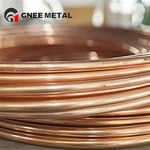
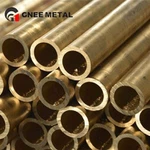
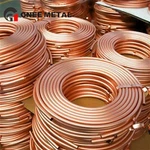
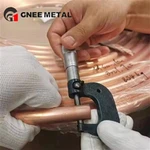


Brass Pipe
Surface:mill,polish,bright,hair line,checkered,mirror,brush,antique,sand blast,etching.
Temper:1/4 Hard, 1/2 Hard, 3/4 Hard, Hard, Soft
Size:
Outside diameter 2-800mm;
wall thickness 1-220mm;
Length 1- 6m;
All sizes can be according to customer's requirements.
Henan Gnee New Material Co., Ltd. is one of the most professional manufacturers and suppliers of brass pipe in China, specialized in providing high quality copper products with competitive price. Welcome to buy discount brass pipe for sale here from our factory. Customized orders are welcome.
Brass is an alloy composed of copper and zinc. Brass made solely of copper and zinc is called ordinary brass, while alloys consisting of two or more elements are referred to as special brass. Brass exhibits strong wear resistance and is commonly used in the manufacture of valves, water pipes, air conditioning connecting tubes, and radiators.
Advantages of brass tubes

Excellent Machinability
The low melting point and high plasticity of brass alloys grant them outstanding machinability. This material can be easily shaped through various processes such as casting, forging, die-casting, and cold drawing, with the finished product featuring a smooth surface and precise dimensions. This makes brass highly suitable for manufacturing mechanical parts requiring high precision.
Electrical and Thermal Conductivity
Due to its copper content, brass inherits copper's excellent electrical and thermal conductivity. Its electrical conductivity is approximately 1.2 times that of pure copper, while its thermal conductivity reaches 0.8 times that of pure copper. These properties make brass widely applicable in electrical, electronic, and light industries.


Strong Corrosion Resistance
Brass alloys demonstrate excellent oxidation and rust resistance in the air, exhibiting robust corrosion resistance. Additionally, surface treatments such as zinc plating, nickel plating, and chrome plating can further enhance their corrosion resistance. As a result, brass is the material of choice in industries requiring high corrosion resistance, such as chemical, marine, and plumbing applications.
Stable Mechanical Properties
Brass alloys not only possess good weldability and machinability but also maintain excellent toughness in low-temperature environments. This gives brass high impact and vibration resistance, reducing the likelihood of deformation, making it ideal for manufacturing high-quality components.

Classification of brass
Pure Brass: Contains over 95% copper and less than 5% zinc, offering good plasticity and conductivity. Commonly used in utensils and decorative items.
Naval Brass: Contains tin, providing high heat resistance and seawater corrosion resistance. Often used in marine environments.
Phosphor Brass: Contains phosphorus, offering excellent corrosion resistance and mechanical properties. Frequently used in automotive parts and piping.
Aluminum Brass: Contains aluminum, providing high strength, corrosion resistance, and superior wear resistance. Commonly used in ship components and mechanical parts.
Lead Brass: Contains lead, categorized into α and (α+β) types. α lead brass has poor high-temperature plasticity, while (α+β) lead brass performs better under high temperatures.
Tin Brass: Contains tin, offering excellent heat resistance and seawater corrosion resistance. Often used in marine applications.
Manganese Brass: Contains manganese, providing high strength and corrosion resistance. Frequently used in mechanical parts.
Iron Brass: Contains iron, offering high strength and toughness. Commonly used in high-strength components.


Chemical Composition
| ASTM Alloy | Common Name | Cu (%) | Zn (%) | Pb (%) | Other Elements (%) | Key Applications |
|---|---|---|---|---|---|---|
| C21000 | Gilding Brass (95/5) | 94.0 – 96.0 | Remainder | ≤ 0.05 | – | Jewelry, decorative parts |
| C22000 | Commercial Bronze (90/10) | 89.0 – 91.0 | Remainder | ≤ 0.05 | – | Architectural, heat exchangers |
| C23000 | Red Brass (85/15) | 84.0 – 86.0 | Remainder | ≤ 0.05 | – | Plumbing, condenser tubes |
| C24000 | Low Brass (80/20) | 78.5 – 81.5 | Remainder | ≤ 0.05 | – | Flexible hoses, hardware |
| C26000 | Cartridge Brass (70/30) | 68.5 – 71.5 | Remainder | ≤ 0.07 | ≤ 0.05 Fe | Ammunition, tubes, fittings |
| C27000 | 65/35 Brass | 63.0 – 68.5 | Remainder | ≤ 0.10 | ≤ 0.07 Fe | Musical instruments, hardware |
| C28000 | Muntz Metal (60/40) | 59.0 – 63.0 | Remainder | ≤ 0.30 | ≤ 0.07 Fe | Marine hardware, bolts |
| C33000 | Low-Lead Brass Tube | 65.0 – 68.0 | Remainder | ≤ 0.25 | ≤ 0.07 Fe | Plumbing, electrical |
| C33200 | High-Lead Brass Tube | 65.0 – 68.0 | Remainder | 0.25 – 0.7 | ≤ 0.07 Fe | Machined parts |
| C35300 | High-Lead Brass (Clock Brass) | 61.0 – 64.0 | Remainder | 1.5 – 2.5 | ≤ 0.15 Fe | Gears, bearings |
| C36000 | Free-Cutting Brass | 60.0 – 63.0 | Remainder | 2.5 – 3.7 | ≤ 0.35 Fe | Screws, valves (machining) |
| C44300 | Admiralty Brass | 70.0 – 73.0 | Remainder | ≤ 0.07 | Sn: 0.9–1.2, As: 0.02–0.06 | Heat exchangers, condensers |
| C46400 | Naval Brass | 59.0 – 62.0 | Remainder | ≤ 0.20 | Sn: 0.5–1.0 | Marine hardware, propeller shafts |
| C48200 | Medium-Lead Naval Brass | 59.0 – 62.0 | Remainder | 0.2 – 0.6 | Sn: 0.5–1.0 | Marine fasteners |
| C68700 | Arsenical Aluminum Brass | 76.0 – 79.0 | Remainder | ≤ 0.07 | Al: 1.8–2.5, As: 0.02–0.06 | Heat exchanger tubes |
Applications of Brass Tubes

Industrial Sector
In mechanical manufacturing, brass tubes are used to transport various fluids and gases, such as lubricating oil, cooling water, and gas-liquid mixtures. They are also widely employed in the production of industrial equipment, instruments, and components.

Construction Sector
In architectural decoration, brass tubes are valued for their elegant appearance and excellent corrosion resistance, making them a key material for indoor plumbing, doors/windows, furniture, and other copper products.

Aerospace Sector
Due to their outstanding heat resistance, corrosion resistance, and thermal conductivity, brass tubes are extensively used in aerospace applications, including fuel pipelines, pneumatic systems, and hydraulic systems for aircraft and rockets.
Brass Fittings
GNEE offers customizable brass fittings.


Brass as pipe fittings have strong corrosion resistance (especially adapted to wet and chemical media environment), high strength to withstand high-pressure fluid impact, both excellent processing plasticity (easy to bend, welding) and thermal conductivity. Its material stability (temperature range -50℃~260℃) and 100% recyclable characteristics, so it is widely used in water supply piping, chemical valves and heat exchangers and other scenarios.
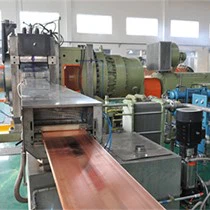
Plant and equipment




Packaging and shipping


Customer visits





GNEE is an enterprise engaged in the research, smelting and processing of copper and copper alloys. The factory covers an area of 350,000 square meters, and now has a series of production equipments such as vacuum induction furnace imported from the United States, vacuum consumable arc furnace made in Germany, 2800mm four-high reversible rolling mill, vacuum annealing furnace, and so on, which can customize the production of any size of plate within 2.6m * 16m, and the maximum length of a single pipe can reach 15m.
Meanwhile, we also have more than 100 sets of various testing instruments, the main equipment includes American non-destructive testing system, spectral analyzer, carbon and sulfur tester, universal testing machine, ultrasonic testing system, fatigue testing machine and so on.
With more than 10 years of export experience, our products are exported to USA, UK, Germany, France, Brazil, Japan, Korea, India, Vietnam, Australia, Philippines, Zambia, Indonesia and other countries.
Contact us today for a quotation:sales@gneesteel.com

Hot Tags: brass pipe, China brass pipe manufacturers, suppliers, factory, copper, copper C27000 plumbing, C26000 copper pipe, C26000 type l copper, C28000 soft copper tubing, C28000 copper hose, C26000 copper hose
Previous
Copper PipesYou Might Also Like


Send Inquiry