

The choice between C11000 (ETP) copper and C36000 (Free-Cutting Brass) for electrical connectors is a trade-off between conductivity and machinability. If the component carries a high current (like a busbar terminal), C11000 copper is the only technical choice due to its conductivity of 101% IACS min. However, if the connector requires complex internal threads or intricate geometries, C36000 brass is far more efficient for mass production, though its conductivity drops to approximately 26% IACS. You can browse our standard conductive bars and profiles on the C11000 copper bar.
Why is C11000 preferred for power-carrying terminals?
Electrical efficiency is the primary driver. C11000 copper is nearly pure, which you can confirm in our chemical composition of C11000 alloy. Because it is Is C110 pure copper, it minimizes resistive heating. C36000 brass contains around 3% lead and 35% zinc, which creates significant resistance.
Using brass for a high-wattage connector will cause the joint to overheat, potentially leading to insulation melting or fire. For any application exceeding 50 Amps, pure copper is the industry standard.
C11000 vs. C36000 Electrical and Mechanical Specs
| Property | C11000 (ETP Copper) | C36000 (Free-Cutting Brass) |
| Electrical Conductivity | 101% IACS min | 26% IACS approx |
| Machinability Rating | 20% (Gummy) | 100% (Industry Standard) |
| Copper Content | 99.90% min | 60% to 63% |
| Thermal Conductivity | 388 W/m·K | 115 W/m·K |
| Hardness (Vickers) | 75 to 95 HV | 130 to 160 HV |
When does C36000 machinability win over C11000?
For low-current signal connectors or complex hardware, the 100% machinability rating of C36000 is a massive advantage. C11000 material is notoriously difficult to machine because it is soft and "gummy," leading to long cycle times and poor thread quality. For C11000 CNC machining projects, specialized diamond-coated tools are often required.
C36000 produces small, brittle chips that fly off the tool, allowing for high-speed Swiss machining. If your design requires deep-drilled holes or fine-pitch threads and the current load is low, brass will significantly reduce your manufacturing costs.
Fabrication and Environmental Comparison
| Factor | C11000 (ETP) | C36000 (Brass) |
| Cold Bending | Excellent | Fair to Poor |
| Corrosion Resistance | Excellent | Good (Risk of dezincification) |
| Joining (Soldering) | Excellent | Excellent |
| Lead Content | None (RoHS compliant) | 2.5% to 3.7% (Restricted) |
| Scrap Value | Highest | High |
Is C11000 copper always more expensive?
From a raw material perspective, the c11000 copper price is higher than brass because it contains nearly 40% more copper. However, the total cost of the part includes the machining time. For a simple part, C11000 is cheaper. For a complex part, C36000 is usually cheaper due to the high-speed production capability.
Additionally, if the part requires significant bending, C36000 is likely to snap. You should consult our technical guide on whether C110 copper bendable to see if the ductility of pure copper is required for your installation.
FAQ: Deciding between Copper and Brass Connectors
1. Can I use C36000 for a ground lug?
It is not recommended. Grounding components must have the lowest possible resistance to safely shunt fault currents. t2 copper is the safe and compliant choice for grounding systems.
2. Is C36000 brass safe for RoHS?
It depends on the specific regulation. Many C36000 alloys contain lead levels that are restricted in certain electronic and medical applications. C11000 is naturally lead-free and safe.
3. Which material has better corrosion resistance?
Both are excellent, but brass is susceptible to "dezincification" in certain environments, where the zinc leaches out and leaves a weak copper structure. C11000 is more stable in most chemical environments.
4. Can I achieve a mirror finish on C11000?
Yes, but it is much harder than on brass. C36000 machines to a naturally high-quality finish, while copper often requires secondary polishing or buffing.
5. How do I identify them in the warehouse?
Copper (C11000) has a distinct reddish-pink hue. Brass (C36000) is a yellowish-gold color. The weight of copper is also slightly higher (8.89 g/cm3 vs 8.50 g/cm3 ).
6. Do you provide both materials for machined parts?
Yes. Our factory maintains a large stock of both pure copper and free-cutting brass. We can provide comparative quotes for both materials to help you balance your performance requirements with your budget.
Product Specifications & Range
| Product Category | Common Grades (Alloys) | Size Range (Dimensions) | Standards |
| Copper Rods | C11000, C12200, C10200, C14500 | Diameter: 3mm – 400mm<br>Shape: Round, Hexagonal, Square | ASTM B187, EN 12163 |
| Copper Tubes | C11000, C12200 (DHP), C10200 (OF), C27200 | OD: 2mm – 219mm<br>Wall Thickness: 0.2mm – 20mm | ASTM B280, EN 12735 |
| Copper Plates | C11000 (ETP), C10200, C12200 | Thickness: 0.1mm – 150mm<br>Width: Up to 2500mm | ASTM B152, DIN 1751 |
| Copper Wires | C11000, C10200, Brass Wire | Diameter: 0.05mm – 10.0mm<br>Form: Spool or Coil | ASTM B3, EN 13602 |
| Copper Strips | C11000, C12200, C26800 (Brass) | Thickness: 0.05mm – 3.0mm<br>Width: 5mm – 610mm | ASTM B19, EN 1652 |
Customization Note:
Custom Dimensions: We provide precision cutting and slitting services to meet your specific project requirements.
Tempers Available: Soft (O), Half-Hard (H02), Full Hard (H04), and Spring Hard (H08).
Surface Finish: Bright annealing, Polished, or Plated (Tin, Silver, Nickel) upon request.
Industrial-Grade Export Packaging
Maximum protection against oxidation, moisture, and transit damage.
1. Anti-Oxidation Protection
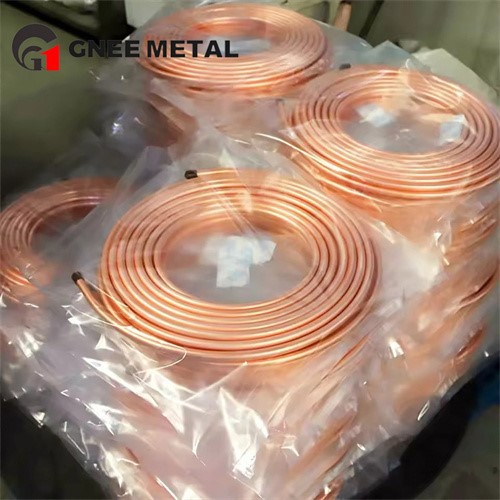
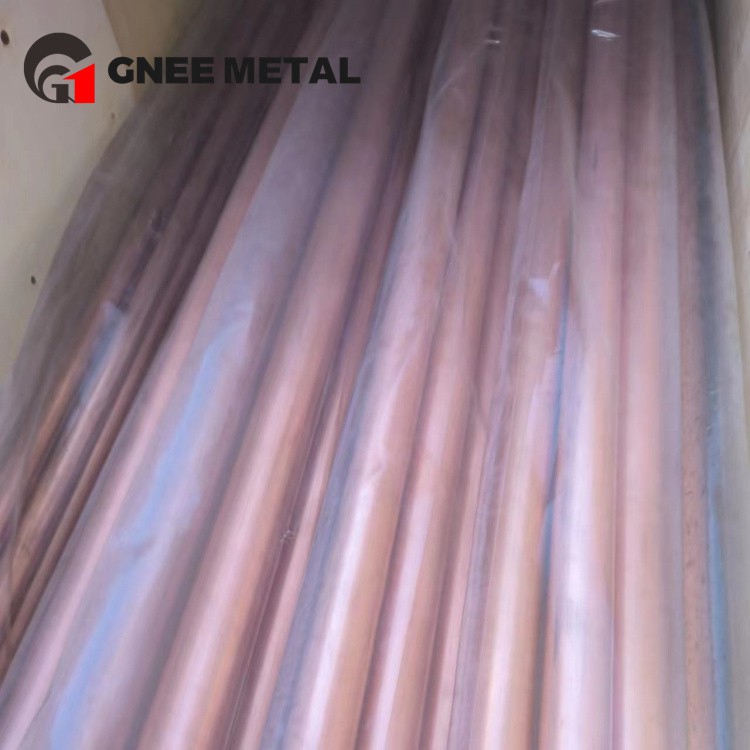
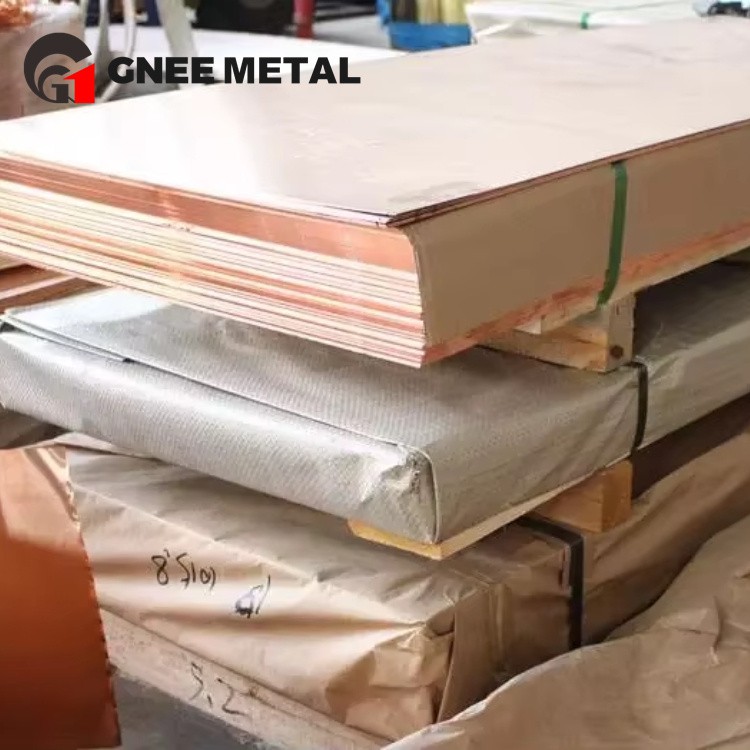
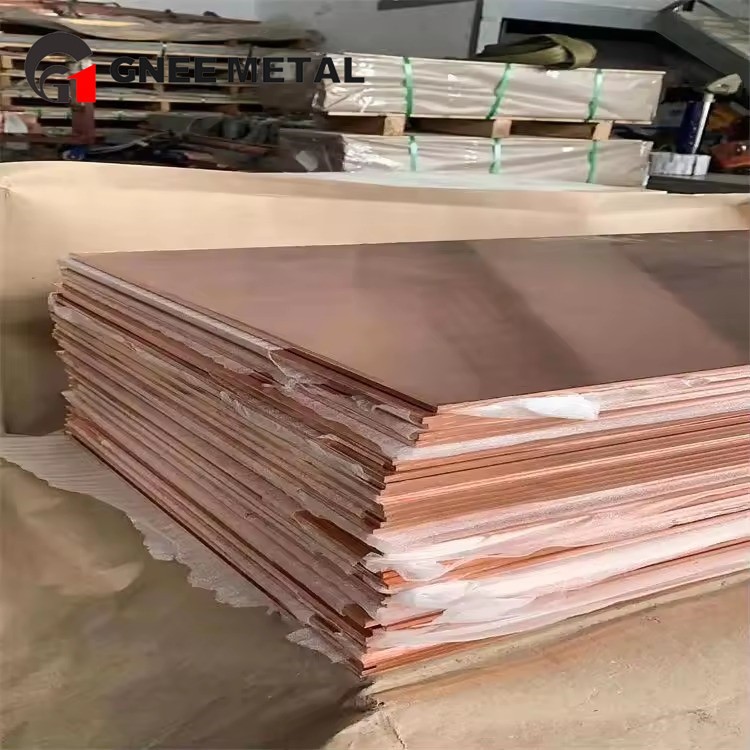
VCI Paper & Moisture-Proof Film: Every order is vacuum-sealed or wrapped in anti-corrosion materials to ensure the copper remains bright and tarnish-free during sea freight.
2. Reinforced Structural Support
Seaworthy Wooden Crates: We use reinforced, fumigation-free wooden cases (ISPM-15) and steel strapping for rods, tubes, and heavy plates to prevent bending or surface scratches.
3. Secure Handling & Loading
Forklift-Ready Pallets: All materials are secured on standardized export pallets for easy unloading and maximum stability in containers.
4. Clear Identification
Professional Labeling: Each package includes detailed labels with heat numbers, specifications, and net weight for efficient inventory management.

Advanced Manufacturing & Quality Control
1. Core Production Equipment
Up-casting & Continuous Casting Lines: Ensures high-purity oxygen-free copper rods and wires with uniform grain structure.
High-Precision Cold/Hot Rolling Mills: Automated thickness control for copper plates and strips with tolerances within ±0.01mm.
Large-Scale Extrusion & Drawing Machines: Capable of producing seamless copper tubes and rods in diverse diameters and shapes.
Atmospheric Controlled Annealing Furnaces: Bright annealing process to achieve specific tempers (Soft, Half-hard, Hard) without surface oxidation.
2. In-House Testing Center
Direct-Reading Spectrometers: Instant chemical composition analysis to guarantee Cu purity and precise alloying (Brass, Bronze, etc.).
Universal Tensile Testers: Verifying mechanical properties including tensile strength, elongation, and yield strength.
Eddy Current & Ultrasonic Testing: 100% non-destructive inspection for tubes and rods to detect internal cracks or flaws.
Conductivity & Hardness Testers: Ensuring electrical conductivity (IACS) and Vickers/Rockwell hardness meet international standards (ASTM, EN, DIN).



Get Fast Quote & Logistics Plan


