

The primary difference lies in the "P" (Phosphorus) content. C11000 contains a controlled amount of oxygen, which makes it "Tough Pitch" copper. In contrast, C12200 is phosphorus-deoxidized copper. Phosphorus is added to remove oxygen, which makes the metal much easier to weld and braze without the risk of internal cracking.
If your project requires high-purity electrical performance without welding, you should specify C11000 electrolytic tough pitch copper. However, if you are building a pressurized plumbing or HVAC system, C12200 is the industry standard.
Is the conductivity of C11000 higher than C12200?
Yes, and the gap is significant. Phosphorus is an "enemy" of electrical conductivity. Even a tiny amount of residual phosphorus in C12200 drops its conductivity to approximately 80%-90% IACS. C11000, as we detailed in our guide on the purity of C11000 copper, is refined to maintain elite conductivity.
Physical and Electrical Property Comparison
| Property | C11000 (ETP) | C12200 (DHP) |
| Electrical Conductivity | 101% IACS | 80% - 90% IACS |
| Thermal Conductivity | 391 W/(m·K) | 305 - 340 W/(m·K) |
| Copper Purity (Min) | 99.90% | 99.90% |
| Phosphorus Content | Nil (Trace) | 0.015% - 0.040% |
Can you weld C11000 as easily as C12200?
No. This is where C12200 wins. C11000 is susceptible to "hydrogen embrittlement" when heated in a reducing atmosphere (like gas welding). The oxygen in C11000 reacts with hydrogen to form steam, creating microscopic cracks that ruin structural integrity.
C12200 is immune to this effect because the phosphorus has already removed the oxygen. If your fabrication involves intense brazing or welding, you must use C12200. For electrical busbars that are joined with bolts rather than welds, the standard price of C11000 copper makes it the more economical and efficient choice.
Which grade is better for HVAC and plumbing tubes?
C12200 is the dominant grade for C11000 copper tube used in air conditioning and water lines. Its ability to withstand brazing and its superior corrosion resistance in water environments make it ideal for pressurized tubing.
C11000 is rarely used for pressurized fluid transport but is excellent for custom C11000 copper cnc machining where high thermal transfer is needed in air-cooled environments, such as CPU heat sinks or power transistor bases.
Typical Application Matrix
| Application | Recommended Grade | Reason |
| Electrical Busbars | C11000 | Maximum IACS conductivity |
| HVAC Cooling Coils | C12200 | Excellent brazing properties |
| Welded Heat Exchangers | C12200 | No hydrogen embrittlement |
| Transformer Terminals | C11000 | Low resistive heat loss |
FAQ
1. Is there a price difference between C11000 and C12200?
Generally, C12200 tubes are priced higher per kilogram than C11000 bars or sheets due to the complex extrusion and drawing processes. However, the base copper value remains tied to the LME for both grades.
2. Can I use C11000 for brazing if I am careful?
You can use silver soldering or low-temperature brazing with C11000, but it is risky. As we noted in our comparison of difference between C11000 and C10100, if you need both high conductivity and welding safety, C10100 is the only high-end alternative.
3. What is the standard temper for C12200 plumbing tube?
Most C12200 tubes are sold in "Soft" (O60) or "Light Drawn" tempers for easy bending. C11000 is more commonly stocked in c11000 h02 (half-hard) for electrical switchgear structural strength.
4. Are these grades interchangeable in architectural roofing?
Yes, but C11000 is more common for roofing C11000 copper sheet because it develops a more consistent aesthetic patina and is easier to form by hand without cracking.
5. Why is C12200 called "DHP"?
DHP stands for Phosphorus-Deoxidized, High Residual Phosphorus. It simply describes the chemical process used to make the copper weldable.
6. Do both grades follow the same ISO certification?
Yes. Any reputable ISO certified C11000 manufacturer will typically produce C12200 as well. Always ensure you have a C11000 mill test certificate (MTC) for electrical work to prove you aren't accidentally receiving lower-conductivity DHP copper.
Procurement Tip: Verify the IACS Before You Buy
The fastest way to tell if you've been sent C12200 instead of C11000 is a conductivity test. If the material tests below 90% IACS, it is likely C12200 or another deoxidized grade. For electrical contractors, this 10-15% drop in conductivity can lead to catastrophic overheating in power grids.
Request a Project-Specific Material Feasibility Review
Product Specifications & Range
| Product Category | Common Grades (Alloys) | Size Range (Dimensions) | Standards |
| Copper Rods | C11000, C12200, C10200, C14500 | Diameter: 3mm – 400mm<br>Shape: Round, Hexagonal, Square | ASTM B187, EN 12163 |
| Copper Tubes | C11000, C12200 (DHP), C10200 (OF), C27200 | OD: 2mm – 219mm<br>Wall Thickness: 0.2mm – 20mm | ASTM B280, EN 12735 |
| Copper Plates | C11000 (ETP), C10200, C12200 | Thickness: 0.1mm – 150mm<br>Width: Up to 2500mm | ASTM B152, DIN 1751 |
| Copper Wires | C11000, C10200, Brass Wire | Diameter: 0.05mm – 10.0mm<br>Form: Spool or Coil | ASTM B3, EN 13602 |
| Copper Strips | C11000, C12200, C26800 (Brass) | Thickness: 0.05mm – 3.0mm<br>Width: 5mm – 610mm | ASTM B19, EN 1652 |
Customization Note:
Custom Dimensions: We provide precision cutting and slitting services to meet your specific project requirements.
Tempers Available: Soft (O), Half-Hard (H02), Full Hard (H04), and Spring Hard (H08).
Surface Finish: Bright annealing, Polished, or Plated (Tin, Silver, Nickel) upon request.
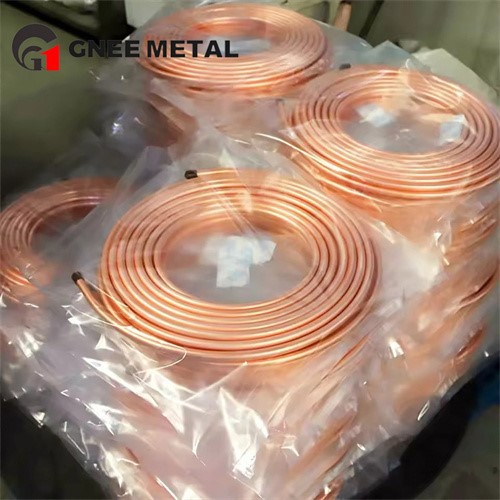
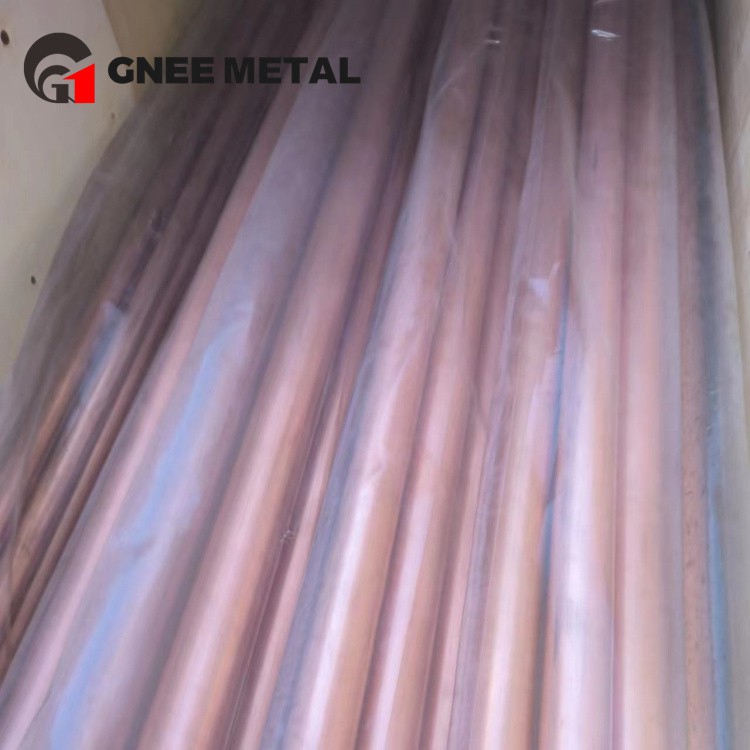
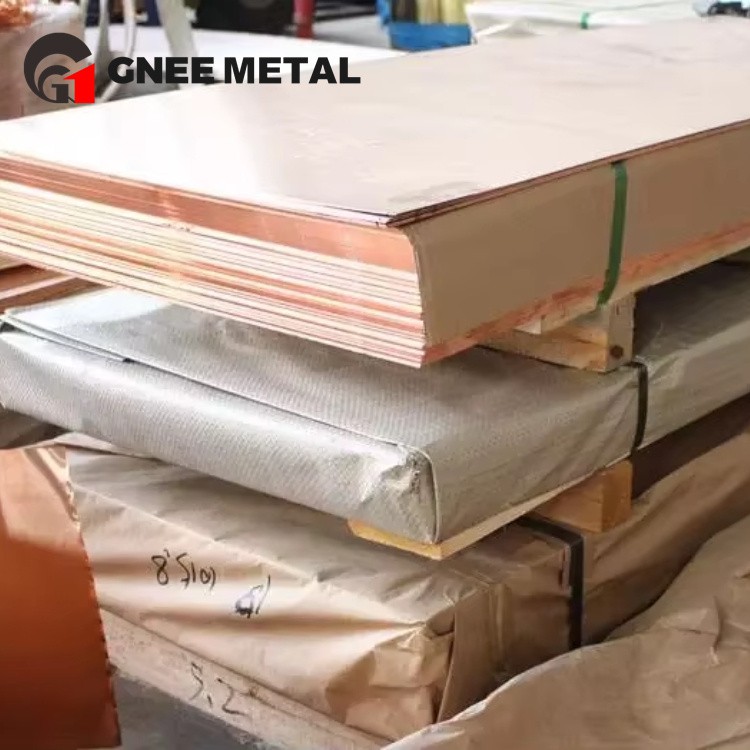
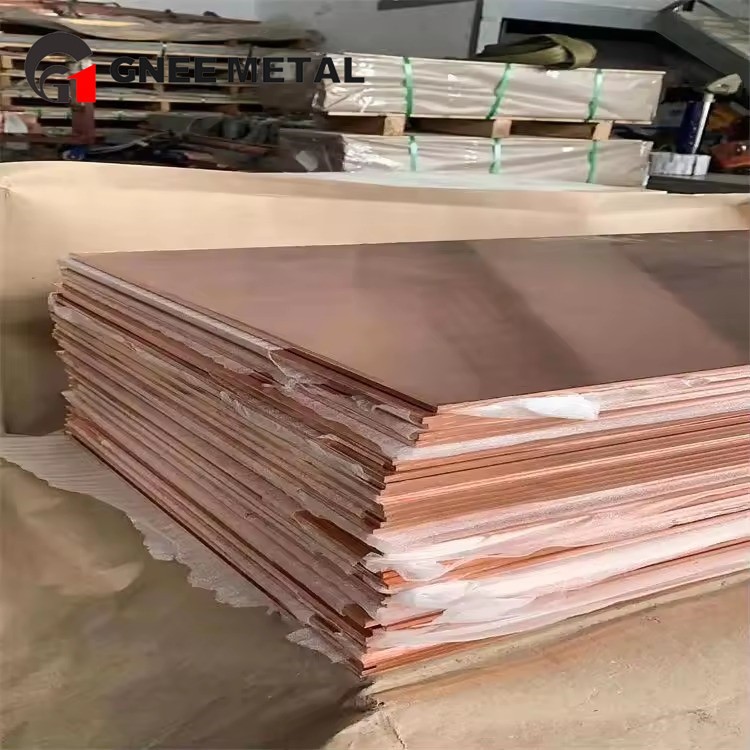
Industrial-Grade Export Packaging
Maximum protection against oxidation, moisture, and transit damage.
1. Anti-Oxidation Protection
VCI Paper & Moisture-Proof Film: Every order is vacuum-sealed or wrapped in anti-corrosion materials to ensure the copper remains bright and tarnish-free during sea freight.
2. Reinforced Structural Support
Seaworthy Wooden Crates: We use reinforced, fumigation-free wooden cases (ISPM-15) and steel strapping for rods, tubes, and heavy plates to prevent bending or surface scratches.
3. Secure Handling & Loading
Forklift-Ready Pallets: All materials are secured on standardized export pallets for easy unloading and maximum stability in containers.
4. Clear Identification
Professional Labeling: Each package includes detailed labels with heat numbers, specifications, and net weight for efficient inventory management.

Advanced Manufacturing & Quality Control
1. Core Production Equipment
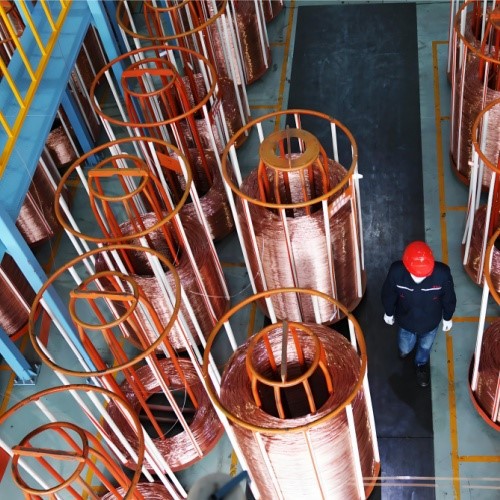
Up-casting & Continuous Casting Lines: Ensures high-purity oxygen-free copper rods and wires with uniform grain structure.
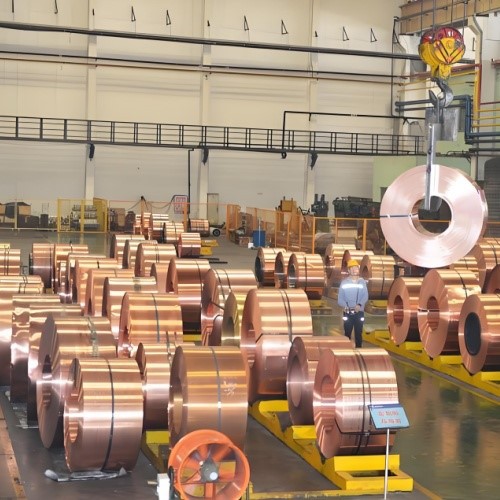
High-Precision Cold/Hot Rolling Mills: Automated thickness control for copper plates and strips with tolerances within ±0.01mm.
Large-Scale Extrusion & Drawing Machines: Capable of producing seamless copper tubes and rods in diverse diameters and shapes.
Atmospheric Controlled Annealing Furnaces: Bright annealing process to achieve specific tempers (Soft, Half-hard, Hard) without surface oxidation.
2. In-House Testing Center
Direct-Reading Spectrometers: Instant chemical composition analysis to guarantee Cu purity and precise alloying (Brass, Bronze, etc.).
Universal Tensile Testers: Verifying mechanical properties including tensile strength, elongation, and yield strength.
Eddy Current & Ultrasonic Testing: 100% non-destructive inspection for tubes and rods to detect internal cracks or flaws.
Conductivity & Hardness Testers: Ensuring electrical conductivity (IACS) and Vickers/Rockwell hardness meet international standards (ASTM, EN, DIN).



Get Fast Quote & Logistics Plan


