

What Is C68700 Aluminum Brass?
C68700 aluminum brass is a copper-zinc alloy enhanced with aluminum and arsenic (As) as a corrosion inhibitor. It delivers exceptional resistance to high-velocity seawater and brackish water. Known for its strength and durability, ASTM B111 C68700 is engineered to withstand impingement attack and erosion-corrosion in aggressive cooling environments.
Inhibited aluminum brass tubes (UNS C68700) are widely used in condenser systems, especially in marine, power generation, and desalination settings, where water velocity and salt content challenge the long-term performance of standard copper alloys.
C68700 Seamless Brass Tube

Customer Visit & Project Reference – India
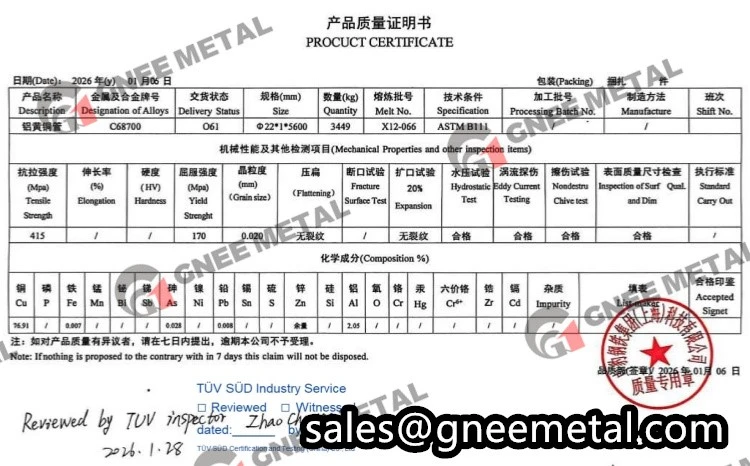
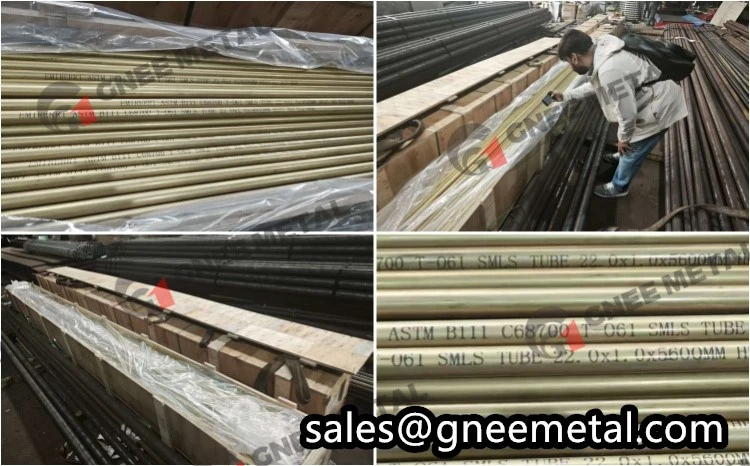
We successfully supplied ASTM B111 C68700 aluminum brass tubes to a customer in India for shell & tube condenser applications. During the project, the customer visited our facility for production inspection and quality verification. All tubes were manufactured in accordance with ASTM B111 requirements and delivered with complete Material Test Certificates (MTC), ensuring full heat number traceability and verified chemical and mechanical properties.

Download ASTM B111 C68700 MTC (PDF)
What Are the Standard Names and Specifications for C68700?
| Item | Specification |
|---|---|
| UNS Number | C68700 |
| BSI Number | CZ110 |
| ISO Name | CuZn22Al2 |
| Common Names | Aluminum Brass, Arsenical Aluminum Brass |
| Primary ASTM Standards | ASTM B111, ASTM B395 |
| Primary ASME Standards | ASME SB111, ASME SB395 |
| Temper | O61 (annealed) |
Submit Your Custom Requirements
What Key Benefits Does C68700 Offer?
Exceptional resistance to impingement and erosion: Handles high-velocity water without thinning or surface degradation.
Superior corrosion resistance in salt and brackish water: Aluminum and arsenic protect against pitting, dezincification, and scaling.
Reliable performance in marine and industrial settings: Maintains mechanical integrity under fluctuating thermal loads and flow conditions.
High thermal conductivity for effective heat transfer: Ensures energy-efficient operation.
Extended service life: Reduces maintenance costs and unplanned downtime.
Compliance with international standards: Manufactured to meet ASTM B111, ASTM B395, and ASME SB111/SB395.
What Are the Typical Applications for C68700?
| Industry | Specific Application |
|---|---|
| Marine & Offshore | Condenser tubes for high-velocity seawater, seawater cooling systems |
| Power Generation | Power station condensers (marine and land-based) |
| Desalination | Desalination plants and saltwater treatment facilities |
| HVAC & Cooling | Heat exchangers exposed to turbulent or contaminated water |
| Industrial | Cooling systems with brackish or saline water circulation |
What Is the Chemical Composition of UNS C68700?
| Element | Standard Range (wt%) | Function |
|---|---|---|
| Copper (Cu) | 76.0 – 79.0 | Matrix, provides conductivity |
| Aluminum (Al) | 1.8 – 2.5 | Enhances strength & corrosion resistance |
| Arsenic (As) | 0.02 – 0.10 | Suppresses dezincification (inhibitor) |
| Zinc (Zn) | Remainder | Improves fluidity, reduces cost |
| Lead (Pb) | ≤0.07 | Improves machinability |
| Iron (Fe) | ≤0.06 | Refines grain structure |
What Are the Physical and Mechanical Properties of C68700?
| Property | Source Value | Corrected Value (ASTM B111) |
|---|---|---|
| Density (g/cm³) | 8.33 | 8.40 |
| Thermal Conductivity (W/(m·K)) | 100.4 | 109 |
| Melting Point (°C) | 932–971 | 900–930 |
| CTE (×10⁻⁶/K, 20-300°C) | 18.5 | 20.2 |
Mechanical Properties (Annealed – Temper O61):
| Property | ASTM B111 Minimum | Typical Value |
|---|---|---|
| Tensile Strength (MPa) | 345 | 360–380 |
| Yield Strength (MPa) | 125 | 80–140 |
| Elongation (%) | 50 | 50–55 |
| Hardness (HRB) | – | 55–65 |
What Is the Effect of Aluminum in C68700 Brass?
Aluminum improves corrosion resistance, strength, and dezincification resistance. Adding 1.8-2.5% aluminum to brass creates a protective aluminum oxide film on the surface, which resists attack in aggressive environments like seawater. Aluminum also increases the alloy's strength without sacrificing ductility.
How Does C68700 Compare to Other Copper Alloys?
| Alloy | Key Feature | Best Application |
|---|---|---|
| C68700 (Aluminum Brass) | High resistance to impingement & erosion | High-velocity seawater, power plant condensers |
| C44300 (Admiralty Brass) | Good resistance to contaminated water | Lower velocity, polluted water |
| C70600 (CuNi 90-10) | Excellent marine corrosion resistance | Higher cost, very aggressive seawater |
| C71500 (CuNi 70-30) | Highest durability among copper alloys | Most demanding marine conditions |
| C12200 (DHP Copper) | High thermal conductivity | Freshwater cooling only |
What ASTM Standards Cover C68700 Seamless Tubes?
| Standard | Scope |
|---|---|
| ASTM B111 / B111M | Seamless copper alloy condenser tubes for surface condensers, evaporators, and heat exchangers |
| ASTM B395 / B395M | U-bend seamless copper alloy tubes for heat exchangers and condensers |
| ASME SB111 | ASME Boiler and Pressure Vessel Code version of B111 |
| ASME SB395 | ASME version of B395 |
C68700 vs Other Copper Alloys: How to Choose?
Comparison Table
| Alloy | Main Alloying Element | Corrosion Resistance | Seawater Service | Heat Transfer | Typical Applications |
|---|---|---|---|---|---|
| C68700 | Aluminum Brass | Excellent | ⭐⭐⭐⭐⭐ | ⭐⭐⭐⭐⭐ | Condensers, Heat Exchangers, Desalination |
| C44300 | Admiralty Brass | Good | ⭐⭐⭐ | ⭐⭐⭐⭐⭐ | Freshwater Condensers, HVAC |
| C70600 | 90/10 CuNi | Excellent | ⭐⭐⭐⭐⭐ | ⭐⭐⭐⭐ | Marine, Offshore, Seawater Pipelines |
| C71500 | 70/30 CuNi | Outstanding | ⭐⭐⭐⭐⭐ | ⭐⭐⭐⭐ | Naval Ships, Offshore Platforms |
Which Alloy Should You Choose?
| If You Need... | Recommended Alloy |
|---|---|
| Best Heat Transfer Efficiency | C68700 |
| Freshwater Cooling Systems | C44300 |
| Continuous Seawater Service | C70600 |
| Harsh Marine & Offshore Conditions | C71500 |
| Better Cost Performance | C68700 |
| Longest Service Life in Seawater | C71500 |
FAQ
Q1: What is C68700 used for?
A: C68700 is used for condenser tubes and heat exchangers in high-velocity seawater. Specifically, ASTM B111 C68700 tubes are installed in power plant condensers, desalination plants, marine vessels, and industrial cooling systems handling saltwater or brackish water.
Q2: What is the difference between C68700 and C44300?
A: C68700 offers better resistance to high-velocity seawater impingement than C44300. C68700 contains aluminum and arsenic for turbulent flow conditions. C44300 contains tin and is suited for contaminated but lower-velocity water.
Q3: What is the European equivalent grade for UNS C68700?
A: The European equivalent for UNS C68700 is CuZn22Al2 (DIN 17660) or CW702R. These designations share the same composition: Cu 76-79%, Al 1.8-2.5%, As 0.02-0.10%.
Q4: What is the Chinese equivalent grade for ASTM B111 C68700?
A: The Chinese equivalent for ASTM B111 C68700 is HAl77-2 per YS/T 649-2018. HAl77-2 has identical requirements: Cu 76-79%, Al 1.8-2.5%, As 0.02-0.10%.
Q5: What is the thermal conductivity of C68700?
A: The thermal conductivity of C68700 is 109 W/(m·K) at 20°C. ASTM B111 C68700 tubes achieve a heat transfer coefficient of ≥5200 W/m²·K, approximately 30% higher than stainless steel.
Q6: What is the recommended hot working temperature for C68700?
A: The recommended hot working temperature for C68700 is 750–830°C. Finish working above 550°C. Control oxygen at 0.5-1.5% to prevent zinc volatilization and hot cracking.
Q7: What is the difference between annealed (O61) and hard temper C68700?
A: Annealed C68700 (O61) has 345 MPa tensile strength and ≥50% elongation. Hard temper C68700 (H04) has 600 MPa tensile strength but only 10% elongation. For forming, always use annealed C68700.
Q8: Can C68700 be used for potable water?
A: No, C68700 is not recommended for potable water. Due to arsenic content (0.02-0.10%), C68700 poses a leaching risk. Use C12200 (DHP copper) for drinking water applications.
Q9: What welding process is recommended for C68700?
A: TIG welding with CuAl8 (ERCuAl-A1) filler metal is recommended for C68700. Use 80-120A current, preheat to 150°C, and maintain argon purity ≥99.99% to prevent arsenic-induced porosity.
Q10: How does the cost of C68700 compare to titanium?
A: C68700 costs approximately 40% less than titanium or cupronickel C70600. Despite lower cost, C68700 provides a comparable service life of >15 years in seawater.
100% Inspection Per ASTM B111 / C68700 – Customer Witnessed
Every tube in this lot has passed third-party witnessed inspection per ASTM B111 standard for C68700 alloy. Below are actual photos from customer-onsite inspection, including eddy current testing and dimensional verification.
Inspection items verified:
• Eddy current testing (ECT) – no through-wall defects
• Outer diameter & wall thickness – within ±0.02mm tolerance
• Surface finish & temper (O61) – conforms to ASTM
• Hardness & chemical composition – certified.
C68700 Heat Exchanger Brass Tube inspection

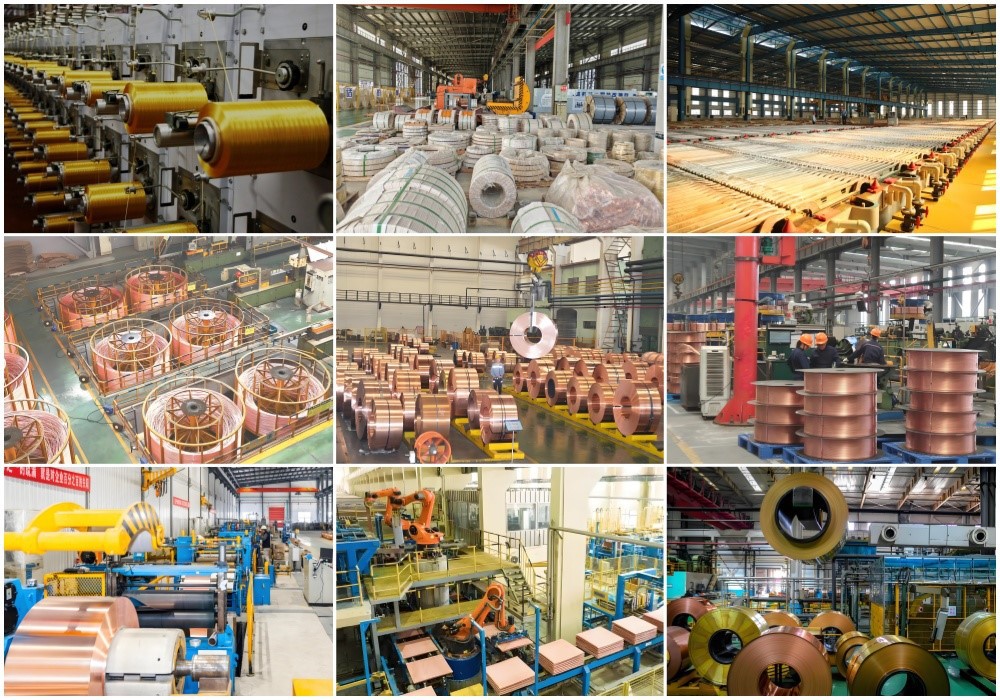
Our Factory & Equipment
All ASTM C68700 tubes are produced and inspected on our in-house equipment, allowing full process control from billet casting to final packing.
Key equipment used for this lot:
• Induction melting furnace – precise alloying (Cu + Zn + Al + As)
• Horizontal continuous casting – uniform billet structure
• Extrusion press (800T / 1630T) – seamless tube forming
• Cold drawing bench (5–40m) – dimensional accuracy to ±0.02mm
• Online eddy current tester (FOERSTER / MAC) – 100% NDT
• Ultrasonic wall thickness gauge – real-time monitoring
• Annealing furnace (controlled atmosphere) – temper O61
In-house metrology: Micrometers, pin gauges, optical comparator, hardness tester (HV/HRB)
All equipment is calibrated quarterly. Production records are traceable by lot number.
C68700 Aluminum Brass Condenser Tube Factory & Equipment
Copper & Copper Alloy Products – Supply Range
| Product Form | Common Alloys / Grades | Size Range | Standards | Typical Applications |
|---|---|---|---|---|
| Tube / Pipe | C12200, C11000, C68700, C70600, C71500, C44300, C27000 | OD: 4mm – 219mm Wall: 0.5mm – 20mm Length: up to 15m |
ASTM B68, B75, B111, B280, B359, B466 | Heat exchangers, condensers, HVAC, plumbing, oil coolers |
| Plate / Sheet | C11000, C12200, C26000, C26800, C52100, C68700 | Thk: 0.5mm – 50mm Width: up to 1200mm Length: up to 4000mm |
ASTM B152, B169, B103, B465 | Electrical parts, roofing, gaskets, industrial panels |
| Rod / Bar | C11000, C26000, C36000, C46400, C48500, C63000 | Dia: 3mm – 120mm Length: 1m – 6m (or custom) |
ASTM B16, B124, B138, B150, B453 | Valve stems, shafts, fasteners, machined components |
| Wire | C11000, C16200, C17500, C26000, C52100, C64700 | Dia: 0.1mm – 12mm Coil weight: up to 100kg |
ASTM B1, B2, B3, B197, B206, B624 | Welding electrodes, electrical conductors, springs, mesh |
| Strip / Foil | C11000, C19400, C26000, C26800, C52100, C70250 | Thk: 0.05mm – 3.0mm Width: 5mm – 600mm |
ASTM B36, B465, B694, B888 | Connectors, terminals, battery tabs, shielding, stamping parts |
Check Today's Stock & Lead Time


