

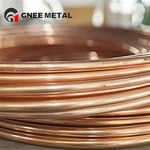
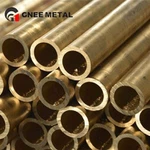
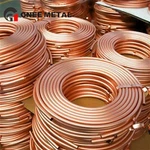
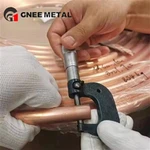


ASTM B111 Copper Heat Exchanger Tube
Source 100% tested ASTM B111 copper heat exchanger tubes. Available in C12200, C70600, C68700, C44300. Custom OD, U-bends & straight. Get MTC and a quote today!
Henan Gnee New Material Co., Ltd. is one of the most professional manufacturers and suppliers of astm b111 copper heat exchanger tube in China, specialized in providing high quality copper products with competitive price. Welcome to buy discount astm b111 copper heat exchanger tube for sale here from our factory. Customized orders are welcome.
What Is ASTM B111?
ASTM B111 is the standard specification for seamless copper and copper alloy condenser tubes and heat exchanger tubes used in industrial thermal systems. It defines requirements for chemical composition, mechanical properties, dimensions, and testing to ensure reliable performance in heat transfer applications.
ASTM B111 is the standard specification for seamless copper and copper alloy tubes used in:
Heat exchangers
Condensers
Marine cooling systems
Power plants
We manufacture a full range of ASTM B111 alloys, including C12200, C44300, C68700, C70600, and C71500, covering applications from freshwater systems to severe seawater and offshore conditions. Production capabilities include seamless tube drawing, precision heat treatment, U-bending, finned tube processing, and custom-length fabrication.
Every tube is tested under strict quality control procedures, including chemical analysis, mechanical testing, eddy current inspection, hydrostatic testing, and dimensional verification. Materials can be supplied with full traceability and inspection documentation such as EN10204 3.1 certificates.
Get ASTM B111 Tube Quote in 12 Hours
ASTM B111 Tube Forms Available


These tube forms are widely used in condenser and heat exchanger fabrication systems.
| Product Form | Description | Typical Applications |
| Seamless Tubes | Standard ASTM B111 seamless tubes with excellent heat transfer and corrosion resistance. | Condensers, shell & tube heat exchangers, chillers |
| Finned Tubes | Enhanced surface area for improved heat transfer efficiency and reduced equipment size. | Air coolers, HVAC systems, refrigeration equipment |
| U-Bend Tubes | Precision bent tubes designed for compact shell-and-tube heat exchangers. | Power plants, petrochemical and refinery heat exchangers |
| Tube Bundles | Pre-assembled tube bundles for new installations or retubing projects. | Surface condensers, marine and industrial heat exchangers |
Which ASTM B111 Material Grade Fits Your Heat Exchanger Calculation?
| Alloy / Grade | Common Name | Primary Application Profile | Factory Processing Advantage |
| ASTM B111 C12200 | DHP Copper | Standard commercial heat exchanger hvac and clean water chillers. | Maximum thermal conductivity; excellent for brazing. |
| ASTM B111 C44300 | Admiralty Brass | River water and brackish fluid cooling systems. | Formulated with inhibitors to prevent severe dezincification. |
| ASTM B111 C68700 | Aluminum Brass | High-velocity shell tube evaporator designs (SB111 C68700). | Exceptional resistance to impingement attack and erosion. |
| ASTM B111 C70600 | CuNi 90/10 | Marine condensers, offshore platforms, ship building. | The globally trusted C70600 tube for seawater bio-fouling resistance. |
| ASTM B111 C71500 | CuNi 70/30 | Severe marine duties and high-pressure desalinization. | A premium C71500 tube offering the highest mechanical strength among standard copper alloys. |
Which ASTM B111 Alloy Should You Choose?
Selecting the right ASTM B111 copper alloy is critical for heat exchanger performance, corrosion resistance, and service life. Different operating environments such as freshwater, seawater, or high-velocity cooling systems require different material choices.
| Service Environment | Recommended Alloy | Key Characteristics | Typical Applications |
|---|---|---|---|
| Freshwater systems | C12200 | Highest thermal conductivity, excellent heat transfer efficiency | HVAC coils, freshwater condensers |
| General industrial cooling water | C44300 | Balanced corrosion resistance and cost-performance | Industrial heat exchangers, utility cooling systems |
| Seawater (moderate conditions) | C68700 | Good resistance to seawater corrosion and biofouling | Power plant condensers, desalination pre-cooling |
| Marine & shipbuilding systems | C70600 | Stable performance in continuous seawater exposure | Shipboard heat exchangers, marine coolers |
| High-velocity seawater systems | C71500 | Superior resistance to erosion-corrosion | Offshore platforms, high-speed seawater condensers |
| Severe offshore environments | C71500 | Long-term durability under aggressive chloride exposure | Oil & gas offshore cooling systems |
C12200 (Phosphorus Deoxidized Copper)
Best choice when thermal conductivity is the top priority
Not suitable for seawater service
Common in HVAC and freshwater heat exchange systems
Often used where high efficiency and clean heat transfer are required
C44300 (Admiralty Brass)
Cost-effective solution for mild corrosion environments
Suitable for industrial cooling water with controlled chemistry
Performs well in non-aggressive water systems
Widely used in general-purpose condensers
C68700 (Aluminum Brass)
Designed for seawater applications with moderate flow conditions
Offers improved resistance to dezincification and corrosion
Commonly used in power plants and desalination systems
Preferred when balancing performance and cost in marine environments
C70600 (90/10 Copper Nickel)
Excellent resistance to seawater corrosion and biofouling
Suitable for continuous marine service and shipboard systems
Stable mechanical performance over long service cycles
Widely adopted in marine engineering projects
C71500 (70/30 Copper Nickel)
Highest corrosion and erosion resistance among B111 copper-nickel alloys
Ideal for high-velocity seawater and offshore environments
Performs well under severe mechanical and chemical stress
Preferred for long-life critical marine installations
Not sure which alloy? Get Engineering Support
ASTM B111 Tube Sizes & Dimensions
Dimensional accuracy ensures proper tube expansion into tube sheets and reliable heat exchanger assembly.
| Parameter | Standard Range / Specification |
| Outside Diameter (OD) | 5 mm – 280 mm (approx. 3/16" – 11") |
| Wall Thickness | 0.3 mm – 10 mm |
| Length | Up to 18,000 mm (18 m) or cut-to-length as required |
| Tube Types | Seamless straight tubes / U-bend tubes |
| Temper | Annealed / Light drawn / As required by application |
| Diameter Tolerance | According to ASTM B111 standard (varies by OD size) |
| Wall Thickness Tolerance | Typically ±10% (depending on size and alloy) |
| Length Tolerance | +6 mm / -0 mm (or as specified) |
| Straightness | Controlled per ASTM requirements for heat exchanger installation |
| End Finish | Plain / Beveled / Square cut / Deburred |
ASTM B111 Chemical Composition (Copper Alloys)
| Alloy (UNS) | Copper (Cu) % | Nickel (Ni) % | Zinc (Zn) % | Tin (Sn) % | Aluminum (Al) % | Iron (Fe) % | Phosphorus (P) / Others |
| C12200 | ≥ 99.9 | - | - | - | - | - | P: 0.015–0.040 |
| C44300 | 70.0–73.0 | - | Balance | 0.9–1.2 | - | - | As: 0.02–0.06 |
| C68700 | 76.0–79.0 | - | Balance | - | 1.8–2.5 | ≤0.06 | As: 0.02–0.10 |
| C70600 | 88.6–91.0 | 9.0–11.0 | - | - | - | 1.0–1.8 | Mn ≤1.0 |
| C71500 | 65.0–68.0 | 29.0–33.0 | - | - | - | 0.4–1.0 | Mn ≤1.0 |
Mechanical Properties (ASTM B111 Copper Alloys)
Mechanical properties ensure tube performance under pressure, temperature, and vibration conditions.
| Alloy (UNS) | Tensile Strength (MPa) | Yield Strength (MPa) | Elongation (%) | Hardness (Typical) |
| C12200 | ≥ 220 | ≥ 70 | ≥ 40 | HV 50–70 |
| C44300 | 310 – 380 | ≥ 105 | ≥ 45 | HV 70–90 |
| C68700 | 350 – 420 | ≥ 125 | ≥ 40 | HV 80–100 |
| C70600 | 300 – 370 | ≥ 105 | ≥ 30 | HV 70–95 |
| C71500 | 360 – 450 | ≥ 125 | ≥ 35 | HV 85–110 |
ASTM B111 Physical & Thermal Properties
| Alloy (UNS) | Density (g/cm³) | Thermal Conductivity (W/m·K) | Electrical Conductivity (% IACS) | Melting Range (°C) | Corrosion Resistance (Seawater) |
|---|---|---|---|---|---|
| C12200 | 8.94 | 330–360 | ≥ 90 | 1083 | Excellent (freshwater service) |
| C44300 | 8.53 | 100–120 | 20–25 | 900–940 | Good (mild seawater / brackish water) |
| C68700 | 8.20 | 120–150 | 25–30 | 900–930 | Very Good (seawater with velocity control) |
| C70600 | 8.90 | 45–60 | 5–10 | 1100–1140 | Excellent (marine service) |
| C71500 | 8.94 | 35–50 | 4–8 | 1150–1180 | Excellent (high velocity seawater) |
Manufacturing Process

This ensures consistent quality, dimensional accuracy, and long-term service reliability.
Surface Finish Options for ASTM B111 Tubes
Surface finish affects corrosion resistance and heat transfer efficiency.

| Surface Finish | Description | Typical Benefits / Applications |
|---|---|---|
| Mill Finish | Standard as-produced surface directly from drawing and annealing process. | General industrial heat exchangers, standard condenser service |
| Bright Annealed (BA) | Clean, smooth, bright surface produced in controlled atmosphere annealing. | HVAC systems, refrigeration, high-efficiency heat transfer |
| Pickled & Cleaned | Acid-cleaned surface to remove oxides and scale for improved corrosion resistance. | Marine condensers, seawater service, desalination plants |
| Polished Finish | Mechanically polished surface with reduced roughness for improved flow characteristics. | High-performance heat exchangers, low fouling systems |
| Protective Coating | Temporary anti-corrosion coating applied for storage and export protection. | Long-distance shipping, offshore projects, inventory storage |
ASTM B111 Heat Exchanger Tube Applications
ASTM B111 tubes are widely used in power generation, marine, desalination, HVAC, and petrochemical systems.
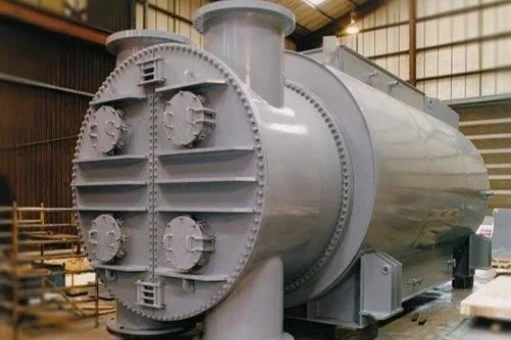
Power Plant Condensers
ASTM B111 tubes are widely used in steam surface condensers for thermal power plants.
Common alloys: C12200, C44300, C68700
Typical form: Straight tubes / tube bundles
Surface finish: Pickled & cleaned / mill finish
Heat treatment: Annealed

Seawater Desalination Plants
Used in evaporators and condenser systems handling high-salinity seawater in desalination facilities.
Common alloys: C68700, C70600, C71500
Typical form: Straight tubes / U-bend tubes
Surface finish: Pickled & cleaned / protective coated
Heat treatment: Annealed

Marine Heat Exchangers
Applied in ship engine cooling systems and seawater auxiliary heat exchangers.
Common alloys: C70600, C71500
Typical form: U-bend tubes / straight tubes
Surface finish: Pickled & cleaned / protective coated
Heat treatment: Annealed

Petrochemical Heat Exchangers
Used in refinery cooling systems and process heat exchangers under corrosive operating conditions.
Common alloys: C44300, C68700, C70600
Typical form: Straight tubes / U-bend tubes
Surface finish: Mill finish / pickled & cleaned
Heat treatment: Annealed

HVAC & Refrigeration Systems
Used in chillers, condensers, and large-scale HVAC heat exchange equipment.
Common alloys: C12200, C44300
Typical form: Straight tubes / finned tubes
Surface finish: Bright annealed (BA) / clean finish
Heat treatment: Annealed

Offshore Oil & Gas Platforms
Used in offshore cooling systems exposed to continuous seawater and harsh marine environments.
Common alloys: C70600, C71500
Typical form: Straight tubes / tube bundles / U-bend tubes
Surface finish: Pickled & cleaned / protective coated
Heat treatment: Annealed
For seawater applications, C70600 and C71500 are most commonly selected due to superior corrosion resistance and long service life.
How to Calculate Tube Requirements for Your Shell and Tube Heat Exchanger?
A copper tube heat exchanger calculation involves several variables. While we do not design your system, we provide engineering support to help you determine the correct ASTM B111 copper heat exchanger tube specifications.
Key inputs for heat exchanger design:
heat duty (kW or BTU/hr)
inlet and outlet temperatures (hot and cold sides)
flow rates (tube side and shell side)
allowable pressure drop
fouling factors
Outputs that determine tube selection:
required heat transfer surface area (square meters)
number of tubes
copper heat exchanger tube od and wall thickness
copper heat exchanger tube length
tube pitch (center-to-center distance between tubes)
For a shell and tube heat exchanger with a u tube bundle, the bend radius also affects tube count and shell diameter.
If you have a preliminary process specification, send it to our engineering team. We will recommend the most cost-effective ASTM B111 alloy and size for your duty.
Send Your Process Data → Get Free Tube Sizing Recommendation
Testing & Quality Inspection
All tubes are tested to ensure compliance with ASTM B111 and international quality standards.

| Test Item | Standard / Method | Purpose |
| Chemical Analysis | ASTM E478 / Spectrographic analysis | Verify alloy composition and trace elements |
| Tensile Test | ASTM E8/E8M | Confirm tensile strength, yield strength, and elongation |
| Flattening Test | ASTM B111 | Check ductility and resistance to cracking under deformation |
| Flanging (Flare) Test | ASTM B111 | Evaluate tube forming performance at ends |
| Eddy Current Test (ECT) | ASTM E243 | Detect surface and near-surface defects in tubes |
| Hydrostatic Test | ASTM B111 / ASTM E1003 | Verify pressure integrity and leak resistance |
| Dimensional Inspection | Calipers / micrometers | Ensure OD, wall thickness, and length compliance |
| Visual Inspection | ASTM B111 | Check surface defects, scratches, dents, and oxidation |
| Hardness Test | ASTM E18 | Confirm material hardness consistency |
| PMI Test (Positive Material Identification) | OES / XRF | Verify alloy grade accuracy before shipment |
Packaging & Documentation

| Packaging Stage | Material / Method | Purpose |
|---|---|---|
| Individual Tube Protection | Anti-rust VCI paper + plastic end caps | Prevents moisture, dust, and scratches on copper tube heat exchanger inner surfaces. |
| Bundling | Nylon straps + wooden spacers | Keeps copper heat exchanger tube OD 19mm, 1 inch, or 5/8 inch sizes organized and vibration-free. |
| Moisture Barrier | Thick PE film wrap (heat-shrunk) | Blocks humidity during long sea voyages to copper heat exchanger tube Germany or Saudi Arabia. |
| Outer Packing | Export-grade plywood cases or steel-banded wooden crates | Withstands stacking and rough handling. Each crate labeled with PO number, alloy (e.g., SB111 C70600), and quantity. |
| Documentation | Packing list + Mill Test Certificate (MTC) attached outside | Customs clearance support for copper heat exchanger tube stockist and distributor partners. |
For U-Bundle Orders: U tube heat exchanger and U tube bundle heat exchanger are placed in dedicated steel jigs inside the crate to prevent bending radius distortion.
Our Factory & Equipment

| Equipment Type | Specification / Capability | Quality Impact |
|---|---|---|
| Horizontal Continuous Casting Line | 10-ton capacity | Produces homogeneous copper alloy tube for heat exchanger billets with zero porosity. |
| Three-Roll Piercing Mill | Up to 60mm OD | Precision wall thickness control for heat exchanger tube wall thickness as low as 0.5mm. |
| Cold Drawing Bench | 5 draws in sequence | Achieves tight tolerances on copper heat exchanger tube length and heat exchanger pipe diameter. |
| Straightening & Cutting Line | CNC servo-controlled | Burr-free cutting for copper heat exchanger tube 3/4 inch and 1 inch to exact project lengths. |
| U-Bending Machine | CNC mandrel type | Produces u tube condenser and U tube bundle heat exchanger without kinking or ovality. |
| Eddy Current Tester | NDT (Non-Destructive Testing) | 100% inspection of C70600 tube and C71500 tube for pinholes or cracks per ASTM B111 pdf standards. |
| Hydrostatic Tester | Up to 200 bar | Validates heat exchanger tube expansion and tube rolling integrity. |
| Spectrometer | Optical emission (OES) | Confirms chemical composition of ASME SB111, EN 12451, and JIS H3300 grades on every batch. |
Our Certifications & Compliance:
ASTM B111 pdf and ASME SB111 pdf full traceability.
ISO 9001:2015 quality management system.
Third-party inspection accepted: SGS, BV, Lloyds, or TUV.
Copper heat exchanger tube life expectancy testing reports available upon request.
Get Fast Quote & Logistics Plan
FAQ
Q1: What is the difference between ASTM B111 and ASME SB111?
ASTM B111 is the material specification. ASME SB111 is identical in technical requirements but is listed in the ASME Boiler and Pressure Vessel Code. For heat exchanger boiler applications that require ASME stamping, you need ASME SB111 pdf certification. We provide both.
Q2: How do I get a copper heat exchanger tube price per meter?
Copper heat exchanger tube cost per meter depends on alloy, OD, wall thickness, length, and quantity. C12200 is the lowest cost. C70600 is approximately 2x the price of C12200. C71500 is approximately 3x the price. Send us your specification for a firm copper heat exchanger tube price.
Q4: How long do ASTM B111 copper heat exchanger tubes last?
Copper heat exchanger tube life expectancy ranges from 15 years (C12200 in aggressive cooling water) to 30+ years (C71500 in clean seawater). Water chemistry, velocity, temperature, and maintenance practices significantly affect actual life.
Q5: Can I weld ASTM B111 C12200 tubes?
For how to weld copper heat exchanger tube, the short answer is that brazing is preferred over welding. Use BCuP-5 filler rod and a neutral flame. Welding requires deoxidized filler and argon purge. For how to bend copper heat exchanger tube in the field, we advise against it – factory bending maintains proper wall thickness.
Q6: How to clean copper heat exchanger tube without damaging it?
How to clean copper heat exchanger tube depends on the fouling type. For scale, use inhibited citric acid or sulfamic acid. Never use hydrochloric acid. For biological fouling, use chlorine dioxide or mechanical cleaning with nylon brushes. Avoid steel brushes which scratch the tube surface.
Q1: What is a copper heat exchanger tube and why use it over other metals?
A: It is a seamless pipe designed for optimal thermal transfer. We use copper because its thermal conductivity is unparalleled, drastically reducing the required surface area compared to steel. This allows engineers to design highly compact systems.
Q2: Copper heat exchanger tube vs stainless steel: Which is better for my project?
A: Copper transfers heat up to 20 times faster than stainless steel and naturally resists marine bio-fouling. However, stainless steel is preferred if your system contains highly corrosive chemicals like strong acids or ammonia.
Q3: Copper heat exchanger tube vs cupronickel: How do I choose?
A: Standard copper (C12200) is perfect for clean freshwater. If your equipment uses seawater, you must upgrade to cupronickel (ASTM B111 C70600 or C71500). The addition of nickel and iron drastically improves erosion-corrosion resistance in high-velocity saltwater.
Q5: How to bend or weld copper heat exchanger tube without damaging it?
A: For a U-tube bundle, we use CNC rotary draw bending with internal mandrels to prevent the tube from flattening. After bending, the stress must be relieved via annealing. If you need to know how to weld copper heat exchanger tube to a tube sheet, TIG welding is standard for cupronickel, while brazing is common for pure copper. Proper control of heat is vital to prevent copper heat exchanger tube corrosion at the weld seam.
Hot Tags: astm b111 copper heat exchanger tube, China astm b111 copper heat exchanger tube manufacturers, suppliers, factory, copper
You Might Also Like




Send Inquiry