

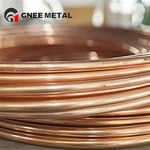
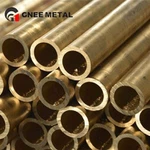
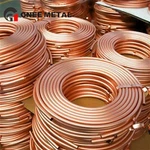
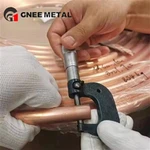


ASTM B111 C71500 Copper Nickel Tube 70/30
Henan Gnee New Material Co., Ltd. is one of the most professional manufacturers and suppliers of astm b111 c71500 copper nickel tube 70/30 in China, specialized in providing high quality copper products with competitive price. Welcome to buy discount astm b111 c71500 copper nickel tube 70/30 for sale here from our factory. Customized orders are welcome.
For high-pressure condensers and marine heat exchangers, ASTM B111 C71500 (Copper Nickel 70/30) is the primary material choice when standard brass or 90/10 copper-nickel fails. Its high nickel content provides the necessary shear strength to resist erosion-corrosion in turbulent seawater, making it the industry standard for naval vessels and desalination plants.
Our copper heat exchanger tube factory produces C71500 tubing specifically for environments where water velocity exceeds 3.5 m/s. We supply these tubes to meet ASME SB111 and EN 12451 standards, ensuring every meter of tubing is tested for integrity before it leaves our facility.
Available Forms of ASTM B111 C71500 Copper Nickel Tubes


| Form / Type | OD Range (mm) | Wall Thickness (mm) | Fin Specifications (if applicable) | Length (mm) | Temper / Condition | Typical Application |
|---|---|---|---|---|---|---|
| Seamless Straight Tubes | 6.0 – 168.0 | 0.5 – 10.0 | - | Up to 18,000 | Annealed (O), Light Drawn (LD), Hard Drawn (HD) | Heat exchangers, condensers, evaporators |
| U-Bend Tubes | 12.0 – 50.8 | 0.7 – 3.5 | - | Custom radii per drawing | Annealed (O) or Stress-Relieved | Power plant & marine condensers, retrofit replacements |
| Finned Tubes | 12.0 – 89.0 | 0.9 – 5.0 | Integral low-fin (11–19 FPI) or High-fin (4–10 FPI, height 8–16mm); G-type / L-foot / Extruded available | Up to 15,000 | Annealed (O) | Air-cooled heat exchangers, radiators, boiler economizers, HVAC systems |
| Tube Bundles (Pre-assembled) | Custom (fabricated to drawing) | Custom | Optional (finned or plain) | Custom | Annealed (O) | Complete condenser & chiller bundle replacements, turnkey retrofit kits |
ASTM B111 C71500 Copper Nickel Tube Specifications
| Item | Specification |
| Material Grade | C71500 (70/30 Copper Nickel) |
| Standard | ASTM B111, ASME SB111, EN 12451, JIS H3300 |
| Product Type | Seamless Copper Nickel Tube |
| Outside Diameter (OD) | 12.7–76.2 mm (1/2"–3") |
| Wall Thickness (WT) | 0.7–3.5 mm |
| Length | Up to 25 m |
| Supply Forms | Straight Length Tubes, U-Bend Tubes, Tube Bundle Components |
| Temper | Annealed (O60), Light Drawn (H55), Stress-Relieved |
| Surface Finish | Mill Finish, Bright Annealed, Pickled and Cleaned |
| End Finish | Plain Ends, Deburred Ends |
| Manufacturing Process | Extruded and Cold Drawn Seamless |
| Testing Methods | Eddy Current, Hydrostatic, Pneumatic, Flattening and Flaring Tests |
| Certificate | EN10204 3.1 Mill Test Certificate |
| Third-Party Inspection | SGS, BV, DNV, TUV, ABS Available |
| Packaging | Wooden Cases, Bundles, Export Seaworthy Packing |
| Applications | Condensers, Heat Exchangers, Desalination Plants, Marine Cooling Systems |
Chemical Composition (ASTM B111 / ASME SB111)
| Element | Composition (%) |
|---|---|
| Copper (Cu) | 65.0 – 70.0 |
| Nickel (Ni) + Cobalt (Co) | 29.0 – 33.0 |
| Iron (Fe) | 0.40 – 1.0 |
| Manganese (Mn) | ≤ 1.0 |
| Lead (Pb) | ≤ 0.05 |
| Zinc (Zn) | ≤ 1.0 |
| Tin (Sn) | - |
| Sulfur (S) | ≤ 0.02 |
| Carbon (C) | ≤ 0.05 |
| Phosphorus (P) | - |
| Copper + Nickel | ≥ 99.5 (total base) |
Physical Properties
| Property | Value |
|---|---|
| Density | 8.94 g/cm³ (0.323 lb/in³) |
| Melting Point Range | 1170 – 1240 °C (2140 – 2260 °F) |
| Thermal Conductivity (20°C) | 29 W/(m·K) (16.8 BTU·in/(hr·ft²·°F)) |
| Electrical Conductivity (20°C) | ~ 4.6 % IACS |
| Electrical Resistivity | 0.38 µΩ·m (at 20°C) |
| Coefficient of Thermal Expansion (20–300°C) | 16.2 × 10⁻⁶ /°C (9.0 × 10⁻⁶ /°F) |
| Specific Heat Capacity (20°C) | 380 J/(kg·K) (0.091 BTU/(lb·°F)) |
| Modulus of Elasticity (Tension) | 152 GPa (22,000 ksi) |
| Modulus of Rigidity | 57 GPa (8,300 ksi) |
| Poisson's Ratio | 0.33 |
Mechanical Properties (Typical Values for Annealed Temper – O)
| Property | ASTM B111 Requirement | Typical Value (Annealed) |
|---|---|---|
| Tensile Strength (min) | 483 MPa (70 ksi) | 500 – 550 MPa |
| Yield Strength (0.2% Offset, min) | 172 MPa (25 ksi) | 180 – 220 MPa |
| Elongation (in 2″ or 50mm, min) | 30% | 35 – 45% |
| Hardness (Rockwell B) | - | 70 – 85 HRB |
| Grain Size (ASTM) | - | 0.035 – 0.060 mm (for annealed) |
ASTM B111 / C71500 – Dimensional Specifications
| Form / Type | OD Range (mm) | OD Tolerance (mm) | Wall Thickness (mm) | Wall Tolerance (mm) | Length (mm) | Length Tolerance (mm) |
|---|---|---|---|---|---|---|
| Seamless Straight Tubes | 6.0 – 168.0 | ±0.08 – ±0.20 (depending on OD) | 0.5 – 10.0 | ±10% of nominal wall | Up to 18,000 | 0 / +3 (for cut lengths) |
| U-Bend Tubes | 12.0 – 50.8 | ±0.10 – ±0.15 | 0.7 – 3.5 | ±10% of nominal wall | Custom radii per drawing | ±1.5 (leg length) / ±3.0 (center-to-center) |
| Finned Tubes | 12.0 – 89.0 (base tube) | ±0.10 – ±0.20 (base tube) | 0.9 – 5.0 (base tube) | ±10% of nominal wall | Up to 15,000 | 0 / +3 |
| Tube Bundles (Pre-assembled) | Custom per drawing | Per drawing requirements | Custom per drawing | Per drawing requirements | Custom per drawing | Per drawing requirements |
Applications

Surface Condensers
Excellent resistance to seawater corrosion and biofouling with high heat transfer efficiency.
Common Form: Straight Tubes / Tube Bundle Components / Finned Tubes
Temper: Annealed (O60)

Marine Heat Exchangers
Superior resistance to seawater, brackish water, and chloride-induced stress corrosion cracking, ensuring long service life in shipboard cooling systems.
Common Form: Straight Tubes / U-Bend Tubes
Temper: Annealed (O60)

Air-Cooled Heat Exchangers (ACHE)
High-efficiency finned tubes deliver extended surface area for optimal air-side heat dissipation in dry cooling applications.
Common Form: Finned Tubes (High-Fin / Extruded) / Straight Tubes
Temper: Annealed (O60)

Power Plant Condensers
Withstands high-temperature steam and aggressive cooling water conditions while maintaining stable thermal performance.
Common Form: Straight Tubes / U-Bend Tubes / Tube Bundles
Temper: Annealed (O60) or Stress-Relieved

Desalination Plants
Exceptional resistance to high-temperature saline water and erosion-corrosion, ideal for thermal and membrane desalination processes.
Common Form: Straight Tubes / U-Bend Tubes
Temper: Annealed (O60)

Offshore Oil & Gas Platforms
Reliable performance in splash zones and submerged service with excellent resistance to hydrogen sulfide and chloride attack.
Common Form: Straight Tubes / Finned Tubes / Tube Bundle Components
Temper: Annealed (O60)
Comparison with Other Alloys
| Alloy | Best application | Thermal conductivity (W/m·K) | Relative cost | Seawater velocity limit | Max temp (°C) | Typical service life |
|---|---|---|---|---|---|---|
| C12200 (copper) | Fresh water | 400 | Low | Not for seawater | 200 | 1-3 years in seawater |
| C44300 (admiralty brass) | Clean seawater, low velocity | 100 | Low-Medium | 2.0 m/s | 150 | 10-15 years |
| C68700 (aluminum brass) | Variable seawater | 100 | Medium | 2.5 m/s | 175 | 15-20 years |
| C70600 (90/10 cupronickel) | Seawater, moderate velocity | 45 | High | 3.5 m/s | 200 | 25-40 years |
| C71500 (70/30 cupronickel) | Aggressive seawater, high velocity, high temp | 30 | Very high | 4.5 m/s | 300 | 30-50 years |
| Titanium (Gr2) | Most aggressive conditions | 17 | Very high | Unlimited | 300+ | 40+ years |
C71500 vs C70600:
C71500 offers better corrosion resistance in aggressive seawater, higher allowable velocity (4.5 m/s vs 3.5 m/s), higher temperature capability (300°C vs 200°C), and higher strength. However, C71500 has lower thermal conductivity (30 vs 45 W/m·K) and costs 30-50% more. For most seawater applications, C70600 is sufficient. Specify C71500 only when C70600 has failed in similar service or when operating conditions exceed C70600 limits.
C71500 vs titanium:
Titanium offers unlimited corrosion resistance and can handle any velocity. However, titanium has very low thermal conductivity (17 W/m·K), is difficult to fabricate (cannot be rolled into tube sheets in the same way), and costs 3-5 times more than C71500. C71500 is the more practical choice for most high-performance seawater applications. Titanium is reserved for the most aggressive conditions (very high velocity, warm seawater, or acidic conditions).
FAQ
What is ASTM B111 C71500 copper nickel tube?
It is a 70/30 copper-nickel alloy tube manufactured to ASTM B111 for heat exchanger and condenser applications. It contains 29-33% nickel, giving it excellent resistance to high-velocity seawater, high temperatures, and aggressive chemical environments.
What is the difference between C71500 and C70600?
C71500 is 70/30 cupronickel (70% copper, 30% nickel). C70600 is 90/10 cupronickel (90% copper, 10% nickel). C71500 offers better corrosion resistance, higher allowable velocity (4.5 m/s vs 3.5 m/s), higher temperature capability (300°C vs 200°C), and higher strength. However, C71500 has lower thermal conductivity and costs 30-50% more.
When should I choose C71500 over C70600?
Choose C71500 when: water velocity exceeds 3.5 m/s, operating temperature exceeds 200°C, C70600 has failed in similar service, or the required service life is 40+ years. For most seawater applications, C70600 is sufficient.
Can C71500 be used in fresh water?
Yes, but it is severely over-specified. Use C12200 copper for fresh water applications.
How to bend copper heat exchanger tube in C71500?
Use annealed temper. Minimum bend radius is 3.5 × OD. Mandrel bending is required for all bends. Expect springback of 5-8 degrees. C71500 is difficult to bend – consider using a larger radius (4-5 × OD) for critical applications.
How to weld copper heat exchanger tube in C71500?
TIG weld with ERCuNi filler metal. Preheating recommended for wall thickness above 3mm. Use argon shield gas with helium addition. No post-weld heat treatment required. Mechanical expansion is preferred over welding for tube-to-tubesheet joints.
What is the difference between ASTM B111 and ASME SB111?
ASME SB111 is the ASME code version. Chemistry and dimensions are identical. SB111 requires additional quality assurance and certification for pressure vessel applications. For ASME-coded heat exchangers, specify SB111.
Copper heat exchanger tube vs stainless steel – which is better for aggressive seawater?
C71500 is significantly better than stainless steel for aggressive seawater. Stainless steel suffers crevice corrosion and pitting in seawater. C71500 does not have these failure modes.
Copper heat exchanger tube vs cupronickel – which lasts longer?
C71500 is the longest-lasting cupronickel alloy among common heat exchanger tube materials. It lasts 30-50 years in seawater, compared to 25-40 years for C70600 and 10-20 years for brass alloys.
Why use copper in heat exchanger applications involving aggressive seawater?
C71500 provides the best combination of corrosion resistance, thermal conductivity (relative to titanium), and fabricability for the most demanding seawater-cooled heat exchangers. For applications where C70600 is not adequate, C71500 is the next step before titanium.
What is the life expectancy of C71500 heat exchanger tube?
30-50 years in properly designed and maintained seawater systems. This is longer than C70600 (25-40 years) and much longer than brass alloys (10-20 years).
What causes corrosion in C71500 tubes?
Most common cause: galvanic corrosion from coupling with titanium (without isolation). Other causes: severe sulfide pollution in industrial harbors, sand erosion at velocities above 4.5 m/s, or low pH below 4.5.
How to clean copper heat exchanger tube made of C71500?
Mechanical cleaning with nylon or stainless steel brushes. Chemical cleaning with inhibited sulfamic or citric acid. C71500 is very acid-resistant, but still avoid pH below 4.0. Chlorination for biofouling control is acceptable at free chlorine below 0.5 ppm.
Do you supply C71500 to EN 12451 or JIS H3300?
Yes. EN 12451 designation is CuNi30Fe1Mn. JIS H3300 designation is C7150T. Specify your required standard when ordering.
Do you provide third-party inspection?
Yes. We can arrange inspection by ABS, DNV, BV, Lloyds, or any other third-party agency at customer expense. Inspection must be specified at time of order. Nuclear-grade certification is available at additional cost.
How Do We Package Copper Heat Exchanger Tubes for Global Delivery?
Poor packaging destroys even the best copper heat exchanger tube. As a professional copper heat exchanger tube factory serving copper heat exchanger tube USA, Europe, UAE, Saudi Arabia, and India, we follow military-grade export packaging standards to ensure zero damage during sea or air freight.

Our Standard Packaging Process:
| Packaging Stage | Material / Method | Purpose |
|---|---|---|
| Individual Tube Protection | Anti-rust VCI paper + plastic end caps | Prevents moisture, dust, and scratches on copper tube heat exchanger inner surfaces. |
| Bundling | Nylon straps + wooden spacers | Keeps copper heat exchanger tube OD 19mm, 1 inch, or 5/8 inch sizes organized and vibration-free. |
| Moisture Barrier | Thick PE film wrap (heat-shrunk) | Blocks humidity during long sea voyages to copper heat exchanger tube Germany or Saudi Arabia. |
| Outer Packing | Export-grade plywood cases or steel-banded wooden crates | Withstands stacking and rough handling. Each crate labeled with PO number, alloy (e.g., SB111 C70600), and quantity. |
| Documentation | Packing list + Mill Test Certificate (MTC) attached outside | Customs clearance support for copper heat exchanger tube stockist and distributor partners. |
For U-Bundle Orders: U tube heat exchanger and U tube bundle heat exchanger are placed in dedicated steel jigs inside the crate to prevent bending radius distortion.
Our Factory & Equipment
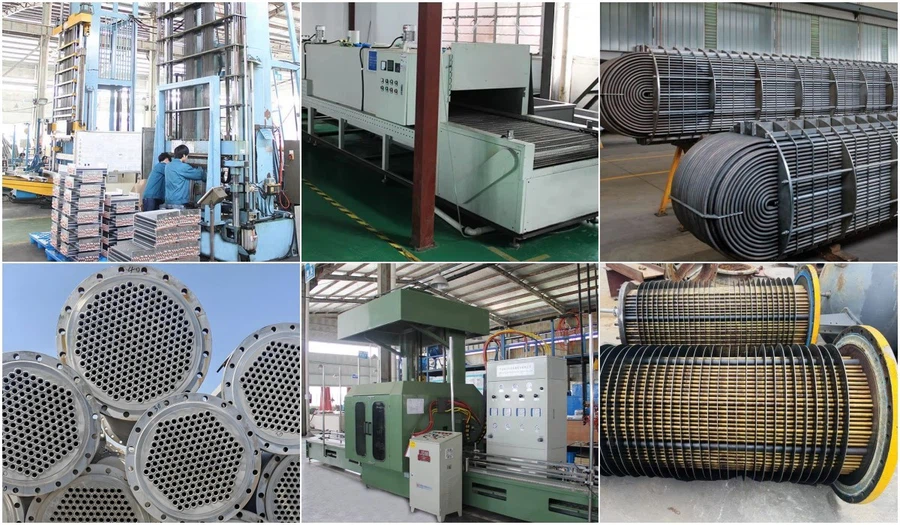
| Equipment Type | Specification / Capability | Quality Impact |
|---|---|---|
| Horizontal Continuous Casting Line | 10-ton capacity | Produces homogeneous copper alloy tube for heat exchanger billets with zero porosity. |
| Three-Roll Piercing Mill | Up to 60mm OD | Precision wall thickness control for heat exchanger tube wall thickness as low as 0.5mm. |
| Cold Drawing Bench | 5 draws in sequence | Achieves tight tolerances on copper heat exchanger tube length and heat exchanger pipe diameter. |
| Straightening & Cutting Line | CNC servo-controlled | Burr-free cutting for copper heat exchanger tube 3/4 inch and 1 inch to exact project lengths. |
| U-Bending Machine | CNC mandrel type | Produces u tube condenser and U tube bundle heat exchanger without kinking or ovality. |
| Eddy Current Tester | NDT (Non-Destructive Testing) | 100% inspection of C70600 tube and C71500 tube for pinholes or cracks per ASTM B111 pdf standards. |
| Hydrostatic Tester | Up to 200 bar | Validates heat exchanger tube expansion and tube rolling integrity. |
| Spectrometer | Optical emission (OES) | Confirms chemical composition of ASME SB111, EN 12451, and JIS H3300 grades on every batch. |
Our Certifications & Compliance:
ASTM B111 pdf and ASME SB111 pdf full traceability.
ISO 9001:2015 quality management system.
Third-party inspection accepted: SGS, BV, Lloyds, or TUV.
Copper heat exchanger tube life expectancy testing reports available upon request.
Get Fast Quote & Logistics Plan
Hot Tags: astm b111 c71500 copper nickel tube 70/30, China astm b111 c71500 copper nickel tube 70/30 manufacturers, suppliers, factory, copper
Next
No InformationYou Might Also Like


Send Inquiry