

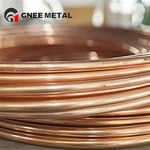
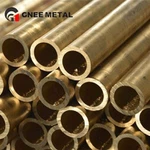
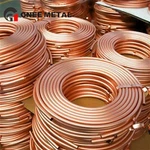
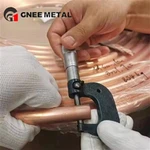


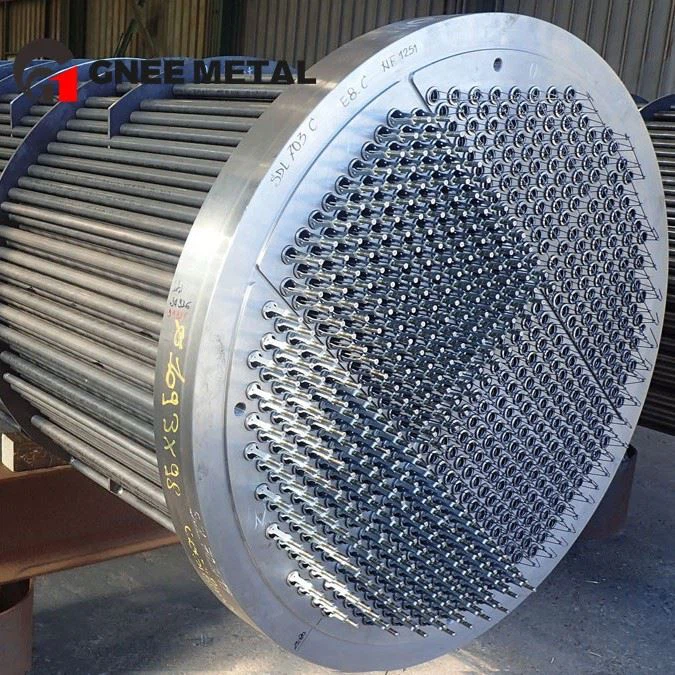

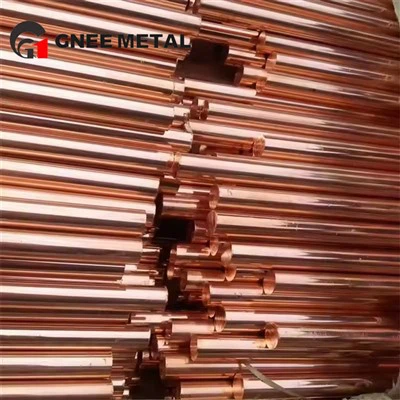
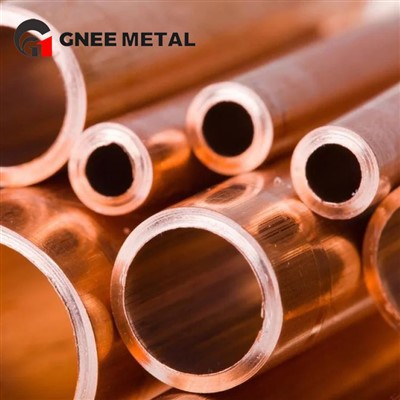
Copper Alloy Heat Exchanger Tube
Alloys: C12200 / C44300 / C68700 / C70600 / C71500
Sizes: 5/8", 3/4", 1" OD | Wall thickness ±0.05mm
Henan Gnee New Material Co., Ltd. is one of the most professional manufacturers and suppliers of copper alloy heat exchanger tube in China, specialized in providing high quality copper products with competitive price. Welcome to buy discount copper alloy heat exchanger tube for sale here from our factory. Customized orders are welcome.

We draw copper tubes for heat exchangers-straight, U-bent, or finned. Alloys: C12200, C44300, C68700, C70600, C71500. Standards: ASME SB111, ASTM B111, EN 12451, JIS H3300. OD 12.7mm–31.8mm, wall 0.5mm–3mm, straight lengths up to 30m. Each tube eddy-current tested before it leaves. We also supply finished U-bundles-jig-welded, tube-rolled, and hydrotested. Every order includes MTC and NDT reports.
Request Current Stock & Mill Test Certificates
Which ASTM B111 Alloy Suits Your Heat Exchanger Application?
Choosing the wrong heat exchanger tube material is the fastest way to corrosion. We stock 5 primary alloys under ASME SB111 and ASTM B111 specifications to match your fluid chemistry and temperature profile.
| Alloy / Standard | Key Feature | Best Application Scenarios |
|---|---|---|
| ASTM B111 C12200 (Phosphorus Deoxidized Copper) |
The gold standard for thermal conductivity. | heat exchanger hvac heat exchanger boiler (clean water) copper tube heat exchanger units |
| ASTM B111 C44300 (Admiralty Brass) |
Inhibited arsenic content prevents dezincification. | heat exchanger condenser units facing brackish water. |
| ASTM B111 C68700 (Aluminum Brass) |
Superior resistance to high-velocity seawater. | shell tube evaporator systems High-flow seawater cooling. |
| ASTM B111 C70600 (Cu-Ni 90/10) |
Handles moderate seawater corrosion. | Naval & marine copper tubing heat exchanger systems. |
| ASTM B111 C71500 (Cu-Ni 70/30) |
Extreme corrosion resistance for harsh marine environments. | u tube condenser units High-temperature sour service. |
International Compliance: We also comply with EN 12451 and JIS H3300 standards for global projects.
Heat Exchanger Copper Tube Configurations We Supply
We supply straight copper tubes, U-bent tubes, finned tubes and complete tube bundles for condensers, evaporators, boilers and HVAC heat exchangers. Custom dimensions and ready-to-install assemblies are available.

U Tube & Complete Tube Bundles
Stress-relieved bends
Grade: C12200 / C70600 / C71500 / C68700
Temper: Annealed
For condensers and boilers

Finned Copper Tubes (Enhanced Heat Transfer)
Enhanced heat transfer efficiency
Grade: C12200 / C11000
Temper: Soft / Half Hard
For HVAC coils and air coolers

Shell Tube Evaporator & Condensers (Straight Tubes)
High straightness and tight tolerances
Grade: C12200 / C70600 / C71500 / C68700
Temper: Soft / Half Hard / Hard Drawn
For shell & tube heat exchangers
Technical Capabilities & Fabrication Services
Technical Capabilities
| Parameter | Specification |
| Tube OD | 6–50.8 mm |
| Wall Thickness | 0.5–3 mm |
| Length | Up to 30 m |
| Temper | Soft / Half Hard / Hard Drawn |
| Alloy Grades | C12200 / C70600 / C71500 / C68700 |
| Standards | ASTM B111 / ASME SB111 / EN 12451 / JIS H3300 |
| Surface Finish | BA / Mill Finish / Pickled |
| Certifications | MTC EN 10204 3.1 |
Fabrication Services
| Service | Description |
| Tube Cutting | Custom lengths according to drawings |
| U-Bending | Precision stress-relieved bends |
| Tube Expansion | Suitable for tube sheet assembly |
| Tube Bundle Assembly | Ready-to-install bundles |
| Packaging | Export seaworthy packaging |
| Testing | 100% Eddy Current & Hydrostatic Test |
Quality Assurance

| Inspection Item | Purpose |
| 100% Eddy Current Testing | Detect surface and subsurface defects in every tube |
| Hydrostatic Pressure Testing | Verify pressure resistance and leakage integrity |
| Positive Material Identification (PMI) | Confirm alloy composition and material consistency |
| Chemical Composition Analysis | Ensure compliance with ASTM B111 requirements |
| Dimensional Inspection | Control OD, wall thickness and length tolerances |
| Surface Quality Inspection | Ensure smooth and defect-free tube surfaces |
| Mill Test Certificate (EN 10204 3.1) | Provide full material traceability |
| Heat Number Traceability | Track each production batch from raw material to shipment |
| ASTM / ASME Compliance Verification | Ensure conformity with applicable standards |
| Final Visual Inspection | Verify appearance and packing before delivery |
Packaging & Export Protection

| Packaging Stage | Material / Method | Purpose |
|---|---|---|
| Individual Tube Protection | Anti-rust VCI paper + plastic end caps | Prevents moisture, dust, and scratches on copper tube heat exchanger inner surfaces. |
| Bundling | Nylon straps + wooden spacers | Keeps copper heat exchanger tube OD 19mm, 1 inch, or 5/8 inch sizes organized and vibration-free. |
| Moisture Barrier | Thick PE film wrap (heat-shrunk) | Blocks humidity during long sea voyages to copper heat exchanger tube Germany or Saudi Arabia. |
| Outer Packing | Export-grade plywood cases or steel-banded wooden crates | Withstands stacking and rough handling. Each crate labeled with PO number, alloy (e.g., SB111 C70600), and quantity. |
| Documentation | Packing list + Mill Test Certificate (MTC) attached outside | Customs clearance support for copper heat exchanger tube stockist and distributor partners. |
For U-Bundle Orders: U tube heat exchanger and U tube bundle heat exchanger are placed in dedicated steel jigs inside the crate to prevent bending radius distortion.
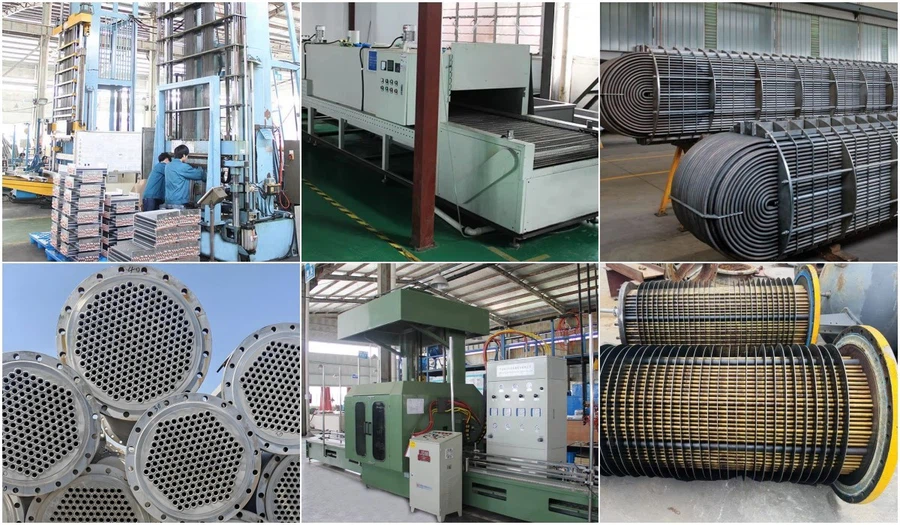
Manufacturing Capabilities
| Equipment Type | Specification / Capability | Quality Impact |
|---|---|---|
| Horizontal Continuous Casting Line | 10-ton capacity | Produces homogeneous copper alloy tube for heat exchanger billets with zero porosity. |
| Three-Roll Piercing Mill | Up to 60mm OD | Precision wall thickness control for heat exchanger tube wall thickness as low as 0.5mm. |
| Cold Drawing Bench | 5 draws in sequence | Achieves tight tolerances on copper heat exchanger tube length and heat exchanger pipe diameter. |
| Straightening & Cutting Line | CNC servo-controlled | Burr-free cutting for copper heat exchanger tube 3/4 inch and 1 inch to exact project lengths. |
| U-Bending Machine | CNC mandrel type | Produces u tube condenser and U tube bundle heat exchanger without kinking or ovality. |
| Eddy Current Tester | NDT (Non-Destructive Testing) | 100% inspection of C70600 tube and C71500 tube for pinholes or cracks per ASTM B111 pdf standards. |
| Hydrostatic Tester | Up to 200 bar | Validates heat exchanger tube expansion and tube rolling integrity. |
| Spectrometer | Optical emission (OES) | Confirms chemical composition of ASME SB111, EN 12451, and JIS H3300 grades on every batch. |
Our Certifications & Compliance:
ASTM B111 pdf and ASME SB111 pdf full traceability.
ISO 9001:2015 quality management system.
Third-party inspection accepted: SGS, BV, Lloyds, or TUV.
Copper heat exchanger tube life expectancy testing reports available upon request.
Get Fast Quote & Logistics Plan
FAQ
Q1: What is a copper heat exchanger tube and why use copper in a heat exchanger?
A: A copper tube heat exchanger utilizes copper's superior thermal conductivity (nearly 8 times higher than aluminum and much higher than steel). We use copper because it transfers heat rapidly, resists bio-fouling naturally, and is highly ductile, making it easy to fabricate into complex bundles.
Q2: Copper heat exchanger tube vs cupronickel: What's the difference?
A: Standard copper (like C12200) is excellent for freshwater. Cupronickel (90/10 or 70/30) adds nickel and iron, significantly increasing its resistance to high-velocity seawater and localized corrosion. Cupronickel is the standard for marine condensers.
Q3: How to clean and maintain a copper heat exchanger tube?
A: To maximize copper heat exchanger tube life expectancy, avoid highly abrasive mechanical cleaning. Use chemical cleaning with weak acids (like sulfamic or citric acid) equipped with copper inhibitors, followed by high-pressure water jetting to remove internal scale and fouling without damaging the passive oxide layer.
Q4: Are there concerns about copper heat exchanger tube corrosion?
A: While highly durable, improper water chemistry (e.g., high ammonia, sulfur, or excessive water velocity) can cause erosion-corrosion. Selecting the right alloy (like Admiralty Brass or Cupronickel) and controlling tube fluid velocity effectively mitigates these issues.
Q5: How to bend or weld a copper heat exchanger tube?
A: For bending, we use CNC rotary draw bending with internal mandrels to maintain wall thickness, crucial for a u tube heat exchanger. For joining, brazing with silver-based alloys is standard. If you need to know how to weld copper heat exchanger tube to a tubesheet, TIG welding is commonly used for cupronickel alloys, requiring specific filler metals and shielding gases.
Hot Tags: copper alloy heat exchanger tube, China copper alloy heat exchanger tube manufacturers, suppliers, factory, copper
You Might Also Like


Send Inquiry