

What is H62 brass?
H62 brass is an alloy composed of approximately 62% copper and 38% zinc. This composition provides the material with specific properties such as enhanced plasticity and good machinability, which facilitate both hot and cold processing techniques. The alloy is commonly utilized in the manufacture of mechanical components, water supply and drainage fittings, medals, and decorative items due to its balance of strength and corrosion resistance. The formability of H62 brass also supports its use in applications requiring detailed shaping and durability. These characteristics make H62 brass a preferred material in various engineering and decorative contexts.
What is the tensile strength of H62 brass?
Tensile strength ≥ 330 MPa, elongation ≥ 10% (in the hard state), excellent cold/hot working performance. Suitable for processes such as stamping, drawing, forging, etc.
Brass H62 Mechanical and Physical Properties
Property | Value |
|---|---|
Tensile Strength (MPa) | 370 - 420 |
Yield Strength (MPa) | 260 - 300 |
Elongation (%) | 10 - 15 |
Hardness (Vickers) | 100 - 140 VHN |
Hardness (Rockwell B) | 60 - 80 HRB |
Density (g/cm³) | 8.4 - 8.5 |
Thermal Conductivity (W/m·K) | 120 - 150 |
Corrosion Resistance | Good |
Wear Resistance | Moderate to Good |
What is the Zinc Composition of Brass H62?
Element | Composition (%) |
|---|---|
Copper (Cu) | 60.5 - 63.5 |
Iron (Fe) | ≤ 0.15 |
Lead (Pb) | ≤ 0.08 |
Zinc (Zn) | Balance |
Antimony (Sb) | ≤ 0.005 |
Bismuth (Bi) | ≤ 0.002 |
Phosphorus (P) | ≤ 0.01 |
H62 Brass Equivalent Grades
| Standard | Grade |
|---|---|
| China (GB) | H62 |
| Japan (JIS) | C2801 |
| Germany (DIN) | CuZn37 |
| USA (ASTM) | C2800 |
| Europe (EN) | CW508L |
Applications of H62 Brass
H62 is used to make all kinds of stuff. People use it to make brass tile trims, profiles, plumbing fittings, electrical connectors, and decorative hardware of all types. In the construction industry, people like to use H62 because it's strong and doesn't corrode outside. That makes it useful for architectural fittings and trims. In the electrical industry, they use it for terminals and connectors because of its good conductivity.
FAQ
| Is H62 brass machinability? More importantly, H62 brass has better machinability than many other brass alloys, which means that manufacturers can produce high-quality parts more efficiently, reducing waste and costs in the production process. |
| What is H62 brass strip used for? H62 brass strip is widely used in architectural decoration, electrical terminals, heat exchangers, hardware components, and ammunition casings due to its good strength, formability, and corrosion resistance. |
| What is the chemical composition of H62 brass strip? The typical chemical composition of H62 brass strip is about 60.5-63.5% Copper (Cu) and the remainder Zinc (Zn), with strict control over impurities like Lead (Pb) and Iron (Fe). |
| What is the equivalent grade of H62 brass strip in ASTM standard? H62 brass strip is equivalent to C28000 (Alloy 280 or Muntz Metal) in the ASTM/UNS system. |
| Can H62 brass strip be used for machining parts? Yes, H62 brass strip has fair machinability. It is suitable for stamping, bending, and forming operations, though it is not a free-machining grade like leaded brass. |
Our product range
1. Pure Copper (Sheet, Tube, Wire)
Primary Grades: T1 (C11000), T2 (C10100). We prioritize C11000 (T1) for its excellent conductivity.
Standards: ASTM B152 (Sheet), ASTM B75/B88 (Tube), ASTM B1/B3 (Wire), EN, JIS, GB/T.
Typical Sizes:
Tube: OD 6mm – 200mm.
Sheet: Thickness 0.5mm – 50mm.
Wire: Diameter 1.0mm – 10mm.
2. Phosphorus Deoxidized Copper (Tube, Sheet)
Primary Grades: TP1 (C12000 / CW023A), TP2 (C12200). Ideal for welding and plumbing.
Standards: ASTM B188, ASTM B75/B88, EN 12451, JIS H3300.
Typical Sizes:
Tube: OD 8mm – 150mm.
Sheet: Thickness 1.0mm – 30mm.
3. Brass (Strip & Coil)
Primary Grades: H96, H68, H62 (CuZn37 / C28000). We strongly recommend H62 for its excellent balance of strength and machinability.
Standards: ASTM B36, ASTM B134, EN 1652, JIS H3100.
Typical Sizes:
Strip/Coil: Thickness 0.1mm – 3.0mm, Width up to 600mm.
Get the complete product catalog
Our factory

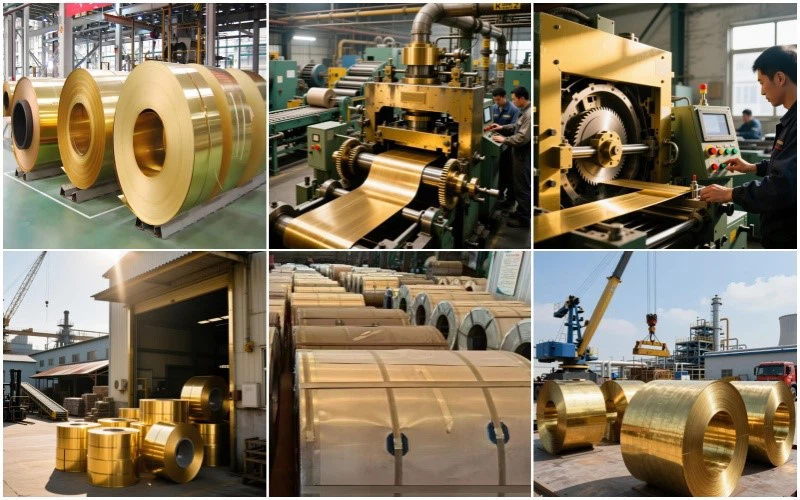
Our facility is equipped with industry-advanced continuous casting and rolling production lines, precision rolling mills, multi-pass drawing units, and automated forming equipment, enabling efficient and stable transformation from copper rods to finished products. Our core machinery allows us to flexibly manufacture a full range of grades-including pure copper (e.g., C11000/T1), phosphorus deoxidized copper (e.g., C12200/TP2), and brass (e.g., H62)-in the form of sheets, tubes, rods, strips, and wires. We also provide tailored processing services such as cutting, slitting, and precision finishing.


