

What is H62 brass?
This brass consists of a copper-zinc alloy with approximately 62% copper and 38% zinc. Due to this composition, the alloy offers a balanced merit of mechanical strength, corrosion resistance, and great malleability. The production of this brass occurs through casting, forging, and rolling processes for the preparation of applications in the industrial and commercial fields. Being versatile and durable, H62 brass is used for fabricating valves, pipes, and decorative fittings.
Is H62 brass machinability?
| Property | Rating / Description |
|---|---|
| Machinability Rating | ~ 40% (compared to C36000 as 100%) |
| Chip Formation | Produces relatively long, stringy chips. It does not break chips as cleanly as leaded alloys. |
| Tool Wear | Moderate. Carbide or high-speed steel (HSS) tools with sharp cutting edges are recommended. |
| Key Limiting Factor | Low Lead (Pb) Content (≤0.08%). Lead acts as a lubricant and chip-breaker in alloys like C36000, which H62 lacks. |
| Best For | Operations where machining is combined with significant cold working (e.g., stamping, bending) after machining, as it has superior ductility. |
Copper and Zinc in H62 Brass
The basic compositions of H62 brass are copper and zinc, which together create the particular qualities of the alloy. In general, about 60 to 63% of the alloy consists of copper, whereas the rest is made up of 37 to 40% zinc. This range is based on a fine balance chosen by the manufacturers between strength, malleability, and corrosion resistance, leaving H62 brass open to numerous applications.
The highest content of copper largely adds to the metals' thermal and electrical conductivity character and corrosion resistance in various environments, including moisture and some acids. It controls the ductility of the material, which allows shaping or machining into intricate components without cracking.
On the contrary, zinc offers strength and wear resistance. It makes the alloy hard enough to withstand mechanical strain, hence the manufacture of gears, bearings, and valves. Zinc serves to lessen the price of the alloy without seriously compromising its performance, thus contributing to its economic worth for industrial use.
The particular blend of copper and zinc in H62 brass yields a balance of mechanical and chemical properties, as well as machining and long lifetimes. By virtue of this perfect combination, H62 brass finds application in manufacturing automotive parts, electrical connectors, and decorative-related materials.
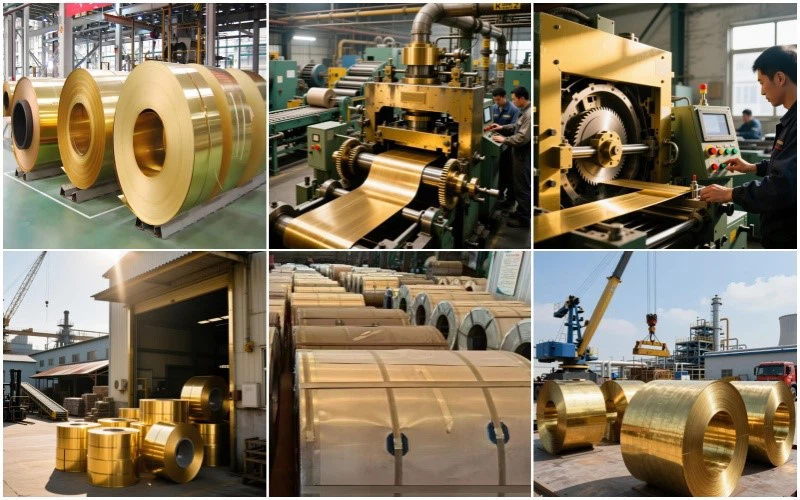
H62 Brass Features
1. High Strength and Plasticity Balance:
Tensile strength ≥ 330 MPa, elongation ≥ 10% (in the hard state), excellent cold/hot working performance.
Suitable for processes such as stamping, drawing, forging, etc.
2. High Cost-Effectiveness: Low cost, one of the most widely used common brasses.
3. Corrosion Resistance: Good corrosion resistance in freshwater and atmospheric conditions, but prone to stress corrosion cracking in seawater or ammonia-containing environments.
4. Wide Processing Adaptability: Supports cold rolling, hot rolling, welding, but annealing is required after cold processing to avoid stress concentration.
Common Product Forms and Specifications
|
Product Form |
H62 Brass Specification Range |
Standard/Condition |
|
Plate |
Thickness 0.2-100mm, Width 305-1000mm |
Hot rolled (R), Soft (M), Hard (Y) |
|
Strip |
Thickness 0.1-3.0mm |
M, Y₂, Y, etc. |
|
Pipe |
Outer diameter 6-530mm, Wall thickness 0.5-50mm |
Cold worked or semi-hard state |
|
Bar |
Diameter 5-200mm, Length 2500-6000mm |
Drawn round, black surface round |
|
Wire |
Diameter 0.5-12.7mm |
Coiled or straight bars |
Processing Considerations
Annealing Process: Requires annealing at 550-650℃ after cold working to eliminate internal stress and prevent cracking.
Welding Requirements: Preferably use argon arc welding to reduce the zinc evaporation and pore defects.
Corrosion Protection: Avoid direct exposure to seawater or ammonia environments; it is recommended to add a coating or plating.
What is the difference between H62 brass and H59 brass?
H62 has a higher copper content (60.5%-63.5% vs. H59's 57%-60%), offering better plasticity, making it suitable for complex processing. H59 has slightly lower strength but is more cost-effective.
Our product range
1. Pure Copper (Sheet, Tube, Wire)
Primary Grades: T1 (C11000), T2 (C10100). We prioritize C11000 (T1) for its excellent conductivity.
Standards: ASTM B152 (Sheet), ASTM B75/B88 (Tube), ASTM B1/B3 (Wire), EN, JIS, GB/T.
Typical Sizes:
Tube: OD 6mm – 200mm.
Sheet: Thickness 0.5mm – 50mm.
Wire: Diameter 1.0mm – 10mm.
2. Phosphorus Deoxidized Copper (Tube, Sheet)
Primary Grades: TP1 (C12000 / CW023A), TP2 (C12200). Ideal for welding and plumbing.
Standards: ASTM B188, ASTM B75/B88, EN 12451, JIS H3300.
Typical Sizes:
Tube: OD 8mm – 150mm.
Sheet: Thickness 1.0mm – 30mm.
3. Brass (Strip & Coil)
Primary Grades: H96, H68, H62 (CuZn37 / C28000). We strongly recommend H62 for its excellent balance of strength and machinability.
Standards: ASTM B36, ASTM B134, EN 1652, JIS H3100.
Typical Sizes:
Strip/Coil: Thickness 0.1mm – 3.0mm, Width up to 600mm.
Get the complete product catalog
Our factory

Our facility is equipped with industry-advanced continuous casting and rolling production lines, precision rolling mills, multi-pass drawing units, and automated forming equipment, enabling efficient and stable transformation from copper rods to finished products. Our core machinery allows us to flexibly manufacture a full range of grades-including pure copper (e.g., C11000/T1), phosphorus deoxidized copper (e.g., C12200/TP2), and brass (e.g., H62)-in the form of sheets, tubes, rods, strips, and wires. We also provide tailored processing services such as cutting, slitting, and precision finishing.


