

What is High Residual Phosphorus UNS C12200?
Phosphorus-deoxidized copper tubes (C12200) are made from 99.9% pure copper, deoxidized with phosphorus to enhance thermal conductivity and resistance to corrosion. This makes them ideal for heat exchanger applications, particularly where water or steam is involved.
Known for their durability and weldability, these tubes are a top choice in sugar refineries, where they are extensively utilized in condensers and evaporators, and the refrigeration industry, where they play a pivotal role in efficient heat transfer in cooling systems.
What Does "High Residual Phosphorus" Actually Mean?
To understand C12200, you need to know a bit about how copper is made. When copper is refined and cast, oxygen can get trapped in the material. For most electrical applications, that's not a huge issue. But for tube and pipe that will be welded or brazed, oxygen is a problem. It can cause embrittlement when exposed to hydrogen during the joining process-a phenomenon called "hydrogen embrittlement."
Deoxidized copper solves this by adding a small amount of phosphorus during processing. The phosphorus reacts with any remaining oxygen, effectively "cleaning" the copper before it's formed into tube. The "high residual" part means that a tiny amount of phosphorus remains in the final material, typically between 0.015% and 0.040%. That leftover phosphorus is what gives C12200 its distinct advantages in fabrication.
Key benefits
Excellent thermal conductivity: enables fast and efficient heat exchange with minimal energy loss.
High corrosion resistance: suitable for use in freshwater and mildly aggressive environments.
Ease of fabrication and joining: supports brazing, welding, and soldering for efficient assembly.
Proven reliability in industry settings: performs under high-pressure and high-temperature conditions.
Long service life: maintains structural and thermal performance over years of use.
Standards compliance: meets ASTM B75, B111, B395 and ASME SB111, SB395 specifications.
Equivalent Standards
ASTM: B42, B68, B75, B88, B111, B280, B360, B447, B543, B743
ASME: SB75, SB111
Military: MIL-T-24107B
JIS Standard: H3300
DIN:12449, 12450, 12451 1785
EN: 12449, 12450, 12451
How Does C12200 Compare to Other Copper Grades Like C11000 or C10200?
This is one of the most common questions we hear from engineers specifying material for new projects. C11000 (electrolytic tough pitch copper) is the standard for electrical applications-bus bars, transformer windings, that kind of work. It has excellent conductivity but doesn't play well with brazing due to its oxygen content.
C10200 (oxygen-free copper) is the premium choice for applications where the absolute highest conductivity and ductility are required, like in high-vacuum systems or advanced electronics. It's also significantly more expensive.
C12200 sits right in the sweet spot. It offers:
Excellent thermal conductivity (good enough for heat exchangers and refrigeration lines)
Superior brazeability and solderability
Better corrosion resistance in potable water systems
A much more favorable price point than oxygen-free grades
For 95% of plumbing, HVAC, refrigeration, and industrial fluid handling applications, C12200 is the right material. The remaining 5% are specialized use cases where either electrical conductivity or ultra-high purity takes priority.
FAQ
Is C12200 the same as DHP copper?
Yes. DHP stands for Deoxidized High Residual Phosphorus, which is exactly what UNS C12200 is. You'll see both terms used interchangeably in specifications and product data sheets.
Can C12200 be welded, or is brazing the only option?
C12200 can be welded, but brazing and soldering are far more common. If you need to weld copper, C12200 can be TIG welded with the right filler metal. However, for most piping applications, brazing with a phosphorus-copper or silver-brazing alloy is the standard joining method.
Does the phosphorus content affect thermal conductivity?
Slightly. C12200 has marginally lower thermal conductivity than pure copper grades like C11000, but the difference is negligible for plumbing, HVAC, and heat exchanger applications. You won't notice any performance impact in real-world installations.
Is C12200 more expensive than standard copper tube?
In most cases, C12200 is the standard. It's what you'll find on the shelf at most supply houses. If anything, specialty grades like C10200 are significantly more expensive. For typical plumbing and HVAC work, C12200 is the baseline, not a premium upgrade.
What's the maximum operating temperature for C12200 tube?
In pressure piping applications, the allowable working pressure decreases as temperature increases. For most building services, C12200 is suitable up to around 250°F for continuous service. For higher-temperature applications like steam or high-pressure boilers, you'd need to consult the applicable pressure piping code and consider wall thickness accordingly.
Our product range
| Product Category | Key Specifications | Common Applications |
|---|---|---|
| Copper Tubes | Outer Diameter: 3–300 mm Wall Thickness: 0.5–10 mm Length: Customized Standards: ASTM B280, EN 1057, JIS H3300 |
Air conditioning, refrigeration, heat exchangers, plumbing, industrial fluid transfer |
| Copper Sheets & Plates | Thickness: 0.5–100 mm Width: up to 3000 mm Length: up to 6000 mm Standards: ASTM B152, EN 1652, GB/T 2040 |
Architectural roofing, busbars, transformer components, industrial panels, heat exchangers |
| Copper Rods & Bars | Diameter: 6–300 mm (round) Cross-section: square, hexagonal, flat Standards: ASTM B124, EN 12163, GB/T 4423 |
Electrical connectors, machining parts, switchgear, fasteners, valve stems |
| Copper Wires | Diameter: 0.1–12 mm Form: bare, tinned, stranded Standards: ASTM B3, EN 13601, IEC 60228 |
Electrical wiring, cables, grounding, automotive harnesses, transformer windings |
Our factory
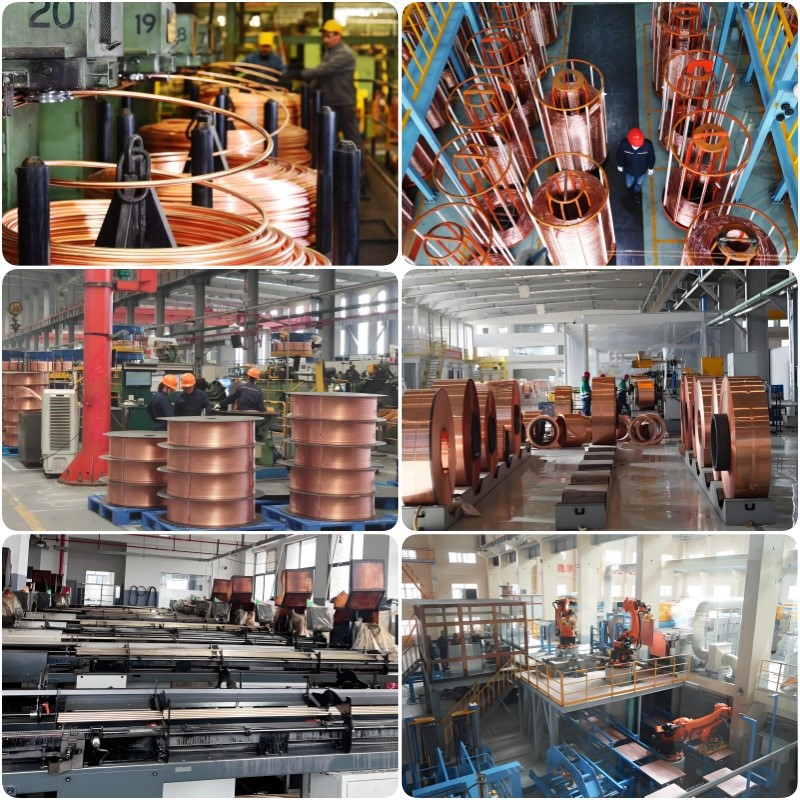
Our factory is equipped with a comprehensive range of advanced production facilities dedicated to the copper processing industry. The production line includes state-of-the-art extrusion presses, precision rolling mills, high-speed drawing machines, continuous casting lines, and automated annealing furnaces, enabling us to manufacture a full spectrum of copper products-tubes, sheets, plates, rods, bars, wires, and strips-with exceptional dimensional accuracy and consistent mechanical properties. To ensure stable output and supply reliability, we operate with an annual production capacity exceeding 80000 tons and maintain a large-scale inventory system that supports just-in-time delivery. Complementing our manufacturing capabilities is a dedicated quality control center equipped with spectrometers, universal testing machines, and hardness testers, ensuring every batch meets international standards such as ASTM, EN, and GB/T. This vertically integrated production setup allows us to control quality at every stage, from raw material selection to final packaging, and to offer flexible customization in dimensions, temper, and surface finishes. With decades of technical expertise and a strong focus on continuous process improvement, we stand as a reliable, large-scale supplier serving clients across global markets.
Check Today's Stock & Lead Time


