

What is UNS C44300 Admiralty Brass Tube?

UNS C44300 is a tin-bearing Admiralty Brass: 70.0–73.0% copper, zinc balance, with 0.9–1.2% tin and a deliberate 0.02–0.06% arsenic addition. Tin lifts resistance to general corrosion, while arsenic inhibits dezincification - the selective loss of zinc that shortens tube life in aggressive waters. Lead, iron and total impurities are held to tight ASTM B111 limits.
The alloy is produced as seamless cold-drawn tube, normally in the annealed condition so that it can be rolled, U-bent and expanded into a tube sheet without cracking.
Annealed C44300 tube is specified mainly for steam surface condensers, oil coolers, feedwater heaters and process exchangers running on fresh water, steam condensate or mildly brackish water. Thermal conductivity sits near 110 W/m·K - roughly double that of copper-nickel - which keeps heat-transfer surface compact.
Sustained high-velocity seawater is not its normal duty; where chloride levels are high, specifiers usually move to a copper-nickel grade.
What is UNS C70600 Copper-Nickel Tube?
UNS C70600, commonly written as Cu-Ni 90/10, is a copper-nickel alloy with 9.0–11.0% nickel, 1.0–1.8% iron, up to 1.0% manganese and 88.6% minimum copper. The iron addition is not incidental - it is what gives the alloy its resistance to erosion-corrosion under flowing seawater.
In service the alloy develops a thin, adherent oxide film that reforms quickly after damage, which is the reason it outperforms brass in chloride-rich cooling water.
C70600 tube is a standard choice for seawater-cooled condensers, desalination plants, shipboard cooling systems and offshore exchangers, and tolerates flow velocities of roughly 2.5–3.5 m/s when iron content and exchanger design allow. Thermal conductivity is lower, around 45 W/m·K, so more surface area is required for the same duty.

Both C44300 and C70600 are also used together in mixed bundles: Admiralty Brass on the low-chloride side, copper-nickel where seawater passes.
C44300 vs C70600 - How to Choose
The decision usually turns on the cooling medium and the required heat-transfer area, not on unit price alone.
| Selection factor | UNS C44300 Admiralty Brass | UNS C70600 Copper-Nickel |
|---|---|---|
| Core alloying | Cu 70–73%, Zn balance, 0.9–1.2% Sn, 0.02–0.06% As | Cu ≥88.6%, 9–11% Ni, 1.0–1.8% Fe, Mn ≤1.0% |
| Corrosion resistance in fresh water / condensate | Very good; arsenic inhibits dezincification | Very good |
| Corrosion resistance in seawater & chlorides | Limited; not for sustained high-velocity seawater | Excellent; stable protective film, self-repairing |
| Flow velocity tolerance | Lower; velocity limits are conservative | Higher, roughly 2.5–3.5 m/s under normal design |
| Thermal conductivity | High, ≈110 W/m·K - smaller surface area needed | Lower, ≈45 W/m·K - more surface area needed |
| Strength (annealed) | Tensile ≈310–450 MPa | Tensile ≈260–400 MPa |
| Relative material cost | Lower | Higher, driven by nickel content |
| Typical duties | Steam condensers, oil coolers, feedwater heaters, fresh-water exchangers | Seawater condensers, desalination, marine and offshore cooling |
| Documentation package | Identical for both grades: EN 10204 Type 3.1 certificate with chemical, mechanical and dimensional results | |
Selection rules of thumb
Seawater, brackish water or any chloride-rich medium - many project teams specify C70600 for film stability and velocity tolerance.
Fresh water, condensate or steam-side duty where footprint matters - specifiers normally choose C44300 for higher conductivity and lower cost.
Mixed bundles are common practice: C44300 in low-chloride sections, C70600 where seawater passes.
Where strength or vibration resistance is the limiting factor, engineers select a higher temper of the same alloy rather than switching grade.
Ask Our Engineers Which Grade Fits
Detailed Specifications & Size Range
Both alloys are supplied as seamless tube produced and tested to ASTM B111 / ASME SB111. The tables below list the ranges manufactured routinely; sizes outside them are generally quotable on request.
UNS C44300 - Admiralty Brass Heat Exchanger Tube
 C44300 Admiralty Brass Technical Datasheet PDF
| Parameter | Specification |
|---|---|
| Material / UNS No. | Admiralty Brass, UNS C44300 |
| Applicable standards | ASTM B111 / B111M; ASME SB111; EN 10204 documentation; equivalent EN registration on request |
| Product form | Seamless cold-drawn tube, straight or U-bend |
| Chemical composition | Cu 70.0–73.0%; Sn 0.9–1.2%; Pb ≤0.07%; Fe ≤0.06%; As 0.02–0.06%; Zn balance; total others ≤0.50% |
| Mechanical properties (annealed) | Tensile ≈310–450 MPa; yield (0.5% ext.) ≈100–170 MPa; elongation ≥35%; test values reported per heat on the certificate |
| Hardness | Approx. 55–90 HRB depending on temper (annealed typically 60–75 HRB) |
| Common tempers | Annealed (O60 / O61), light-drawn (H55 / H58); annealed temper usual for condenser and U-bend service |
| Outside diameter | 6.35 mm (1/4 in) to 76.2 mm (3 in); small-diameter thin-wall drawn from 6.35 mm OD |
| Wall thickness | 0.50 mm to 5.0 mm (approx. BWG 6–22); 0.60 mm and 0.70 mm walls produced in routine runs |
| Length | Straight: fixed or random up to 12,000 mm; cut to exact finished length, e.g. 505 mm or 1,550 mm; U-bend and coil on request |
| Tolerances | OD ±0.05–0.10 mm; wall ±10% (minimum wall ≥0.9 × nominal); cut length +3.0 / 0 mm |
| End finish | Plain, square-cut, deburred and capped; clean oil-free ID/OD finish available |
| Testing & NDT | Hydrostatic test per ASTM B111; eddy current test (ASTM E243); flaring test; grain size; hardness; dimensional check |
| Available forms | straight tube / U-bend tube / coil tube / finned tube / low-fin tube / cut-to-length finished tube |
| Related products | Matching tube fittings (elbow, tee, coupling, ferrule), tube sheets and baffle plate in the same alloy family; companion C70600 tube for mixed bundles |
UNS C70600 - Copper-Nickel Heat Exchanger Tube
 C70600 Copper Nickel Technical Datasheet PDF
| Parameter | Specification |
|---|---|
| Material / UNS No. | Copper-nickel Cu-Ni 90/10, UNS C70600 |
| Applicable standards | ASTM B111 / B111M; ASME SB111; EN 10204 documentation; EN 12451 registration on request |
| Product form | Seamless cold-drawn tube, straight or U-bend |
| Chemical composition | Cu ≥88.6%; Ni 9.0–11.0%; Fe 1.0–1.8%; Mn ≤1.0%; Zn ≤1.0%; Pb ≤0.05%; C ≤0.05%; total others ≤0.50% |
| Mechanical properties (annealed) | Tensile ≈260–400 MPa; yield (0.5% ext.) ≈100–180 MPa; elongation ≥30%; test values reported per heat on the certificate |
| Hardness | Approx. 50–85 HRB depending on temper (annealed typically 55–70 HRB) |
| Common tempers | Annealed (O61), light-drawn (H55), hard-drawn; annealed temper typical for seawater condensers |
| Outside diameter | 6.35 mm (1/4 in) to 76.2 mm (3 in); small-diameter thin-wall drawn from 6.35 mm OD |
| Wall thickness | 0.50 mm to 5.0 mm (approx. BWG 6–22); 0.60 mm and 0.70 mm walls produced in routine runs |
| Length | Straight: fixed or random up to 12,000 mm; cut to exact finished length, e.g. 505 mm or 1,550 mm; U-bend and coil on request |
| Tolerances | OD ±0.05–0.10 mm; wall ±10% (minimum wall ≥0.9 × nominal); cut length +3.0 / 0 mm |
| End finish | Plain, square-cut, deburred and capped; clean oil-free ID/OD finish available |
| Testing & NDT | Hydrostatic test per ASTM B111; eddy current test (ASTM E243); expansion and flaring test; grain size; hardness; dimensional check |
| Available forms | straight tube / U-bend tube / coil tube / finned tube / low-fin tube / cut-to-length finished tube |
| Related products | Matching tube fittings (elbow, tee, coupling, ferrule), tube sheets and baffle plate in the same alloy family; companion C44300 tube for mixed bundles |
Related Products
Beyond straight tube, the same two alloys are supplied as U-bend tube, coil tube, low-fin and finned tube, and fixed-length cut tube, so a retrofit bundle can be sourced from one supplier.
Matching fittings (elbow, tee, coupling, ferrule), tube sheets and baffle plates are available in the same alloy family, and mixed bundles - C44300 in the steam section, C70600 in the seawater section - can ship as one consignment with aligned heat traceability.
Material Test Certificates, Chemical & Mechanical Documentation
EN 10204 Type 3.1 Material Test Certificate
Every production batch ships with an EN 10204 Type 3.1 material test certificate. It is issued by our own qualified inspection department, independent of the producing line, and records the specification, heat number, dimensions and the actual test results for that batch.
For a heat exchanger tube bundle this is the traceability document most project teams file, so it is prepared before packing rather than after shipment.
Chemical composition report
Composition is verified by spectrometric analysis of each heat and reported against ASTM B111 limits - Cu, Zn, Sn, Pb, Fe and As for C44300, and Cu, Ni, Fe, Mn, Zn and Pb for C70600. Measured values are listed beside the applicable range on the same certificate, so a specifier can confirm compliance line by line without a separate request.


Mechanical properties
Tensile strength, yield strength, elongation and hardness are tested on specimens taken from the finished tube and recorded on the same document. The temper designation (annealed, light-drawn or hard) is stated explicitly, because it governs how the tube behaves during rolling, U-bending and expansion into a tube sheet.
Dimensional Inspection, Standards & Third-Party Inspection
Dimensional inspection report
Wall thickness is measured at multiple points around and along each length; outside diameter, ovality, wall eccentricity and length are checked against the order and issued as a dimensional inspection report tied to the heat and batch number.
On small-diameter thin-wall tube - for example 6.35 mm OD × 0.60 mm wall or 9.525 mm OD × 0.70 mm wall - wall tolerance is held to ±10% with a minimum wall of 0.9 × nominal, and ends are square-cut, clean and deburred.


ASTM B111 / ASME SB111 confirmation
 ASTM B111 / ASME SB111 Copper Alloy Tubes for Heat Exchangers Standard PDF
ASTM B111/B111M is the material specification; ASME SB111 is the same chemistry and tolerance set adopted for ASME-coded exchangers. Both are confirmed in writing on the offer and on the certificate, so purchasers can match the document to the exchanger code directly.
Third-party inspection
Third-party inspection is accepted without restriction. SGS, BV, TÜV or any other nominated agency may attend our works for witnessed testing, dimensional checks, eddy current review and pre-shipment inspection, and the release note and test data required for their report are provided.
Inspection can be scheduled before packing is closed, which allows any observation to be resolved while the material is still on the line.
Commercial Offer, Ex-Work & FOB Pricing, Lead Time and Payment
Commercial offer and quotation structure
A commercial offer is issued with each size quoted as a separate line item - alloy, outside diameter, wall thickness, temper, finished length, quantity and unit price - together with the documentation package, packing and delivery terms.
Where two sizes are sourced for the same project, freight is consolidated and loading is planned so both line items arrive together.
Best Ex-Work price and FOB terms
Prices are quoted Ex-Works as standard, with FOB Chinese main ports quoted on request. CIF, CFR and DAP terms can be offered against a nominated destination port.
MOQ starts at 100–300 kg per size, with price steps at 500 kg, 1 t and 3 t per size. Trial quantities below MOQ can be discussed for first orders.
Production lead time
Standard lead time is 15–25 working days from order confirmation for routine sizes, extending to 25–35 working days where new dies are required or a full third-party inspection programme is included.
Finished length, annealed temper and plain deburred ends are confirmed in writing before production starts, so the cut plan and bundle build are fixed early.
Payment terms
Payment is normally 30% deposit by T/T with the balance against copy of B/L. Irrevocable L/C at sight is accepted, as are documented credit arrangements for repeat accounts. Terms are stated on the offer.
Packing Details


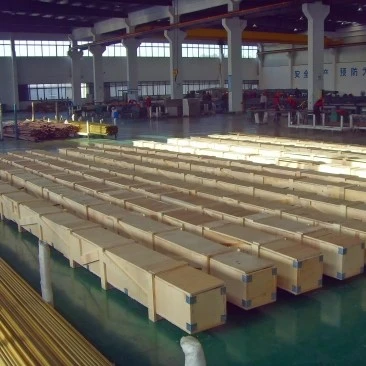
Tube is packed to survive ocean freight and humid ports. Small-diameter tube is bundled, wrapped in VCI or plastic film and packed in wooden cases; larger straight lengths go into wooden crates with end caps, and U-bend bundles are separated with spacers so the bends are not loaded in transit.
Fumigated wooden packing with ISPM 15 marking is standard for export, and every case is labelled with alloy, heat number, size and quantity so the consignment can be reconciled against the certificate on arrival.
FAQ
Q: Can C44300 and C70600 heat exchanger tube be made to small OD and thin wall, cut to exact finished lengths?
A: Yes. Seamless tube in both C44300 and C70600 is drawn from 6.35 mm (1/4 in) OD upward with wall thickness from 0.5 mm. Fixed lengths such as 505 mm or 1,550 mm are cut to a +3/0 mm tolerance, annealed, and supplied with plain, burr-free ends.
Q: What is the difference between ASTM B111 and ASME SB111 for these two grades?
A: They cover the same alloys, chemistries and tolerances. ASTM B111/B111M is the material standard; ASME SB111 is its adoption for ASME-coded pressure equipment. Tube certified to one satisfies the other.
Q: Which grade is right for seawater - C44300 or C70600?
A: For sustained seawater or brackish service, C70600 is the usual specification because its copper-nickel film tolerates chlorides and higher flow velocity. C44300 is normally reserved for fresh water, condensate and steam-side duty, where its higher conductivity is an advantage.
Q: Does C70600 copper-nickel tube come with an EN 10204 3.1 certificate?
A: Yes. EN 10204 Type 3.1 certificates are issued as standard for both C44300 and C70600, covering chemical composition, mechanical properties and dimensional results for every batch.
Q: Are U-bend, coil and finned forms available in both alloys?
A: Yes. Straight, U-bend, coil and finned tube are all produced in C44300 and C70600, and matching fittings can be supplied with the same heat traceability as the tube.
Q: What are the MOQ, lead time and payment terms?
A: MOQ is typically 100–300 kg per size; lead time is 15–25 working days for standard sizes and up to 35 working days with a full third-party inspection programme; payment is 30% T/T deposit with the balance against copy of B/L, or irrevocable L/C at sight.


