

Five Surface Finishes
| Finish | Cost | Conductivity | Corrosion Resistance | Insulation | Best For |
|---|---|---|---|---|---|
| Bare copper | $ (baseline) | Excellent | Poor (indoor only) | None | Dry indoor panels |
| Tin plating | $$ | Excellent | Good | None | Most indoor switchgear |
| Silver plating | $$$ | Best (lowest contact resistance) | Fair | None | High-frequency, sliding contacts |
| Heat shrink tubing | $ | N/A (insulation only) | N/A | Good (touch-proof) | Phase identification, touch safety |
| Epoxy coating | $$$ | N/A (insulation only) | Excellent | Best (full coverage) | Outdoor, high voltage |
For 90% of indoor switchgear and panel board applications, tin plating is the right choice. It is affordable, corrosion-resistant, and widely available.
Bare Copper
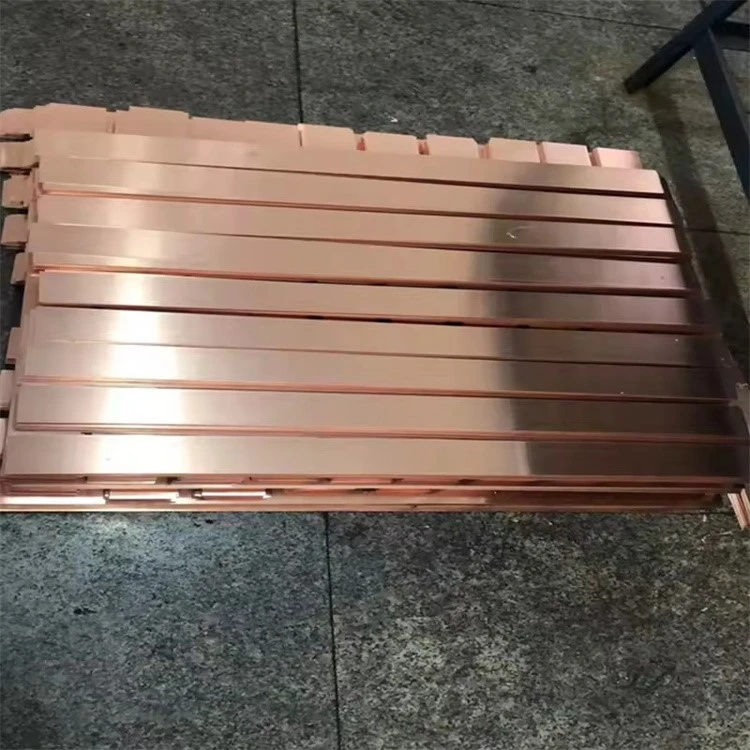
When Bare Copper Works
| Condition | Acceptable? | Notes |
|---|---|---|
| Indoor, climate-controlled | Yes | Standard for many panels |
| Dry environment (humidity <60%) | Yes | Minimal corrosion risk |
| No chemical exposure | Yes | No acids, salts, or industrial gases |
| Temporary installation | Yes | Short-term use only |
When Bare Copper Does NOT Work
| Condition | Why Not |
|---|---|
| Outdoor installation | Rain, humidity, and temperature cycles cause corrosion |
| Coastal / salt air | Salt accelerates corrosion – green patina forms quickly |
| Industrial environment (chemicals) | Acids and gases attack copper |
| High humidity (>80%) | Moisture + oxygen = corrosion |
| Long-term storage | Bare copper oxidizes over time |
If your busbar will be installed outdoors, near the coast, or in an industrial environment, do not use bare copper. You need tin plating or epoxy coating.
Tin Plating
Tin plating is electroplated tin (3-8 microns thick) applied to the copper busbar after all fabrication is complete.

Why Tin Plating Is the Standard
| Advantage | Why It Matters |
|---|---|
| Low cost | Only 5-10% premium over bare copper |
| Good corrosion resistance | Protects against humidity, mild chemicals |
| Maintains conductivity | Tin is conductive – no ampacity loss |
| Solderable | Easy to solder connections if needed |
| Widely available | Most common plated finish – short lead times |
Technical Specifications
| Parameter | Value |
|---|---|
| Plating thickness | 3-8 microns (standard); 10+ microns (heavy duty) |
| Plating method | Electroplating after fabrication |
| Salt spray resistance | ≥96 hours (ASTM B117) – no red rust |
| Operating temperature | Up to 150°C (tin melts at 232°C) |
| Conductivity | Similar to bare copper |
When to Choose Tin Plating
| Application | Why Tin Plating |
|---|---|
| Indoor switchgear | Standard specification – corrosion protection |
| Panel boards | Prevents oxidation during storage and operation |
| Motor control centers (MCCs) | Reliable, cost-effective |
| Solar combiner boxes | Outdoor but protected – tin is sufficient |
| General electrical distribution | The industry standard |
For 90% of applications, choose tin plating. It is the best balance of cost and protection.
Silver Plating
Silver plating is electroplated silver (5-15 microns thick) applied to copper busbars. It offers the lowest contact resistance of any finish.

Why Choose Silver Plating
| Advantage | Why It Matters |
|---|---|
| Lowest contact resistance | Critical for high-frequency and high-current connections |
| Excellent conductivity | Silver is the most conductive metal |
| Good lubricity | Works well for sliding contacts (disconnect switches) |
| Corrosion resistant (moderate) | Better than bare copper, worse than tin |
Disadvantages of Silver Plating
| Disadvantage | What You Need to Know |
|---|---|
| High cost | 20-30% more than tin plating |
| Tarnishes | Silver reacts with sulfur in air – turns black |
| Tarnish is conductive | (Unlike aluminum oxide, silver sulfide still conducts) |
| Not for welding | Must be removed before welding |
Technical Specifications
| Parameter | Value |
|---|---|
| Plating thickness | 5-15 microns (standard) |
| Contact resistance | <1 mΩ (much lower than tin) |
| Salt spray resistance | 48-72 hours (less than tin) |
| Operating temperature | Up to 200°C (silver melts at 962°C) |
When to Choose Silver Plating
| Application | Why Silver Plating |
|---|---|
| High-frequency busbars (RF, RF) | Skin effect – silver's low resistance matters |
| EV battery connectors | Low contact resistance for high currents |
| Disconnect switches | Sliding contact requires lubricity |
| Cryogenic applications | Silver performs well at low temperatures |
| Precision instrumentation | Contact resistance must be minimized |
For most standard switchgear, silver plating is overkill. Tin plating is sufficient and much cheaper. Only specify silver plating if you genuinely need the lowest possible contact resistance.
Send your application details for a plating recommendation
Heat Shrink Tubing
Heat shrink tubing is a polymer tube that shrinks when heated, conforming tightly to the busbar surface. It provides insulation and touch-proof protection.

Why Choose Heat Shrink Tubing
| Advantage | Why It Matters |
|---|---|
| Low cost | Very affordable for straight busbars |
| Easy to apply | Slide on, heat with heat gun – no special equipment |
| Color options | Red, black, blue, yellow, green – perfect for phase identification |
| Good dielectric strength | Withstands up to 15kV depending on wall thickness |
| Removable | Can be cut off for modifications |
Technical Specifications
| Parameter | Value |
|---|---|
| Material | Polyolefin (standard) or PVC |
| Shrink ratio | 2:1 or 3:1 |
| Dielectric strength | 15-25 kV/mm |
| Temperature range | -55°C to +135°C (polyolefin) |
| Color options | Red, black, blue, yellow, green, clear |
When to Choose Heat Shrink Tubing
| Application | Why Heat Shrink |
|---|---|
| Phase identification | Color-coded tubing identifies R/Y/B phases |
| Touch-proof safety | Prevents accidental contact with live busbars |
| Indoor panels with straight busbars | Easy to install, low cost |
| Temporary insulation | Can be removed for modifications |
| Retrofit projects | Quick to apply on-site |
Heat shrink tubing does NOT work well on bent busbars (L-shape, Z-shape, U-shape). The tubing wrinkles and leaves gaps at bends. For bent busbars requiring insulation, use epoxy coating.
Surface Finish Selection
Does the busbar need insulation?
| Answer | Go To |
|---|---|
| Yes – for touch safety or high voltage | Question 2 |
| No – insulation not required | Question 3 |
Is the busbar straight or bent?
| Answer | Recommendation |
|---|---|
| Straight busbar | Heat shrink tubing – lower cost, easy application |
| Bent busbar (L, Z, U shape) | Epoxy coating – only option that covers bends completely |
What is the installation environment?
| Environment | Recommendation |
|---|---|
| Indoor, dry, climate-controlled | Bare copper (cheapest) or tin plating |
| Indoor with humidity or mild chemicals | Tin plating |
| Outdoor, coastal, or industrial | Tin plating (minimum) or epoxy coating (best) |
Do you need the lowest possible contact resistance?
| Answer | Recommendation |
|---|---|
| Yes – high-frequency, EV, sliding contacts | Silver plating |
| No – standard switchgear | Tin plating or bare copper |
| Your Application | Recommended Finish |
|---|---|
| Indoor dry panel, straight busbar, no insulation | Bare copper |
| Indoor panel, standard environment | Tin plating |
| Indoor panel, need phase colors, straight busbar | Heat shrink tubing |
| Outdoor panel, straight busbar | Tin plating (or epoxy for full insulation) |
| Bent busbar (L/Z/U), needs insulation | Epoxy coating |
| High-frequency or sliding contact | Silver plating |
| Coastal / marine environment | Tin plating or epoxy coating |
| High voltage (>1kV) | Epoxy coating |
Send your installation environment for a free recommendation
Plating Thickness and Adhesion Testing

| Test | Equipment | Standard | Acceptance |
|---|---|---|---|
| Plating thickness | XRF analyzer | ASTM B568 | Tin: 3-8 microns; Silver: 5-15 microns |
| Adhesion | Cross-cut tape test | ASTM D3359 | No peeling |
| Salt spray | ASTM B117 chamber | ASTM B117 | Tin: ≥96 hours; Silver: ≥48 hours |
| Porosity | Electrographic test | ASTM B741 | No pinholes |
Automatic Plating Line for Copper Busbars

Plating Process Steps
| Step | Process | Purpose |
|---|---|---|
| 1 | Degreasing | Removes oils and contaminants |
| 2 | Acid pickling | Removes surface oxides |
| 3 | Electroplating | Deposits tin or silver |
| 4 | Rinsing | Removes excess chemicals |
| 5 | Drying | Prepares for packaging |
| 6 | Inspection | Thickness and adhesion testing |
Plating Capabilities
| Parameter | Tin Plating | Silver Plating |
|---|---|---|
| Maximum busbar length | 4000 mm | 4000 mm |
| Thickness range | 3-15 microns | 5-25 microns |
| Thickness uniformity | ±1 micron | ±2 microns |
| Production capacity | 10 tons/day | 3 tons/day |
| Lead time (plating only) | +3-5 days | +5-7 days |
FAQ
Q1: Can I use bare copper busbar outdoors?
Not recommended. Bare copper outdoors will corrode – forming a green patina. While the patina is still conductive, it looks bad, can flake off, and may eventually reduce cross-section in severe environments. For outdoor use, specify tin plating (minimum) or epoxy coating (best). For coastal or marine environments, epoxy coating is strongly recommended.
Q2: What is the difference between tin plating and silver plating?
Tin plating costs less (5-10% premium over bare copper) and offers good corrosion resistance. Silver plating costs more (20-30% more than tin) but offers the lowest possible contact resistance. For most switchgear, tin is sufficient. Use silver for high-frequency applications (skin effect), sliding contacts (disconnect switches), or where contact resistance must be minimized.
Q3: Does tin-plated copper busbar rust?
Tin does not "rust" (iron oxide), but it can corrode. Tin plating provides good corrosion resistance – typically 96+ hours in salt spray testing without red rust. In severe environments (coastal, chemical), tin will eventually corrode. For those environments, upgrade to epoxy coating. For indoor use, tin plating lasts decades without issues.
Q4: What is the difference between heat shrink tubing and epoxy coating?
Heat shrink tubing is a polymer tube shrunk onto the busbar – low cost, easy to apply, but only works on straight sections (no bends). Epoxy coating is sprayed or dipped – higher cost, full coverage including bends, higher dielectric strength, and UV resistant. For straight busbars needing insulation, heat shrink is fine. For bent busbars or outdoor use, epoxy coating is required.
Q5: What is the standard plating thickness for tin and silver?
Tin plating: 3-8 microns standard (10+ microns for heavy duty). Silver plating: 5-15 microns standard. Thicker plating costs more and adds lead time. Most applications do not need plating thicker than standard. We measure thickness using XRF and provide a report with every shipment.
Q6: Silver-plated copper busbar turns black. Is this a problem?
No – silver tarnish (silver sulfide) is still conductive. This is a common concern, but tarnish does NOT affect electrical performance. Unlike aluminum oxide (which is an insulator), silver sulfide conducts electricity. If appearance matters, specify anti-tarnish treatment (available upon request). For most applications, tarnish is cosmetic only.
Q7: Does surface finish affect copper busbar ampacity?
No – bare copper, tin plating, and silver plating have essentially the same ampacity. The plating layer is very thin (3-15 microns) and highly conductive. Heat shrink tubing and epoxy coating DO reduce ampacity because they trap heat. For insulated busbars, derate ampacity by 10-15% (heat shrink) or 15-20% (epoxy coating). See our Copper Busbar Ampacity Guide for details.


