

What is C28000 brass?
C28000 Muntz Metal, commonly referred to as 60/40 brass, is a copper-zinc alloy with approximately 60% copper and 40% zinc. It combines high strength with good corrosion resistance, making it suitable for both structural and marine applications. C28000 is tougher and stronger than cartridge brass (C26000) and is widely used in shipbuilding, architectural hardware, and industrial forgings.
Chemical Composition of C28000 Brass
|
Element |
Content (%) |
|
Copper (Cu) |
59.0 – 63.0 |
|
Zinc (Zn) |
Balance (~37–41) |
|
Lead (Pb) |
≤ 0.05 |
|
Iron (Fe) |
≤ 0.10 |
|
Other Impurities |
≤ 0.50 |
Mechanical Properties of C28000 Brass
|
Temper |
Tensile Strength Rm (MPa) |
Yield Strength Minimum Rp₀.₂ (MPa) |
Elongation Minimum A₅₀mm (%) |
Hardness HV * |
|
R340 (annealed) |
340 – 420 |
≤ 240* |
33 |
85 – 115 |
|
R400 |
400 – 480 |
≥ 200* |
15 |
110 – 140 |
|
R470 |
≥ 470 |
≥ 390* |
6 |
≥ 140 |
Fabrication & Manufacturing of C28000 Brass
Hot Forming: Excellent (commonly forged at 700–900 °C)
Cold Forming: Fair to Good (less ductile than C26000)
Machinability: Fair (~30–35 machinability rating vs free-cutting brass 100)
Joining:
Soldering: Excellent
Brazing: Excellent
Welding: Fair (gas-shielded arc welding possible)
Corrosion Resistance: Excellent in atmospheric and marine environments
Applications for C28000
Architectural
Architectural Trimwork
Decorative Facia
Fasteners
Heat Exchangers
Tubesheets
FAQ
| What is equivalent to C28000 brass? The alloy C28000 brass is directly and universally equivalent to the Chinese standard alloy H62. Beyond this primary equivalent, it corresponds to several other major international designations: In the European (EN) standard, it is known as CuZn37 or the material code CW508L. In the Japanese (JIS) standard, it is designated as C2800. |
| What is the composition of brass c28000? Brass UNS C28000 (equivalent to H62) is primarily 60.0-63.0% Copper and 37.0-40.0% Zinc. It is a low-lead brass with a maximum lead (Pb) content of 0.30% (typically much lower). Iron is limited to a maximum of 0.07%, and total other impurities do not exceed 0.15%. This composition provides a strong, formable, and versatile general-purpose brass. |
| What is the difference between brass 260 and 280? C260 plates and sheets are the most ductile of the brasses, and is used in greater quantity than any other copper-zinc alloy. C280 (Muntz) most important characteristic is its color, and is stronger, harder and more rigid than brasses of lesser zinc content. |
| What is the difference between C28000 and C26000 brass? The main difference is copper content. C28000 brass (60% Cu) is stronger and better for hot working, while C26000 brass (70% Cu) is more ductile, has better cold formability, and higher corrosion resistance. |
| What is the melting point of C28000 brass? C28000 brass has a melting range of approximately 900 to 925 degrees Celsius (1650 to 1700 degrees Fahrenheit). |
| Does C28000 brass contain lead? Yes, but in very low amounts. The ASTM specification allows a maximum of 0.30% lead, but commercial C28000 brass is typically supplied with a much lower lead content, often below 0.07%, qualifying it as "low-lead." |
| What tempers is C28000 brass available in? C28000 brass strip, sheet, and plate are commonly available in tempers such as annealed (soft), quarter hard (H01), half hard (H02), hard (H03), and spring hard (H04). |
| How does C28000 brass compare to C36000 brass? C36000 brass is a high-lead, free-machining alloy with excellent chip-breaking properties (100% machinability). C28000 brass has much lower lead content, inferior machinability (~40%), but significantly better cold workability and formability. |
| What standards cover C28000 brass strip and sheet? The primary standard for C28000 brass plate, sheet, and strip in the U.S. is ASTM B36. Other relevant standards include ASTM B370 for plate and ASTM B134 for wire. |
Our product range
1. Pure Copper (Sheet, Tube, Wire)
Primary Grades: T1 (C11000), T2 (C10100). We prioritize C11000 (T1) for its excellent conductivity.
Standards: ASTM B152 (Sheet), ASTM B75/B88 (Tube), ASTM B1/B3 (Wire), EN, JIS, GB/T.
Typical Sizes:
Tube: OD 6mm – 200mm.
Sheet: Thickness 0.5mm – 50mm.
Wire: Diameter 1.0mm – 10mm.
2. Phosphorus Deoxidized Copper (Tube, Sheet)
Primary Grades: TP1 (C12000 / CW023A), TP2 (C12200). Ideal for welding and plumbing.
Standards: ASTM B188, ASTM B75/B88, EN 12451, JIS H3300.
Typical Sizes:
Tube: OD 8mm – 150mm.
Sheet: Thickness 1.0mm – 30mm.
3. Brass (Strip & Coil)
Primary Grades: H96, H68, H62 (CuZn37 / C28000). We strongly recommend H62 for its excellent balance of strength and machinability.
Standards: ASTM B36, ASTM B134, EN 1652, JIS H3100.
Typical Sizes:
Strip/Coil: Thickness 0.1mm – 3.0mm, Width up to 600mm.
Get the complete product catalog
Our factory

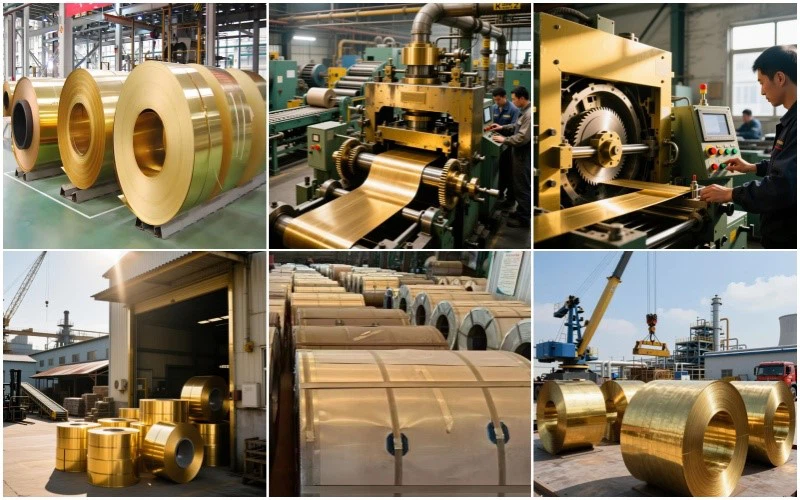
Our facility is equipped with industry-advanced continuous casting and rolling production lines, precision rolling mills, multi-pass drawing units, and automated forming equipment, enabling efficient and stable transformation from copper rods to finished products. Our core machinery allows us to flexibly manufacture a full range of grades-including pure copper (e.g., C11000/T1), phosphorus deoxidized copper (e.g., C12200/TP2), and brass (e.g., H62)-in the form of sheets, tubes, rods, strips, and wires. We also provide tailored processing services such as cutting, slitting, and precision finishing.


