

What is H68 brass?
Standard Designation: H68 (Common Brass)
International/National Standards: GB/T 5231-2012, GB/T 2059-2000 (Strips)
Other Name: Arsenical Brass (H68A with trace arsenic for enhanced corrosion resistance)
Material Category: Copper-Zinc Alloy (Cu-Zn), Copper content 67.0%-70.0%, Zinc as the remainder.
H68 brass Description
Excellent Plasticity: H68 has the best plasticity among commom brass, with outstanding cold and hot working ability, making it suitable for deep drawing, bending, and other complex forming processes.
High Strength and Ductility Balance: Tensile strength ranges widely (M≥290 MPa, up to 660 MPa9(Y)).
Corrosion Resistance: Good resistance to freshwater and atmospheric corrosion. However, it is susceptible to stress corrosion cracking in ammonia and seawater environments (corrosion rate approximately 0.1 mm/a).
Versatile Processability: Supports cold rolling, hot rolling, welding, soldering and brazing, making it ideal for shell casings and precision components.
H68 brass Common Product Forms and Specifications
|
Product Form |
Specification Range |
Typical Applications |
|
Plate |
Thickness 0.2-100mm, Width 305-1000mm |
Architectural decoration, instrument housings |
|
Strip |
Thickness 0.01-3.0mm |
Electronic components, metal meshes |
|
Tube |
Outer diameter 6-530mm, Wall thickness 0.5-50mm |
Condenser tubes, radiators |
|
Bar |
Diameter 4-350mm, Length 2500-6000mm |
Mechanical parts, Shell casings |
|
Wire |
Diameter 0.1-12.7mm |
Welding wires, Spring components |
Chemical Composition
|
Element |
Cu |
Zn |
Pb |
Fe |
Total Impurities |
As (H68A) |
|
Content (%) |
67.0-70.0 |
Remainder |
≤0.03 |
≤0.10 |
≤0.3 |
Trace Addition |
Physical Properties
|
Property |
Value |
Remarks |
|
Density |
8.5 g/cm³ |
Lightweight design advantage |
|
Thermal Conductivity |
116.7-141.7 W/(m·K) |
Close to pure copper, suitable for heat dissipation components |
|
Melting Point |
966-1001℃ |
Alloy melting range |
|
Coefficient of Thermal Expansion |
19.1×10⁻⁶/℃ (20-300℃) |
Good thermal stability |
|
Electrical Conductivity |
~32% IACS (M) |
Lower than pure copper, sufficient for general conductivity needs |
Mechanical Properties
|
Property |
Value |
Test Condition |
|
Tensile Strength (σb) |
370-660 MPa |
M≥290 MPa, Y ≥660 MPa |
|
Elongation (δ10) |
≥15% (Y) |
Up to 45% (M) |
|
Hardness (HV) |
55-190 |
Higher hardness (Y) |
|
Annealing Temperature |
520-650℃ (Conventional Furnace Annealing) |
Eliminate cold work hardening |
|
Low-Temperature Annealing |
260-270℃ |
Relieve internal stress |
Core Advantages
Outstanding Comprehensive Performance: Best plasticity among brasses with balanced strength, suitable for deep drawing and bending.
Environmental Corrosion Resistance: Longer service life in freshwater and atmospheric environments compared to common carbon steel.
Versatile Product Forms: Available in plates, tubes, wires, and more to meet industrial customization needs.
Main Application Fields
Military Manufacturing: Shell casings, weapon components (core application).
Electronics and Electricals: Waveguides, heat sink casings, connectors.
Construction and Marine: Condenser tubes, decorative grilles, plumbing fittings (marine protection recommended).
Industrial Equipment: Pump bodies, valves, cold-formed parts, chains.
FAQ
Q: What is the difference between H68 and H68A?
A: H68A contains trace arsenic (As) to significantly enhance corrosion resistance and prevent dezincification, making it suitable for harsher environments.
Q: Is H68 suitable for seawater environments?
A: Direct exposure results in a relatively high corrosion rate (0.1 mm/a). A protective coating or choosing H68A is recommended.
Q: Why is H68 referred to as "Cartridge-Case Brass"?
A: Due to its excellent plasticity and strength, it is widely used for efficiently stamping complex shell casing structures in military applications.
Our product range
1. Pure Copper (Sheet, Tube, Wire)
Primary Grades: T1 (C11000), T2 (C10100). We prioritize C11000 (T1) for its excellent conductivity.
Standards: ASTM B152 (Sheet), ASTM B75/B88 (Tube), ASTM B1/B3 (Wire), EN, JIS, GB/T.
Typical Sizes:
Tube: OD 6mm – 200mm.
Sheet: Thickness 0.5mm – 50mm.
Wire: Diameter 1.0mm – 10mm.
2. Phosphorus Deoxidized Copper (Tube, Sheet)
Primary Grades: TP1 (C12000 / CW023A), TP2 (C12200). Ideal for welding and plumbing.
Standards: ASTM B188, ASTM B75/B88, EN 12451, JIS H3300.
Typical Sizes:
Tube: OD 8mm – 150mm.
Sheet: Thickness 1.0mm – 30mm.
3. Brass (Strip & Coil)
Primary Grades: H96, H68, H62 (CuZn37 / C28000). We strongly recommend H62 for its excellent balance of strength and machinability.
Standards: ASTM B36, ASTM B134, EN 1652, JIS H3100.
Typical Sizes:
Strip/Coil: Thickness 0.1mm – 3.0mm, Width up to 600mm.
Get the complete product catalog
Our factory

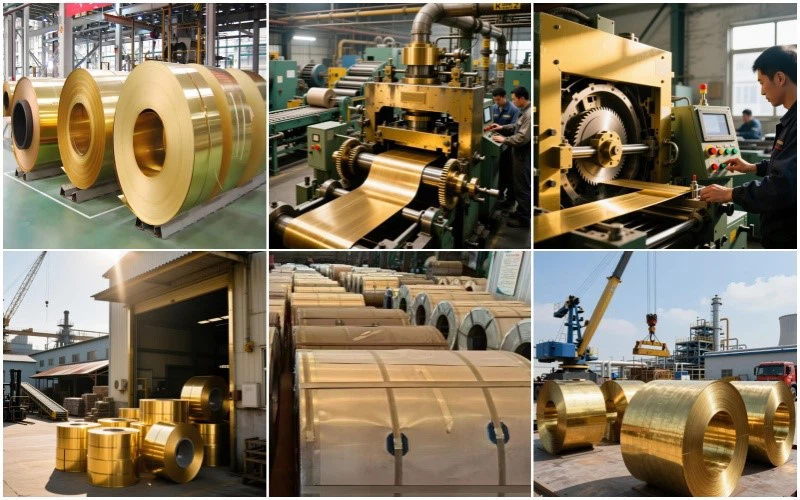
Our facility is equipped with industry-advanced continuous casting and rolling production lines, precision rolling mills, multi-pass drawing units, and automated forming equipment, enabling efficient and stable transformation from copper rods to finished products. Our core machinery allows us to flexibly manufacture a full range of grades-including pure copper (e.g., C11000/T1), phosphorus deoxidized copper (e.g., C12200/TP2), and brass (e.g., H62)-in the form of sheets, tubes, rods, strips, and wires. We also provide tailored processing services such as cutting, slitting, and precision finishing.


