

What is C28000 brass?
C28000 is a lead-free material that's well-suited for machining due to its structural composition. It can serve as a cost-effective alternative to traditional lead-containing machining brass, provided that it doesn't need to meet stringent requirements for mechanical properties and corrosion resistance.
C28000 CHEMICAL COMPOSITION
| Elements | Min (%) | Max (%) |
| Cu | 59.00 | 63.00 |
| Pb | – | 0.09 |
| Fe | – | 0.07 |
| Total Others | – | 0.30 |
| Zn | Remainder | |
MECHANICAL PROPERTIES ACCORDING TO ASTM B36 (AS PER TEMPER HO2)
| Range (Inch) | From | To | UTS Min (ksi) | UTS Max (ksi) | PS Min | Elongation Min (%) | Hardness Min (HRB) | Hardness Max (HRB) |
| Round (Dia) | 0.059 | 2.953 | 58 | 70 | – | – | 52 | 80 |
| Hex (A/F) | 0.118 | 2.756 | 58 | 70 | – | – | 52 | 80 |
| Square (A/F) | 0.118 | 2.362 | 58 | 70 | – | – | 52 | 80 |
| Range (mm) | From | To | UTS Min (MPa) | UTS Max (MPa) | PS Min | Elongation Min (%) | Hardness Min (HRB) | Hardness Max (HRB) |
| Round (Dia) | 1.5 | 75 | 400 | 485 | – | – | 52 | 80 |
| Hex (A/F) | 3 | 70 | 400 | 485 | – | – | 52 | 80 |
| Square (A/F) | 3 | 60 | 400 | 485 | – | – | 52 | 80 |
PHYSICAL PROPERTIES
| Melting Point – Liquidus°F | 1660 |
| Melting Point – Solidus°F | 1650 |
| Density lb/cu in. at 68°F | 0.303 |
| 8.39 | 8.39 |
| Electrical Conductivity % IACS at 68°F | 28 |
| Thermal Conductivity Btu/ sq ft/ ft hr/ °F at 68°F | 71 |
| Coefficient of Thermal Expansion 68-57210⁻⁶ per °F (68 – 572°F) | 11.6 |
| Specific Heat Capacity Btu/ lb /°F at 68°F | 0.09 |
| Modulus of Elasticity in Tension ksi | 15000 |
| Modulus of Rigidity ksi | 5600 |
FABRICATION PROPERTIES
| Technique | Suitability |
| Soldering | Excellent |
| Brazing | Excellent |
| Oxyacetylene Welding | Good |
| Gas Shielded Arc Welding | Fair |
| Coated Metal Arc Welding | Not Recommended |
| Spot Weld | Good |
| Seam Weld | Not Recommended |
| Butt Weld | Good |
| Capacity for Being Cold Worked | Fair |
| Capacity for Being Hot Formed | Excellent |
| Forgeability Rating | 90 |
| Machinability Rating | 40 |
FAQ
| What is C28000 brass? C28000 brass is a standardized copper-zinc alloy under the UNS system, commonly known as Muntz Metal. It contains approximately 60% copper and 40% zinc, offering a good balance of strength, formability, and corrosion resistance. |
| What is the chemical composition of C28000 brass? The nominal composition is 60.0-63.0% copper, 0.30% maximum lead, 0.07% maximum iron, and the remainder being zinc. The total of other impurities is limited to 0.15%. |
| What is C28000 brass equivalent to? C28000 brass is the direct U.S. equivalent to China's H62 brass, Europe's CuZn37 (CW508L), and Japan's C2800 brass. |
| What are the mechanical properties of C28000 brass? In the annealed condition, typical properties include a tensile strength of ≥ 370 MPa, yield strength of ≥ 150 MPa, elongation of ≥ 20%, and a hardness of approximately 65 HRB. |
| What is the machinability rating of C28000 brass? C28000 brass has a fair machinability rating of around 40% on the standard scale where free-cutting brass C36000 is rated at 100%. It produces continuous chips. |
| What is C28000 brass used for? C28000 brass is widely used in architectural hardware (hinges, locks), electrical connectors, heat exchanger components, plumbing fittings, decorative trim, and various stamped parts. |
| Can C28000 brass be welded? Yes, C28000 brass can be welded and brazed using appropriate techniques and filler metals designed for copper alloys, such as silicon-bronze or brass filler rods. |
| What is the density of C28000 brass? The density of C28000 brass is approximately 8.43 grams per cubic centimeter (g/cm³), or 0.304 pounds per cubic inch (lb/in³). |
| Is C28000 brass corrosion resistant? C28000 brass offers good corrosion resistance in atmospheric, fresh water, and many mild chemical environments. However, it can be susceptible to dezincification in specific stagnant or high-chloride waters. |
| What is the difference between C28000 and C26000 brass? The main difference is copper content. C28000 brass (60% Cu) is stronger and better for hot working, while C26000 brass (70% Cu) is more ductile, has better cold formability, and higher corrosion resistance. |
| What is the melting point of C28000 brass? C28000 brass has a melting range of approximately 900 to 925 degrees Celsius (1650 to 1700 degrees Fahrenheit). |
| Does C28000 brass contain lead? Yes, but in very low amounts. The ASTM specification allows a maximum of 0.30% lead, but commercial C28000 brass is typically supplied with a much lower lead content, often below 0.07%, qualifying it as "low-lead." |
| What tempers is C28000 brass available in? C28000 brass strip, sheet, and plate are commonly available in tempers such as annealed (soft), quarter hard (H01), half hard (H02), hard (H03), and spring hard (H04). |
| How does C28000 brass compare to C36000 brass? C36000 brass is a high-lead, free-machining alloy with excellent chip-breaking properties (100% machinability). C28000 brass has much lower lead content, inferior machinability (~40%), but significantly better cold workability and formability. |
| What standards cover C28000 brass strip and sheet? The primary standard for C28000 brass plate, sheet, and strip in the U.S. is ASTM B36. Other relevant standards include ASTM B370 for plate and ASTM B134 for wire. |
Our product range
1. Pure Copper (Sheet, Tube, Wire)
Primary Grades: T1 (C11000), T2 (C10100). We prioritize C11000 (T1) for its excellent conductivity.
Standards: ASTM B152 (Sheet), ASTM B75/B88 (Tube), ASTM B1/B3 (Wire), EN, JIS, GB/T.
Typical Sizes:
Tube: OD 6mm – 200mm.
Sheet: Thickness 0.5mm – 50mm.
Wire: Diameter 1.0mm – 10mm.
2. Phosphorus Deoxidized Copper (Tube, Sheet)
Primary Grades: TP1 (C12000 / CW023A), TP2 (C12200). Ideal for welding and plumbing.
Standards: ASTM B188, ASTM B75/B88, EN 12451, JIS H3300.
Typical Sizes:
Tube: OD 8mm – 150mm.
Sheet: Thickness 1.0mm – 30mm.
3. Brass (Strip & Coil)
Primary Grades: H96, H68, H62 (CuZn37 / C28000). We strongly recommend H62 for its excellent balance of strength and machinability.
Standards: ASTM B36, ASTM B134, EN 1652, JIS H3100.
Typical Sizes:
Strip/Coil: Thickness 0.1mm – 3.0mm, Width up to 600mm.
Get the complete product catalog
Our factory

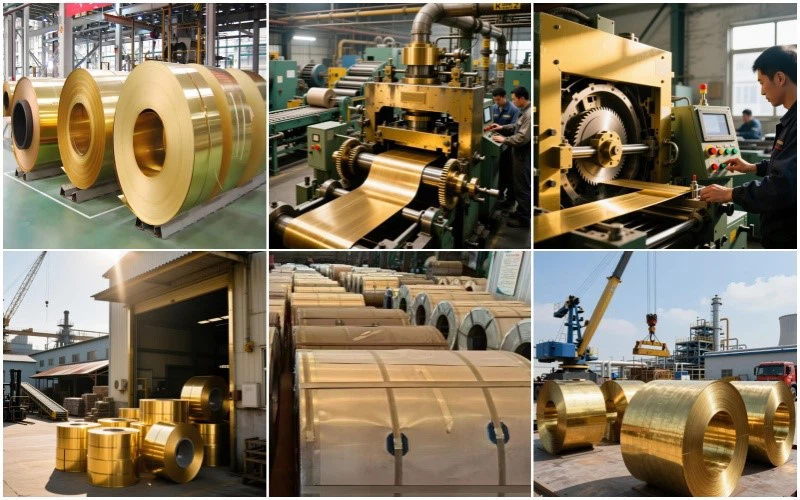
Our facility is equipped with industry-advanced continuous casting and rolling production lines, precision rolling mills, multi-pass drawing units, and automated forming equipment, enabling efficient and stable transformation from copper rods to finished products. Our core machinery allows us to flexibly manufacture a full range of grades-including pure copper (e.g., C11000/T1), phosphorus deoxidized copper (e.g., C12200/TP2), and brass (e.g., H62)-in the form of sheets, tubes, rods, strips, and wires. We also provide tailored processing services such as cutting, slitting, and precision finishing.


