

The ASTM B111 C71500 seamless condenser tubes are made from a copper-nickel alloy that contains approximately 70% copper and 30% nickel by weight percent. Its nominal composition was once designated as "Cu-30Ni-0.5Fe" or "70Cu-30Ni." Hence they are also called CuNi 70/30 condenser tubing.
Similar to C70600 (90/10 copper-nickel), C71500 is among the most corrosion resistant and thermally stable of all copper alloys and is virtually immune to stress corrosion cracking (SCC). The ASTM B111 C71500 tubes are mostly produced for condensers in ships and seacoast power stations. They are also widely used for evaporators, distillers, and heat exchangers in seawater desalination plants.
Chemical Composition Requirements
| Element | Percentage |
|---|---|
| Nickel + Cobalt | 29.0% – 33.0% |
| Lead (Pb) | ≤ 0.02% |
| Iron (Fe) | 0.40% – 1.00% |
| Zinc (Zn) | ≤ 0.50% |
| Manganese (Mn) | ≤ 1.00% |
| Phosphorus (P) | ≤ 0.02% |
| Carbon (C) | ≤ 0.05% |
| Sulfur (S) | ≤ 0.02% |
| Copper (Cu) | Remainder |
Mechanical Properties
ASTM B111 C71500 condenser tubing can be furnished in two temper designations based on final heat treatment:
| Temper | Wall Thickness | Tensile Strength | Yield Strength | Elongation (in 2") |
|---|---|---|---|---|
| O61 (annealed) | All | ≤ 52 ksi (360 MPa) | ≤ 18 ksi (125 MPa) | Not specified |
| HR50 (drawn & stress-relieved) | ≤ 0.048" | ≤ 72 ksi (495 MPa) | ≤ 50 ksi (345 MPa) | ≥ 12% |
| HR50 (drawn & stress-relieved) | > 0.048" | ≤ 72 ksi (495 MPa) | ≤ 50 ksi (345 MPa) | ≥ 15% |
International Equivalent Grades
| Standard | Grade |
|---|---|
| China (GB) | BFe30-1-1 |
| British Standard (BS 2871-2) | CN107 |
| German (DIN 17664) | 2.0882 |
| European (EN 12449) | CuNi30Mn1Fe (CW354H) |
| Japanese (JIS H) | C7150 |
| Military Specifications | MIL-T-15005, MIL-T-16420, MIL-T-22214 |
Inspection & Testing
The following inspections and tests are conducted on ASTM B111 UNS C71500 seamless condenser tubes:
| Test / Inspection |
|---|
| Grain size determination |
| Expansion test |
| Flattening test |
| Residual stress test (optional) |
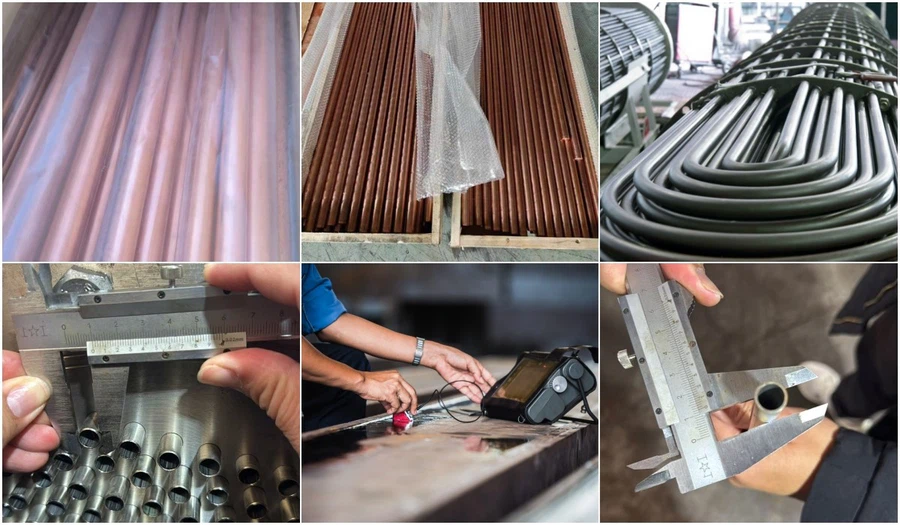
| Eddy current test |
| Hydrostatic test |
| Dimensional inspection (diameter, wall thickness, length, end cut) |
| Visual examination |
FAQ
Q1: What is the difference between C71500 CuNi 70/30 and C70600 CuNi 90/10?
A: C71500 contains 70% copper and 30% nickel, while C70600 contains 90% copper and 10% nickel. C71500 has higher strength (72 ksi vs 52 ksi tensile) and better corrosion resistance in high-velocity seawater, especially at temperatures above 200°F. C70600 costs less and is adequate for many marine applications. C71500 is preferred for very high velocity water, aggressive seawater, and higher temperature service.
Q2: Why is iron added to C71500 copper-nickel condenser tubes?
A: Iron (0.40-1.00%) is added to C71500 to improve resistance to impingement attack (erosion-corrosion) and enhance film stability on the tube surface. The iron modifies the protective oxide layer, making it more adherent and resistant to mechanical removal by high-velocity water or sand. Without sufficient iron, copper-nickel tubes would erode faster in turbulent seawater. This is why C71500 is sometimes called "CuNi 70/30 with iron."
Q3: What is the maximum seawater velocity for ASTM B111 C71500 tubes?
A: C71500 tubes can tolerate seawater velocities up to 12-15 feet per second (3.7-4.6 m/s), significantly higher than C70600 (10-12 ft/s) and much higher than aluminum brass (8-10 ft/s). This makes C71500 suitable for condenser tubes in naval ships and high-flow power plants. For velocities above 15 ft/s, titanium or super austenitic stainless steel may be required. Always verify with the manufacturer for specific conditions.
Q4: Is C71500 resistant to stress corrosion cracking (SCC)?
A: Yes, C71500 copper-nickel is virtually immune to stress corrosion cracking, even in ammonia or sulfide environments that would crack other copper alloys like aluminum brass or admiralty brass. This is a major advantage for marine condensers where ammonia from biological growth or cleaning agents can be present. C71500 does not require post-weld stress relief to prevent SCC.
Q5: What is the difference between O61 and HR50 temper for C71500 tubes?
A: O61 is fully annealed (soft), with low strength (52 ksi tensile) and high ductility. HR50 is drawn and stress-relieved (harder), with higher strength (72 ksi tensile) but lower elongation (12-15%). HR50 is used when the tube needs to withstand higher pressure or external loads. O61 is used when the tube will be expanded into tubesheets and needs ductility for rolling. Most condenser tubes are supplied in O61 temper.
Q6: What is the international equivalent of UNS C71500 copper-nickel tube?
A: C71500 equivalents include: Chinese GB grade BFe30-1-1; British BS CN107; German DIN 2.0882; European EN CuNi30Mn1Fe (CW354H); Japanese JIS C7150. All have similar composition (29-33% Ni, 0.4-1.0% Fe, balance Cu). Always verify chemistry because some equivalents have slightly different iron or manganese ranges. GNEE can supply any of these standards upon request.
Q7: Can C71500 CuNi 70/30 tubes be used in polluted or stagnant seawater?
A: Yes, C71500 performs better than C70600 in polluted or stagnant seawater because the higher nickel content provides better resistance to sulfide-induced corrosion. In stagnant conditions where sulfides (from organic decay) are present, C70600 can form a black sulfide film that may flake off. C71500 is more resistant to this attack. For severely polluted or low-oxygen seawater, C71500 is the preferred copper alloy.
Q8: What is the thermal conductivity of C71500 compared to C70600?
A: C71500 has lower thermal conductivity (approximately 29 W/m·K) compared to C70600 (approximately 40 W/m·K). This means C71500 transfers heat less efficiently than C70600. For heat exchanger design, more surface area (longer tubes or more tubes) may be needed when using C71500 to achieve the same heat transfer duty. The trade-off is better corrosion resistance and higher strength.
Q9: What tests are required for ASTM B111 C71500 condenser tubes?
A: ASTM B111 requires chemical analysis (Ni, Fe, Mn, Cu), tensile test (strength and elongation), expansion test (ductility for tube rolling), flattening test, grain size examination, eddy current or hydrostatic test for leaks, and dimensional inspection. Optional tests include residual stress test. GNEE provides mill test reports (MTR) certifying all required tests for each lot.
Q10: Are C71500 tubes suitable for desalination plants?
A: Yes, C71500 is widely used in seawater desalination plants for evaporators, distillers, and heat exchangers. The high nickel content provides excellent resistance to high-temperature seawater corrosion, erosion from flashing brine, and impingement from vapor bubbles. For multi-stage flash (MSF) and multiple-effect distillation (MED) plants, C71500 is a standard material. For reverse osmosis (RO) plants, C71500 is used in energy recovery devices and interconnecting piping.
Q11: Can C71500 tubes be welded to tubesheets?
A: Yes, C71500 can be welded using gas tungsten arc welding (GTAW/TIG) with matching filler metal (ERCuNi). The tube is typically first expanded (rolled) into the tubesheet, then seal welded. Welding requires preheating (200-300°F) and low heat input to avoid hot cracking. Post-weld heat treatment is not required because C71500 is not susceptible to stress corrosion cracking. Brazing is not recommended for high-strength joints.
Q12: What is the typical application for ASTM B111 C71500 tubes in ships?
A: C71500 tubes are used in naval and commercial ship condensers, coolers, and heat exchangers that handle seawater on the tube side. Common applications include main engine seawater coolers, auxiliary engine coolers, central cooling systems, and cargo vapor recovery condensers on tankers. The 70/30 alloy is specified for high-performance systems where reliability in aggressive seawater is critical. For less demanding service, C70600 (90/10) is more common.
How Do We Package Copper Heat Exchanger Tubes for Global Delivery?
Poor packaging destroys even the best copper heat exchanger tube. As a professional copper heat exchanger tube factory serving copper heat exchanger tube USA, Europe, UAE, Saudi Arabia, and India, we follow military-grade export packaging standards to ensure zero damage during sea or air freight.
Our Standard Packaging Process:
| Packaging Stage | Material / Method | Purpose |
|---|---|---|
| Individual Tube Protection | Anti-rust VCI paper + plastic end caps | Prevents moisture, dust, and scratches on copper tube heat exchanger inner surfaces. |
| Bundling | Nylon straps + wooden spacers | Keeps copper heat exchanger tube OD 19mm, 1 inch, or 5/8 inch sizes organized and vibration-free. |
| Moisture Barrier | Thick PE film wrap (heat-shrunk) | Blocks humidity during long sea voyages to copper heat exchanger tube Germany or Saudi Arabia. |
| Outer Packing | Export-grade plywood cases or steel-banded wooden crates | Withstands stacking and rough handling. Each crate labeled with PO number, alloy (e.g., SB111 C70600), and quantity. |
| Documentation | Packing list + Mill Test Certificate (MTC) attached outside | Customs clearance support for copper heat exchanger tube stockist and distributor partners. |
For U-Bundle Orders: U tube heat exchanger and U tube bundle heat exchanger are placed in dedicated steel jigs inside the crate to prevent bending radius distortion.
Our Factory & Equipment
| Equipment Type | Specification / Capability | Quality Impact |
|---|---|---|
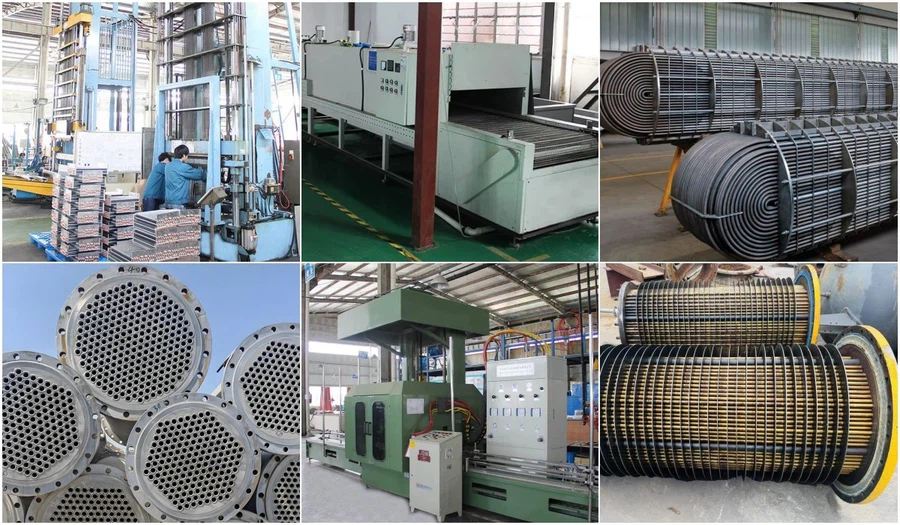
| Horizontal Continuous Casting Line | 10-ton capacity | Produces homogeneous copper alloy tube for heat exchanger billets with zero porosity. |
| Three-Roll Piercing Mill | Up to 60mm OD | Precision wall thickness control for heat exchanger tube wall thickness as low as 0.5mm. |
| Cold Drawing Bench | 5 draws in sequence | Achieves tight tolerances on copper heat exchanger tube length and heat exchanger pipe diameter. |
| Straightening & Cutting Line | CNC servo-controlled | Burr-free cutting for copper heat exchanger tube 3/4 inch and 1 inch to exact project lengths. |
| U-Bending Machine | CNC mandrel type | Produces u tube condenser and U tube bundle heat exchanger without kinking or ovality. |
| Eddy Current Tester | NDT (Non-Destructive Testing) | 100% inspection of C70600 tube and C71500 tube for pinholes or cracks per ASTM B111 pdf standards. |
| Hydrostatic Tester | Up to 200 bar | Validates heat exchanger tube expansion and tube rolling integrity. |
| Spectrometer | Optical emission (OES) | Confirms chemical composition of ASME SB111, EN 12451, and JIS H3300 grades on every batch. |
Our Certifications & Compliance:
ASTM B111 pdf and ASME SB111 pdf full traceability.
ISO 9001:2015 quality management system.
Third-party inspection accepted: SGS, BV, Lloyds, or TUV.
Copper heat exchanger tube life expectancy testing reports available upon request.
Get Fast Quote & Logistics Plan


