

Condenser tubes made of ASTM B111 UNS C68700, also known as aluminum brass, offer exceptional corrosion resistance, erosion resistance, thermal conductivity, and mechanical properties, making them ideal for a wide range of heat exchange applications.
UNS C68700 is an alloy containing nominally 77.5% copper, 2% aluminum, and 20.5% zinc with a trace of arsenic (0.04%) as an inhibitor. Brass is basically a copper-zinc alloy. Aluminum additions incorporate an important constituent of the corrosion film onto brass: aluminum oxide, which markedly increases resistance to impingement attack in turbulent high-velocity saline water.
A trace of arsenic is added to the aluminum brass to inhibit its susceptibility to dezincification (a corrosion process where zinc is selectively removed from the alloy). Hence, tubes made of arsenical aluminum brass ASTM B111 UNS C68700 are frequently used for marine condensers and heat exchangers where impingement attack by high-velocity cooling water is likely to pose a serious problem.
Chemical Composition Requirements
| Element | Percentage |
|---|---|
| Copper (Cu) | 76.0% – 79.0% |
| Aluminum (Al) | 1.8% – 2.5% |
| Iron (Fe) | ≤ 0.06% |
| Lead (Pb) | ≤ 0.07% |
| Arsenic (As) | 0.02% – 0.06% |
| Zinc (Zn) | Balance |
Mechanical Properties
ASTM B111 UNS C68700 seamless tubes are furnished in annealed condition with temper designation O61:
| Property | Value (ksi) | Value (MPa) |
|---|---|---|
| Tensile strength | ≥ 50 ksi | ≥ 345 MPa |
| Yield strength | ≥ 18 ksi | ≥ 125 MPa |
| Elongation | ≥ 55% | ≥ 55% |
| Machinability rating | 30% | 30% |
International Equivalent Grades
| Standard | Grade |
|---|---|
| China (GB) | HAL77-2 |
| British Standard (BS) | CZ110 |
| German (DIN) | CuZn20Al2 |
| Japanese (JIS H) | C6870 |
| UNS | C68700 |
Annealing temperature: Bright annealed at 425°C – 600°C (800°F – 1100°F)
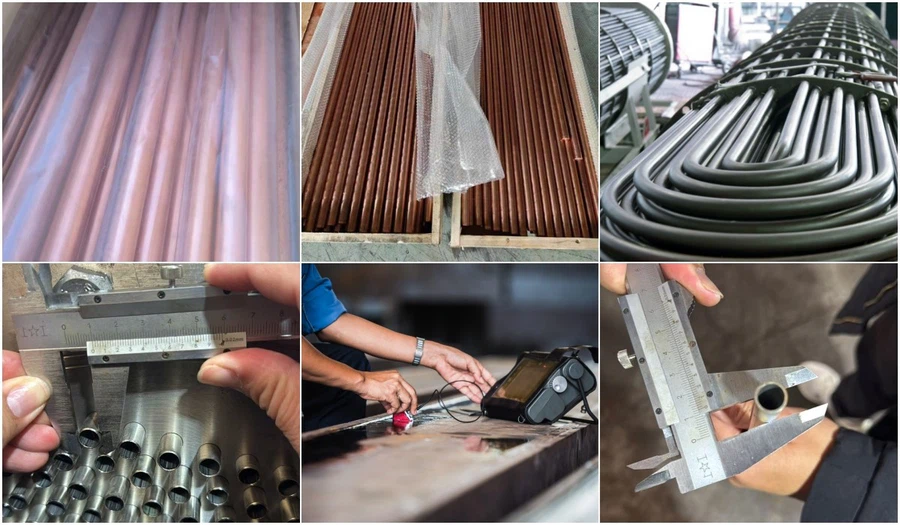
Inspections & Tests
| Test / Inspection |
|---|
| Chemical analysis |
| Visual inspection |
| Dimensional examination |
| Tensile test |
| Grain size examination (ASTM E112) |
| Expansion test |
| Flattening test |
| Residual stress test |
| Eddy current test |
| Hydrostatic test |
| Pneumatic test |
FAQ
Q1: What is the difference between UNS C68700 aluminum brass and UNS C12200 copper tube?
A: UNS C68700 aluminum brass contains 76-79% copper, 1.8-2.5% aluminum, and about 20% zinc, plus arsenic as an inhibitor. It is specifically designed for seawater and high-velocity water applications because the aluminum forms a protective oxide layer. UNS C12200 is pure copper (99.9%) with phosphorus, used for fresh water plumbing. C68700 resists impingement attack and dezincification much better than C12200 in marine environments.
Q2: What is dezincification in UNS C68700 aluminum brass tubes?
A: Dezincification is a corrosion process where zinc is selectively removed from the brass alloy, leaving behind porous, weak copper. This causes tube leakage and failure. UNS C68700 contains 0.02-0.06% arsenic, which inhibits dezincification. Without arsenic (like in non-arsenical brass), the tube would fail within months in aggressive water. The arsenic addition is why C68700 is called "arsenical aluminum brass."
Q3: Where are ASTM B111 UNS C68700 tubes typically used?
A: UNS C68700 tubes are used for marine condensers, power plant heat exchangers, desalination plants, and cooling systems using seawater or brackish water. They are ideal for applications where cooling water velocity is high (6-10 ft/s) and impingement attack is a concern. Common in ships, coastal power plants, and refinery cooling systems. For fresh water or low-velocity service, standard copper or admiralty brass may be sufficient.
Q4: What is the difference between UNS C68700 and UNS C70600 (copper-nickel)?
A: UNS C68700 (aluminum brass) costs less than UNS C70600 (90/10 copper-nickel). C68700 has good resistance to impingement attack but is more susceptible to ammonia corrosion. C70600 has excellent resistance to ammonia, higher erosion resistance, and better performance in polluted seawater. For clean seawater with high velocity, C68700 is a cost-effective choice. For polluted or stagnant seawater with sulfides, C70600 is preferred.
Q5: What is temper O61 for UNS C68700 aluminum brass tubes?
A: O61 is an annealed temper designation for ASTM B111 tubes. It means the tube has been heated and slowly cooled to produce a soft, ductile condition. For C68700 O61, tensile strength is minimum 345 MPa and elongation is minimum 55%. This soft temper allows the tube to expand and contract with thermal cycling without cracking. O61 is the standard temper for heat exchanger tubes.
Q6: Can UNS C68700 tubes be used with ammonia-based cooling fluids?
A: No. UNS C68700 aluminum brass is susceptible to stress corrosion cracking in the presence of ammonia or ammonium compounds. Even small amounts of ammonia (from biological growth or cleaning agents) can cause cracking. For ammonia service, use copper-nickel alloys (C70600, C71500) or stainless steel. Do not use C68700 in fertilizer plants or refrigeration systems using ammonia.
Q7: What is the maximum water velocity for ASTM B111 C68700 tubes?
A: UNS C68700 tubes can tolerate water velocities up to 8-10 feet per second (2.4-3.0 m/s) on the tube side without significant impingement attack. This is much higher than the 3-4 ft/s limit for pure copper or admiralty brass. The aluminum in the alloy forms a tough, adherent oxide layer that resists mechanical erosion. For velocities above 10 ft/s, copper-nickel alloys are recommended.
Q8: What is the international equivalent of UNS C68700 aluminum brass tube?
A: UNS C68700 has several international equivalents: China GB standard calls it HAL77-2; British Standard calls it CZ110; German DIN calls it CuZn20Al2; Japanese JIS H calls it C6870. All of these are arsenical aluminum brass with the same nominal composition (76-79% Cu, 1.8-2.5% Al, balance Zn, plus arsenic). They are interchangeable for heat exchanger applications.
Q9: Why is aluminum added to UNS C68700 brass tubes?
A: Aluminum (1.8-2.5%) is added to form a protective aluminum oxide film on the tube surface. This oxide film is very hard, adherent, and self-healing. It protects the tube from impingement attack (erosion-corrosion) caused by high-velocity water, bubbles, or suspended particles. Without aluminum, standard brass would erode quickly in turbulent seawater. The oxide film also improves general corrosion resistance in many environments.
Q10: What tests are required for ASTM B111 UNS C68700 tubes?
A: ASTM B111 requires chemical analysis (to verify Cu, Al, As, Zn), tensile test (min 345 MPa UTS), expansion test (ductility), flattening test, grain size examination (ASTM E112), residual stress test (for cracking susceptibility), and eddy current or hydrostatic test for leaks. GNEE provides mill test reports certifying all required tests for each tube lot.
Q11: Can UNS C68700 tubes be welded or brazed?
A: UNS C68700 can be brazed but is not recommended for fusion welding. The zinc content (approximately 20%) vaporizes at welding temperatures, creating porosity and weakening the joint. For tube-to-tubesheet joints in heat exchangers, rolling and expansion is the standard method. Brazing with silver-based filler metal is possible with careful temperature control. For welded assemblies, use low-zinc brass or copper-nickel instead.
Q12: What is the machinability rating of UNS C68700 aluminum brass tubes?
A: UNS C68700 has a machinability rating of 30% (compared to free-cutting brass C36000 at 100%). This means it is somewhat difficult to machine because the material is ductile and tends to smear rather than form chips. For tube end finishing and facing, sharp tools with positive rake angles are required. This low machinability is acceptable because tubes are typically rolled into tubesheets rather than heavily machined.
How Do We Package Copper Heat Exchanger Tubes for Global Delivery?
Poor packaging destroys even the best copper heat exchanger tube. As a professional copper heat exchanger tube factory serving copper heat exchanger tube USA, Europe, UAE, Saudi Arabia, and India, we follow military-grade export packaging standards to ensure zero damage during sea or air freight.
Our Standard Packaging Process:
| Packaging Stage | Material / Method | Purpose |
|---|---|---|
| Individual Tube Protection | Anti-rust VCI paper + plastic end caps | Prevents moisture, dust, and scratches on copper tube heat exchanger inner surfaces. |
| Bundling | Nylon straps + wooden spacers | Keeps copper heat exchanger tube OD 19mm, 1 inch, or 5/8 inch sizes organized and vibration-free. |
| Moisture Barrier | Thick PE film wrap (heat-shrunk) | Blocks humidity during long sea voyages to copper heat exchanger tube Germany or Saudi Arabia. |
| Outer Packing | Export-grade plywood cases or steel-banded wooden crates | Withstands stacking and rough handling. Each crate labeled with PO number, alloy (e.g., SB111 C70600), and quantity. |
| Documentation | Packing list + Mill Test Certificate (MTC) attached outside | Customs clearance support for copper heat exchanger tube stockist and distributor partners. |
For U-Bundle Orders: U tube heat exchanger and U tube bundle heat exchanger are placed in dedicated steel jigs inside the crate to prevent bending radius distortion.
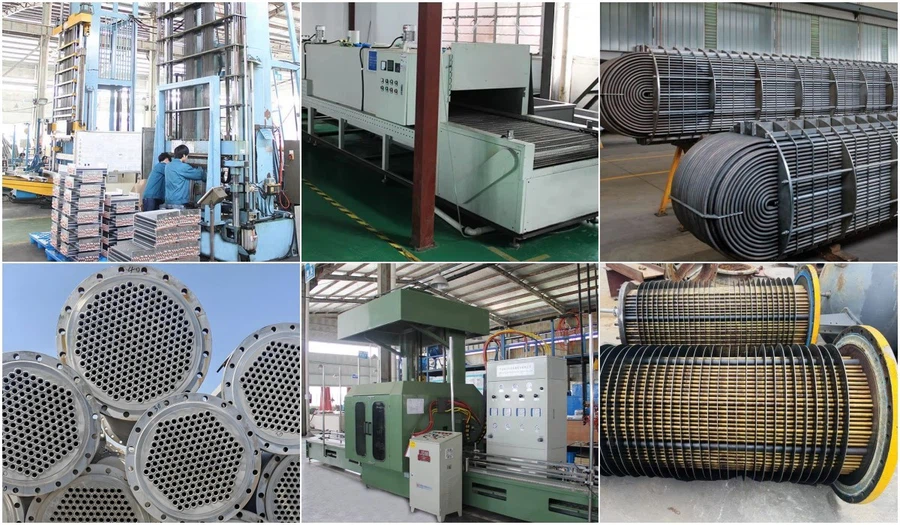
Our Factory & Equipment
| Equipment Type | Specification / Capability | Quality Impact |
|---|---|---|
| Horizontal Continuous Casting Line | 10-ton capacity | Produces homogeneous copper alloy tube for heat exchanger billets with zero porosity. |
| Three-Roll Piercing Mill | Up to 60mm OD | Precision wall thickness control for heat exchanger tube wall thickness as low as 0.5mm. |
| Cold Drawing Bench | 5 draws in sequence | Achieves tight tolerances on copper heat exchanger tube length and heat exchanger pipe diameter. |
| Straightening & Cutting Line | CNC servo-controlled | Burr-free cutting for copper heat exchanger tube 3/4 inch and 1 inch to exact project lengths. |
| U-Bending Machine | CNC mandrel type | Produces u tube condenser and U tube bundle heat exchanger without kinking or ovality. |
| Eddy Current Tester | NDT (Non-Destructive Testing) | 100% inspection of C70600 tube and C71500 tube for pinholes or cracks per ASTM B111 pdf standards. |
| Hydrostatic Tester | Up to 200 bar | Validates heat exchanger tube expansion and tube rolling integrity. |
| Spectrometer | Optical emission (OES) | Confirms chemical composition of ASME SB111, EN 12451, and JIS H3300 grades on every batch. |
Our Certifications & Compliance:
ASTM B111 pdf and ASME SB111 pdf full traceability.
ISO 9001:2015 quality management system.
Third-party inspection accepted: SGS, BV, Lloyds, or TUV.
Copper heat exchanger tube life expectancy testing reports available upon request.
Get Fast Quote & Logistics Plan


