

ASTM B111 UNS C70600 CuNi 90/10 Seamless Tube
GNEE supplies ASTM B111 UNS C70600 copper nickel seamless tubes, also known as CuNi 90/10 seamless tubes, widely used in heat exchangers, condensers, evaporators, and seawater cooling systems.
The alloy C70600 (CuNi10Fe1Mn) consists of approximately 90% copper and 10% nickel, with controlled additions of iron and manganese. This composition provides excellent resistance to:
Seawater corrosion
Stress corrosion cracking
Erosion and impingement attack
Biofouling
Key Applications: Marine engineering, offshore platforms, desalination plants, and power plant cooling systems.

ASTM B111 Copper Nickel Tube Standard
ASTM B111 is the standard specification for seamless copper and copper-alloy condenser tubes and ferrule stock used in heat transfer equipment such as condensers and evaporators.
Manufacturing Processes:
Casting
Extrusion
Cold drawing
Annealing
Straightening
Trimming
Available Tempers:
| Temper | Condition |
|---|---|
| Annealed | Soft, high ductility |
| Light drawn | Slightly stronger |
| Hard drawn | High strength |
| Hard drawn and end annealed | Strong with annealed ends |
Required ASTM Tests:
| Test | Purpose |
|---|---|
| Expansion test | Assess ductility |
| Flattening test | Assess ability to flatten without cracking |
| Residual stress test | Detect harmful stresses |
| Eddy current test | Detect surface/subsurface flaws |
| Hydrostatic test | Verify pressure integrity |
| Pneumatic test | Leak detection |
| Ammonia vapor test | Detect susceptibility to stress corrosion cracking |
Equivalent Standards & International Grades
ASTM B111 C70600 complies with multiple international standards:
| Standard | Description |
|---|---|
| ASTM B111 | USA – Seamless condenser tubes |
| EN 12451 / 12449 | Europe – Heat exchanger tubes |
| BS 2871-3 | United Kingdom |
| DIN 1785 | Germany |
| JIS H3300 | Japan |
| GB/T 8890 | China |
Equivalent Material Grades of C70600 by Country
| Country | Standard | Equivalent Grade |
|---|---|---|
| USA | ASTM | C70600 |
| United Kingdom | BS | CN102 |
| Germany | DIN | CuNi10Fe1Mn |
| Japan | JIS | C7060 |
| China | GB | BFe10-1-1 |
| Europe | EN | CW352H |
ASTM B111 C70600 Tube Specifications
| Parameter | Specification |
|---|---|
| Material | Copper Nickel CuNi10Fe1Mn (CuNi 90/10) |
| Tube Temper | Bright Annealed |
| Manufacturing Process | Hot extrusion + Cold drawing |
| Outer Diameter Range | 4 mm – 419 mm |
| Length | Up to 12 meters |
| Surface Quality | Bright, smooth, clean – no burrs on ends |
| Inspection | 100% Eddy Current Testing, Hydrostatic Testing, Chemical & Mechanical testing |
Chemical Composition of C70600 Copper Nickel Tube
| Element | Composition (%) |
|---|---|
| Nickel (Ni) | 9.0 – 11.0 |
| Iron (Fe) | ≤ 1.8 |
| Manganese (Mn) | ≤ 1.0 |
| Lead (Pb) | ≤ 0.05 |
| Zinc (Zn) | ≤ 1.0 |
| Copper (Cu) | Balance |
Note: The addition of iron and manganese significantly improves resistance to seawater corrosion and erosion, making CuNi 90/10 ideal for marine applications.
Mechanical Properties of C70600 Copper Nickel Tube
| Property | Value |
|---|---|
| Minimum Tensile Strength | 38 ksi (262 MPa) |
| Minimum Yield Strength | 15 ksi (103 MPa) |
| Elongation | 30% |
Note: These values are typical for annealed temper. Light-drawn or hard-drawn tempers offer higher strength.
Applications of ASTM B111 C70600 Copper Nickel Tubes
Due to their excellent corrosion resistance, CuNi 90/10 tubes are widely used in heat transfer equipment operating in seawater environments.
Power Plants
Surface condensers
Turbine cooling systems
Boiler heat exchangers
Marine and Offshore Engineering
Ship condensers
Marine air coolers
Offshore cooling systems
Petrochemical Industry
Oil refinery heat exchangers
Chemical plant cooling systems
Desalination Plants
Seawater evaporators
Distillers
Brine heaters
Other Applications
Steam turbines
Air conditioning systems
Shell and tube heat exchangers
Copper Nickel Tubes & Pipes
| Alloy | UNS Number | Key Feature |
|---|---|---|
| CuNi 90/10 | C70600 | Excellent seawater corrosion resistance |
| CuNi 70/30 | C71500 | Higher strength for high-velocity seawater |
| CuNi FeMn | C71640 | Advanced corrosion resistance |
GNEE also supplies related products:
ASTM B466 copper nickel pipes
ASTM B171 copper nickel plates
ASTM B151 copper nickel bars
Advantages of ASTM B111 C70600 Copper Nickel Tubes
| Advantage | Benefit |
|---|---|
| Excellent seawater corrosion resistance | Long service life in marine environments |
| High resistance to biofouling | Reduced cleaning and maintenance |
| Good mechanical strength | Withstands operating pressures |
| Long service life | Lower total cost of ownership |
| Low maintenance costs | Minimal downtime |
Result: CuNi 90/10 is the preferred material for marine heat exchangers and seawater cooling systems.
C70600 vs. C71500 Copper Nickel Tubes
| Property | C70600 (90/10 CuNi) | C71500 (70/30 CuNi) |
|---|---|---|
| Nickel content | 9-11% | 28-30% |
| Copper content | Balance (~88%) | Balance (~67%) |
| Tensile strength (min) | 38 ksi | 50-55 ksi |
| Seawater corrosion | Excellent | Superior |
| Erosion resistance | Good | Excellent (for high velocity) |
| Thermal conductivity | Higher (45 W/m-K) | Lower (~40 W/m-K) |
| Relative cost | Lower | Higher |
| Typical application | General seawater cooling | High-velocity seawater, impingement-prone areas |
Why Choose GNEE for ASTM B111 C70600 Tubes?
| Service | Description |
|---|---|
| Custom tube sizes | OD: 4mm – 419mm, Length: up to 12m |
| Fast production | Quick turnaround for standard and custom orders |
| Competitive pricing | Factory-direct pricing |
| Export packaging | Seaworthy wooden cases for international shipping |
| Certification | EN 10204 3.1 Mill Test Certificate (MTC) |
| Third-party inspection | Available upon request |
FAQ
Q1: What is the difference between ASTM B111 C70600 and ASTM B466 C70600 tubes?
A: ASTM B111 C70600 is specifically for condenser and heat exchanger tubes with stricter dimensional tolerances. ASTM B466 C70600 covers general seamless copper-nickel pipe for fluid transport. GNEE supplies both.
Q2: What are the international equivalent grades for ASTM B111 C70600?
A: ASTM B111 C70600 equivalents are: BS CN102 (UK), DIN CuNi10Fe1Mn (Germany), JIS C7060 (Japan), GB BFe10-1-1 (China), and EN CW352H (Europe).
Q3: What is the minimum tensile strength of ASTM B111 C70600 annealed tube?
A: ASTM B111 C70600 annealed tube has a minimum tensile strength of 38 ksi (262 MPa) and minimum yield strength of 15 ksi (103 MPa) with 30% elongation.
Q4: What manufacturing processes are used for ASTM B111 C70600 seamless tubes?
A: ASTM B111 C70600 seamless tubes are produced by hot extrusion followed by cold drawing, then annealing, straightening, and trimming to final dimensions.
Q5: What tests are required for ASTM B111 C70600 condenser tubes?
A: ASTM B111 C70600 tubes require expansion, flattening, residual stress, eddy current, hydrostatic, pneumatic, and ammonia vapor tests. GNEE provides 100% eddy current testing.
Q6: Where are ASTM B111 C70600 CuNi 90/10 tubes commonly used?
A: ASTM B111 C70600 tubes are commonly used in power plant condensers, marine heat exchangers, desalination evaporators, offshore cooling systems, and petrochemical refineries.
Q7: What is the chemical composition of C70600 copper nickel tube?
A: C70600 contains 9.0-11.0% nickel, balance copper, with ≤1.8% iron, ≤1.0% manganese, ≤1.0% zinc, and ≤0.05% lead. Iron and manganese improve seawater corrosion resistance.
Q8: Why is CuNi 90/10 resistant to biofouling in seawater?
A: CuNi 90/10 releases copper ions that are toxic to marine organisms, preventing barnacles, mussels, and algae from attaching to the tube surface, reducing maintenance.
Q9: Can ASTM B111 C70600 tubes be used for high-velocity seawater?
A: Yes, C70600 can withstand seawater velocities up to 3-4 m/s. For velocities above 4 m/s or severe impingement conditions, GNEE recommends C71500 (70/30 CuNi) .
Q10: What certifications does GNEE provide for ASTM B111 C70600 tubes?
A: GNEE provides EN 10204 3.1 Mill Test Certificates (MTC) , and can arrange third-party inspection by SGS, TUV, DNV, Lloyds, or ABS upon request.
Q11: What sizes does GNEE offer for ASTM B111 C70600 tubes?
A: GNEE supplies ASTM B111 C70600 tubes in outer diameters from 4 mm to 419 mm and lengths up to 12 meters, with custom sizes available.
Q12: How does ASTM B111 C70600 compare to stainless steel for seawater heat exchangers?
A: ASTM B111 C70600 offers superior resistance to chloride pitting and biofouling compared to 304/316 stainless steel in seawater, with better thermal conductivity and lower cost.
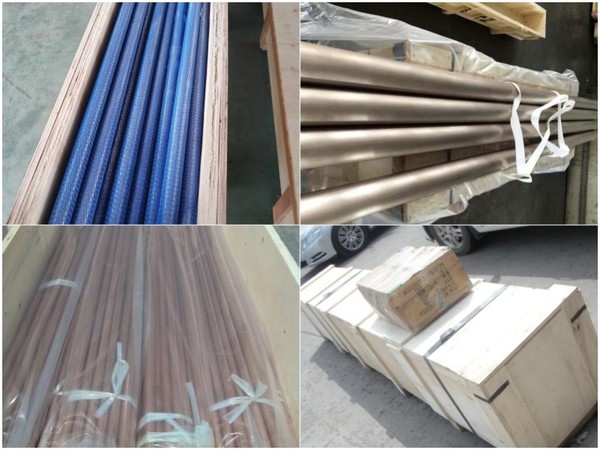
Packaging – How We Ship C70600 Without Damage
Our packing rules for C70600:
Tubes: capped both ends + foam wrap + wooden spool or woven bag
Plates/sheets: anti-rust paper + plywood crate
Rods/bars: VCI film + fumigation-free case
Wire: spooled + pallet wrapped
Strip: interleaved paper + carton or coil box
All C70600 packaging includes:
Moisture barrier
Edge protection (where needed)
Clear labeling (grade, heat, size, PO number)
We pack for sea freight, air freight, or warehouse storage.
Factory – What We Use to Make C70600 Right
What we use for C70600:
Horizontal caster (billet control)
Reverse extrusion press (seamless starts here)
Cold pilger & draw benches (tube precision)
Roller leveler & slitter (plate/strip)
Annealing furnace (consistent temper)
Pickling line (clean surface)
What we don't do: mix scrap, skip heat treatment, fake test reports.
Result: C70600 that actually meets ASTM B151 / ASME SB151.

Upload Drawing for Custom Quote


