

What Is C70600 Copper-Nickel?
C70600 is 88.6% copper, 10% nickel, 1.4% iron - the alloy everyone calls "90/10". Seawater destroys plain copper in months, so the nickel and iron exist for one reason: they build the dark, sticking oxide film that lets this tube sit in flowing seawater for decades. Get the iron below 0.15% and that film stops repairing itself - pitting shows up at the first haul-out. That is why the iron line on the certificate matters more than almost anything else on it. For condenser tubes, ship seawater lines and desalination pipework - including our heat exchanger tube program - 90/10 is the sensible default; you pay more only when the water is faster, sandier or deeper than 90/10 was built for.
Where The Price Actually Went This Week
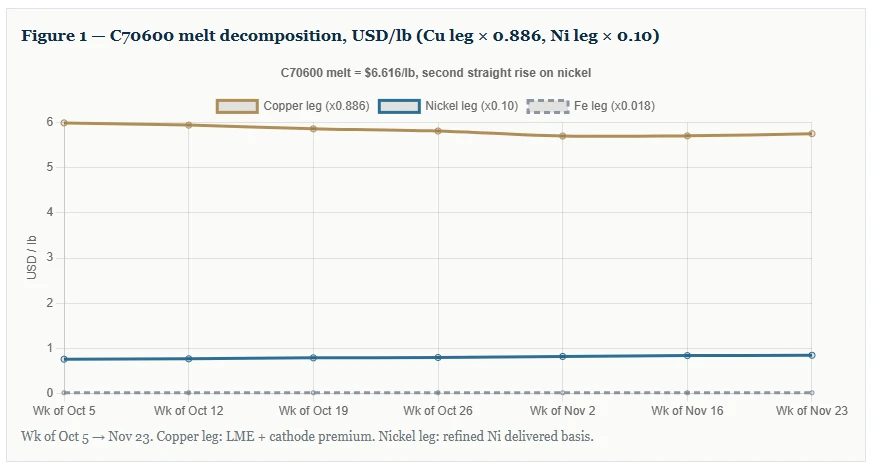
Nothing dramatic, and that is the point. Copper was flat; nickel added another leg. The alloy premium over plain copper is now $0.13/lb, up from $0.11 two weeks ago, and all of it is nickel. Form prices followed within the week - tube went from $8.61 to $8.72/kg - because the hot-rolling queue is still full and mills are passing nickel through rather than eating it.
| Item | Value | Unit | Weekly move | What it means |
|---|---|---|---|---|
| C70600 melt value | 6.616 | USD / lb | +0.055 / +0.84% | Second straight rise |
| Copper leg (LME 14,310) | 5.750 | USD / lb | +0.048 | Half of the move this time |
| Nickel leg | 0.848 | USD / lb | +0.007 | +11.4% in seven weeks |
| C70600 tube, seamless (ASTM B466) | 8.72 | USD / kg | +0.11 / +1.28% | Nickel passed through |
| C70600 plate (ASTM B171) | 10.47 | USD / kg | +0.09 / +0.87% | Queue still full |
| C70600 bar (ASTM B151) | 10.94 | USD / kg | +0.09 / +0.83% | Slowest to discount, as always |
| Melt premium over C11000 | +0.13 | USD / lb | from +0.11 | Nickel-only widening |
So What Is Your Clause Worth Right Now?
Last week we put three clause structures side by side on a 2-tonne seamless release. Here is how they settle after nickel's second week:
| Clause | Quoted then | Worth today | Verdict |
|---|---|---|---|
| Split leg: copper on LME+, nickel fixed quarterly | $8.61/kg | +$30 | The nickel number never moved. This is the clause that does what it says |
| Fixed price, 30-day validity | $8.61/kg | Re-quote pending | Fine inside the window; you re-negotiate at the top |
| "Material at time of shipment" | $8.44/kg | −$330 and counting | Cheaper on paper, expensive in practice |
A nickel run is exactly when open clauses hurt, because they only ever move one way. The split-leg quote asks for one extra sentence on the RFQ - "state the nickel leg as a fixed USD figure per pound" - and it is the difference between a known number and a moving one.

Thicker Wall Or 70/30? Do The Sum Before The Sales Call
This is the decision we get asked about most, and it is easier than the sales literature makes it sound. 90/10 is rated for flowing seawater up to about 3 m/s; beyond that, or where sand and silt ride in the water, the film erodes and wall thickness starts disappearing. You have two fixes. Go up a wall schedule - 1.0 to 1.2 mm adds about 20% to the metal on a 2 t coil package, roughly $1,900 - or change grade. 70/30 (C71500) is about $0.55/kg over 90/10 on tube, which on the same package is around $1,100 - but it buys higher velocity tolerance and better fouling behaviour, not just wall.
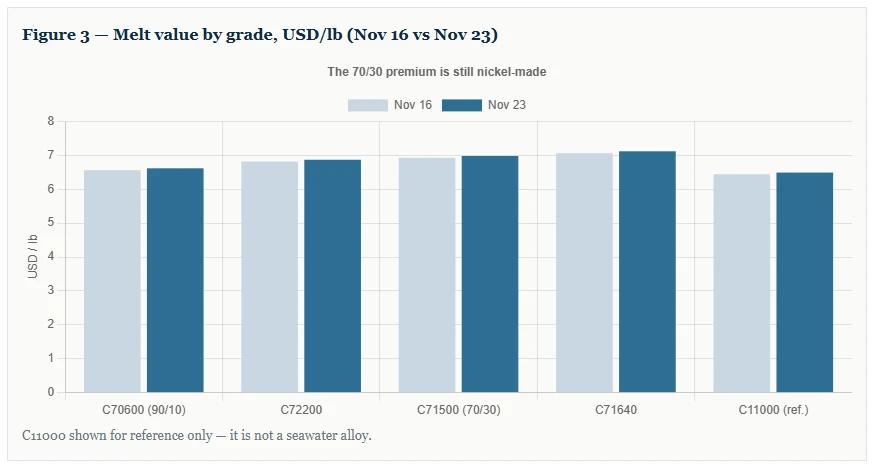
The honest rule of thumb from our shop floor: clean coastal water under 3 m/s stays 90/10, full stop. Silted harbours, fast pumps, or anything running near design limits goes 70/30 - or C71640 if the pumps run hot. Buying 70/30 for calm water is a $1,100 donation per package; buying 90/10 for a silted channel is a tube failure at year three, which costs more than every package combined.
C70600 Equivalent Grades
The purchase order should carry UNS C70600. The equivalents decide which certificate arrives with the heat - and which one quietly fails your drawing.
| System | Designation | Notes |
|---|---|---|
| UNS | C70600 | The universal key - put it on the RFQ |
| ASTM | B466 (tube), B171 (plate), B151 (bar), B122 (sheet/strip), B467 (pipe) | B466 adds eddy-current or hydrostatic |
| ASME | SB-466 / SB-171 / SB-151 | Section II documentation for coded vessels |
| EN / DIN | CuNi10Fe1Mn1 (2.0872) | Same chemistry; EN 10204 3.1 default |
| ISO | CuNi10Fe1Mn1 | Marine piping standard route |
| JIS | C7060 (H3300) | Quote the class symbol with the tensile band |
| GB / China | B10 / T70600 (GB/T 5231) | Close - demand actual Ni, Fe, Mn values |
| AWS filler | CuNi-1 / ERCuNi (A5.7) | Correct filler for 90/10 - not CuNi-2 |
The mistake we see most: a 70/30 certificate (CuNi30Fe, 2.0882) against a 90/10 drawing. It passes every NDT check, costs about $0.50/kg more, and fails the drawing. Check the certificate against the grade name, not the test results.
The Certificate Lines That Actually Stop Rejections
Iron: 0.15–0.50%, actual value, not "pass". Below 0.15% the film stops self-repairing - this single line separates good marine tube from the cheap stuff.
Manganese: 0.30–1.0%. It scavenges sulphur. High-sulphur heats show pitting early; we have seen it inside twelve months of commissioning.
Nickel: 9.5–10.5%. The window the price and the performance both assume.
For welded line pipe: ask for the eddy-current report on the seam, not just the base-metal analysis.
Three Things Worth Doing This Week
Put the nickel clause on paper while you can. Two weeks of nickel gains have made split-leg quotes easy to get - mills would rather fix the nickel number than lose the order. That willingness usually outlasts the run by about a week.
Re-run the 90/10 vs 70/30 sum on every package above 2 tonnes. The gap moved again this week; any 70/30 line rated for 90/10 conditions is $550 per tonne of budget you can hand back.
Book Q1 melt slots now. The hot-rolling queue is still full, and a booking fee holds both the slot and today's conversion rate - re-quoting into a third nickel week costs more than the fee by a mile.
What Would Change This Picture
Nickel stalling. If the leg flat-lines for two weeks, the premium over C11000 stops widening and conversion discounts come back - that is when re-negotiation pays.
Copper breaking $14,000/tonne. It would pull both legs down together and hand you leverage you have not had since October.
The hot-rolling queue clearing. Conversion, not metal, is where the next real price relief lives - watch the queue, not the exchange.
C70600 Product Range And Specifications
| Product | Standard | Range | Condition |
|---|---|---|---|
| Copper-nickel tube, seamless | ASTM B466 / ASME SB-466 | OD 6–219 mm; wall 0.5–10 mm; to 12,000 mm | Annealed; bright annealed for condenser duty |
| Copper-nickel pipe | ASTM B467 | NPS 1/8–12; sch 10–80 | Welded, annealed |
| Copper-nickel plate | ASTM B171 / ASME SB-171 | 3–60 mm; width to 1,250 mm | Hot-rolled, annealed, pickled |
| Copper-nickel bar / rod | ASTM B151 | Ø 6–120 mm; hex & square on request | Hot-rolled, turned or ground |
| Copper-nickel sheet / strip | ASTM B122 | 0.3–12 mm; width to 600 mm | Cold-rolled, annealed |
| Fittings | Flanges, elbows, tees to B466 | To NPS 12 | Machined from plate or forged block |
| Melting & testing | Induction melt; EN 10204 3.1 standard, 3.2 with witness available; actual Ni, Fe, Mn, Pb values on every certificate; eddy current or hydrostatic on B466 tube | ||
| Lead time | Seamless tube 7–10 weeks; plate 6–8; bar 5–7; fittings 8–12. Hot-rolling queue remains the constraint | ||
Buying C70600 this quarter? Send the line list and annual quantity. We will quote copper leg and nickel leg as two separate, stated USD figures, put the actual Fe, Mn and Pb values on every certificate, and hold the melt slot at purchase order. Tube, plate, bar, pipe, fittings - ASTM B466 / B171 / B151 / B467 and ASME SB equivalents, and we will run the 90/10 vs 70/30 sum for you before you commit.


