

What Is C70600 Copper-Nickel?
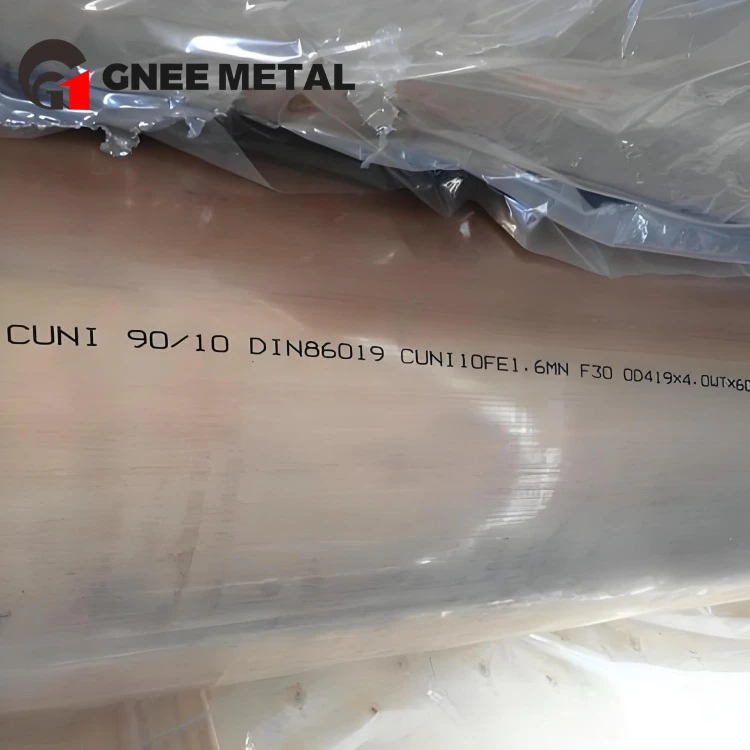
C70600 is a 90/10 copper-nickel alloy - nominally 90% copper and 10% nickel, with deliberate additions of iron and manganese. It is the standard material for seawater piping, condenser and heat-exchanger tubing, shipboard cooling systems, desalination plant piping and offshore platform firewater loops. Its two properties that no other common copper alloy matches are resistance to flowing seawater erosion-corrosion and natural resistance to marine biofouling.
Both of those properties come from the iron, not the nickel, and that is the single most important thing a buyer can know about this alloy. C70600 carries 1.0–1.8% iron by specification, and that iron migrates to the surface in service to form a thin, adherent, iron-rich oxide film over the cuprous oxide layer. The film is what resists erosion-corrosion at velocity - without adequate iron the alloy still resists static seawater well but fails rapidly once water is moving, which is exactly the service it is bought for. Manganese is added as a deoxidiser and sulphur getter, and it improves hot workability.
Price Snapshot - C70600, Week of November 2, 2026
| Indicator | Reading | Unit | vs. October 26 | Direction |
|---|---|---|---|---|
| LME 3-month copper | 14,180 | USD / tonne | −275 / −1.90% | Second consecutive weekly decline |
| LME 3-month nickel | 18,120 | USD / tonne | +510 / +2.90% | Third consecutive weekly gain |
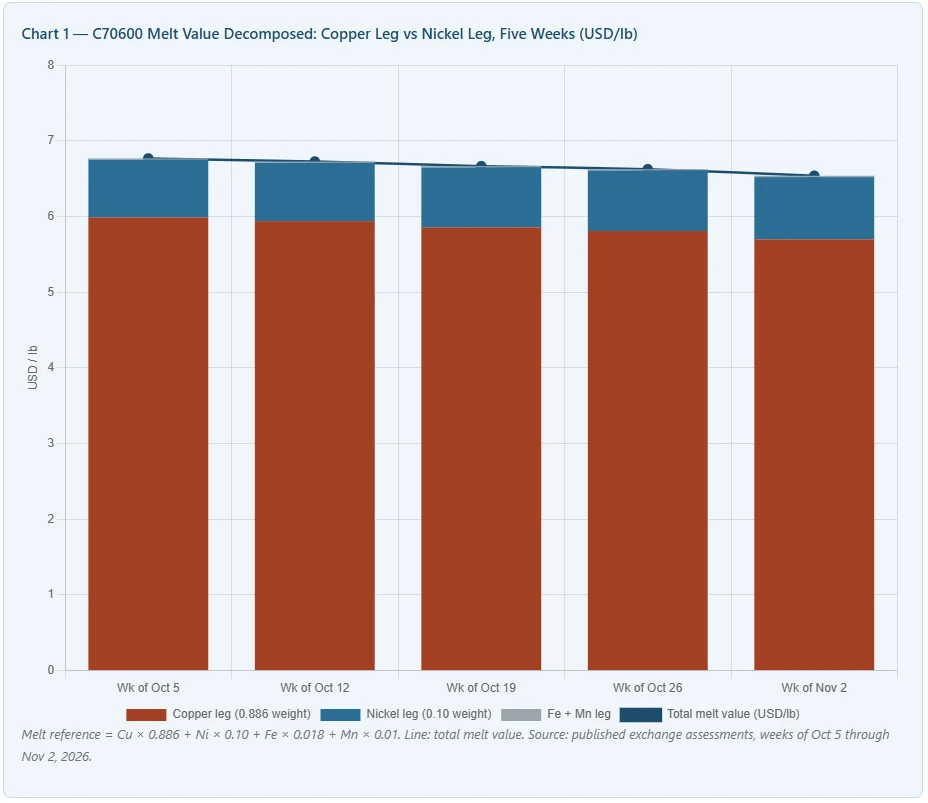
| C70600 melt reference value | 6.539 | USD / lb | −0.088 / −1.31% | Largest weekly fall in six weeks |
| - copper leg (0.886 weight) | 5.699 | USD / lb | −0.111 | Drives the fall |
| - nickel leg (0.10 weight) | 0.822 | USD / lb | +0.023 | Offsets about 26% of the copper decline |
| - iron + manganese leg | 0.018 | USD / lb | unchanged | Negligible in cost, decisive in service |
| Nickel physical premium | 0.48 | USD / lb over LME | from 0.35 | +37% - does not appear in the LME price |
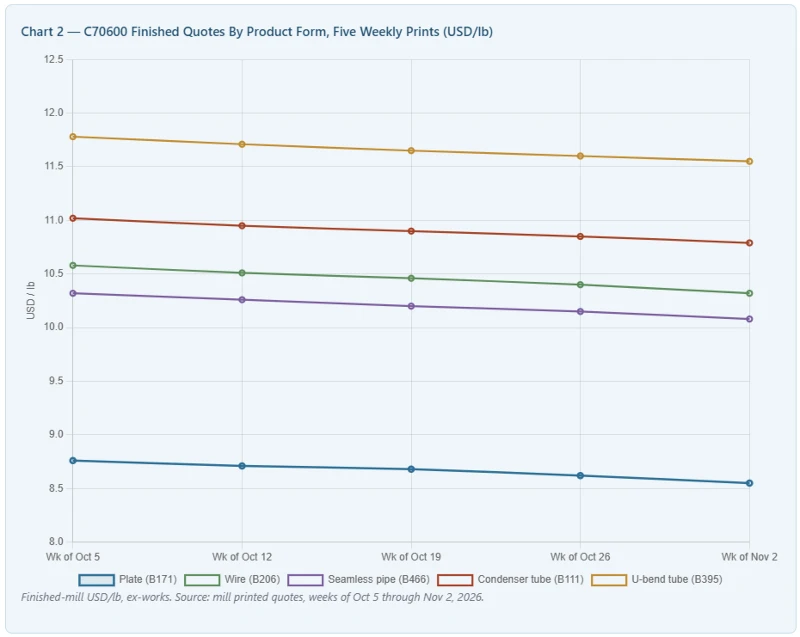
| Plate (B171, 3–40 mm) | 8.55 | USD / lb | −0.07 / −0.81% | Largest product move of the week |
| Sheet (B171, 0.5–3 mm) | 8.71 | USD / lb | −0.07 / −0.80% | Follows plate |
| Strip / coil (B171 / B152) | 8.97 | USD / lb | −0.08 / −0.88% | Thin-gauge capacity still firm |
| Seamless pipe (B466 / B467) | 10.08 | USD / lb | −0.07 / −0.69% | Extrusion slots booked |
| Condenser tube (B111) | 10.79 | USD / lb | −0.06 / −0.55% | Smallest move - order book full |
| U-bend tube (B395) | 11.55 | USD / lb | −0.05 / −0.43% | Bending and stress-relief capacity |
| Welded pipe (B467 / B543) | 9.58 | USD / lb | −0.07 / −0.73% | Cheapest pipe route |
| Bar / rod (B151) | 9.12 | USD / lb | −0.08 / −0.87% | Follows melt most closely |
| Wire (B206) | 10.32 | USD / lb | −0.08 / −0.77% | Drawing capacity steady |
| Fittings / flanges (B16.50 / B16.24 / MSS SP-104) | 13.74 | USD / lb | −0.06 / −0.43% | Conversion leg is 52% of the price |
| C71500 (70/30) melt reference | 6.896 | USD / lb | −0.016 / −0.23% | Fell far less than 90/10 |
| Third-party class-society inspection | 0.12–0.35 | USD / lb amortised | unchanged | DNV / LR / ABS / BV witness |
Conversion reference: 1 tonne = 2,204.62 lb. To convert USD/lb to USD/kg, multiply by 2.2046 - C70600 melt at $6.539/lb is $14.42/kg, and B111 condenser tube at $10.79/lb is $23.79/kg. The melt reference is computed as Cu × 0.886 + Ni × 0.10 + Fe × 0.018 + Mn × 0.01, using LME settlement for copper and nickel and prevailing merchant prices for iron and manganese. Product prices are finished-mill USD/lb, ex-works.
Sources: published exchange assessments, merchant nickel premium indications, mill printed quotes by product form (week ending Oct 30, 2026). Reference trading day: November 2, 2026.
Why Melt Fell 1.31% And Your Quote Only Fell 0.6%
That $0.088/lb went somewhere. Here is the accounting, and it is worth understanding because it tells you how much of the next copper decline will actually reach you.
| Component | Effect | Explanation |
|---|---|---|
| Melt value decline (copper leg) | −0.111 | LME copper −1.90%, weighted at 0.886 |
| Melt value increase (nickel leg) | +0.023 | LME nickel +2.90%, weighted at 0.10 |
| Net melt change | −0.088 | Theoretical maximum that could reach the quote |
| Nickel physical premium absorbed by the mill | +0.013 | Premium rose from $0.35 to $0.48/lb; at 10% nickel that is $0.013/lb of metal cost the LME price does not show |
| Cathode inventory bought at the old nickel premium | +0.009 | Mills bought cathode two to four weeks ago |
| Pass-through lag (3–5 weeks on Cu-Ni) | +0.006 | Only about 30% of the melt move reached this week's quote; the rest lands in December |
| Actual quote change on B111 condenser tube | −0.060 | You received 68% of the melt decline. The other 32% is nickel premium and lag. |
The line to take away is the nickel premium. A melt shop making C70600 does not buy LME nickel - it buys nickel cathode, briquettes or pellets at LME plus a physical premium, and that premium moved from $0.35/lb to $0.48/lb this week, a 37% increase, on tightening Class 1 supply. At 10% nickel content that is roughly $0.013/lb of real cost that the exchange price does not show you, and mills pass it straight through. That is why the melt value can fall 1.31% while the metal in the furnace costs nearly the same as it did last week.
The second reason is timing, and it favours waiting only if nickel stops rising. Copper-nickel has a three-to-five-week melt-to-quote pass-through - longer than brass, because nickel is bought on a separate procurement cycle from copper. The November 2 melt decline is not in the November 2 quote; it lands in the December print. Hold two scenarios side by side: if copper keeps falling and nickel steadies, waiting four weeks saves you another $0.10–0.15/lb. If nickel keeps rising at this week's rate, the nickel leg adds roughly $0.023/lb per week and eats the entire copper benefit within two weeks. Watch the nickel premium, not the copper headline.
What A C70600 Quote Is Actually Made Of
Every C70600 product form starts from the same $6.539/lb melt value. Everything above it is conversion, and the conversion share ranges from 23.5% on plate to 52.4% on fittings - which tells you immediately where negotiation has room and where it does not.
| Product form | Standard | Quote | Melt leg | Conversion leg | Conversion share | Lead time |
|---|---|---|---|---|---|---|
| Plate | B171 | 8.55 | 6.539 | 2.011 | 23.5% | 6–8 weeks |
| Sheet | B171 | 8.71 | 6.539 | 2.171 | 24.9% | 6–8 weeks |
| Strip / coil | B171 / B152 | 8.97 | 6.539 | 2.431 | 27.1% | 7–9 weeks |
| Bar / rod | B151 | 9.12 | 6.539 | 2.581 | 28.3% | 6–8 weeks |
| Welded pipe | B467 / B543 | 9.58 | 6.539 | 3.041 | 31.7% | 8–11 weeks |
| Seamless pipe | B466 | 10.08 | 6.539 | 3.541 | 35.1% | 9–12 weeks |
| Wire | B206 | 10.32 | 6.539 | 3.781 | 36.6% | 7–9 weeks |
| Condenser tube | B111 | 10.79 | 6.539 | 4.251 | 39.4% | 10–14 weeks |
| U-bend tube | B395 | 11.55 | 6.539 | 5.011 | 43.4% | 11–15 weeks |
| Fittings / flanges | B16.50 / B16.24 | 13.74 | 6.539 | 7.201 | 52.4% | 8–11 weeks |
Two decisions follow directly from that table. On plate, bar and sheet you are buying metal with a conversion surcharge - those are the forms where a melt decline reaches you fastest and where waiting has the most value. On condenser tube, U-bends and fittings the conversion leg is 39–52% of the price, so metal moves are muted and capacity is what sets both price and date. Condenser tube at 10–14 weeks and U-bends at 11–15 weeks are the longest lead times in the whole line, and they are driven by bending, stress-relief and inspection capacity rather than by alloy availability. If a package needs both plate and tube, order the tube first.
One substitution is worth checking on every pipe enquiry: welded B467 pipe at $9.58/lb against seamless B466 at $10.08/lb is $0.50/lb back and roughly two weeks faster, and for most seawater, firewater and ballast service the weld seam is not the limiting factor. Seamless remains the right call for high-pressure, high-velocity or class-coded pressure boundary work - but that should be an engineering decision, not a habit.
Choosing Between C70600, C71500, C71640 And C72200
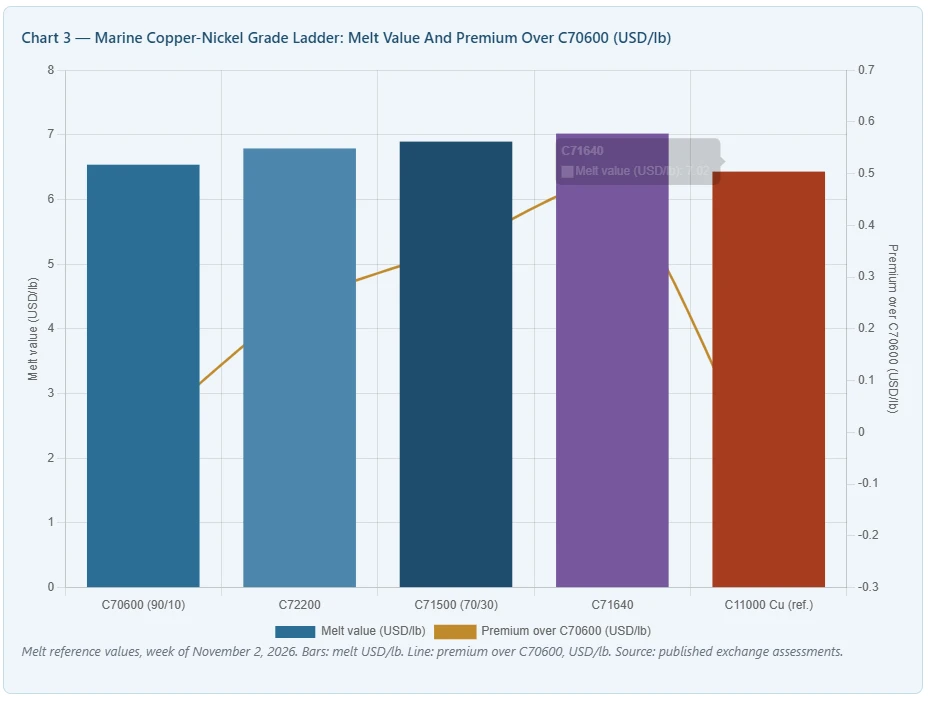
Nickel rising changes this comparison, and this week it moved in a direction most buyers will not expect. C71500 carries roughly 30% nickel, so it fell only 0.23% this week while C70600 fell 1.31%. The consequence: the C70600 discount against 70/30 widened from $0.286/lb to $0.357/lb - 90/10 got $0.071/lb cheaper relative to 70/30 in a single week.
| Grade | Nominal Ni | Melt USD/lb | vs C70600 | B111 tube USD/lb | Velocity ceiling | Choose it when |
|---|---|---|---|---|---|---|
| C70600 (90/10) | 10% | 6.539 | baseline | 10.79 | 2.4–3.0 m/s | Default seawater service; most cost-effective at today's nickel spread |
| C70620 | 10% | 6.539 | same melt | 9.85 (welded) | 2.4–3.0 m/s | Welded tube production - needs engineer approval to substitute |
| C71500 (70/30) | 30% | 6.896 | +0.357 | 12.60 | 3.6–4.5 m/s | Velocity above 3.0 m/s, or higher strength needed |
| C71640 | ~30% | 7.02 | +0.48 | 13.15 | Higher | Severe erosion-corrosion; sandy or silt-laden seawater |
| C72200 | ~16% | 6.79 | +0.25 | 12.05 | Intermediate | Chromium-bearing variant for improved fouling and erosion resistance |
| C70600 vs C11000 copper | 0% | 6.432 | −0.107 | n/a | Low | Pure copper is cheaper and unsuitable for flowing seawater - not a valid downgrade |
The practical rule for this week: if your design velocity is inside 90/10's 2.4–3.0 m/s ceiling and you are currently on 70/30, the case for stepping back to C70600 is $1.81/lb on condenser tube, and it got stronger this week. The reverse is also true and matters more for safety: if your velocity exceeds 3.0 m/s, do not solve it with a heavier C70600 wall - erosion-corrosion is a velocity problem, not a thickness problem, and the correct move is C71500 at 3.6–4.5 m/s. Note also that pure copper is $0.107/lb cheaper on melt and completely unsuitable for this service. C70600 is not an upgrade from copper; it is a different material class.
Four Lines To Check On The Mill Certificate Before You Accept
C70600 failures in service are rarely about the alloy being wrong. They are about a certificate that was in specification and still described material that will not survive your duty.
Iron, and specifically the iron value - not just "within 1.0–1.8%". Iron is the element that produces the erosion-resistant film. A certificate that reports Fe at 1.02% is compliant and inadequate. For flowing seawater, put "Fe 1.2% minimum, actual value reported" on the RFQ. It costs about $0.03–0.05/lb to hold iron in the upper half of the band, and it is the cheapest insurance on the whole order.
Sulphur and lead, at 0.02% and 0.05% maximum. Sulphur forms a low-melting nickel-sulphide eutectic that causes hot cracking during welding and hot forming, and lead does the same through hot shortness. Both pass a compositional check and both can ruin a fabrication. If the part will be welded, ask for both actual values.
Nickel at the low end, with manganese as the tell. Nickel at 9.1% with manganese at 0.15% is a melt that was held to minimums across the board. Nickel at 10.2–10.6% with manganese at 0.6–0.9% is a properly controlled heat. The composition is legal either way; only one of them is what you meant to buy.
Condition, hardness and residual stress. Annealed, light-drawn or stress-relieved are not interchangeable, and if the service contains ammonia or ammonium compounds, residual stress plus ammonia is a stress-corrosion mechanism that applies to copper-nickel too. Specify the temper, require stress relief where ammonia is present, and ask for the hardness reading as evidence.
C70600 Equivalent Grades
C70600 appears under different designations in every major standard system, and the equivalences are close but not always interchangeable - the differences are usually in iron, manganese or residual limits, and those are exactly the elements that govern velocity resistance and weldability. Use this table to translate a drawing, then confirm the specific product standard before you substitute.
| System | Designation | Governing standard | Match quality / note |
|---|---|---|---|
| UNS | C70600 | - | Reference designation |
| Common name | 90/10 copper-nickel, Cu-Ni 90/10 | - | Industry shorthand used on most RFQs |
| ASTM (plate / sheet / strip) | C70600 | ASTM B171 / B152 | Plate, sheet, strip and flat products |
| ASTM (seamless pipe / tube) | C70600 | ASTM B466 / B467 | B466 seamless, B467 welded |
| ASTM (condenser / heat exchanger) | C70600 | ASTM B111 / B395 / B543 | B111 seamless condenser, B395 U-bend, B543 welded |
| ASTM (bar, rod, wire) | C70600 | ASTM B151 / B206 | B151 bar and rod, B206 wire |
| ASME (pressure use) | SB-171 / SB-466 / SB-467 / SB-111 | ASME Section II | Required for coded pressure boundary work |
| EN / DIN | CuNi10Fe1Mn · material no. 2.0872 | EN 12451 / EN 12449 / DIN 17664 | Closest match; iron range is comparable |
| GB (China) | BFe10-1-1 (legacy mark: B10) | GB/T 5231 | Ni ≈10%, Fe ≈1%, Mn ≈1% - the iron content is what makes this a true equivalent |
| JIS | C7060 | JIS H3100 / H3300 / H3270 | Plate / strip, tube, and bar respectively |
| BS | CN102 | BS 2870 / BS 2871 | Legacy designation, still common on older drawings |
| ISO | CuNi10Fe1Mn | ISO 1190 series | Composition designation |
| Welded-tube variant | C70620 | ASTM B467 / B543 | Slightly higher phosphorus allowance for weldability - not a free substitution for C70600 |
| Higher-nickel upgrade | C71500 / C71520 | ASTM B171 / B466 / B111 | 70/30 Cu-Ni - higher strength and a higher velocity ceiling |
| Modified marine grades | C71640 / C72200 | ASTM B111 / B395 | Adjusted Fe-Mn and chromium-bearing variants for severe erosion-corrosion duty |
| Matching filler metal | ERCuNi (AWS A5.6) / ECuNi (AWS A5.7) | AWS A5.6 / A5.7 | Filler designation, not a base-metal equivalent |
C70600 Product Range And Specifications
Mill-direct C70600 (90/10 copper-nickel) across plate, sheet, strip, pipe, tube, bar, wire and fittings, with iron held in the upper half of the specification band on request and the actual Ni, Fe and Mn values reported on every certificate. Equivalent grades supplied to EN CuNi10Fe1Mn (2.0872), GB BFe10-1-1, JIS C7060 and BS CN102 chemistry on request.
| Product | Standard | Grade coverage | Size envelope | Condition | Lead time |
|---|---|---|---|---|---|
| Cu-Ni plate & sheet | ASTM B171 / ASME SB-171 / EN 12451 | C70600, C71500, C71640, C72200 | Plate 3–60 mm; sheet 0.5–3 mm; width to 2,500 mm; length to 6,000 mm | Hot-rolled, annealed (O61) | 6–8 weeks |
| Cu-Ni strip & coil | ASTM B171 / B152 | C70600, C71500 | Thickness 0.1–3.0 mm; width 10–600 mm; coil ID 300 / 400 / 500 mm | Cold-rolled, annealed | 7–9 weeks |
| Cu-Ni pipe, seamless | ASTM B466 / ASME SB-466 | C70600, C71500, C71640 | OD 6–324 mm; wall 1–20 mm; length to 12,000 mm | Annealed, light drawn | 9–12 weeks |
| Cu-Ni pipe, welded | ASTM B467 / B543 / ASME SB-467 | C70600 / C70620, C71500 / C71520 | OD 15–600 mm; wall 1–10 mm | Welded, annealed, bead-worked | 8–11 weeks |
| Condenser & heat-exchanger tube | ASTM B111 / ASME SB-111 / EN 12451 | C70600, C71500, C71640, C72200 | OD 10–50.8 mm; wall 0.7–3.5 mm; length to 18,000 mm | Annealed (O61), light drawn (H55) | 10–14 weeks |
| U-bend tube | ASTM B395 / ASME SB-395 | C70600, C71500, C71640 | OD 12–25.4 mm; bend radius from 1.5× OD; leg length to 12,000 mm | U-bent, stress relieved | 11–15 weeks |
| Low-finned integral tube | ASTM B111 / B359 | C70600, C71500 | Root OD 12–25.4 mm; 19–40 fins per inch | As-formed, annealed | 12–16 weeks |
| Cu-Ni bar & rod | ASTM B151 / ASME SB-151 | C70600, C71500, C71640 | Round Ø 6–200 mm; hex / square 8–100 mm; length to 4,000 mm | Hot-worked, annealed, drawn | 6–8 weeks |
| Cu-Ni wire | ASTM B206 | C70600, C71500 | Ø 0.5–8 mm; coil, spool or cut length | Drawn, annealed | 7–9 weeks |
| Fittings, flanges & unions | ASME B16.50 / B16.24 / MSS SP-104 | C70600, C71500, C71640 | ½" to 24"; elbows, tees, reducers, stub ends, lap-joint flanges | Forged or formed, annealed | 8–11 weeks |
| Welding consumables | AWS A5.6 ERCuNi / AWS A5.7 ECuNi | Matching filler for C70600 and C71500 | TIG / MIG spool, covered electrode | - | Stock |
| Composition control | Ni 9.0–11.0% · Fe 1.0–1.8%, held at 1.2–1.6% on request for flowing-seawater duty · Mn to 1.0% · Pb ≤0.05%, S ≤0.02%, P ≤0.02%, C ≤0.05% · actual Ni, Fe and Mn values reported on every certificate | ||||
| Processing | Vacuum or controlled-atmosphere melting · Continuous and semi-continuous casting · Hot extrusion · Cold pilgering and drawing · Cold rolling and slitting · U-bending with controlled radius · Stress-relief and bright annealing · Precision cut-to-length · Machining | ||||
| Surface condition | Mill finish · Pickled · Bright annealed · Polished · Internally cleaned and degreased for heat-exchanger duty · plastic end caps and individually sleeved tube on request | ||||
| Testing & certification | Mill test certificate per EN 10204 3.1 (3.2 on request) · Chemical composition by ICP / OES with actual Ni, Fe, Mn, Pb and S values · Tensile, yield and elongation · Hardness · Eddy-current testing per ASTM E426 · Hydrostatic test per ASTM B111 · Pneumatic underwater test · Flattening, flare and reverse-bend test · Positive material identification (PMI) · Grain size per ASTM E112 · Residual stress test on request | ||||
| Quality systems | ISO 9001:2015 · SGS audited · BV audited · DNV, LR, ABS and BV class-society witness available - book at order release to avoid a 2–3 week serial delay · Heat-number traceability to plate, tube bundle and fitting level | ||||
| Lead time | Quote within 24 hours · Stock-size plate and bar: 6–8 weeks · Condenser tube: 10–14 weeks · U-bends: 11–15 weeks · Add 4–6 weeks for non-stock melting · Add 2–3 weeks for class-society witness · Expedite available on melting and extrusion slots | ||||
| Trade terms | EXW, FOB, CIF, DDP · all quotes USD-denominated; EUR / GBP settlement available · MOQ varies by form (typically 300 kg for stock items, 1–5 tonnes for mill-run tube production) · Export packing with end protection, desiccant and steel-strapped pallets | ||||
Planning a C70600 package, or checking whether 90/10 is the right call? Send us the standard, product form, size envelope, quantity with annual estimate, design flow velocity and any class-society requirement. You get a line-by-line USD quote within 24 hours, the actual Ni and Fe values we can hold, and a straight answer on whether C70600 or C71500 fits your duty.


