

This comprehensive analysis compares C26000 (ASTM Cartridge Brass) and H68 (Chinese Standard Brass), two of the most widely used single-phase brass alloys globally. While both alloys share similar copper-zinc compositions and single-phase microstructures, their subtle differences in chemistry and processing standards create distinct performance characteristics that influence their suitability for specific applications.
C26000, with its 70% copper content, represents the Western standard for high-performance brass applications, particularly where corrosion resistance and formability are critical. H68, containing 68% copper, has become the most widely used brass grade in China and increasingly in Asian markets, offering excellent plasticity combined with cost-effectiveness.
Understanding the nuanced differences between these alloys is crucial for engineers, procurement specialists, and manufacturers operating in today's interconnected global supply chains, where material selection impacts both performance and economic outcomes.
Chemical Composition and Metallurgy
Detailed Chemical Analysis
| Element | C26000 (ASTM B36) | H68 (GB/T 5231) | Difference Impact |
|---|---|---|---|
| Copper (Cu) | 68.5 – 71.5% | 67.0 – 70.0% | C26000: +1.5% average |
| Zinc (Zn) | Balance (28.5-31.5%) | Balance (30.0-33.0%) | H68: +1.5% average |
| Lead (Pb) | ≤ 0.07% | ≤ 0.05% | H68: Tighter control |
| Iron (Fe) | ≤ 0.05% | ≤ 0.10% | H68: More permissive |
| Aluminum (Al) | – | ≤ 0.002% | H68: Specified limit |
| Tin (Sn) | – | ≤ 0.002% | H68: Specified control |
| Antimony (Sb) | – | ≤ 0.005% | H68: Trace element control |
| Arsenic (As) | ≤ 0.02% | – | C26000: Dezincification control |
| Phosphorus (P) | ≤ 0.02% | ≤ 0.002% | H68: Stricter limit |
| Silicon (Si) | – | ≤ 0.007% | H68: Process control |
Microstructural Characteristics
| Property | C26000 | H68 | Significance |
|---|---|---|---|
| Phase Structure | Single α-phase | Single α-phase | Both excellent formability |
| Grain Size (ASTM) | 5-7 | 4-6 | H68: Slightly finer grain |
| Zinc Equivalent | 30.5% | 31.5% | H68: Higher equivalent |
| Phase Stability | Excellent | Excellent | Both stable at room temperature |
| Recrystallization Temp | 300-400°C | 310-420°C | Similar processing windows |
Compositional Impact on Properties
C26000 Advantages from Higher Copper:
Enhanced electrical conductivity (28% IACS vs 26% IACS)
Superior corrosion resistance in atmospheric conditions
Better thermal conductivity for heat transfer applications
Improved brazing and welding characteristics
Enhanced ductility for extreme forming operations
H68 Advantages from Optimized Composition:
Improved strength-to-cost ratio
Better dimensional stability during processing
Enhanced machinability due to refined microstructure
Optimized hot working characteristics
Reduced material cost while maintaining performance
Mechanical Properties Comprehensive Analysis
Tensile Properties Comparison
| Condition | Property | C26000 | H68 | Units | Performance Difference |
|---|---|---|---|---|---|
| Annealed (O) | Tensile Strength | 300-380 | 295-375 | MPa | C26000: +5 MPa average |
| Yield Strength (0.2%) | 75-140 | 80-145 | MPa | H68: +5 MPa average | |
| Elongation | 60-68 | 65-70 | % | H68: +3% average | |
| Hardness (HV) | 60-85 | 55-80 | HV | C26000: +5 HV average | |
| Half Hard (H02) | Tensile Strength | 370-450 | 365-445 | MPa | Comparable |
| Yield Strength | 170-275 | 175-280 | MPa | H68: +5 MPa average | |
| Elongation | 25-35 | 28-38 | % | H68: +3% average | |
| Hard (H04) | Tensile Strength | 410-540 | 405-535 | MPa | Comparable |
| Yield Strength | 275-380 | 280-385 | MPa | H68: +5 MPa average | |
| Elongation | 15-25 | 18-28 | % | H68: +3% average |
Fatigue and Endurance Properties
| Test Condition | C26000 | H68 | Units | Application Impact |
|---|---|---|---|---|
| High Cycle Fatigue (10^7) | 140-160 | 145-165 | MPa | H68: Better spring applications |
| Low Cycle Fatigue (10^4) | 280-320 | 285-325 | MPa | Similar performance |
| Rotating Bending | 120-140 | 125-145 | MPa | H68: Slight advantage |
| Axial Fatigue | 100-120 | 105-125 | MPa | H68: Better for rods/bars |
| Corrosion Fatigue | 80-100 | 75-95 | MPa | C26000: Better in corrosive environments |
Temperature-Dependent Mechanical Properties
| Temperature | Property | C26000 | H68 | Performance Notes |
|---|---|---|---|---|
| -40°C | Tensile Strength | 420 MPa | 415 MPa | Both maintain ductility |
| Impact Resistance | High | High | No brittle transition | |
| 20°C | Tensile Strength | 340 MPa | 335 MPa | Reference condition |
| Modulus | 110 GPa | 108 GPa | Similar stiffness | |
| 100°C | Tensile Strength | 315 MPa | 310 MPa | Gradual reduction |
| Creep Resistance | Good | Good | Suitable for moderate temp | |
| 200°C | Tensile Strength | 280 MPa | 275 MPa | Limited applications |
| Oxidation | Moderate | Moderate | Protective atmosphere recommended | |
| 300°C | Tensile Strength | 245 MPa | 240 MPa | Short-term exposure only |
Forming and Manufacturing Characteristics
Cold Forming Performance
| Forming Operation | C26000 Rating | H68 Rating | Relative Performance | Recommended Applications |
|---|---|---|---|---|
| Deep Drawing | Excellent (5/5) | Excellent (5/5) | C26000: +5% deeper draws | Cartridge cases, cups |
| Spinning | Excellent (5/5) | Excellent (4.8/5) | C26000: Better thin walls | Decorative components |
| Bending | Excellent (5/5) | Excellent (5/5) | Equal performance | Architectural hardware |
| Stretch Forming | Excellent (5/5) | Very Good (4.5/5) | C26000: Better complex curves | Automotive panels |
| Cold Heading | Very Good (4/5) | Excellent (5/5) | H68: Better surface finish | Fasteners, rivets |
| Coining | Good (3.5/5) | Very Good (4/5) | H68: Better detail definition | Precision parts |
| Roll Forming | Excellent (5/5) | Excellent (5/5) | Equal performance | Continuous sections |
Hot Working Characteristics
| Process Parameter | C26000 | H68 | Optimal Range | Process Notes |
|---|---|---|---|---|
| Hot Working Temperature | 600-800°C | 650-820°C | 650-800°C | H68: Wider window |
| Forging Temperature | 650-750°C | 670-780°C | 670-750°C | Similar optimal range |
| Rolling Temperature | 600-750°C | 620-770°C | 620-750°C | H68: More forgiving |
| Extrusion Temperature | 650-800°C | 670-820°C | 670-800°C | Both excellent |
| Hot Forming Rate | Moderate | Moderate-Fast | Variable | H68: Faster rates possible |
| Grain Growth Control | Good | Very Good | Critical | H68: Better control |
Machinability Assessment
| Machining Operation | C26000 Performance | H68 Performance | Cutting Parameters | Tool Life Comparison |
|---|---|---|---|---|
| Turning | Good (3.5/5) | Very Good (4/5) | Speed: 150-300 m/min | H68: 15% longer life |
| Drilling | Good (3.5/5) | Very Good (4/5) | Speed: 80-150 m/min | H68: 20% longer life |
| Milling | Good (3/5) | Good (3.5/5) | Speed: 100-200 m/min | H68: 10% longer life |
| Threading | Fair (2.5/5) | Good (3.5/5) | Speed: 60-120 m/min | H68: 25% longer life |
| Surface Finish | Ra 1.6-3.2 μm | Ra 1.2-2.5 μm | – | H68: Superior finish |
| Chip Formation | Long, stringy | Shorter, better | – | H68: Easier handling |
Physical and Thermal Properties
Fundamental Physical Properties
| Property | C26000 | H68 | Units | Application Impact |
|---|---|---|---|---|
| Density | 8.53 | 8.50 | g/cm³ | Weight calculations |
| Melting Point | 915-940 | 905-930 | °C | Processing temperatures |
| Liquidus | 940 | 930 | °C | Casting parameters |
| Solidus | 915 | 905 | °C | Heat treatment |
| Specific Heat | 0.38 | 0.38 | J/g·K | Thermal calculations |
| Thermal Expansion | 20.5×10⁻⁶ | 20.8×10⁻⁶ | /K | Dimensional stability |
| Magnetic Permeability | 1.0 | 1.0 | μ/μ₀ | Non-magnetic applications |
Electrical and Thermal Conductivity
| Condition | Property | C26000 | H68 | Units | Performance Difference |
|---|---|---|---|---|---|
| Annealed | Electrical Conductivity | 28% IACS | 26% IACS | % | C26000: +7% better |
| Thermal Conductivity | 120 | 109 | W/m·K | C26000: +10% better | |
| Resistivity | 6.2×10⁻⁸ | 6.6×10⁻⁸ | Ω·m | C26000: Lower resistance | |
| Cold Worked | Electrical Conductivity | 25% IACS | 23% IACS | % | C26000: +8% better |
| Thermal Conductivity | 108 | 98 | W/m·K | C26000: +10% better |
Heat Treatment Response
| Treatment | C26000 Response | H68 Response | Typical Parameters | Microstructural Changes |
|---|---|---|---|---|
| Stress Relief | Excellent | Excellent | 250-300°C, 1-2h | Residual stress reduction |
| Partial Anneal | Very Good | Excellent | 350-450°C, 1h | Partial recrystallization |
| Full Anneal | Excellent | Excellent | 450-650°C, 2h | Complete recrystallization |
| Grain Size Control | Good | Very Good | Controlled cooling | H68: Better uniformity |
| Precipitation | Not applicable | Not applicable | – | Single-phase alloys |
Corrosion Resistance and Environmental Performance
Atmospheric Corrosion Performance
| Environment Type | C26000 Performance | H68 Performance | Corrosion Rate (μm/year) | Service Life Estimate |
|---|---|---|---|---|
| Rural Atmosphere | Excellent | Very Good | C26000: 1-2, H68: 2-3 | C26000: >50 years |
| Urban Atmosphere | Excellent | Good | C26000: 2-5, H68: 4-7 | C26000: 30-50 years |
| Industrial Atmosphere | Good | Fair-Good | C26000: 5-10, H68: 8-15 | C26000: 20-30 years |
| Marine Atmosphere | Very Good | Good | C26000: 8-15, H68: 12-20 | C26000: 15-25 years |
| Coastal Severe | Good | Fair | C26000: 15-25, H68: 20-30 | C26000: 10-15 years |
Aqueous Corrosion Resistance
| Water Type | C26000 Rating | H68 Rating | Corrosion Mechanism | Recommended Applications |
|---|---|---|---|---|
| Distilled Water | Excellent | Excellent | Minimal attack | Laboratory equipment |
| Tap Water (Soft) | Excellent | Very Good | Uniform corrosion | Plumbing fittings |
| Tap Water (Hard) | Very Good | Good | Scale formation | Water meters |
| Seawater | Good | Fair-Good | Uniform + pitting | Marine hardware |
| Brackish Water | Good | Fair | Selective attack | Coastal applications |
| Acidic Water (pH 4-6) | Fair | Fair | Accelerated uniform | Limited exposure |
Dezincification Susceptibility
| Test Method | C26000 Result | H68 Result | Interpretation | Application Guidelines |
|---|---|---|---|---|
| ASTM B858 Method A | Type 1 (Excellent) | Type 2 (Good) | Surface layer <200μm | C26000: Unrestricted use |
| ISO 6509-1 (24h, 75°C) | Layer <100μm | Layer 100-200μm | Acceptable performance | Both suitable with limits |
| Accelerated (80°C, 168h) | Minimal penetration | Moderate penetration | Relative performance | H68: Controlled conditions |
| Field Exposure (5 years) | Surface only | Subsurface <0.5mm | Real-world validation | C26000: Superior long-term |
Our product range
1. Pure Copper (Sheet, Tube, Wire)
Primary Grades: T1 (C11000), T2 (C10100). We prioritize C11000 (T1) for its excellent conductivity.
Standards: ASTM B152 (Sheet), ASTM B75/B88 (Tube), ASTM B1/B3 (Wire), EN, JIS, GB/T.
Typical Sizes:
Tube: OD 6mm – 200mm.
Sheet: Thickness 0.5mm – 50mm.
Wire: Diameter 1.0mm – 10mm.
2. Phosphorus Deoxidized Copper (Tube, Sheet)
Primary Grades: TP1 (C12000 / CW023A), TP2 (C12200). Ideal for welding and plumbing.
Standards: ASTM B188, ASTM B75/B88, EN 12451, JIS H3300.
Typical Sizes:
Tube: OD 8mm – 150mm.
Sheet: Thickness 1.0mm – 30mm.
3. Brass (Strip & Coil)
Primary Grades: H96, H68, H62 (CuZn37 / C28000). We strongly recommend H62 for its excellent balance of strength and machinability.
Standards: ASTM B36, ASTM B134, EN 1652, JIS H3100.
Typical Sizes:
Strip/Coil: Thickness 0.1mm – 3.0mm, Width up to 600mm.
Get the complete product catalog
Our factory

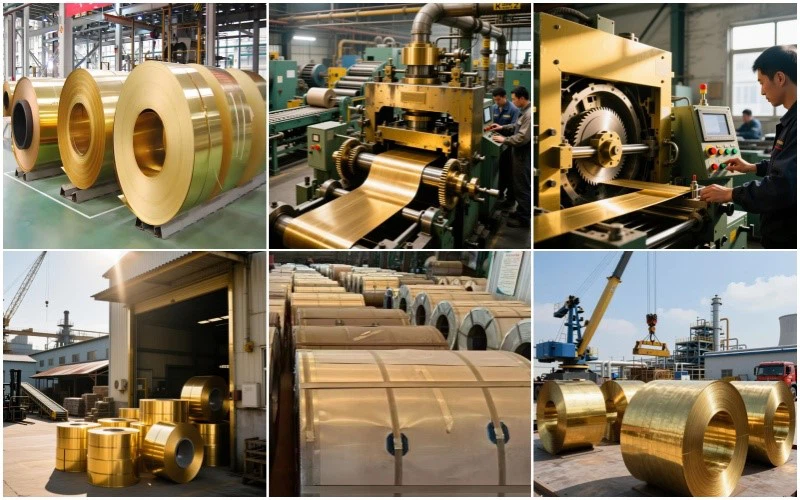
Our facility is equipped with industry-advanced continuous casting and rolling production lines, precision rolling mills, multi-pass drawing units, and automated forming equipment, enabling efficient and stable transformation from copper rods to finished products. Our core machinery allows us to flexibly manufacture a full range of grades-including pure copper (e.g., C11000/T1), phosphorus deoxidized copper (e.g., C12200/TP2), and brass (e.g., H62)-in the form of sheets, tubes, rods, strips, and wires. We also provide tailored processing services such as cutting, slitting, and precision finishing.


