

What is UNS C70600 Copper Tube?

UNS C70600 is the unified numbering system designation for the 90/10 copper nickel alloy, commonly written Cu/Ni 90/10 (UNS C70600). The alloy contains roughly 90% copper, 9–11% nickel, 1.0–1.8% iron and up to 1.0% manganese. The iron and manganese additions refine the grain structure and help form a protective oxide film, which is what gives the material its resistance to fast-flowing seawater and industrial cooling water.
In tube form the material is traded worldwide as Copper Nickel Tube or cupronickel tube. It is produced seamless by cold drawing, or welded, and supplied as straight lengths, coils, finned tube and U-bend tube. UNS C70600 offers good thermal conductivity, easy rolling and welding, and erosion-corrosion resistance that plain copper and most brasses cannot deliver.
The grade is specified across a wide range of heat transfer and water-handling duties:
Condenser, evaporator and heat exchanger tube bundles in power generation and marine engineering
Oil coolers, lube oil and hydraulic oil cooling bundles (OHTB oil cooler service)
Seawater piping, desalination plants, offshore platforms and shipbuilding
Refinery, chemical and refrigeration systems working with brackish or chloride-bearing water
C70600 Copper Tube - Detailed Specifications & Size Range
The table below summarises the technical scope normally supplied. Non-standard sizes, tempers and lengths are produced to order. All figures are the commonly accepted industrial ranges for this grade.
| Parameter | Specification |
|---|---|
| Standard Grade | UNS C70600 / Cu/Ni 90/10 (CuNi10Fe1Mn) |
| Available Forms | Seamless tube, welded tube - straight tube, coil, U-bend tube, finned tube (low-fin / high-fin), capillary-free bore finishes on request |
| Applicable Standards | ASTM B111 / ASME SB-111 (condenser & heat exchanger tube); ASTM B466 / ASME SB-466 (seamless copper-nickel pipe and tube); EN 12451 (seamless round tubes for heat exchangers); EN 12449 (seamless tubes for general purposes); JIS H3300; GB/T 1527 |
| Chemical Composition | Cu: balance (≥88.7%); Ni: 9.0–11.0%; Fe: 1.0–1.8%; Mn: ≤1.0%; Zn: ≤1.0%; Pb: ≤0.05% |
| Mechanical Properties - Annealed | Tensile strength ≥275 MPa; Yield strength ≥105 MPa; Elongation ≥30% |
| Mechanical Properties - Hard Drawn | Tensile strength ≥310 MPa; Yield strength ≥170 MPa; Elongation ≥25% |
| Hardness | Typically 65–85 HRB in annealed temper; 85–100 HRB in drawn tempers |
| Tempers / Conditions | Annealed (soft / O61), light drawn (H55), hard drawn (H80); grain size controlled on request |
| Size Range - Tube | OD 6–114 mm; wall thickness 0.5–10 mm; straight lengths up to 12 m, coils on request |
| Heat Exchanger / Oil Cooler Sizes | OD 12.7 mm, 15.88 mm, 19 mm, 19.05 mm, 25.4 mm with WT 0.8–2.0 mm; reference size OD 19.00 mm × WT 1.40 mm (ID 16.20 mm), typically supplied in 4 m per piece |
| Dimensional Tolerances | OD ±0.05 mm to ±0.13 mm depending on size; wall thickness ±10%; straightness ≤1.0 mm/m; cut length +5 / −0 mm |
| Mandatory & Optional Testing | Hydrostatic test, eddy current test, flattening test, flaring / expansion test, tensile and hardness test, grain size, chemical analysis, dimensional and visual inspection |
| Surface / Finish | Clean and pickled or bright annealed, oil-free, ends capped; bore cleaned and dried for oil cooler and instrument duty |
| Related Products | Elbow / 90° bend, tee, coupling, reducer, stub end and matching flange in the same copper nickel grade; tube sheet plate; same-family grades C71500 (70/30 CuNi) and C68700 aluminium brass tube |
Beyond the tube itself, purchasers assembling a complete bundle or water circuit are supported with the matching items listed above - fittings machined to the same dimensional standard as the tube, plus same-family grades for mixed-material coolers - so a single order covers the tube, the joints and the spare lengths.
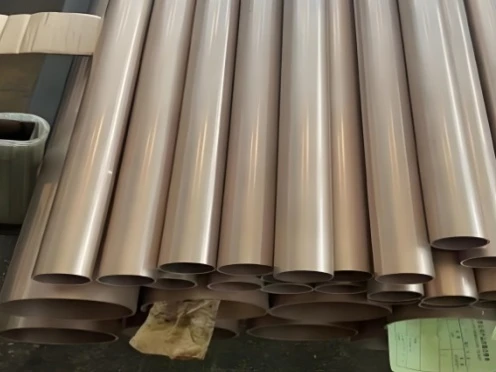
Seamless Tubes
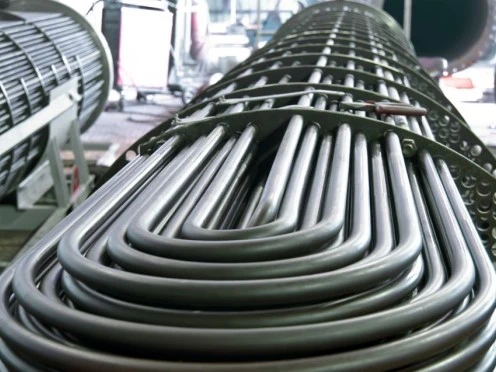
U-Bend Tubes
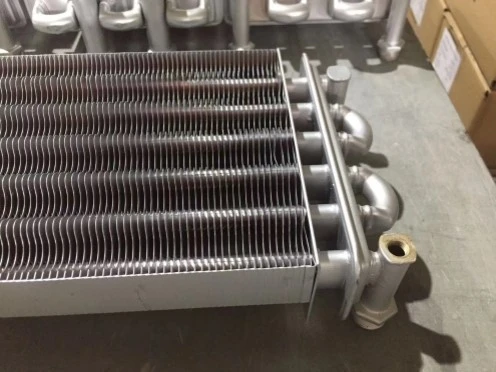
Finned Tubes
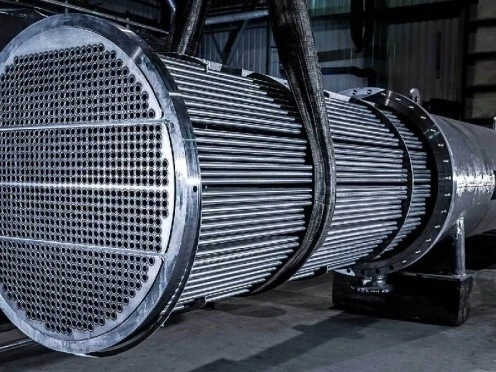
Tube Bundles
Get a quote for C70600 Copper Tube within 24 hours
Equivalent Grades: UNS C70600 Across International Standards
The same 90/10 copper nickel alloy is written differently in each national system. The table below maps UNS C70600 to the designations used in the UNS, ASTM/ASME, European, German, British, Japanese and Chinese standards.
| Standard System | Standard No. | Equivalent Designation |
|---|---|---|
| UNS | UNS C70600 | C70600 (Cu/Ni 90/10) |
| ASTM | ASTM B111 / B466 / B151 / B171 | C70600 |
| ASME | ASME SB-111 / SB-466 | C70600 |
| EN | EN 12451 / EN 12449 | CW352H (CuNi10Fe1Mn) |
| DIN | DIN 17664 / Werkstoff-Nr. 2.0872 | CuNi10Fe1Mn |
| BS | BS 2871 Part 3 | CN102 |
| JIS | JIS H3300 | C7060T |
| GB (China) | GB/T 5231 / GB/T 1527 | BFe10-1-1 (T) |
How to Choose: C70600 vs Other Copper Alloys
Copper nickel tube is rarely the only candidate for a heat transfer duty. The comparison below covers the grades most often quoted alongside C70600, so specifiers can judge where the 90/10 alloy sits.
| Grade | Composition | Key Characteristics | Typical Use |
|---|---|---|---|
| UNS C70600 | Cu 90%, Ni 10%, Fe, Mn | Excellent seawater resistance at moderate velocity, resistant to biofouling and stress corrosion, good thermal conductivity, moderate cost | Heat exchanger and oil cooler tubes, seawater piping, desalination, shipboard systems |
| UNS C71500 | Cu 70%, Ni 30%, Fe, Mn | Higher strength, higher permissible flow velocity, better resistance to erosion and to ammonia-bearing water, higher cost | High-velocity seawater condensers, severe-service salt water piping, offshore and naval heat exchangers |
| UNS C68700 | Cu-Zn with Al and As | Lower cost aluminium brass, good seawater resistance at moderate velocity, sensitive to deposits and to impingement attack | Condenser and heat exchanger tubes in power plants and marine units with clean cooling water |
| UNS C44300 | Cu-Zn with Sn and As | Economical admiralty brass, good resistance to fresh and brackish water, limited tolerance to high chloride and high velocity | Condenser and cooler tubes in fresh water or low-chloride cooling circuits |
| UNS C12200 | Cu 99.9%, P 0.02% | Highest thermal and electrical conductivity, excellent formability, poor resistance to fast or chloride-rich water | Domestic and process water tube, refrigeration, general plumbing and heat transfer where water chemistry is benign |
Some engineers specify UNS C70600 or C68700 when the cooling medium is seawater at moderate velocity, because both resist chloride attack and aluminium brass costs less. Where velocity is high, or the water carries sand, pollutants or ammonia, many purchasers choose C71500 (70/30 CuNi) despite the higher price, since the extra nickel pays back in tube life.
For oil cooler bundles and general water service, C70600 remains the most widely accepted compromise between corrosion life, thermal performance and cost. Where the medium is clean fresh water, C12200 (DHP copper) is often sufficient and offers the best conductivity. Project teams are advised to fix the flow velocity, chloride level and target service life before locking the grade.
Unsure between C70600 and C71500? Send us the duty conditions for a grade recommendation
Copper Tube for Oil Cooler
Copper Tube for Oil Cooler service is normally specified by outside diameter, wall thickness, length and temper rather than by grade alone. The tube carries cooling water on the inside while hot oil flows across the shell side, so both surfaces matter: the water side needs chloride resistance, and the oil side needs a smooth, clean bore that resists deposit build-up and cleaning damage.
Sizes and formats used in oil cooler bundles
Common callouts include OD 12.7 mm, 15.88 mm, 19 mm and 25.4 mm with wall thickness from 0.8 mm to 2.0 mm, supplied as 3 m, 4 m or 6 m straight lengths or as U-bend tube. One frequently specified size is OD 19.00 mm × WT 1.40 mm, giving a 16.20 mm bore - a size that suits standard cooler tube sheets and balances heat transfer area against structural stiffness.
Temper, bore cleanliness and vibration
Oil cooler bundles are usually rolled or expanded into the tube sheet, so annealed (soft) tube is preferred for reliable expansion and a leak-tight joint. Tubes are supplied oil-free and, where required, with a cleaned, capped bore. In bundles with wide support spacing, light drawn temper can be selected to raise stiffness and resist flow-induced vibration.
Testing before assembly
Because a tube that fails in service means an unplanned shutdown, each tube is hydrostatically tested and eddy-current tested before dispatch, with flattening and flaring tests available to demonstrate forming behaviour. Test records travel with the goods so that a quality team can trace every tube back to its heat number.
Certificates, Inspection and Delivery
Mill test certificate and certificate of quality
Every shipment of UNS C70600 tube is released with a manufacturer-issued Certificate of Quality in EN 10204 Type 3.1 format. The document states the heat number, chemical composition (Cu, Ni, Fe, Mn, Zn, Pb) and the mechanical results of the batch it belongs to - tensile strength, yield strength, elongation and hardness where applicable.
The certificate is issued by the producing mill rather than by an intermediary, and one certificate set accompanies each bundle together with the packing list, so incoming inspection can match material to drawing. Where a importing authority requires a specific certificate language or template, it is prepared when the requirement is stated at quotation stage.
Certificate of origin and customs documents
A Certificate of Origin issued by a Chamber of Commerce is available for every export order, and can be applied for under the scheme the destination allows - an ordinary CO, Form E, Form A or another preferential format, subject to the applicable origin rules. Consular legalisation or embassy endorsement is arranged where the importing country demands it.
Certificate and endorsement fees are presented as separate, itemised lines rather than absorbed into the tube price, so that landed cost can be calculated before the order is placed and no unstated charge appears at shipment.
Third-party inspection
Inspection by SGS, BV, TÜV, Intertek or any agency nominated by the purchaser is accepted as standard. Pre-shipment inspection, PMI material identification, dimensional verification, witness of hydrostatic or eddy current testing, and container loading checks can all be arranged.
Where an inspector works to a written inspection and test plan, the plan is agreed before production starts so that hold points sit inside the schedule instead of delaying dispatch.
Order quantity, lead time and shipping
Standard sizes are held in stock and can ship in 7–14 days; made-to-size tube is typically produced in 15–30 days, depending on diameter, wall thickness and ordered quantity. Minimum order quantity is normally 500 kg or one full bundle for standard sizes, and several sizes can be combined in a single order.
Full bundles move by sea, while urgent or small lots go by air or courier. Documents are issued in English as standard - commercial invoice, packing list, mill test certificate, certificate of origin and bill of lading matched to the customs requirements of the destination market.
Packaging and loading
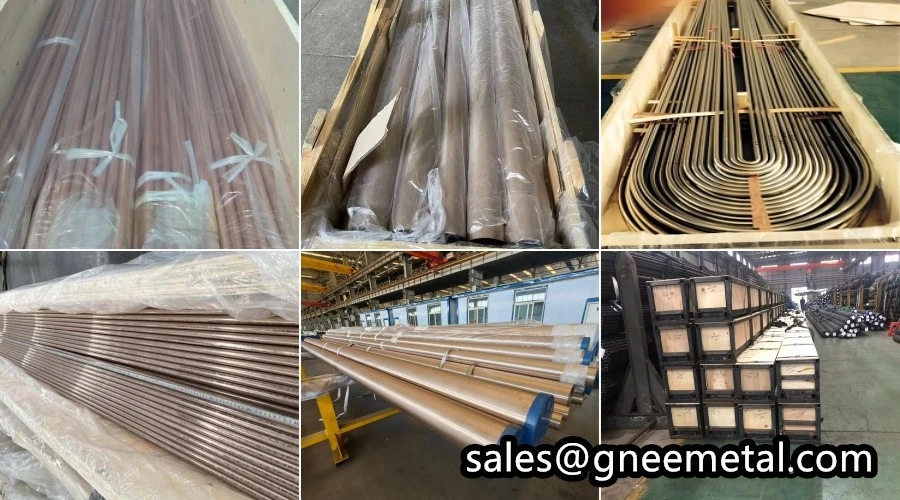
Straight tube is packed in seaworthy wooden cases or on wooden pallets, bound with steel strapping and lined with moisture barrier film, with a plastic cap on every tube end. U-bend and finned tubes are interleaved so bends and fins are not deformed in transit.
Loading plans keep case weights within the unloading limits at destination, and photographs of the packed goods are supplied before departure so the receiving team knows exactly what to expect.
Need the MTC, certificate of origin or third-party inspection? Email us for a document checklist
FAQ
Q: What is the difference between C70600 and C71500 copper nickel tube?
A: Both are cupronickel. C70600 contains about 10% nickel, C71500 about 30% nickel. The 90/10 alloy is the workhorse for seawater and oil cooler duty; the 70/30 alloy is stronger, tolerates higher flow velocity and polluted or ammonia-bearing water, and costs more. Choice usually comes down to water chemistry, design velocity and required tube life.
Q: Can the tube be produced in an exact engineered size, such as 19 mm OD × 1.4 mm wall?
A: Yes. Tube is drawn to the ordered outside diameter and wall thickness within standard tolerances, and cut to the required length. Sizes outside the usual 6–114 mm OD range can be reviewed on request, and the temper, straightness and cut tolerance are agreed in writing before production.
Q: Which documents are supplied with a C70600 tube shipment?
A: Standard issue: EN 10204 Type 3.1 mill test certificate, packing list, commercial invoice and bill of lading. Certificates of Origin by the Chamber of Commerce, Form E or Form A, third-party inspection reports and material identification records are added when ordered. All documents reference the same heat numbers as the goods.
Q: What is the minimum order quantity and typical lead time?
A: Normally 500 kg or one bundle for stock sizes, with dispatch in 7–14 days. Custom diameters, wall thicknesses, U-bend or finned tube are made to order in about 15–30 days. Mixed sizes may be combined to reach the minimum order quantity.
Q: Is C70600 suitable for seawater and for oil cooler service?
A: It is one of the standard choices for both. The alloy resists flowing seawater, chlorides and biofouling, and is widely used in condenser, desalination and shipboard systems. For Copper Tube for OHTB oil cooler bundles it is selected for its chloride resistance, formability during tube sheet expansion and stable thermal performance.
Q: Are U-bend, finned and low-fin copper nickel tubes available as well as straight tube?
A: Yes - straight tube, coil, U-bend tube and finned tube are all available in C70600, together with fittings such as elbow, tee, coupling and reducer, and matching flanges in the same grade. Combining tube and fittings in one order keeps dimensions and material certificates consistent across the whole bundle.
Still have questions? Email us and an engineer will reply within one working day


