

Copper is one of the most versatile and widely used metals in industry, prized for its excellent electrical and thermal conductivity, corrosion resistance, and workability. Among the various copper alloys, phosphorus-deoxidized coppers-particularly TP1 (C12000) and TP2 (C12200)-are critical in applications ranging from plumbing and HVAC systems to electrical engineering and heat exchangers. While they share many similarities, their differences in composition, properties, and applications are significant. This article explores these differences to help engineers, designers, and procurement specialists make informed decisions.
Chemical Composition
| Element | TP1 (C12000) | TP2 (C12200) |
|---|---|---|
| Cu + Ag | ≥ 99.9% | ≥ 99.9% |
| P | 0.004% – 0.012% | 0.015% – 0.040% |
| O | ≤ 0.01% | ≤ 0.01% |
TP1 (Low Residual Phosphorus):
With phosphorus content controlled between 0.004% and 0.012%, TP1 retains higher electrical and thermal conductivity. The low phosphorus level effectively deoxidizes the copper without significantly impeding electron flow.
TP2 (Higher Residual Phosphorus):
TP2 contains 0.015% to 0.040% phosphorus, which provides enhanced deoxidization. This makes it especially suitable for welding and brazing but slightly reduces conductivity compared to TP1.
Key Performance Comparison
Electrical and Thermal Conductivity
TP1 has an electrical conductivity of approximately 85% IACS (International Annealed Copper Standard), making it better suited for applications where conductivity is a priority, such as electrical busbars, connectors, and heat exchangers.
TP2 offers around 80% IACS due to its higher phosphorus content. While still highly conductive, it is typically chosen for applications where conductivity is secondary to joinability.
Weldability and Brazability
TP2 excels in weldability and brazability. The higher phosphorus content acts as a fluxing agent during brazing, promoting better capillary flow and stronger joints. This makes TP2 the preferred choice for plumbing, HVAC piping, and medical gas systems where leak-free joints are critical.
TP1 also offers good weldability but may require more careful process control during brazing. It is often used in applications where welding is required but not the primary focus.
Corrosion Resistance
Both alloys exhibit excellent corrosion resistance in most environments, including water, atmospheric exposure, and mild chemical conditions. Their low oxygen content prevents "hydrogen embrittlement" in reducing atmospheres, making them stable under a wide range of service conditions.
Mechanical Properties
Tensile Strength: TP1 and TP2 offer comparable tensile strength (≈ 215–345 MPa, depending on temper and product form).
Formability: Both alloys exhibit excellent ductility and cold-working properties, especially in the annealed temper. TP1's slightly lower phosphorus content may provide marginally better cold-bending performance.
Get Dedicated Engineer Support


Common Product Forms and Applications
TP1 (C12000)
Typical Forms: Tubes, pipes, sheets, plates, bars, and wires.
Primary Applications:
Heat exchangers and condensers
Electrical components (busbars, connectors)
Industrial fluid transfer systems
General engineering and fabrication
TP2 (C12200)
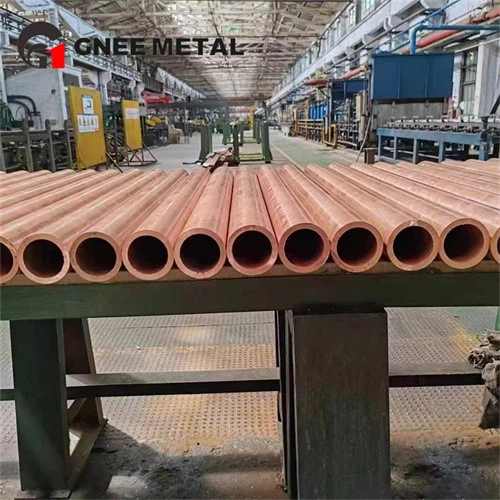
Typical Forms: Predominantly tubes and pipes.
Primary Applications:
Plumbing and potable water systems
HVAC and refrigeration piping
Medical gas lines
Brazed or welded assemblies requiring high joint integrity
How to Choose Between TP1 and TP2
Choose TP1 if:
Electrical or thermal conductivity is a primary requirement.
The application involves electrical components, heat transfer, or general fabrication where joinability is not the sole focus.
You need a balanced combination of conductivity, strength, and workability.
Choose TP2 if:
Ease of brazing or welding is critical (e.g., plumbing, HVAC, medical gas systems).
Joint reliability and leak prevention are top priorities.
Slightly lower conductivity is acceptable for the application.
Our product range
| Product Category | Key Product Forms | Common Standards (Examples) | Typical Applications / Features |
|---|---|---|---|
| Copper Rods & Bars | Round Rods, Square Bars, Hexagonal Bars | ASTM B187, C11000, C10200; EN 12163-66; JIS H3250 | Electrical conductors, machined parts, connectors, hardware. Available in various tempers (soft, hard). |
| Copper Tubes & Pipes | Seamless Tubes, Straight Lengths, Coils (for flexible tubes) | ASTM B75, B280, B88; EN 12735; JIS H3300 | Plumbing, HVAC/R, heat exchangers, medical gas lines, hydraulic systems. |
| Copper Plates & Sheets | Plates (>6mm thickness), Sheets (<6mm thickness) | ASTM B152, C11000; EN 1652; JIS H3100 | Architectural cladding, industrial fabrication, grounding plates, chemical processing. |
| Copper Strips & Foils | Strips, Rolls, Precision Foils | ASTM B272, C11000; EN 1652; JIS H3100 | Electrical contacts, transformers, shielding, gaskets, decorative inlays. |
| Copper Wires | Bare Copper Wire, Stranded Wire, Busbars | ASTM B1, B3, B187; EN 13601; JIS H3260 | Windings, cables, busbars, fasteners, welding electrodes. |
Our factory
We provide a full range of copper products-rods, tubes, plates, bars, wires, and strips-tailored to international specifications including ASTM, BS, and JIS. Our manufacturing capabilities feature horizontal continuous casting for large-diameter bars, rotary piercing mills for high-precision tubes, and multi-roll finishing mills for ultra-thin strips. To ensure superior quality, we implement comprehensive testing protocols: chemical analysis via XRF, mechanical property verification on universal testing machines, and non-destructive testing (ultrasonic and eddy current) for internal and surface integrity. With integrated production, rigorous inspection, and flexible customization, we deliver high-performance copper materials for electrical, HVAC, machinery, and construction industries worldwide.


Get Fast Quote & Logistics Plan


