

The short answer is: Yes, C11000 and C110 refer to the exact same material.
"C110" is the older 3-digit trade name established by the Copper Development Association (CDA). "C11000" is the formal 5-digit designation under the Unified Numbering System (UNS) used in modern standards like ASTM B152 and ASTM B187. Both represent C11000 electrolytic tough pitch copper, which is the global industry standard for high-conductivity electrical applications.
Whether your blueprint says Alloy 110, CDA 110, or UNS C11000, the material must contain a minimum of 99.90% copper and reach at least 100% IACS (International Annealed Copper Standard) conductivity.
Why did the industry move from C110 to C11000?
The shift from 3-digit to 5-digit codes was driven by the need for computerized inventory and more precise categorization. By adding two zeros to the end of the old CDA 110 code, the UNS system created room for future variations of the alloy without changing the core identity of the material.
From a procurement standpoint, specifying C11000 is more "future-proof" and ensures your C11000 mill test certificate (MTC) reflects the most current ASTM or SAE standards.
Grade Correlation for C110 / C11000
| Trade Name | UNS Code | Purity (Min Cu%) | Conductivity | Primary Standard |
| CDA 110 / Alloy 110 | C11000 | 99.90% | 101% IACS | ASTM B152 / B187 |
| T2 Copper | C11000 | 99.90% | 100% - 101% IACS | GB/T 5231 |
| Cu-ETP | CW004A | 99.90% | 100% - 101% IACS | EN 1652 |
If you are sourcing from a china t2 copper plate factory, you will find that T2 is the direct equivalent of the C110/C11000 grade. As we discussed in our guide on C11000 copper equivalents , these international names all target the same electrolytic refining results.
Are the C11000 Mechanical Properties Different from C110?
Since they are the same alloy, their mechanical performance is identical. However, "C110" is often used colloquially without specifying the temper, which can lead to manufacturing issues.
When buying C11000 material, you must specify the hardness-whether it is c11000 h02 (half-hard) for structured components or c11000 h04 (full-hard) for springs and high-tension clips.
C11000 Mechanical Properties (Commonly referred to as C110)
| Temper | Tensile Strength (MPa) | Yield Strength (MPa) | Hardness (Vickers) | Application |
| Soft (O60) | 200 - 250 | 50 - 90 | 40 - 65 HV | Deep drawing, extreme bends |
| Half-Hard (H02) | 260 - 320 | 170 - 240 | 75 - 95 HV | C11000 electrical copper busbar |
| Full-Hard (H04) | 330 - 390 | 250 - 320 | 100 - 120 HV | High-tension connectors |
If your project involves complex geometries, ensuring the correct temper is more important than the 3-digit vs 5-digit naming convention.
Consult Our Engineering Team for Custom Tempering Trials
When Should You Be Careful About Using the Name "C110"?
In most cases, C110 and C11000 are interchangeable. However, in high-end medical or semiconductor projects, the drawing might specifically call for "Oxygen-Free" copper.
A common mistake is assuming "C110" is the same as "C101" (Oxygen-Free Electronic). It is not. C110 (C11000) contains a controlled amount of oxygen, which makes it "Tough Pitch." If your fabrication involves high-temperature hydrogen brazing, using C110 instead of C10100 will cause "hydrogen embrittlement."
To understand this critical distinction further, please refer to our analysis: C110 vs C10100.
FAQ
1. Can I use a C11000 mill test certificate for a project that specifies C110?
Yes. Since C11000 is the formal UNS name for C110, any modern C11000 mill test certificate (MTC) will satisfy an auditor looking for C110 compliance.
2. Is there a price difference between "C110 sheet" and "C11000 sheet"?
No. They are the same material. The c11000 copper price is driven by the LME base price and the fabrication premium for the shape (e.g., sheet, bar, or tube), not by which naming convention is used in the quote.
3. What is the standard form factor for C11000?
C11000 is incredibly versatile. It is most commonly stocked as C11000 copper bar for power distribution, but it is also available in C11000 copper tube for thermal exchangers and C11000 copper plate for heavy industrial use.
4. Is C11000 copper RoHS compliant?
Absolutely. High-purity RoHS compliant C11000 copper from an ISO certified C11000 manufacturer naturally contains trace elements well below the restricted thresholds, making it safe for global export.
5. Why is C110 sometimes called "ETP"?
ETP stands for Electrolytic Tough Pitch. It describes the refining process (electrolysis) and the oxygen content (tough pitch). C110, C11000, and ETP all describe the same grade of copper.
6. Can I get custom cut C11000 copper plate with a polished finish?
Yes. For architectural or aesthetic high-end electrical parts, we provide polished t2 copper sheet (C11000). You can request custom cut C11000 copper plate to reduce your internal scrap and speed up your assembly line.
How to Avoid Sourcing Errors for C11000
When placing an order, the best practice is to use the full UNS designation (C11000) followed by the temper (e.g., H02) and the relevant standard (e.g., ASTM B152). This leaves no room for ambiguity between you and the manufacturer.
Request a Batch-Specific Purity & Conductivity Audit
Product Specifications & Range
| Product Category | Common Grades (Alloys) | Size Range (Dimensions) | Standards |
| Copper Rods | C11000, C12200, C10200, C14500 | Diameter: 3mm – 400mm<br>Shape: Round, Hexagonal, Square | ASTM B187, EN 12163 |
| Copper Tubes | C11000, C12200 (DHP), C10200 (OF), C27200 | OD: 2mm – 219mm<br>Wall Thickness: 0.2mm – 20mm | ASTM B280, EN 12735 |
| Copper Plates | C11000 (ETP), C10200, C12200 | Thickness: 0.1mm – 150mm<br>Width: Up to 2500mm | ASTM B152, DIN 1751 |
| Copper Wires | C11000, C10200, Brass Wire | Diameter: 0.05mm – 10.0mm<br>Form: Spool or Coil | ASTM B3, EN 13602 |
| Copper Strips | C11000, C12200, C26800 (Brass) | Thickness: 0.05mm – 3.0mm<br>Width: 5mm – 610mm | ASTM B19, EN 1652 |
Customization Note:
Custom Dimensions: We provide precision cutting and slitting services to meet your specific project requirements.
Tempers Available: Soft (O), Half-Hard (H02), Full Hard (H04), and Spring Hard (H08).
Surface Finish: Bright annealing, Polished, or Plated (Tin, Silver, Nickel) upon request.
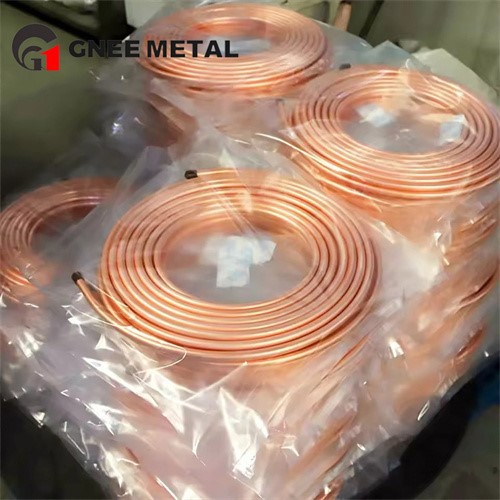
Industrial-Grade Export Packaging
Maximum protection against oxidation, moisture, and transit damage.
1. Anti-Oxidation Protection
VCI Paper & Moisture-Proof Film: Every order is vacuum-sealed or wrapped in anti-corrosion materials to ensure the copper remains bright and tarnish-free during sea freight.
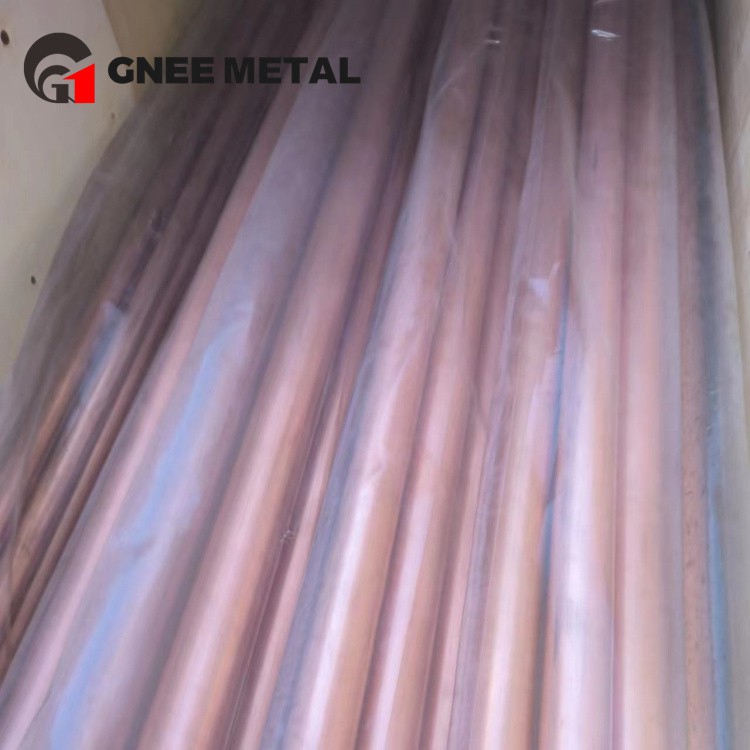
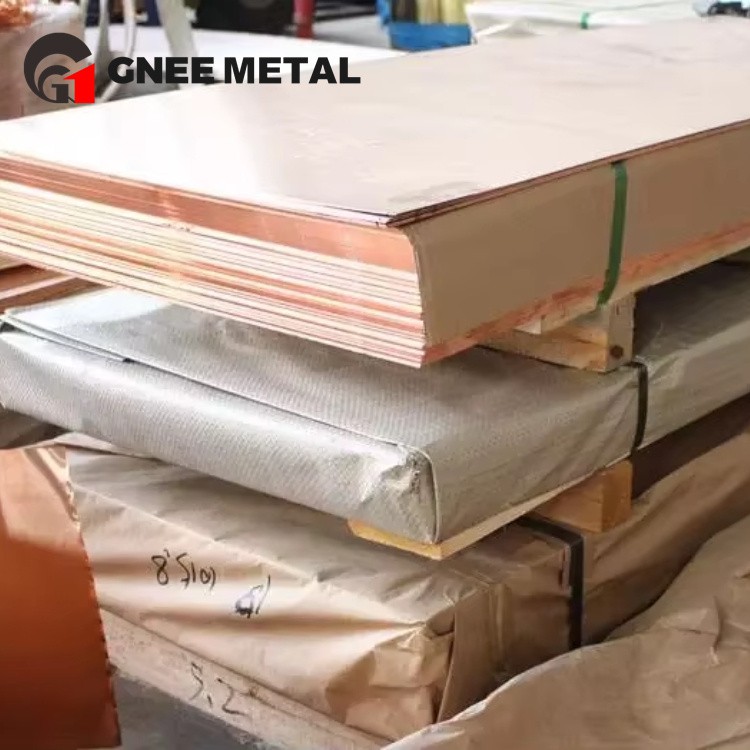
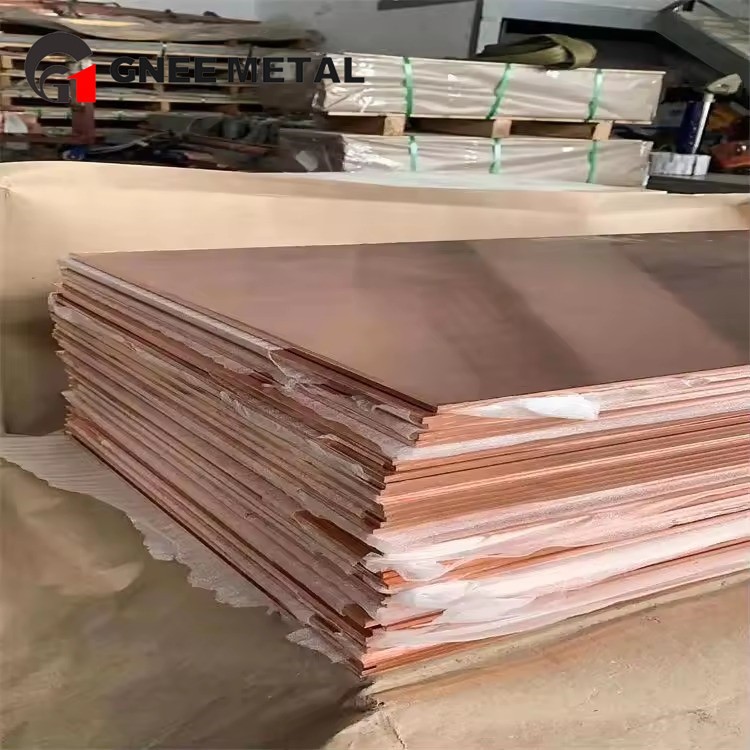
2. Reinforced Structural Support
Seaworthy Wooden Crates: We use reinforced, fumigation-free wooden cases (ISPM-15) and steel strapping for rods, tubes, and heavy plates to prevent bending or surface scratches.
3. Secure Handling & Loading
Forklift-Ready Pallets: All materials are secured on standardized export pallets for easy unloading and maximum stability in containers.
4. Clear Identification
Professional Labeling: Each package includes detailed labels with heat numbers, specifications, and net weight for efficient inventory management.

Advanced Manufacturing & Quality Control
1. Core Production Equipment
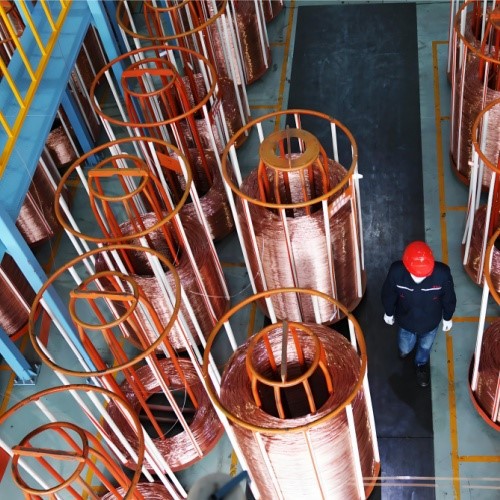
Up-casting & Continuous Casting Lines: Ensures high-purity oxygen-free copper rods and wires with uniform grain structure.
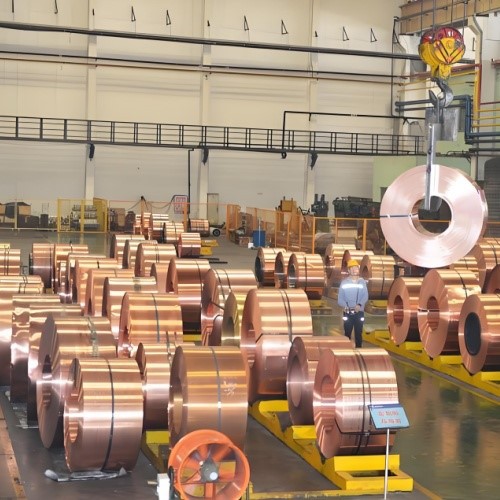
High-Precision Cold/Hot Rolling Mills: Automated thickness control for copper plates and strips with tolerances within ±0.01mm.
Large-Scale Extrusion & Drawing Machines: Capable of producing seamless copper tubes and rods in diverse diameters and shapes.
Atmospheric Controlled Annealing Furnaces: Bright annealing process to achieve specific tempers (Soft, Half-hard, Hard) without surface oxidation.
2. In-House Testing Center
Direct-Reading Spectrometers: Instant chemical composition analysis to guarantee Cu purity and precise alloying (Brass, Bronze, etc.).
Universal Tensile Testers: Verifying mechanical properties including tensile strength, elongation, and yield strength.
Eddy Current & Ultrasonic Testing: 100% non-destructive inspection for tubes and rods to detect internal cracks or flaws.
Conductivity & Hardness Testers: Ensuring electrical conductivity (IACS) and Vickers/Rockwell hardness meet international standards (ASTM, EN, DIN).



Get Fast Quote & Logistics Plan


