

Selecting the wrong heat exchanger tube can be a costly mistake. Premature failure, unplanned downtime, and early retubing can cost your facility hundreds of thousands of dollars. But with so many options on the market, how do you choose the right ASTM B111 C68700 tube for your specific application?
This guide walks you through everything you need to know - from size selection to supplier evaluation - to make an informed purchasing decision.
Need a quick quote? Visit our [ASTM B111 C68700] for current pricing and available sizes. Also browse our full [ASTM B111 heat exchanger tubes] collection to compare all alloy options.
Customer Visit & Project Reference – India
We successfully supplied ASTM B111 C68700 aluminum brass tubes to a customer in India for shell & tube condenser applications. During the project, the customer visited our facility for production inspection and quality verification. All tubes were manufactured in accordance with ASTM B111 requirements and delivered with complete Material Test Certificates (MTC), ensuring full heat number traceability and verified chemical and mechanical properties.


What Are the Standard Sizes Available for ASTM B111 C68700 Tubes?
ASTM B111 C68700 condenser tube is available in a wide range of diameters and wall thicknesses. Selecting the correct size is critical for proper tube-to-tubesheet fit and long-term reliability.
| Parameter | Common Range | Typical Values |
|---|---|---|
| Outside Diameter (OD) | 6 mm to 50 mm | 15.88 mm (5/8"), 19.05 mm (3/4"), 25.4 mm (1") |
| Wall Thickness (BWG) | 0.5 mm to 3.0 mm | 1.245 mm (18 BWG), 1.65 mm (16 BWG), 2.11 mm (14 BWG) |
| Length | 1 m to 30 m | Custom cut to specification |
| Temper | Annealed (O61) or Light Drawn (H55) | O61 is standard for roller expansion |
BWG (Birmingham Wire Gauge) Reference Table:
| BWG Gauge | Wall Thickness (mm) | Wall Thickness (inches) | Typical Application |
|---|---|---|---|
| 20 BWG | 0.889 mm | 0.035" | Low pressure, HVAC |
| 18 BWG | 1.245 mm | 0.049" | Standard condenser service |
| 16 BWG | 1.651 mm | 0.065" | High pressure, power plants |
| 14 BWG | 2.108 mm | 0.083" | Severe service, erosion-prone |
| 12 BWG | 2.642 mm | 0.104" | Special high-pressure applications |
Selection tip: For most seawater-cooled power plant condensers, 19.05 mm OD x 1.245 mm wall (5/8" x 18 BWG) is the industry standard. Always confirm your tubesheet hole dimensions before ordering.
What Temper Condition Should You Order - O61 or H55?
The temper (hardness) of your ASTM B111 C68700 tube affects both installation and in-service performance.
| Temper | Condition | Hardness (HRF) | Best For |
|---|---|---|---|
| O61 (Annealed) | Soft, fully annealed | 60-80 | Roller expansion into tubesheets, easy bending |
| H55 (Light Drawn) | Slightly hardened | 70-90 | Retubing tight clearances, higher erosion resistance |
Which should you choose?
Choose O61 for new installations where tubes will be roller-expanded. The soft temper allows proper tube expansion without cracking.
Choose H55 for retubing jobs where the original tubesheet holes may have worn larger, or for high-velocity applications where extra erosion resistance is desired.
Critical note: If you order H55 tubes, ensure your installation contractor is experienced with light-drawn temper - it requires higher expansion torque than annealed tubes.
How to Verify That Your C68700 Tubes Meet ASTM B111 Specifications?
Receiving non-compliant tubes is more common than you think. To protect your investment, always perform the following verification steps:
1. Request and review Mill Test Reports (MTRs)
The MTR must certify:
Chemical composition (Cu: 76-79%, Al: 1.8-2.5%, As: 0.02-0.06%, Zn: remainder)
Mechanical properties (Tensile ≥ 50,000 psi, Yield ≥ 18,000 psi, Elongation ≥ 30%)
Temper (O61 or H55 as specified)
Hydrostatic or eddy current test results
2. Perform dimensional inspection
Randomly sample tubes and measure:
Outside diameter (±0.05 mm tolerance)
Wall thickness (minimum wall must meet specification)
Length (±3 mm typically acceptable)
Straightness (max 1.5 mm per meter)
3. Check surface quality
No cracks, seams, or visible defects
Inside surface should be clean and smooth
No excessive oxidation or discoloration
4. Confirm packaging and marking
Each tube should be marked with manufacturer, ASTM B111, C68700, temper, and size
Tubes should be bundled with protective end caps to prevent damage during shipping
What Is the Difference Between Seamless and Welded C68700 Tubes?
For ASTM B111 applications, only seamless tubes are permitted. The ASTM B111 standard specifically requires seamless construction for heat exchanger and condenser tubes.
| Feature | Seamless C68700 Tube | Welded C68700 Tube (Not ASTM B111) |
|---|---|---|
| ASTM Compliance | Yes (B111) | No |
| Weld Seam | None | Present |
| Corrosion Risk | Uniform | Weld seam preferential attack |
| Pressure Rating | Higher | Lower |
| Cost | Higher | Lower |
| Availability | Standard | Rare for C68700 |
Why seamless? The weld seam in welded tubes is a potential corrosion initiation site, especially in seawater service. ASTM B111 C68700 seamless tube eliminates this risk, providing uniform corrosion resistance throughout.
How to Calculate How Many Tubes You Need for Your Heat Exchanger?
Calculating tube quantity is essential for budgeting and ordering. Here is a simple method:
Step 1: Determine tubesheet layout
Tubesheet diameter (D) in mm
Tube pitch (center-to-center spacing) - typically 1.25 x tube OD
Triangular or square pattern?
Step 2: Estimate tube count
For a rough estimate: Number of tubes ≈ (Tubesheet area × packing factor) / (Tube pitch²)
| Tube OD | Typical Pitch | Packing Factor (Triangular) | Tubes per m² of tubesheet |
|---|---|---|---|
| 15.88 mm (5/8") | 20 mm | 0.907 | ~2,270 |
| 19.05 mm (3/4") | 24 mm | 0.907 | ~1,575 |
| 25.4 mm (1") | 31.75 mm | 0.907 | ~900 |
Step 3: Add spare tubes
Order 5-10% extra tubes for:
Installation damage (scratches, dents)
Future plugging and replacement
Testing and sample retention
Example: A condenser with 1,000 tubes should order 1,050-1,100 tubes to ensure adequate spares.
How Does Wall Thickness Affect Tube Performance and Cost?
Wall thickness is a trade-off between cost and longevity. Thicker walls cost more but provide more corrosion allowance and higher pressure ratings.
| Wall Thickness (BWG) | Relative Cost | Corrosion Allowance | Typical Service Life |
|---|---|---|---|
| 20 BWG (0.889 mm) | 1.0x (baseline) | Low | 10-15 years |
| 18 BWG (1.245 mm) | 1.3x | Medium | 15-20 years |
| 16 BWG (1.651 mm) | 1.7x | High | 20-25 years |
| 14 BWG (2.108 mm) | 2.2x | Very High | 25-30 years |
Selection guide:
Clean, well-maintained system → 18 BWG is optimal (best value)
Aggressive or poorly controlled water → 16 BWG or 14 BWG for extra corrosion allowance
Budget-constrained project → 20 BWG may work but expect shorter life
Cost-saving insight: Paying 30% more for 16 BWG instead of 18 BWG can double tube life. Calculate lifecycle cost, not just purchase price.
What Is the Typical Lead Time for ASTM B111 C68700 Tubes?
Lead times vary significantly by supplier and order quantity. Understanding this helps you plan your project schedule.
| Order Type | Typical Lead Time | Notes |
|---|---|---|
| Standard sizes in stock | 1-2 weeks | Limited quantities |
| Standard sizes, mill production | 4-6 weeks | Most common |
| Non-standard OD or wall | 8-12 weeks | Requires special tooling |
| Large quantity (>50 tons) | 10-14 weeks | Mill scheduling |
To avoid project delays:
Order at least 8 weeks before your planned installation date
For emergency retubing, ask about expedited production (additional cost)
Keep safety stock of common sizes for critical equipment
FAQ
1. What is the difference between ASTM B111 C68700 and other C68700 specifications?
ASTM B111 is the specific standard for seamless copper alloy heat exchanger and condenser tubes. While C68700 is the UNS alloy designation, ASTM B111 defines the manufacturing requirements, tolerances, testing procedures, and delivery conditions for tubes made from C68700. Other specifications (like ASTM B359 for finned tubes) may also reference C68700, but for smooth-bore heat exchanger tubes, ASTM B111 is the correct specification. Always specify both the alloy and the standard: "ASTM B111 C68700 seamless tube."
2. Can ASTM B111 C68700 tubes be used for hydraulic lines or instrumentation?
No, ASTM B111 C68700 is not intended for hydraulic or instrumentation applications. The ASTM B111 standard is specifically for heat exchangers and condensers. For hydraulic lines, use ASTM B75 or B280 seamless copper tube. For instrumentation, use ASTM B819. Using C68700 in the wrong application could lead to unexpected failure because the alloy is optimized for corrosion resistance in cooling water, not for high-pressure hydraulic fluid service.
3. What is the maximum pressure rating for ASTM B111 C68700 tubes?
The maximum pressure rating depends on tube OD, wall thickness, temperature, and safety factor. A common formula for thin-wall tubes is Barlow's formula: P = (2 × S × t) / (OD) , where S = allowable stress (approximately 6,000-8,000 psi for C68700 at room temperature). For a typical 19.05 mm (0.75") OD x 1.245 mm (0.049") wall tube, the burst pressure is approximately 4,000-5,000 psi, but design pressure is typically limited to 300-500 psi with a safety factor of 5-10. Always consult a pressure vessel engineer for your specific application.
4. How should ASTM B111 C68700 tubes be stored before installation?
Store C68700 tubes in a clean, dry, indoor location to prevent corrosion before installation. Follow these guidelines: (1) Keep tubes in their original packaging with end caps until ready to install, (2) Store on flat, padded racks to prevent bending, (3) Maintain storage temperature between 10-35°C (50-95°F), (4) Avoid contact with ammonia, acids, or harsh chemicals, (5) Do not store directly on concrete floors (moisture can cause underside corrosion). For long-term storage (>6 months), consider adding a vapor corrosion inhibitor (VCI) inside the tubes.
5. Can I mix ASTM B111 C68700 tubes from different manufacturers in the same heat exchanger?
Technically yes, but it is not recommended. Different manufacturers may have slight variations in dimensional tolerances, surface finish, and even minor chemistry differences within the ASTM allowed range. Mixing tubes could lead to: (1) inconsistent roller expansion (some tubes loose, others over-expanded), (2) galvanic differences (unlikely but possible), (3) different thermal expansion behavior. For best results, purchase all tubes for a single retubing project from the same manufacturer and same heat lot. If you must mix, clearly document which tubes came from which supplier.
6. What is the standard length tolerance for ASTM B111 C68700 tubes?
The ASTM B111 standard specifies length tolerance of +6 mm / -0 mm for tubes up to 6 meters (20 feet), and +10 mm / -0 mm for longer tubes. This means tubes cannot be shorter than ordered length, but can be slightly longer. In practice, many suppliers hold ±3 mm. Always confirm length tolerance with your supplier before ordering, especially if your tubesheet design has very tight clearances for tube end projection beyond the tubesheet face.
7. How do I calculate the tube expansion force required for C68700?
Tube expansion force depends on tube OD, wall thickness, tubesheet material, and desired joint strength. For ASTM B111 C68700 tubes expanded into a carbon steel tubesheet, a typical rolling torque is 50-150 N·m (40-110 ft·lb) depending on tube size. Critical parameters: (1) Tubesheet hole diameter should be OD + 0.1 to 0.3 mm, (2) Tubesheet hardness should be ≤ 150 HB for good expansion, (3) Use lubricated roller expanders to prevent galling. For precise calculations, consult a roller expander manufacturer's technical guide. Over-expansion can crack the tube; under-expansion leads to leaks.
8. Can ASTM B111 C68700 tubes be bent into U-shapes?
Yes, but you must follow proper procedures to avoid stress corrosion cracking. For U-bend applications: (1) Use annealed (O61) temper tubes, (2) Bend on a proper mandrel bender with minimum bend radius typically 1.5-2× tube OD, (3) After bending, stress-relief anneal at 300-400°C (570-750°F) for 1-2 hours, (4) Inspect bend areas for cracks or thinning using eddy current testing. Without stress relief, residual bending stresses combined with ammonia or moisture can cause catastrophic stress corrosion cracking within months.
9. What is the difference between ASTM B111 and ASME SB111 for C68700?
ASTM B111 and ASME SB111 are essentially identical standards. ASME SB111 is the ASME Boiler and Pressure Vessel Code adoption of ASTM B111. Tubes meeting ASTM B111 automatically meet ASME SB111 requirements. The only practical difference is that ASME SB111 may require additional documentation for Code-stamped vessels. If your heat exchanger requires an ASME U-stamp, specify "ASME SB111 C68700." For non-Code applications, ASTM B111 is sufficient and typically less expensive.
10. How do I clean C68700 tubes after installation but before commissioning?
Pre-commissioning cleaning is essential to remove manufacturing oils, debris, and oxidation. Recommended procedure: (1) Flush with clean fresh water to remove loose debris, (2) Circulate a mild alkaline cleaner (non-ammoniated, pH 9-10) at 50-60°C for 2-4 hours, (3) Rinse thoroughly with fresh water until pH returns to neutral, (4) If passivation is desired, circulate a dilute inhibitor solution. Never use ammonia-based cleaners on C68700 - they can cause stress corrosion cracking. Never use hydrochloric acid (HCl) - it attacks both aluminum and brass.
100% Inspection Per ASTM B111 / C68700 – Customer Witnessed
Every tube in this lot has passed third-party witnessed inspection per ASTM B111 standard for C68700 alloy. Below are actual photos from customer-onsite inspection, including eddy current testing and dimensional verification.
Inspection items verified:
• Eddy current testing (ECT) – no through-wall defects
• Outer diameter & wall thickness – within ±0.02mm tolerance
• Surface finish & temper (O61) – conforms to ASTM
• Hardness & chemical composition – certified.


Export-Ready Packing – Anti-Rust & Wooden Case
After passing inspection, all tubes are packed according to export standards and customer-specific requirements. The packing process is documented below to ensure traceability and damage-free delivery.
Packing steps shown in video & images:
1. Tube cleaning & drying
2. Plastic end caps on both ends
3. VCI anti-rust paper wrapping
4. Bundle strapping with moisture barrier film
5. Plywood wooden case (ISPM-15 compliant) with foam padding
6. Labeling with ASTM grade, lot number, and inspection stamp


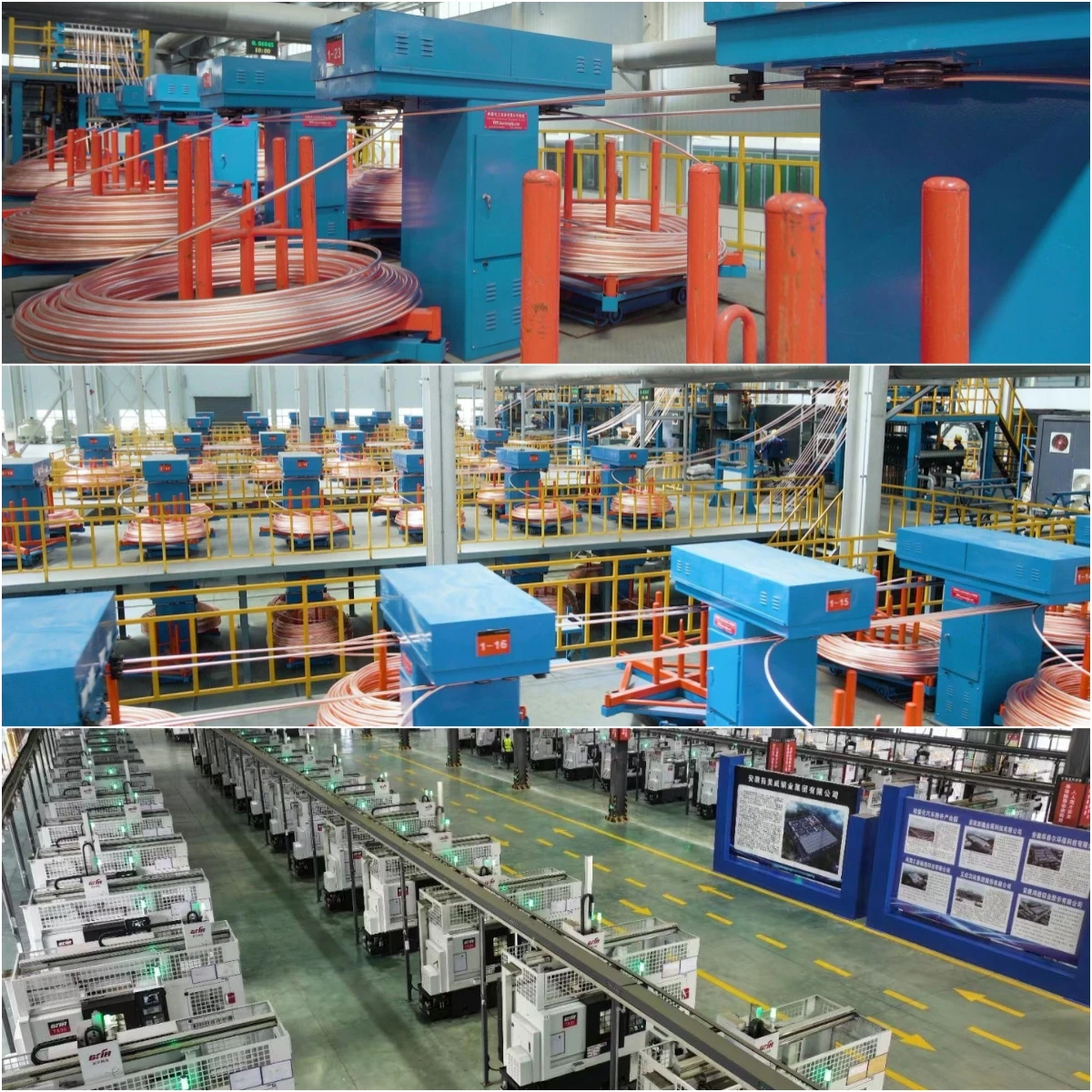
Our Factory & Equipment
All ASTM C68700 tubes are produced and inspected on our in-house equipment, allowing full process control from billet casting to final packing.
Key equipment used for this lot:
• Induction melting furnace – precise alloying (Cu + Zn + Al + As)
• Horizontal continuous casting – uniform billet structure
• Extrusion press (800T / 1630T) – seamless tube forming
• Cold drawing bench (5–40m) – dimensional accuracy to ±0.02mm
• Online eddy current tester (FOERSTER / MAC) – 100% NDT
• Ultrasonic wall thickness gauge – real-time monitoring
• Annealing furnace (controlled atmosphere) – temper O61
In-house metrology: Micrometers, pin gauges, optical comparator, hardness tester (HV/HRB)
All equipment is calibrated quarterly. Production records are traceable by lot number.
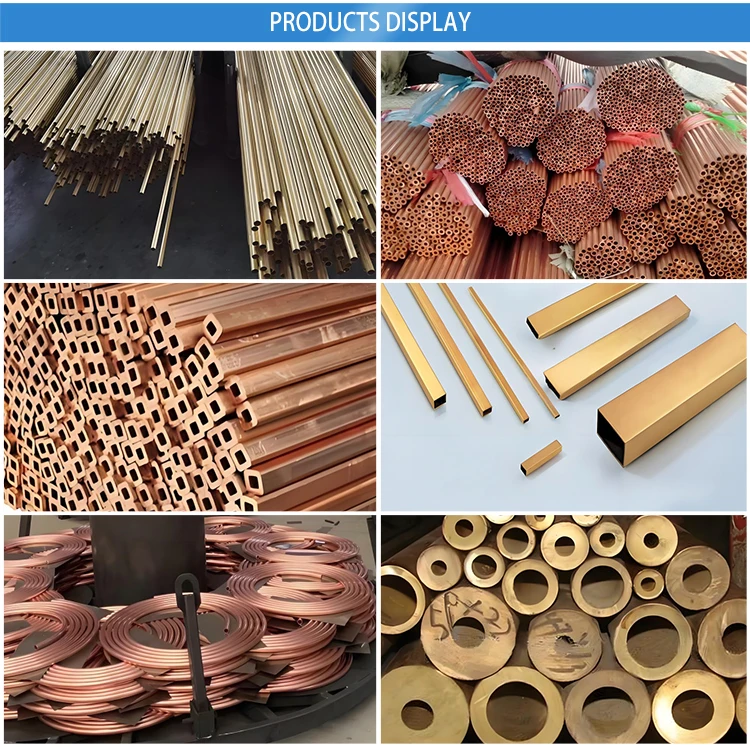
Copper & Copper Alloy Products – Supply Range
| Product Form | Common Alloys / Grades | Size Range | Standards | Typical Applications |
|---|---|---|---|---|
| Tube / Pipe | C12200, C11000, C68700, C70600, C71500, C44300, C27000 | OD: 4mm – 219mm Wall: 0.5mm – 20mm Length: up to 15m |
ASTM B68, B75, B111, B280, B359, B466 | Heat exchangers, condensers, HVAC, plumbing, oil coolers |
| Plate / Sheet | C11000, C12200, C26000, C26800, C52100, C68700 | Thk: 0.5mm – 50mm Width: up to 1200mm Length: up to 4000mm |
ASTM B152, B169, B103, B465 | Electrical parts, roofing, gaskets, industrial panels |
| Rod / Bar | C11000, C26000, C36000, C46400, C48500, C63000 | Dia: 3mm – 120mm Length: 1m – 6m (or custom) |
ASTM B16, B124, B138, B150, B453 | Valve stems, shafts, fasteners, machined components |
| Wire | C11000, C16200, C17500, C26000, C52100, C64700 | Dia: 0.1mm – 12mm Coil weight: up to 100kg |
ASTM B1, B2, B3, B197, B206, B624 | Welding electrodes, electrical conductors, springs, mesh |
| Strip / Foil | C11000, C19400, C26000, C26800, C52100, C70250 | Thk: 0.05mm – 3.0mm Width: 5mm – 600mm |
ASTM B36, B465, B694, B888 | Connectors, terminals, battery tabs, shielding, stamping parts |
Check Today's Stock & Lead Time


