

What is H62 brass?
H62 brass is a common copper-zinc alloy with a copper content of approximately 60.5% to 63.5% and zinc as the balance. It is a high-precision, high-strength α+β dual-phase brass. The "H" in its name represents brass, and "62" indicates an average copper content of 62%. This material possesses excellent mechanical properties, corrosion resistance, and machinability, and is widely used in industrial manufacturing and civilian applications.
h62 brass chemical composition
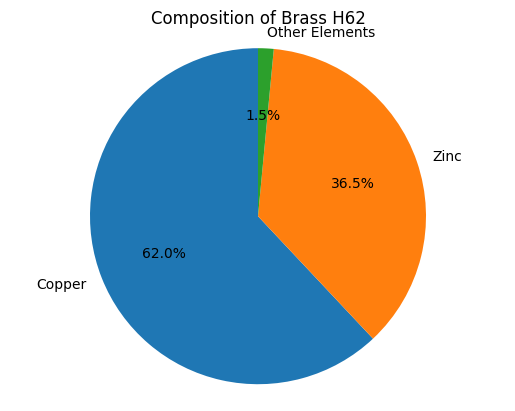
|
Element |
Composition (%) |
|---|---|
|
Copper (Cu) |
60.5 - 63.5 |
|
Iron (Fe) |
≤ 0.15 |
|
Lead (Pb) |
≤ 0.08 |
|
Zinc (Zn) |
Balance |
|
Antimony (Sb) |
≤ 0.005 |
|
Bismuth (Bi) |
≤ 0.002 |
|
Phosphorus (P) |
≤ 0.01 |
h62 brass Application Fields
Building Hardware: Door and window fittings, locks, plumbing fittings.
Electronics and Electrical Appliances: Heat exchangers, conductive terminals, switch contacts.
Mechanical Manufacturing: Screws, rivets, washers, stamped parts.
Decorative Materials: Metal mesh, decorative strips, crafts.
Industrial Equipment: Condenser tubes, heat exchangers (must be protected from seawater corrosion).
What are the Advantages of Using H62 Brass?
H62 brass offers several advantages, including high corrosion resistance, excellent machinability, and good wear resistance. It's cost-effective for many applications. It holds up a long time mechanically so it'll do what you need it to. H62 is a good, adaptable alloy, because it's one of those brass alloys that works well. It's a great all-around option, so use it.
How Does H62 Brass Compare to Other Brass Alloys?
H62 offers a great balance of strength and ductility in your brass. Why would you choose H70 over H62? It's going to be more ductile. It's going to be easier to cold work. On the other hand, if you pick H59, you'll get a stronger brass, but it won't have the ductility that H62 does. H62 brass is in the middle. It gives you a great combination of strength and workability. That's why it's such a good all-around brass for most of us.
Our product range
1. Pure Copper (Sheet, Tube, Wire)
Primary Grades: T1 (C11000), T2 (C10100). We prioritize C11000 (T1) for its excellent conductivity.
Standards: ASTM B152 (Sheet), ASTM B75/B88 (Tube), ASTM B1/B3 (Wire), EN, JIS, GB/T.
Typical Sizes:
Tube: OD 6mm – 200mm.
Sheet: Thickness 0.5mm – 50mm.
Wire: Diameter 1.0mm – 10mm.
2. Phosphorus Deoxidized Copper (Tube, Sheet)
Primary Grades: TP1 (C12000 / CW023A), TP2 (C12200). Ideal for welding and plumbing.
Standards: ASTM B188, ASTM B75/B88, EN 12451, JIS H3300.
Typical Sizes:
Tube: OD 8mm – 150mm.
Sheet: Thickness 1.0mm – 30mm.
3. Brass (Strip & Coil)
Primary Grades: H96, H68, H62 (CuZn37 / C28000). We strongly recommend H62 for its excellent balance of strength and machinability.
Standards: ASTM B36, ASTM B134, EN 1652, JIS H3100.
Typical Sizes:
Strip/Coil: Thickness 0.1mm – 3.0mm, Width up to 600mm.
Get the complete product catalog
Our factory

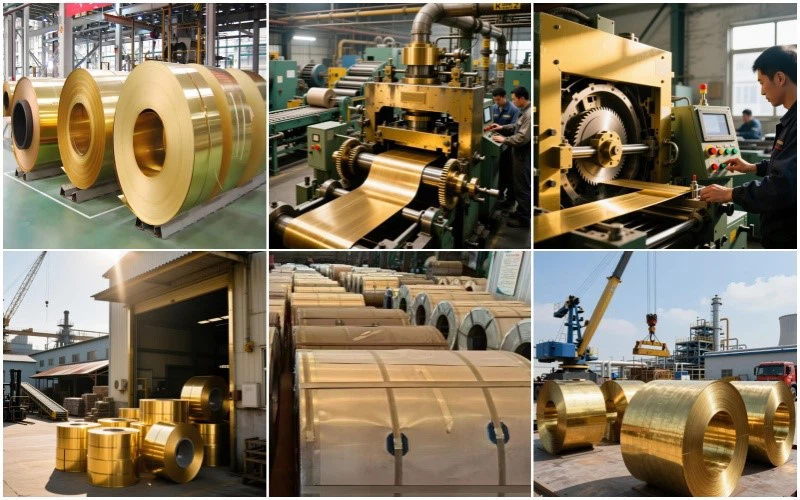
Our facility is equipped with industry-advanced continuous casting and rolling production lines, precision rolling mills, multi-pass drawing units, and automated forming equipment, enabling efficient and stable transformation from copper rods to finished products. Our core machinery allows us to flexibly manufacture a full range of grades-including pure copper (e.g., C11000/T1), phosphorus deoxidized copper (e.g., C12200/TP2), and brass (e.g., H62)-in the form of sheets, tubes, rods, strips, and wires. We also provide tailored processing services such as cutting, slitting, and precision finishing.


