

Copper tubes play a major role in facilitating heat transfer between two fluids within the heat exchanger. Copper has a high thermal conductivity of about 400 W/mK, ensuring quick heat transfer. This is vital for industries such as HVAC (Heating, Ventilation, Air Conditioning), power generation and refrigeration, where operational efficiency depends on optimal temperature levels.
Furthermore, copper is malleable enough to be coiled or shaped into other configurations, thus increasing the surface area available for heat exchange without compromising system integrity. Moreover, copper will not corrode, especially from water or atmospheric conditions, extending the life span of these equipment since they do not need frequent maintenance.
Copper Tubes for Locomotives
Copper tubes are mainly used in locomotive engine cooling systems. The cooling system must be robust and reliable to cool down the intense heat generated by a moving train's engine and ensure efficiency.
Copper is also preferred for use in radiator tubes within a locomotive's engine due to its excellent dissipation abilities when compared to other metals like aluminum, which cannot withstand prolonged high temperatures like copper can. In addition to being able to stand up against some kinds of corrosion brought about by engine fluids (such as coolant), this metal can endure extreme temperatures without degrading, further proving its appropriateness in such an environment.
Besides, even under harsh conditions, copper's strength is such that it remains functional over long periods, thus improving the effectiveness of railway transportation in terms of reliability.
Manufacturing Process
| Step | Process |
|---|---|
| 1 | Melting |
| 2 | Casting |
| 3 | Extruding |
| 4 | Drawing & Pilgering |
| 5 | Annealing |
| 6 | Inspection |
| 7 | Cutting |
| 8 | Packing |
In both systems (heat exchangers as well as locomotives), durability constitutes another advantage of using copper tubing. Various forms of copper corrosion, including crevice, pitting, and stress corrosion cracking, are important factors in maintaining system performance.
The tubes in heat exchangers often have to tolerate a range of chemicals and high-temperature fluctuations, but the fact that copper can withstand such conditions without degrading means it lasts for a long time. Similarly, copper tubes cope with constant locomotive vibrations and mechanical stresses. Rail transport is tough on these tubes, making it necessary that they are strong enough not to require frequent repair or replacement.
Despite being initially more expensive than materials like aluminum or steel, copper proves cost-effective over time, mainly through reduced maintenance costs, fewer replacements, and improved system output. The superior thermal conductivity of copper facilitates efficient system operation, which results in energy savings. Similarly, industries where operation continuity is critical, such as industrial and transportation sectors, benefit from reduced instances of repairs caused by corrosion-related failures, which lead to unexpected downtimes and repair costs being minimized.
Specifications of Copper Tube For Heat Exchangers & Locomotives
| Property | Details |
|---|---|
| Standard | ASTM B68 / ASTM B75 / ASTM B280 / ASTM B88 / JIS H3300 / EN1057 or BS2871: Part 2:1972 / DIN 1754/8905 / IS2501 |
| Specification | ASTM B280, JIS H3300, AS/NZS1571, JIS3300-2006 |
| Description | Copper Pipe and Tube For Heat Exchangers & Locomotives |
| Material | TU2, C1020T, C10200, T2, C1100, TP1, C1201T, C1200, TP2, C1220T, C12200, C14200, C19400, etc. |
| Outer Diameter (OD) | 4mm to 150mm |
| Wall Thickness | 0.2mm ~ 5mm |
| Length | 1m, 2m, 3m, 6m, or as required |
| Types | Seamless Pipes, Tube / Inner Grooved Pipes / Square Pipes, Tube / Rectangular Pipes, Tube / Finned Pipes, Tube |
| Application | 1. Pancake Coil for ACR, General Engineering Applications 2. LWC Coil for ACR, General Engineering Applications 3. Straight Copper Tubes for ACR and Refrigeration 4. Inner-grooved copper tube for ACR and Refrigeration 5. Copper Pipe for Transportation System of water, gas and oil 6. Semi-finished Copper tube for industrial applications |
Types of Copper Tube For Heat Exchangers & Locomotives
Standard Types
Copper Round Tube
Copper Seamless Tube
Copper Condenser Tube
Other Types
| Copper Alloy C10100 Tube Heat Exchangers | Locomotives Copper Pipe 3/8" |
| Copper Tubes Heating Locomotives Stockist | Copper Alloy C10200 Pipes Heat Exchangers |
| Heat Exchangers Copper Condenser Tubes | Locomotives Copper C10800 Pipe |
| Copper C10300 Tubes Locomotives | Copper C12000 Tubes Heat Exchangers |
| Copper Tubes Heat Exchangers Supplier | B75 Seamless Copper Tube Locomotives |
| Copper Capillary Tubing Locomotives | Copper Heat Exchanger Tube Heat Exchangers |
| Heat Exchangers Copper Tube Manufacturer | Locomotives Copper Alloy Round Pipes |
| B88 Seamless Copper Tube Heat Exchangers | Copper Pipe For Heat Exchangers Stockholder |
| Table X Copper Tube For Locomotives | Copper Tube 5/8" Locomotives |
| Table Y Copper Tubing Heat Exchangers | Heat Exchangers Copper Pipe 3/4" |
| Table Z Copper Tube For Locomotives | Copper Pipe HVAC For Locomotives |
| Copper Hard Drawn Tube Heat Exchangers | Copper Tube For Heat Exchangers |
| Copper Soft Tubes For Locomotives | Half Hard Copper Pipe Locomotives |
| Heat Exchangers Copper Tube 1/2" | Copper Soft Pipe For Heat Exchangers |
| Copper Tube 1/4" Heat Exchangers | Copper Inner Grooved Tube Locomotives |
Application Industries for Copper Tube For Heat Exchangers & Locomotives
| Industry | Application |
|---|---|
| Marine | Heat exchangers, cooling systems |
| Plumbing and HVAC | Heating, ventilation, air conditioning |
| Architecture | Building systems |
| Interior Design | Decorative and functional elements |
| Automotive | Cooling systems, radiators |
| Electrical and Fuel Gas | Wiring, gas distribution |
FAQ
Q1: What is the thermal conductivity of copper tubes for heat exchangers?
A: The product page states copper has a high thermal conductivity of about 400 W/mK. This is among the highest of any commercially available metal, ensuring rapid and efficient heat transfer in heat exchanger applications.
Q2: Why is copper preferred over aluminum for locomotive radiator tubes?
A: Copper is preferred because:
Aluminum cannot withstand prolonged high temperatures like copper can
Copper has excellent heat dissipation abilities
Copper resists corrosion from engine fluids (coolant, etc.)
Copper endures extreme temperatures without degrading
Q3: What materials/grades are available for these tubes?
A: Available grades include: TU2, C1020T, C10200, T2, C1100, TP1, C1201T, C1200, TP2, C1220T, C12200, C14200, C19400, and more.
Q4: What is the size range for these tubes?
A:
Outer Diameter: 4mm to 150mm
Wall Thickness: 0.2mm to 5mm
Length: 1m, 2m, 3m, 6m, or custom
Q5: What standards do these tubes comply with?
A: Standards include: ASTM B68, ASTM B75, ASTM B280, ASTM B88, JIS H3300, EN1057, BS2871, DIN 1754/8905, and IS2501.
Q6: What types of tubes are available?
A: Types include:
Seamless Pipes / Tube
Inner Grooved Pipes
Square / Rectangular Pipes / Tube
Finned Pipes / Tube
Q7: What is the manufacturing process for these tubes?
A: The process includes: Melting → Casting → Extruding → Drawing & Pilgering → Annealing → Inspection → Cutting → Packing.
Q8: Is copper cost-effective despite being more expensive than aluminum or steel initially?
A: Yes. Copper proves cost-effective over time due to:
Reduced maintenance costs
Fewer replacements
Improved system output
Energy savings from superior thermal conductivity
Reduced unexpected downtime
Q9: What corrosion resistance properties does copper offer?
A: Copper resists various forms of corrosion including:
Crevice corrosion
Pitting corrosion
Stress corrosion cracking
This is critical for both heat exchanger tubes (exposed to chemicals and temperature fluctuations) and locomotive tubes (exposed to engine fluids and vibrations).
Q10: Are these tubes suitable for marine applications?
A: Yes. Marine is listed as one of the application industries. However, for direct seawater service, copper-nickel alloys (C70600, C71500) are typically recommended over pure copper.
Q11: What is the ASTM B819 standard mentioned for locomotives?
A: ASTM B819 is the standard for Seamless Copper Tube for Medical Gas Systems. Its mention here for locomotives may be an error or may indicate cross-application. For locomotive cooling systems, ASTM B75 or B280 are more typical.
Q12: What is the difference between C12200 and C1220T?
A: C1220T is the JIS equivalent of ASTM C12200. The chemical composition is essentially the same (Cu ≥ 99.9%, P 0.015-0.040%). The "T" suffix in JIS designation typically indicates tube form. For most heat exchanger applications, they are interchangeable.
How Do We Package Copper Heat Exchanger Tubes for Global Delivery?
Poor packaging destroys even the best copper heat exchanger tube. As a professional copper heat exchanger tube factory serving copper heat exchanger tube USA, Europe, UAE, Saudi Arabia, and India, we follow military-grade export packaging standards to ensure zero damage during sea or air freight.
Our Standard Packaging Process:
| Packaging Stage | Material / Method | Purpose |
|---|---|---|
| Individual Tube Protection | Anti-rust VCI paper + plastic end caps | Prevents moisture, dust, and scratches on copper tube heat exchanger inner surfaces. |
| Bundling | Nylon straps + wooden spacers | Keeps copper heat exchanger tube OD 19mm, 1 inch, or 5/8 inch sizes organized and vibration-free. |
| Moisture Barrier | Thick PE film wrap (heat-shrunk) | Blocks humidity during long sea voyages to copper heat exchanger tube Germany or Saudi Arabia. |
| Outer Packing | Export-grade plywood cases or steel-banded wooden crates | Withstands stacking and rough handling. Each crate labeled with PO number, alloy (e.g., SB111 C70600), and quantity. |
| Documentation | Packing list + Mill Test Certificate (MTC) attached outside | Customs clearance support for copper heat exchanger tube stockist and distributor partners. |
For U-Bundle Orders: U tube heat exchanger and U tube bundle heat exchanger are placed in dedicated steel jigs inside the crate to prevent bending radius distortion.
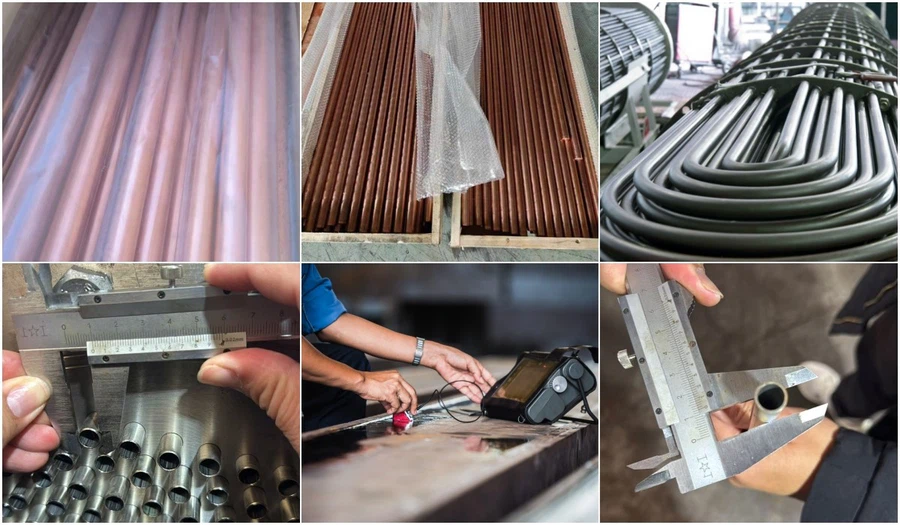
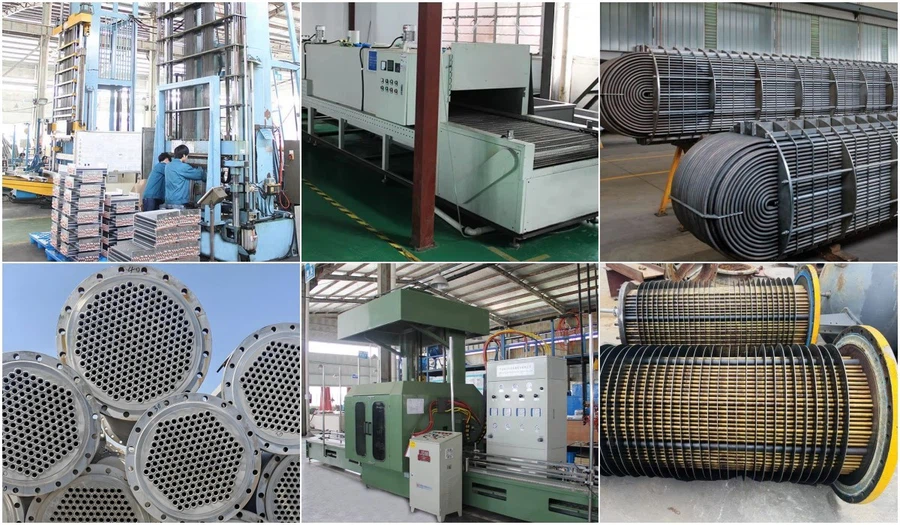
Our Factory & Equipment
| Equipment Type | Specification / Capability | Quality Impact |
|---|---|---|
| Horizontal Continuous Casting Line | 10-ton capacity | Produces homogeneous copper alloy tube for heat exchanger billets with zero porosity. |
| Three-Roll Piercing Mill | Up to 60mm OD | Precision wall thickness control for heat exchanger tube wall thickness as low as 0.5mm. |
| Cold Drawing Bench | 5 draws in sequence | Achieves tight tolerances on copper heat exchanger tube length and heat exchanger pipe diameter. |
| Straightening & Cutting Line | CNC servo-controlled | Burr-free cutting for copper heat exchanger tube 3/4 inch and 1 inch to exact project lengths. |
| U-Bending Machine | CNC mandrel type | Produces u tube condenser and U tube bundle heat exchanger without kinking or ovality. |
| Eddy Current Tester | NDT (Non-Destructive Testing) | 100% inspection of C70600 tube and C71500 tube for pinholes or cracks per ASTM B111 pdf standards. |
| Hydrostatic Tester | Up to 200 bar | Validates heat exchanger tube expansion and tube rolling integrity. |
| Spectrometer | Optical emission (OES) | Confirms chemical composition of ASME SB111, EN 12451, and JIS H3300 grades on every batch. |
Our Certifications & Compliance:
ASTM B111 pdf and ASME SB111 pdf full traceability.
ISO 9001:2015 quality management system.
Third-party inspection accepted: SGS, BV, Lloyds, or TUV.
Copper heat exchanger tube life expectancy testing reports available upon request.
Get Fast Quote & Logistics Plan


