

What is C70600 copper nickel tube?
C70600, also known as 90/10 copper nickel, is a copper alloy containing approximately 90% copper and 10% nickel, plus small amounts of iron and manganese. It is specifically designed for seawater and brackish water service. The alloy forms a protective oxide film when exposed to clean seawater. This film blocks further corrosion and self‑repairs if damaged. Unlike stainless steel, C70600 also releases copper ions that prevent barnacles and algae from attaching. That is why shipbuilders, power plants, and desalination facilities have used C70600 tube for over 50 years. The material is defined under several ASTM standards, with ASTM B111 being the most common for heat exchanger and condenser tubes.
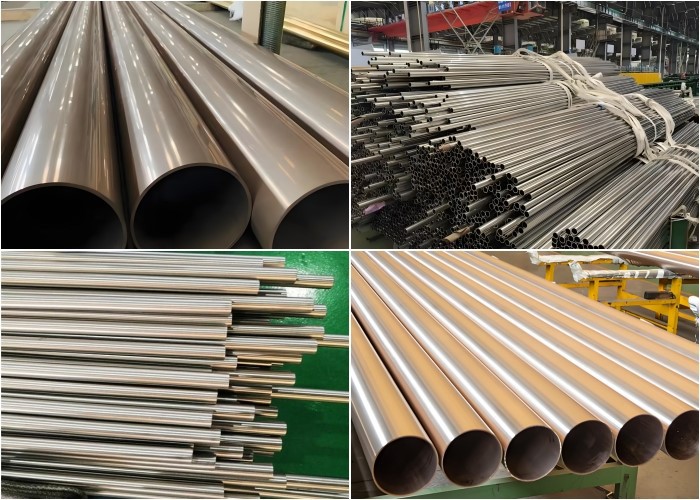
What ASTM standards cover C70600 tube?
ASTM B111 is the main standard for C70600 heat exchanger and condenser tubes. Other standards apply for different product forms and applications. Here is the full list.
| Standard | Title | Product form |
|---|---|---|
| ASTM B111 | Seamless copper alloy tube for heat exchangers and condensers | Tube |
| ASTM B466 | Seamless copper nickel pipe for general piping | Pipe |
| ASTM B467 | Welded copper nickel pipe | Welded pipe |
| ASTM B552 | Seamless and welded copper nickel tube for general service | Tube |
| ASTM B608 | Welded copper nickel tube for heat exchangers | Welded tube |
| ASME SB111 | Same as B111 but for ASME code applications | Tube |
| MIL‑T‑16420 | Military specification for copper nickel tube | Tube |
What is the chemical composition of C70600?
| Element | Composition (%) | Notes |
|---|---|---|
| Copper (Cu) | Remainder (88.0% min) | Base metal |
| Nickel (Ni) | 9.0 – 11.0 | Critical for corrosion resistance |
| Iron (Fe) | 1.0 – 1.8 | Helps form protective film |
| Manganese (Mn) | 1.0 max | Deoxidizer |
| Lead (Pb) | 0.02 max | Tramp element |
| Zinc (Zn) | 0.5 max | Tramp element |
| Carbon (C) | 0.05 max | Tramp element |
| Phosphorus (P) | 0.02 max | Residual |
What are the mechanical properties of C70600?
C70600 in annealed temper has minimum tensile strength of 310 MPa and yield strength of 110 MPa. Elongation is 30% minimum. Hardness ranges from 40 to 80 HRB. Here are the full mechanical specifications.
| Property | Annealed (O60) | Light drawn (H55) | Hard drawn (H80) |
|---|---|---|---|
| Tensile strength (min) | 310 MPa (45 ksi) | 345 MPa (50 ksi) | 380 MPa (55 ksi) |
| Yield strength (min) | 110 MPa (16 ksi) | 200 MPa (29 ksi) | 280 MPa (41 ksi) |
| Elongation in 50mm (min) | 30% | 15% | 8% |
| Hardness (Rockwell HRB) | 40 – 80 | 70 – 85 | 80 – 90 |
Which temper to order:
Annealed (O60) – Most common. Easy to bend, flare, and roll into tube sheets.
Light drawn (H55) – Moderate strength. Used when tube needs some stiffness.
Hard drawn (H80) – Rarely used. Difficult to form. Only for straight runs with no bending.
What are the physical properties of C70600?
| Property | Value | Unit |
|---|---|---|
| Density | 8.94 | g/cm³ |
| Melting point range | 1100 – 1150 | °C |
| Thermal conductivity (20°C) | 45 | W/m·K |
| Electrical resistivity (20°C) | 0.19 | µΩ·m |
| Specific heat capacity | 377 | J/kg·K |
| Coefficient of thermal expansion (20-300°C) | 17.0 | µm/m·K |
| Modulus of elasticity | 140 | GPa |
| Poisson's ratio | 0.34 | - |
What are the dimensional specifications for C70600 tube under ASTM B111?
ASTM B111 C70600 tube is available from 1/4 inch (6.35mm) to 3 inches (76.2mm) outside diameter. Wall thickness ranges from BWG 22 (0.71mm) to BWG 10 (3.40mm). Here are the key dimensional specifications.
| OD (inch) | OD (mm) | Available BWG | Most common |
|---|---|---|---|
| 1/4" | 6.35 | 22, 20, 18 | BWG 20 |
| 3/8" | 9.53 | 22, 20, 18 | BWG 20 |
| 1/2" | 12.70 | 20, 19, 18, 17, 16 | BWG 18 |
| 5/8" | 15.88 | 20, 19, 18, 17, 16 | BWG 18 |
| 3/4" | 19.05 | 19, 18, 17, 16, 15 | BWG 18 |
| 7/8" | 22.23 | 19, 18, 17, 16 | BWG 16 |
| 1" | 25.40 | 18, 17, 16, 15, 14 | BWG 16 |
| 1-1/4" | 31.75 | 16, 14, 13 | BWG 16 |
| 1-1/2" | 38.10 | 16, 14, 13, 12 | BWG 14 |
| 2" | 50.80 | 14, 13, 12, 11 | BWG 14 |
Dimensional tolerances:
| OD range | OD tolerance (±) | Wall tolerance | Length tolerance |
|---|---|---|---|
| Up to 1" | 0.004" (0.10mm) | ±10% | +6mm / -0mm (under 6m) |
| 1" to 1.5" | 0.005" (0.13mm) | ±10% | +10mm / -0mm (over 6m) |
| 1.5" to 2" | 0.006" (0.15mm) | ±10% | Random length 5-7m |
| 2" to 3" | 0.008" (0.20mm) | ±10% | Specify on PO |
What testing is required for ASTM B111 C70600 tube?
| Test | ASTM standard | Frequency | Acceptance criteria |
|---|---|---|---|
| Chemical analysis | E1473 | Per heat | Within specified range |
| Tensile test | E8 | Per heat (sample) | 310 MPa min |
| Flattening test | B968 | Per heat (sample) | No cracks at 3x wall |
| Flaring test | B969 | Per heat (sample) | No visible splits |
| Hardness test | E18 | Per heat (sample) | 40-80 HRB |
| Eddy current test | E243 | 100% of tubes | No reference level signal |
| Hydrostatic test | B111 | Upon request | 3000 psi, no leak |
FAQ
Q1: What is the difference between ASTM B111 and ASTM B466 for C70600?
ASTM B111 covers thin wall tubes for heat exchangers and condensers. ASTM B466 covers thick wall pipe for general seawater piping. B111 uses BWG for wall thickness and has tighter tolerances. B466 uses Schedule numbers (Sch 40, Sch 80) and has looser tolerances. The alloy chemistry is the same for both standards. Choose B111 for heat transfer equipment. Choose B466 for pressure piping systems.
Q2: What is the minimum tensile strength of C70600?
310 MPa (45 ksi) minimum for annealed temper. Light drawn temper is 345 MPa minimum. Hard drawn temper is 380 MPa minimum. Most buyers specify annealed temper because it is easier to fabricate. If you need higher strength, order light drawn or hard drawn, but expect reduced formability.
Q3: Is C70600 magnetic?
No, C70600 is not magnetic. It contains only 9-11% nickel, well below the level where magnetic behavior appears. Copper nickel alloys become magnetic only when nickel exceeds about 30% (C71500 is slightly magnetic, C70600 is not). This matters for applications near sensitive electronics.
Q4: What is the thermal conductivity of C70600?
45 W/m·K at 20°C (68°F). This is about 12% of pure copper (385 W/m·K) but about 3 times higher than stainless steel (15 W/m·K). For heat exchanger design, C70600 provides adequate heat transfer while offering excellent corrosion resistance. Designers may need slightly more surface area compared to pure copper tubes.
Q5: What is the electrical resistivity of C70600?
0.19 µΩ·m at 20°C. This is about 20 times higher than pure copper. C70600 is never used for electrical applications. It is a mechanical and corrosion alloy. If you need electrical conductivity, use C11000 or C10200 pure copper.
Q6: What is the density of C70600?
8.94 g/cm³ (0.323 lb/in³). This is slightly higher than pure copper (8.96 g/cm³ – almost identical). Use this density for weight calculations. Weight per meter = (OD² - ID²) x π/4 x density. A 3/4" OD x BWG 18 tube weighs about 0.492 kg per meter.
Q7: What is the coefficient of thermal expansion for C70600?
17.0 µm/m·K from 20°C to 300°C. This is higher than carbon steel (12 µm/m·K) but lower than many plastics. When welding C70600 tube to a carbon steel tube sheet, the difference in expansion can create stress. Design for this differential. Preheating both materials helps reduce mismatch stress.
Q8: What is the maximum working temperature for C70600 in seawater?
60°C (140°F) is the recommended maximum for continuous seawater service. Above this temperature, corrosion rate increases sharply. At 80°C, corrosion rate may be 10-20 times higher than at 30°C. For seawater above 60°C, consider C71500 or titanium. For non‑seawater applications, C70600 can go higher but strength decreases.
Q9: What is the difference between C70600 and 90/10 copper nickel?
They are the same material. C70600 is the UNS number. 90/10 is the common name. 90/10 refers to approximately 90% copper and 10% nickel. The exact specification adds iron (1.0-1.8%) and manganese (1.0% max). Always specify both the UNS number and the common name on your PO to avoid confusion.
Q10: Does ASTM B111 allow welded C70600 tube or only seamless?
ASTM B111 covers both seamless and welded tubes. However, seamless is by far the most common for C70600. Welded C70600 tube is rare and usually requires agreement between buyer and mill. If you receive welded tube without asking for it, reject it unless your specification explicitly allows it. Most heat exchanger applications use seamless tube.
Q11: What is the standard length for ASTM B111 C70600 tube?
Random length is 5 to 7 meters (16 to 23 feet). Cut lengths from 1 meter to 15 meters are available. For heat exchanger bundles, tubes are often ordered to exact bundle length plus 50-100mm for rolling. Length tolerance is +6mm / -0mm for lengths under 6 meters. Specify cut length clearly on your PO.
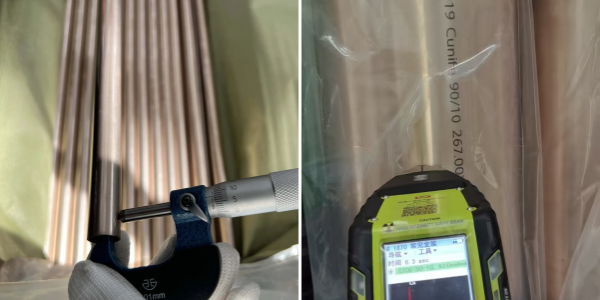
Our Testing
Incoming material
Spectrometer check (ASTM E1473) → Ni 9-11%, Fe 1.0-1.8%
Reject if chemistry is off by more than 0.2%
During production
Laser OD gauge → continuous monitoring, accuracy ±0.01mm
Ultrasonic wall sensor → alarms if wall drifts beyond ±10%
After drawing (sample per heat)
Tensile test → must break above 310 MPa
Flatten test → squeeze flat, no cracks
Flare test → 30° cone, no splits
Before shipping (100% of tubes)
Eddy current test → probe through every tube
Pass only if no signal above reference level
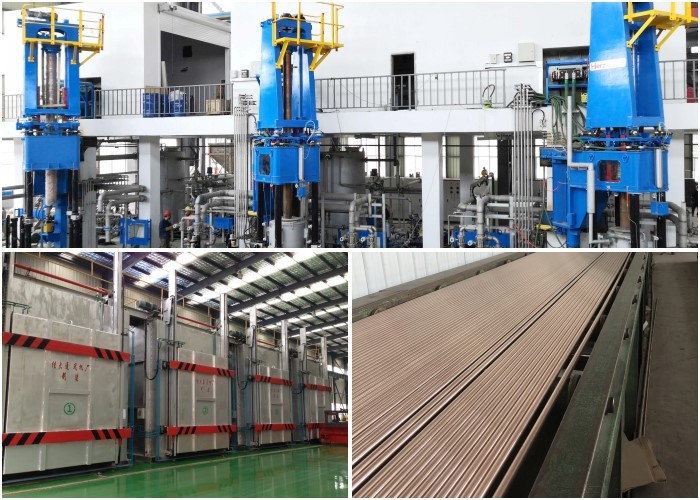
Our Factory Equipment
| Step | Equipment | Output |
|---|---|---|
| 1 | Melting furnace (3 units, 5t each) | Liquid alloy |
| 2 | Continuous caster (2 lines) | Solid billet 80-220mm |
| 3 | Extrusion press (2500T / 3500T) | Hollow shell |
| 4 | Pilger mill (4 units) | Reduced diameter |
| 5 | Drawing bench (8 lines) | Final OD + wall |
| 6 | Annealing furnace (4 units, 600°C) | Soft temper |
| 7 | Straightener + cutter (3 lines) | Cut to length |
Our Product Range
| Category | Shapes | Size | Grades |
|---|---|---|---|
| Tube | Round, square, coil, grooved | OD 3-219mm | C11000, C12200, C70600, C71500, C26000 |
| Rod | Round, hex, square | Dia 2-120mm | C11000, C36000, C14500, C18200 |
| Wire | Round, flat, tinned | Dia 0.1-12mm | C11000, C16200, C17200 |
| Strip | Coiled, slit | Thk 0.05-3mm | C11000, C19400, C70250 |
| Foil | Thin sheet | Thk 0.01-0.1mm | C11000, C10200 |
| CNC parts | Bushings, flanges, nuts | Custom | C36000, C63000, C70600 |


