

Inhibited Admiralty brass (C44300) tubes are copper-zinc alloys containing tin and a trace of arsenic. They are specifically engineered for superior resistance to dezincification and corrosion in polluted, brackish, or low-velocity seawater. Sourced from Henan, China, these tubes meet stringent international standards for industrial heat transfer applications.
With a minimum 70% copper content, C44300 offers an optimal balance of thermal conductivity, formability, and long-term durability. It is the industry-standard material for steam surface condensers and heat exchangers where water quality is inconsistent or contains sulfides.
Applications of C44300 Admiralty Brass
C44300 Admiralty brass tubes are commonly specified for:
Steam Condensers (Power Generation)
Feedwater Heaters
Oil Refinery Heat Exchangers
Marine and Offshore Cooling Systems
Desalination Units
Water Treatment Facilities
HVAC Chiller Condensers
Key Benefits Summary
| Feature | Benefit for Buyers |
|---|---|
| Inhibited Alloy Composition | Resists dezincification in polluted or sulfide-bearing water, reducing premature tube failure. |
| Compliance with ASTM B111 / ASME SB111 | Guarantees material traceability and meets global pressure vessel codes. |
| High Thermal Conductivity | Ensures efficient heat transfer, lowering operational energy costs. |
| Excellent Ductility | Allows for easy rolling and flaring into tube sheets without cracking. |
| O61 Annealed Temper | Supplied in the optimal soft condition for installation and expansion. |
Technical Specifications Table
| Specification Category | Details |
|---|---|
| UNS Designation | C44300 |
| ISO / European Name | CuZn28Sn1 |
| British Standard (BSI) | CZ111 |
| Chemical Composition | Cu: 70.0 – 73.0% / Sn: 0.9 – 1.2% / As: 0.02 – 0.06% Pb: 0.07% max / Fe: 0.06% max / Zn: Remainder |
| Applicable ASTM Standards | ASTM B111 (Seamless Condenser Tubes) / ASTM B395 (U-Bend Tubes) |
| Applicable ASME Standards | ASME SB111 / ASME SB395 (For Boiler & Pressure Vessel Code) |
| Standard Temper | O61 (Light Annealed / Soft) |
Physical & Mechanical Properties
| Property | Metric Value | Imperial Value |
|---|---|---|
| Density | 8.53 g/cm³ | 0.308 lb/in³ |
| Tensile Strength | 310 - 380 MPa | 45 - 55 ksi |
| Yield Strength (0.5% Ext) | 105 MPa min | 15 ksi min |
| Elongation | 30 - 45% | 30 - 45% |
| Thermal Conductivity | 109 W/m-K | 64 BTU/ft²/ft/h/°F |
| Melting Point (Liquidus) | 938 °C | 1720 °F |
FAQ
1. What is the difference between C44300 Admiralty Brass and standard C28000 Brass?
C44300 Admiralty Brass contains a deliberate addition of Tin (approx 1%) and Arsenic (0.02-0.06%). This inhibited chemistry prevents dezincification in salt or polluted water, whereas standard C28000 Brass would rapidly corrode and weaken in similar marine or brackish environments.
2. What is the ASTM standard for C44300 Admiralty Brass Tubes?
C44300 Admiralty Brass Tubes are manufactured in accordance with ASTM B111 (Standard Specification for Copper and Copper-Alloy Seamless Condenser Tubes and Ferrule Stock) and ASME SB111 for pressure vessel applications.
3. What are the equivalent grades to C44300 Admiralty Brass in international markets?
The direct equivalents for C44300 Admiralty Brass are BSI CZ111 (British Standard) and ISO CuZn28Sn1. These designations refer to the same chemical and mechanical property requirements.
4. Is C44300 Admiralty Brass suitable for seawater cooling applications?
Yes, C44300 Admiralty Brass is highly suitable for seawater service, provided the water velocity is maintained within recommended limits (typically 1.0 - 2.5 m/s). It offers excellent resistance to general corrosion but is best applied in clean or slightly polluted seawater rather than very high-velocity, silt-laden seawater where Aluminum Brass (C68700) might be preferred.
5. What is the maximum operating temperature for C44300 Admiralty Brass Tubes in a heat exchanger?
The maximum recommended continuous service temperature for C44300 Admiralty Brass Tubes is approximately 232°C (450°F) . Exceeding this temperature can lead to annealing of the material and significant loss of mechanical strength, as well as increased susceptibility to stress corrosion cracking.
6. What is the difference between C44300 Admiralty Brass and C68700 Aluminum Brass?
C44300 Admiralty Brass is optimized for resistance to dezincification in polluted or stagnant water conditions. C68700 Aluminum Brass contains Aluminum and is optimized for resistance to impingement erosion in high-velocity, clean seawater. The choice depends on whether the primary threat is pollution (C44300) or velocity/erosion (C68700).
7. What is the hardness and temper of C44300 Admiralty Brass Tubes typically supplied for condenser service?
C44300 Admiralty Brass Tubes for condenser and heat exchanger service are almost exclusively supplied in the O61 (Annealed) temper. This ensures the material is soft and ductile, allowing for reliable roller expansion into tube sheets without cracking the tube ends.
8. What is the chemical composition requirement for Tin (Sn) in C44300 Admiralty Brass?
The ASTM B111 specification requires C44300 Admiralty Brass to contain 0.9% to 1.2% Tin (Sn) . This specific range is critical for activating the corrosion film that protects the zinc in the alloy from leaching out in seawater.
9. How should C44300 Admiralty Brass Tubes be stored to prevent corrosion before installation?
C44300 Admiralty Brass Tubes should be stored indoors in a dry, well-ventilated area. They must be kept away from ammonia, amines, or sources of moisture. Even trace amounts of ammonia in a confined space can cause season cracking (stress corrosion cracking) of brass materials.
10. What is the role of Arsenic (As) in C44300 Admiralty Brass?
The small, controlled addition of Arsenic (0.02 - 0.06%) acts as an inhibitor. It forms a protective film on the internal surface of the C44300 Admiralty Brass Tube that prevents dezincification, which is the primary failure mechanism of plain brasses in water service. Without Arsenic, the alloy would be classified as uninhibited and unsuitable for condensers.
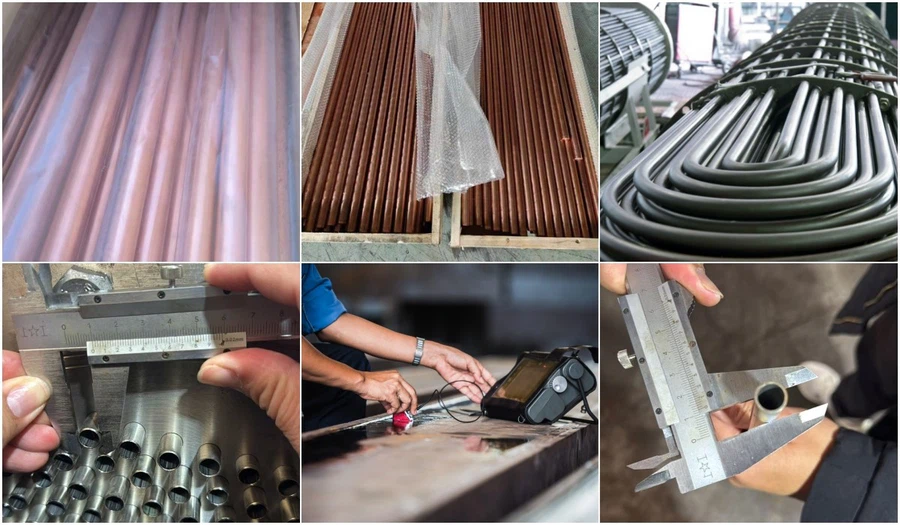
How Do We Package Copper Heat Exchanger Tubes for Global Delivery?
Poor packaging destroys even the best copper heat exchanger tube. As a professional copper heat exchanger tube factory serving copper heat exchanger tube USA, Europe, UAE, Saudi Arabia, and India, we follow military-grade export packaging standards to ensure zero damage during sea or air freight.
Our Standard Packaging Process:
| Packaging Stage | Material / Method | Purpose |
|---|---|---|
| Individual Tube Protection | Anti-rust VCI paper + plastic end caps | Prevents moisture, dust, and scratches on copper tube heat exchanger inner surfaces. |
| Bundling | Nylon straps + wooden spacers | Keeps copper heat exchanger tube OD 19mm, 1 inch, or 5/8 inch sizes organized and vibration-free. |
| Moisture Barrier | Thick PE film wrap (heat-shrunk) | Blocks humidity during long sea voyages to copper heat exchanger tube Germany or Saudi Arabia. |
| Outer Packing | Export-grade plywood cases or steel-banded wooden crates | Withstands stacking and rough handling. Each crate labeled with PO number, alloy (e.g., SB111 C70600), and quantity. |
| Documentation | Packing list + Mill Test Certificate (MTC) attached outside | Customs clearance support for copper heat exchanger tube stockist and distributor partners. |
For U-Bundle Orders: U tube heat exchanger and U tube bundle heat exchanger are placed in dedicated steel jigs inside the crate to prevent bending radius distortion.
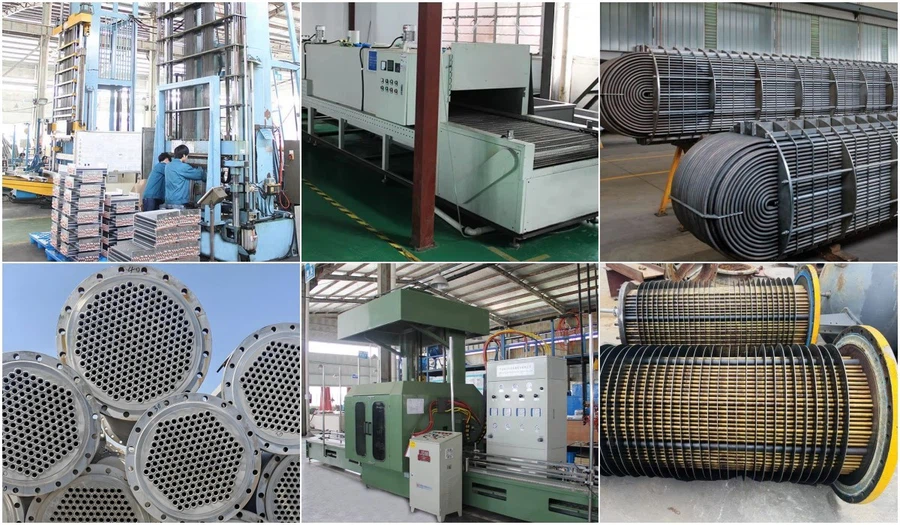
Our Factory & Equipment
| Equipment Type | Specification / Capability | Quality Impact |
|---|---|---|
| Horizontal Continuous Casting Line | 10-ton capacity | Produces homogeneous copper alloy tube for heat exchanger billets with zero porosity. |
| Three-Roll Piercing Mill | Up to 60mm OD | Precision wall thickness control for heat exchanger tube wall thickness as low as 0.5mm. |
| Cold Drawing Bench | 5 draws in sequence | Achieves tight tolerances on copper heat exchanger tube length and heat exchanger pipe diameter. |
| Straightening & Cutting Line | CNC servo-controlled | Burr-free cutting for copper heat exchanger tube 3/4 inch and 1 inch to exact project lengths. |
| U-Bending Machine | CNC mandrel type | Produces u tube condenser and U tube bundle heat exchanger without kinking or ovality. |
| Eddy Current Tester | NDT (Non-Destructive Testing) | 100% inspection of C70600 tube and C71500 tube for pinholes or cracks per ASTM B111 pdf standards. |
| Hydrostatic Tester | Up to 200 bar | Validates heat exchanger tube expansion and tube rolling integrity. |
| Spectrometer | Optical emission (OES) | Confirms chemical composition of ASME SB111, EN 12451, and JIS H3300 grades on every batch. |
Our Certifications & Compliance:
ASTM B111 pdf and ASME SB111 pdf full traceability.
ISO 9001:2015 quality management system.
Third-party inspection accepted: SGS, BV, Lloyds, or TUV.
Copper heat exchanger tube life expectancy testing reports available upon request.
Get Fast Quote & Logistics Plan


