

What Is C44300 Admiralty Brass?
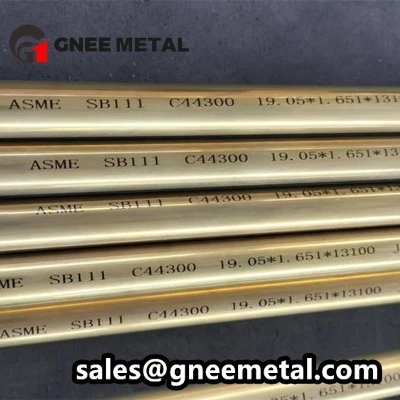
C44300 is an arsenical Admiralty Brass alloy belonging to the copper-zinc-tin family. It contains approximately 70–73% copper, 0.9–1.2% tin, and a controlled amount of arsenic, with zinc making up the remainder.
It is commonly supplied in seamless tube form for heat exchangers and condensers where heat transfer and resistance to water-side corrosion are important.
The addition of tin helps improve corrosion resistance compared with ordinary brass, while arsenic acts as an inhibitor against dezincification under suitable service conditions.

C44300 Chemical Composition
| Element | Composition (%) |
|---|---|
| Copper (Cu) | 70.0–73.0 |
| Tin (Sn) | 0.9–1.2 |
| Arsenic (As) | 0.02–0.06 |
| Lead (Pb) | 0.07 max. |
| Iron (Fe) | 0.06 max. |
| Zinc (Zn) | Remainder |
Why do tin and arsenic matter in C44300?
Tin (Sn): Improves the corrosion resistance of the copper-zinc alloy, particularly in water-handling applications.
Arsenic (As): Helps inhibit dezincification, a corrosion mechanism in which zinc is selectively removed from brass.
Copper (Cu): Provides the main metallic matrix and contributes to thermal conductivity and workability.
Zinc (Zn): Forms the brass alloy system and contributes to its mechanical characteristics.
The chemical composition should always be verified against the applicable product standard and the actual material test certificate (MTC).
Physical and Mechanical Properties
| Propertya | Typical / Reference Value |
|---|---|
| Density | Approximately 8.53 g/cm³ |
| Thermal Conductivity | Approximately 109 W/m·K |
| Melting Range | Approximately 899–938°C |
| O61 Tensile Strength | 310 MPa min. |
| O61 Yield Strength | 105 MPa min. |
The mechanical strength values above are reference minimums associated with the O61 annealed temper. Actual acceptance requirements depend on the applicable standard, product dimensions, and testing conditions.
For heat exchanger tube buyers, thermal conductivity alone is not enough to determine material suitability. Water chemistry, operating temperature, flow velocity, corrosion conditions, tube wall thickness, and maintenance requirements must also be considered.
Equivalent Grades of C44300 Admiralty Brass
| Standard / Designation System | Grade or Material Designation |
|---|---|
| UNS / ASTM | C44300 |
| BS | CZ111 |
| DIN / Werkstoff | CuZn28Sn1 / 2.0470 |
| EN | CW706R |
| JIS | C4430 |
| ISO-style alloy designation | CuZn28Sn1 |
C44300 Seamless Tube Standards and Specifications
C44300 Admiralty Brass Seamless Tubes are commonly specified under ASTM B111/B111M. The corresponding ASME material specification is SB-111/SB-111M.
These standards cover seamless copper and copper-alloy condenser tubes and ferrule stock, including C44300.
ASTM B111 vs. ASME SB-111
| Specification | Description |
|---|---|
| ASTM B111/B111M | Standard Specification for Seamless Copper and Copper-Alloy Condenser Tubes and Ferrule Stock |
| ASME SB-111/SB-111M | ASME material specification for seamless copper and copper-alloy condenser tubes and ferrule stock |
| UNS C44300 | Material designation for Admiralty Brass |
When preparing a purchase order, buyers should identify the exact standard edition required by the project.
ASTM B111 and ASME SB-111 are closely related specifications, but the applicable code edition and project requirements must be checked rather than assuming that every edition is automatically identical.
Typical C44300 Seamless Tube Specifications
| Specification | Product Information |
|---|---|
| Material Grade | C44300 |
| Alloy Name | Admiralty Brass |
| UNS Number | C44300 |
| Product Type | Seamless Tube |
| Manufacturing Method | Seamless |
| Applicable Standard | ASTM B111/B111M / ASME SB-111/SB-111M |
| Delivery Temper | O61 Annealed, when specified |
| Product Shape | Straight Round Tube |
| Surface Condition | As agreed in the purchase specification |
| Inspection Documents | MTC and specified test reports |
Available dimensions depend on manufacturing capability, order quantity, and the applicable standard.
Understanding OD, Wall Thickness, and Tube Length
When ordering C44300 heat exchanger tubes, buyers should clearly identify three main dimensional parameters:
Outside Diameter (OD): The external diameter of the tube.
Wall Thickness (WT): The thickness of the tube wall.
Length: The overall length of each straight tube.
The inside diameter (ID) can be calculated from the outside diameter and wall thickness:
ID = OD − 2 × WT
For example, a tube with an outside diameter of 19.05 mm and a nominal wall thickness of 1.65 mm has an approximate inside diameter of:
ID = 19.05 − 2 × 1.65 = 15.75 mm
This calculation is useful for preliminary specification checks. Actual dimensions must be determined by the measured tube dimensions and applicable tolerances.
Understanding BWG Wall Thickness
BWG stands for Birmingham Wire Gauge. It is a traditional gauge system used to identify tube and sheet thicknesses.
For reference:
| BWG | Nominal Wall Thickness |
|---|---|
| BWG 14 | 2.11 mm |
| BWG 16 | 1.65 mm |
| BWG 18 | 1.24 mm |
| BWG 20 | 0.89 mm |
| BWG 22 | 0.71 mm |
BWG 16 corresponds to approximately 1.65 mm nominal wall thickness.
However, buyers should state the required wall thickness in millimeters or inches in addition to the BWG number. This avoids confusion when different suppliers use different gauge conversion references or dimensional tolerance tables.
Applications of C44300 Admiralty Brass Seamless Tubes
C44300 is widely used in heat transfer equipment because it combines useful thermal conductivity with corrosion resistance in suitable water environments.
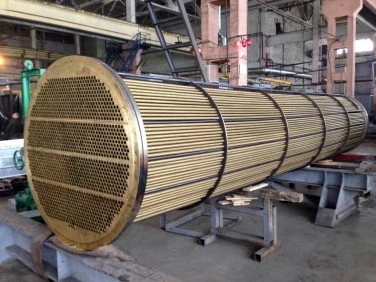
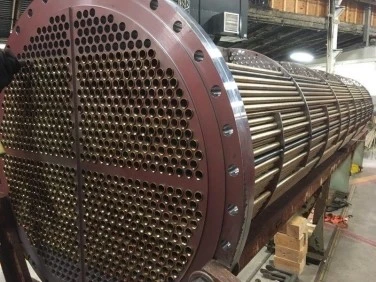
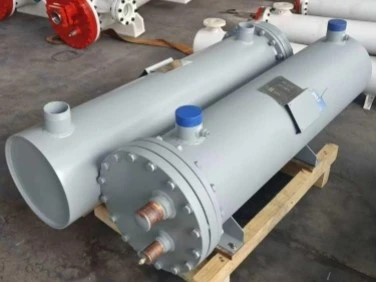
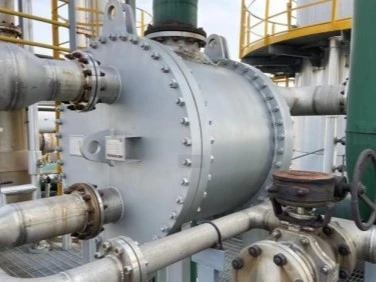
Heat Exchangers
C44300 seamless tubes are used in shell-and-tube heat exchangers where heat passes through the tube wall between two fluids.
Common purchasing considerations include:
Tube outside diameter and wall thickness
Straight length and dimensional tolerance
Water-side corrosion conditions
Tube expansion requirements
Operating temperature and pressure
Steam Condensers
In steam condensers, tubes provide the heat transfer surface required to condense steam into water.
C44300 Admiralty Brass has a long history of use in condenser tube applications, particularly where freshwater or suitable seawater conditions are involved.
Marine Cooling Systems
C44300 tubes may be used in marine cooling equipment and related heat transfer systems.
However, the suitability of Admiralty Brass for seawater service depends on water composition, velocity, temperature, fouling, and operating conditions. It should not be selected solely because the equipment is installed in a marine environment.
Desalination and Industrial Cooling Equipment
C44300 may also be considered for selected desalination, evaporator, and industrial cooling applications.
The actual selection should be based on the process medium, operating conditions, and corrosion requirements.
Discuss Your Material Requirements
C44300 vs. C68700 vs. C70600: Which Material Should You Choose?
C44300, C68700, and C70600 are commonly encountered copper alloy tube materials in heat exchangers and marine cooling equipment.
Although they may be used in similar industries, their alloy compositions and corrosion characteristics are different.
| Comparison | C44300 | C68700 | C70600 |
|---|---|---|---|
| Alloy Name | Admiralty Brass | Aluminum Brass | 90/10 Copper Nickel |
| Main Alloy System | Cu-Zn-Sn-As | Cu-Zn-Al-As | Cu-Ni-Fe-Mn |
| Typical Application | Condensers and heat exchangers | Condensers and heat exchangers | Marine heat exchangers and seawater systems |
| Main Selection Consideration | Water chemistry and corrosion conditions | Seawater corrosion performance | Seawater corrosion resistance and service conditions |
| Product Standard | ASTM B111 | ASTM B111 | ASTM B111 |
C44300 vs. C68700
Both alloys are used in condenser and heat exchanger tubes.
The main difference is their alloying system:
C44300 is an arsenical Admiralty Brass containing tin.
C68700 is an arsenical Aluminum Brass containing aluminum.
The selection depends on the water quality, operating conditions, corrosion risks, and equipment design.
C44300 vs. C70600
C70600 is a 90/10 copper-nickel alloy containing approximately 10% nickel.
Compared with C44300, it belongs to a different alloy family and is commonly considered for marine and seawater applications where copper-nickel corrosion characteristics are required.
C44300 should not automatically replace C70600, or vice versa. Buyers should compare corrosion conditions, design requirements, service life expectations, and total equipment costs before changing materials.
Quality Inspection and Testing of C44300 Tubes
For heat exchanger and condenser applications, dimensional accuracy, material composition, mechanical properties, and tube integrity are important quality requirements.
C44300 seamless tubes should be inspected according to the applicable ASTM B111/B111M or ASME SB-111/SB-111M requirements, together with any additional conditions specified in the purchase order.
|
Inspection Item |
Inspection Purpose |
What Buyers Should Check |
|---|---|---|
|
Chemical Composition Analysis |
Verify the C44300 alloy composition |
Cu, Sn, As, Zn and other specified elements |
|
Tensile Test |
Evaluate mechanical strength |
Tensile strength, yield strength and elongation |
|
Expansion Test |
Check suitability for tube expansion |
Cracking or defects after the specified expansion test |
|
Flattening Test |
Evaluate deformation resistance |
Cracks or unacceptable defects after flattening |
|
Hydrostatic Test |
Check pressure resistance and leakage |
Test pressure, holding conditions and leakage results |
|
Eddy Current Test |
Detect relevant tube discontinuities |
Inspection coverage, acceptance criteria and test results |
|
Dimensional Inspection |
Verify tube dimensions |
OD, wall thickness, length and straightness |
|
Surface Inspection |
Check external and internal surface condition |
Scratches, cracks, dents and other unacceptable defects |
|
Wall Thickness Measurement |
Verify specified wall thickness |
Actual measurements and minimum wall thickness requirements |
|
Material Traceability |
Link products to manufacturing records |
Heat number, tube identification and MTC |

How to Select and Purchase C44300 Admiralty Brass Seamless Tubes
A complete technical specification helps suppliers evaluate production feasibility and prepare accurate quotations.
When requesting a quotation, buyers should provide the following information.
| Purchasing Parameter | Information to Confirm |
|---|---|
| Material Grade | UNS C44300 |
| Product Type | Straight Seamless Tube |
| Standard | ASTM B111/B111M or ASME SB-111/SB-111M |
| Outside Diameter | mm or inch |
| Wall Thickness | mm or BWG |
| Wall Thickness Tolerance | Standard tolerance or special minimum-wall requirement |
| Length | Required length per piece |
| Quantity | Pieces, meters, or total weight |
| Temper | O61 Annealed or other specified condition |
| Testing | Hydrostatic, eddy current, and other specified tests |
| Certification | MTC / EN 10204 3.1, when required |
| End Preparation | Square cut, deburred, or other requirements |
| Packaging | Export wooden cases or other specified packaging |
What Should Buyers Confirm Before Placing an Order?
Before issuing a purchase order, we recommend confirming:
The exact material grade and standard edition.
Whether the tubes must be seamless.
Nominal and minimum acceptable wall thickness.
Required temper and mechanical properties.
Whether tubes must be suitable for expansion.
Required nondestructive or pressure testing.
Certificate format and heat number traceability.
Tube end preparation and packaging requirements.
A detailed specification reduces the risk of quotation differences, production misunderstandings, and rejection during incoming inspection.
Request a C44300 Tube Quotation
FAQ
Q: 1. What Is C44300 Admiralty Brass?
A: C44300 is an arsenical Admiralty Brass alloy consisting mainly of copper and zinc, with controlled tin and arsenic additions. It is commonly used for condenser and heat exchanger tubes.
Q: 2. What Is the ASTM Standard for C44300 Seamless Tubes?
A: C44300 seamless condenser tubes are covered by ASTM B111/B111M. The corresponding ASME specification is SB-111/SB-111M. The required standard edition should be confirmed in the purchase order.
Q: 3. What Are the Equivalent Grades of C44300?
A: Commonly referenced designations include CZ111, CuZn28Sn1, CW706R, and JIS C4430. However, buyers should verify chemical composition, product standard, and mechanical requirements before treating another designation as an approved substitute.
Q: 4. Is C44300 Suitable for Seawater Heat Exchangers?
A: C44300 has a history of use in suitable marine and water-handling applications. Its suitability depends on seawater composition, temperature, velocity, fouling, and other operating conditions. More demanding seawater environments may require a different alloy.
Q: 5. What Is O61 Temper for C44300 Tubes?
A: O61 is an annealed temper designation used for C44300 tubes. Annealing provides a softer material condition and supports forming and tube expansion operations. The specified mechanical properties should be verified against the applicable standard.
Q: 6. Can C44300 Seamless Tubes Be Used for Tube Expansion?
A: Yes. C44300 tubes can be used in heat exchanger tube expansion applications when the selected temper, dimensions, and material properties meet the equipment design requirements. Buyers should confirm the expansion requirements before ordering.
Q: 7. What Tests Are Required for C44300 Heat Exchanger Tubes?
A: Testing may include chemical analysis, tensile testing, expansion testing, flattening testing, hydrostatic testing, and eddy current testing, depending on the applicable standard and project requirements.
Q: 8. Can C44300 Tubes Be Supplied with EN 10204 3.1 Certificates?
A: Yes, EN 10204 3.1 inspection certificates can be supplied when agreed in the purchase specification and supported by the manufacturer's inspection and traceability system.
Q: 9. What Information Is Needed to Quote C44300 Seamless Tubes?
A: Buyers should provide the material grade, standard, outside diameter, wall thickness, length, quantity, temper, tolerance requirements, testing scope, and certificate requirements.
As a copper alloy tube supplier, we can review customer drawings, technical specifications, and RFQs for C44300 seamless tube requirements.


