

What is TP1/C12000 copper?
C12000 Copper Alloy is a copper-based alloy primarily composed of copper with the addition of phosphorus. Due to the special role of phosphorus, C12000 copper alloy exhibits excellent corrosion resistance, particularly in marine, chemical, and humid natural environments. Its phosphorus content typically ranges from 0.015% to 0.040%, significantly enhancing the alloy's oxidation resistance, acid and alkali corrosion resistance, and mechanical properties.
Application Areas of C12000 Copper Alloy
Marine Engineering
C12000 copper alloy is an ideal material for marine environments, widely applied in submarine cables, offshore platform equipment, ships, and underwater sensors. Its performance in high-salinity, high-humidity, and highly corrosive environments is exceptional, effectively resisting seawater corrosion.
Chemical Industry
In the chemical industry, C12000 copper alloy is commonly used to manufacture reactors, pipelines, heat exchangers, and other equipment. These devices often operate under strong acids, alkalis, or other corrosive media. C12000 alloy provides long-term corrosion protection, reducing maintenance costs and downtime.
Electronic Devices and Precision Instruments
C12000 copper alloy is also widely used in the manufacturing of connectors, conductive materials, and sensors for high-frequency electronic devices and precision instruments. Due to its excellent electrical conductivity and oxidation resistance, C12000 copper alloy ensures the stability and reliability of electronic devices during long-term use.
High-Temperature Environment Applications
In environments requiring high-temperature operation, C12000 copper alloy also performs exceptionally well. Its oxidation resistance at high temperatures makes it suitable for manufacturing key components of high-temperature equipment, such as boilers and heating systems.
Common Product Forms & Dimensions
Form | Thickness (mm) | Width (mm) | Length (mm) | Diameter (mm) |
Sheet/Strip | 0.5 – 10 | 100 – 600 | Custom | - |
Rod/Bar | - | - | Custom | 5 – 50 |
Wire | - | - | Custom | 0.5 – 10 |
Tube | 1 – 20 (wall) | - | Custom | 10 – 200 (OD) |


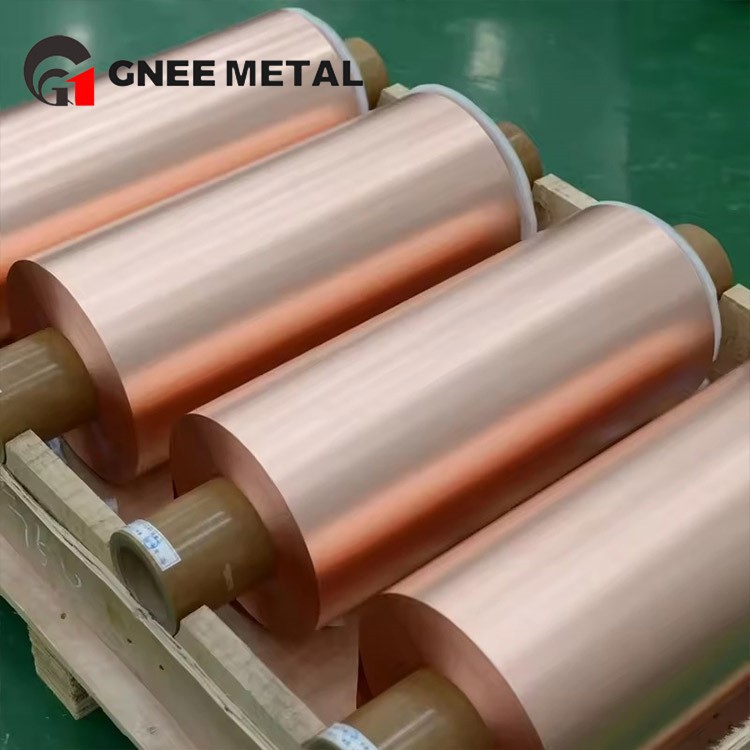
C12000 Phosphorus-Deoxidized Copper
| Category | Property | Value / Range | Condition / Notes |
|---|---|---|---|
| Chemical Composition | Copper (Cu) | ≥ 99.9% | By mass |
| Phosphorus (P) | 0.004% – 0.012% | Deoxidizing agent | |
| Other Impurities (total) | ≤ 0.1% | Includes Fe, Pb, Sn, etc. | |
| Physical Properties | Electrical Conductivity | ≥ 98% IACS | Annealed condition |
| Thermal Conductivity | ≥ 350 W/(m·K) | At 20°C | |
| Density | 8.94 g/cm³ | At 20°C | |
| Melting Point | ~1083°C | ||
| Coefficient of Thermal Expansion | 17.0 × 10⁻⁶ /K | 20–300°C | |
| Mechanical Properties | Tensile Strength | 200 – 250 MPa | Soft (Annealed) |
| 300 – 400 MPa | Hard (Cold Worked) | ||
| Yield Strength (0.2% Offset) | ~ 70 – 150 MPa | Soft | |
| ~ 250 – 350 MPa | Hard | ||
| Elongation | ≥ 40% | Soft (Annealed) | |
| ≥ 10% | Hard (Cold Worked) | ||
| Hardness (Vickers HV) | 40 – 60 HV | Soft (Annealed) | |
| 80 – 100 HV | Hard (Cold Worked) | ||
| Modulus of Elasticity | ~ 115 – 130 GPa | ||
| Key Features | Decxidization | Phosphorus-deoxidized, very low oxygen content | Eliminates hydrogen embrittlement risk |
| Weldability | Excellent (brazing, soldering, welding) | ||
| Corrosion Resistance | Good in atmosphere, freshwater, non-oxidizing acids | Better oxidation resistance than pure copper | |
| Workability | Excellent hot & cold workability | Suitable for drawing, stamping, forming |
FAQ
| Can C12000 copper be welded or brazed easily? Yes, C12000 is highly weldable and brazeable due to its deoxidized nature. Autogenous welding and brazing can be performed without flux when joining copper-to-copper. |
| What are the main applications of C12000 copper tubes? It's widely used in HVAC/R (heat exchangers, condensers), plumbing, medical gas systems, industrial fluid lines, and electrical busbars. |
| Does C12000 copper corrode in water systems? It has excellent corrosion resistance in clean, non-aggressive water. However, like all copper, it can be affected by acidic water, high-velocity flow, or certain chemicals (e.g., ammonia, sulfides). |
| Is C12000 suitable for underground water lines? Yes, especially when using Type K thick-walled tubing for burial. Its corrosion resistance and strength make it a durable choice for direct burial when soil conditions are non-aggressive. |
| What standards cover C12000 copper tubes? ASTM B75 (seamless), B280 (ACR tubes), EN 12735-1, and JIS H3300 are key standards for tubing. ASTM B152 covers sheet/plate forms. |
| What tempers are available for C12000 tubing? Common tempers are annealed (soft, O60), drawn (hard, H58), and light-drawn (H55). Annealed offers maximum formability; drawn provides higher strength. |
| Can C12000 be used in oxygen service or medical gas systems? Yes, after proper cleaning and degreasing, C12000 tubes are widely used in medical gas (oxygen, nitrous oxide) and high-purity gas systems due to their cleanliness and non-permeability. |
| How does phosphorus affect conductivity in C12000? The low residual phosphorus slightly reduces electrical conductivity (~85% IACS) compared to pure C11000 (~101% IACS), but it remains excellent for most thermal and electrical applications. |
| Is C12000 susceptible to stress corrosion cracking (SCC)? Copper alloys are generally less prone to SCC than brasses, but in environments with ammonia, amines, or nitrites, SCC can occur. Proper design and avoiding sustained tensile stress in such environments are recommended. |
| What's the maximum continuous service temperature for C12000? Typically up to about 150–200°C (302–392°F) for long-term service. Short-term exposure can go higher, but annealing and softening will occur above ~250°C (482°F). |
Inquire about C12000 Pricing & Samples
Our product range
| Category | Key Products | Standards | Typical Applications |
|---|---|---|---|
| Copper Tubes & Pipes | Seamless copper tubes, medical gas pipes (ASTM B819), ACR tubes, capillary tubes, large-diameter pipes, plumbing tubes (Type K/L/M) | ASTM B68, B75, B88, B280, B819, EN1057 | HVAC, refrigeration, plumbing, medical gas systems, industrial pipelines |
| Copper Sheets & Plates | Pure copper sheets, copper alloy plates (brass, bronze), perforated sheets, embossed sheets, clad sheets | ASTM B152, B465, EN1652 | Architectural cladding, electrical components, heat exchangers, decorative arts |
| Copper Bars & Rods | Round bars, square bars, hexagonal bars, flat bars, copper alloy rods (brass, bronze) | ASTM B187, B301, EN12163/12164 | Machined parts, connectors, fasteners, electrodes, forgings |
| Copper Wires & Strands | Bare copper wires, tinned copper wires, braided wires, stranded conductors, enameled wires | ASTM B1, B3, B174, IEC 60228 | Electrical wiring, power transmission, cables, windings, grounding systems |
| Copper Foils | Rolled copper foils, electrolytic copper foils, flexible copper strips | ASTM B370, IPC-4562 | Printed circuit boards (PCBs), electromagnetic shielding, batteries, decorative laminates |
Our factory
Our factory is equipped with state-of-the-art production lines for extrusion, rolling, drawing, and finishing. We specialize in producing a full range of copper and copper alloy products, including tubes, plates, bars, wires, and foils, serving the global HVAC, construction, electrical, medical, and automotive industries.
We are committed to quality and precision, strictly adhering to international standards including ASTM, EN, DIN, and JIS, and maintaining ISO 9001 certification. Our in-house laboratories conduct rigorous testing-from chemical composition and mechanical properties to pressure and cleanliness verification-ensuring end-to-end traceability and compliance for our products.

Get Fast Quote & Logistics Plan


