

ASTM B111 is a standard developed by the American Society for Testing and Materials, which specifically specifies technical requirements for the chemical composition, mechanical properties, dimensional tolerances, non-destructive testing, hydrostatic testing, and other aspects of seamless copper and copper alloy tubes used in the manufacture of condensers, evaporators, and heat exchangers. C12200 is a specific copper alloy grade specified under this standard, belonging to phosphorus deoxidized copper, which is a low residual phosphorus oxygen-free copper.
Why is ASTM B111 C12200 Copper Tube widely used in the Heat Exchange Industry?
Excellent thermal conductivity: Copper has excellent thermal conductivity, second only to silver, while C12200 copper tube has a very high thermal conductivity coefficient (about 391 W/m·K) , which is the core advantage of making it a heat exchange tube such as condenser and heat exchange tube, capable of efficiently transferring heat.
Good corrosion resistance: C12200 copper tube not only has good corrosion resistance and can maintain excellent performance in fresh water and steam condensate water, but also has good resistance to dezincification corrosion and stress corrosion cracking, both of which are due to phosphorus element. Resistance to dezincification corrosion is a significant advantage of phosphorus containing deoxidized copper such as C12200 compared to oxygen-free copper such as C10200/C10100. In environments containing dissolved oxygen and carbon dioxide in brackish water, seawater, or certain water treatment chemicals, ordinary copper tubes are prone to dezincification due to the selective dissolution of zinc, leaving behind porous and fragile copper structures. The phosphorus in C12200 can effectively prevent this corrosion form from occurring, while also improving the stress corrosion cracking resistance of copper pipes in specific media environments such as ammonia.
Good welding and brazing performance: The presence of phosphorus improves the welding and brazing performance of copper tubes, making it easier to perform tube plate connections during the manufacturing of heat exchangers.
Good mechanical and processing properties: C12200 copper tubes have sufficient strength, hardness, and ductility, making them easy to bend, expand, and form to meet installation requirements.
Good ductility and toughness: C12200 copper tubes can maintain good toughness even at lower temperatures.
Conductivity: Due to the presence of phosphorus impurities, although the conductivity of C12200 copper tube is slightly lower than that of oxygen-free copper such as C10200/C10100, its conductivity is still very high, about 85-90% IACS, which is sufficient to meet the needs of the vast majority of heat exchange applications.
ASTM B111 C12200 Copper Tube Chemical Composition
| UNS NO. | ASTM B111 C12200 CHEMICAL COMPOSITION % | ||||
|---|---|---|---|---|---|
| Cu | Al | Ni | Zn | P | |
| C12200 | 99.9 | --- | --- | --- | 0.015-0.040 |
What is the difference between ASTM B111 C12200 Copper Tube and other Copper Tubes?
Vs C11000 (ETP Copper - electrolytic tough pitch copper): C11000 has a higher oxygen content (0.02%-0.04%), which may cause hydrogen embrittlement in reducing atmospheres such as hydrogen, and its resistance to dezincification corrosion is not as good as C12200. C12200, due to deoxidation treatment, avoids hydrogen embrittlement problems and has better resistance to dezincification, making it a better choice for condenser tubes.
Vs C10200/C10100 (Oxygen-Free Copper): Oxygen-free copper has the highest electrical and thermal conductivity, close to 100% IACS, and good resistance to hydrogen embrittlement, but its resistance to dezincification corrosion is not as good as C12200. C10200/C10100 oxygen-free copper is usually more expensive and is commonly used in situations where high conductivity is required for conductors or in environments that are extremely sensitive to hydrogen embrittlement.
Vs copper alloy tubes (such as admiralty brass C44300, C68700 aluminum brass, CuNi 70/30, CuNi 90/10): These alloy copper tubes have better corrosion resistance in seawater or more harsh environments, especially in terms of erosion corrosion resistance and seawater corrosion resistance, but lower thermal conductivity than C12200 and higher production costs. C12200 is more cost-effective in freshwater, brackish water, or relatively mild seawater environments.
What industries are ASTM B111 C12200 Copper Tubes mainly used in?
Power plant condenser: This is the largest and most classic application of ASTM B111 C12200 copper tubes, mainly used to condense and return the exhaust steam from the turbine.
Ship condensers and heat exchangers: ASTM B111 C12200 copper tubes can be used for condensation and various cooling systems in ship power plants.
Heat exchangers in petrochemical, chemical, and industrial processes: ASTM B111 C12200 can be used for cooling process fluids, heating media, etc.
Evaporators and condensers in HVAC systems, especially in chillers and large systems.
Refrigeration equipment: such as heat exchange components for large cold storage and industrial refrigeration machines.
Other heat exchange applications that require high thermal conductivity, corrosion resistance, and good formability.
Check Today's Stock & Lead Time
FAQ
Q1: What is the typical lead time for ASTM B111 C12200 copper tubes?
A: According to the product page, the delivery time is approximately 7 days for standard orders. However, this may vary based on order quantity, specifications, and current production schedules. Always confirm with your supplier.
Q2: What certifications are available for these tubes?
A: The manufacturer offers multiple certifications including ABS, GL, DNV, NK, PED, AD2000, GOST9941-81, CCS, and ISO 9001-2008. These are important for projects requiring third-party inspection or compliance with specific marine or pressure equipment directives.
Q3: What is the minimum order quantity (MOQ)?
A: The MOQ listed is 100 KGS. This is relatively low compared to many mill-direct suppliers, making it suitable for smaller projects or trial orders.
Q4: How is the product packaged for shipment?
A: Packaging options include ply-wooden cases, iron cases, or bundles with plastic end caps. Proper packaging is critical to prevent damage and contamination during transit.
Q5: What non-destructive testing (NDT) methods are applied?
A: The product listing mentions ET (Eddy Current Testing), HT (Hydrostatic Testing), and UT (Ultrasonic Testing) . These tests ensure the tube's integrity and are standard requirements for heat exchanger and condenser applications.
Q6: Can C12200 be used in seawater-cooled condensers?
A: With caution. C12200 has good corrosion resistance and the phosphorus content helps resist dezincification. However, for continuous seawater service, especially at higher flow rates (>2 m/s), copper-nickel alloys (C70600 or C71500) are generally preferred due to their superior erosion-corrosion resistance. C12200 is more suitable for freshwater, brackish water, or treated cooling water.
Q7: Is the thermal conductivity of C12200 really 391 W/m·K as stated?
A: The page states approximately 391 W/m·K. Typical published values for C12200 are around 339-385 W/m·K depending on temperature and manufacturing method. For precise engineering calculations, always consult the certified mill test report or the latest ASTM standard values. The key point is that C12200 offers among the highest thermal conductivity of any commercially available heat exchanger tube material.
Q8: What is the difference between ASTM B111 and ASME SB111?
A: ASME SB111 is essentially identical to ASTM B111 but is adopted by the ASME Boiler and Pressure Vessel Code. For heat exchangers and pressure vessels built to ASME code, SB111 is the required specification. Many manufacturers offer tubes certified to both standards.
Q9: Why does C12200 cost more than C11000?
A: The additional phosphorus deoxidation step adds processing cost. However, for heat exchanger applications, the superior dezincification resistance and weldability of C12200 justify the premium. C11000's susceptibility to hydrogen embrittlement makes it unsuitable for many welded or high-temperature applications.
Q10: What should I check on the Mill Test Certificate (MTC)?
A: Ensure the MTC confirms:
Standard: ASTM B111 (or ASME SB111)
Grade: C12200
Chemical composition (especially Cu ≥ 99.9%, P 0.015-0.040%)
Mechanical properties (tensile, yield, elongation for the specified temper)
NDT results (eddy current or hydrostatic)
Dimensional tolerances
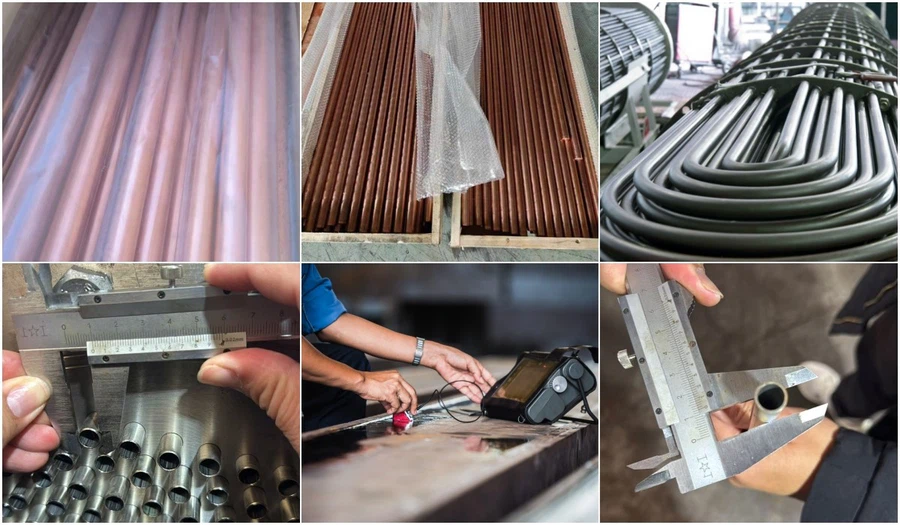
How Do We Package Copper Heat Exchanger Tubes for Global Delivery?
Poor packaging destroys even the best copper heat exchanger tube. As a professional copper heat exchanger tube factory serving copper heat exchanger tube USA, Europe, UAE, Saudi Arabia, and India, we follow military-grade export packaging standards to ensure zero damage during sea or air freight.
Our Standard Packaging Process:
| Packaging Stage | Material / Method | Purpose |
|---|---|---|
| Individual Tube Protection | Anti-rust VCI paper + plastic end caps | Prevents moisture, dust, and scratches on copper tube heat exchanger inner surfaces. |
| Bundling | Nylon straps + wooden spacers | Keeps copper heat exchanger tube OD 19mm, 1 inch, or 5/8 inch sizes organized and vibration-free. |
| Moisture Barrier | Thick PE film wrap (heat-shrunk) | Blocks humidity during long sea voyages to copper heat exchanger tube Germany or Saudi Arabia. |
| Outer Packing | Export-grade plywood cases or steel-banded wooden crates | Withstands stacking and rough handling. Each crate labeled with PO number, alloy (e.g., SB111 C70600), and quantity. |
| Documentation | Packing list + Mill Test Certificate (MTC) attached outside | Customs clearance support for copper heat exchanger tube stockist and distributor partners. |
For U-Bundle Orders: U tube heat exchanger and U tube bundle heat exchanger are placed in dedicated steel jigs inside the crate to prevent bending radius distortion.
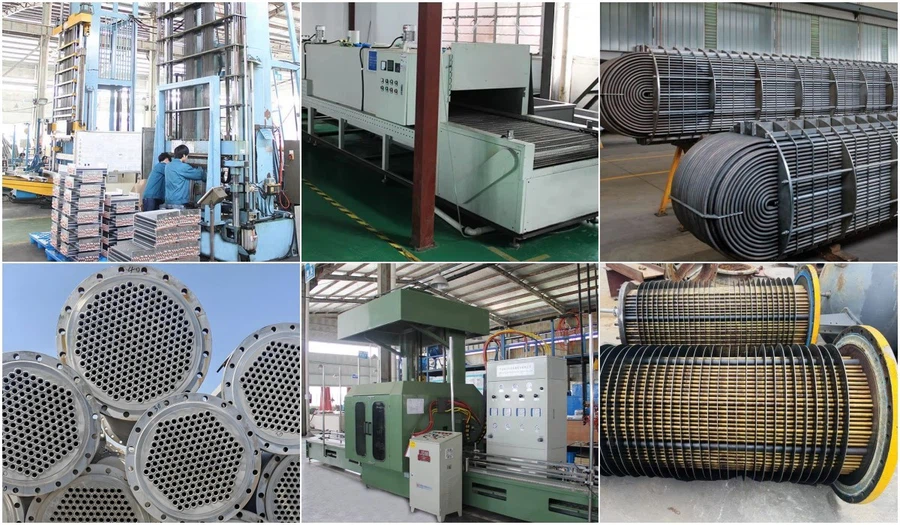
Our Factory & Equipment
| Equipment Type | Specification / Capability | Quality Impact |
|---|---|---|
| Horizontal Continuous Casting Line | 10-ton capacity | Produces homogeneous copper alloy tube for heat exchanger billets with zero porosity. |
| Three-Roll Piercing Mill | Up to 60mm OD | Precision wall thickness control for heat exchanger tube wall thickness as low as 0.5mm. |
| Cold Drawing Bench | 5 draws in sequence | Achieves tight tolerances on copper heat exchanger tube length and heat exchanger pipe diameter. |
| Straightening & Cutting Line | CNC servo-controlled | Burr-free cutting for copper heat exchanger tube 3/4 inch and 1 inch to exact project lengths. |
| U-Bending Machine | CNC mandrel type | Produces u tube condenser and U tube bundle heat exchanger without kinking or ovality. |
| Eddy Current Tester | NDT (Non-Destructive Testing) | 100% inspection of C70600 tube and C71500 tube for pinholes or cracks per ASTM B111 pdf standards. |
| Hydrostatic Tester | Up to 200 bar | Validates heat exchanger tube expansion and tube rolling integrity. |
| Spectrometer | Optical emission (OES) | Confirms chemical composition of ASME SB111, EN 12451, and JIS H3300 grades on every batch. |
Our Certifications & Compliance:
ASTM B111 pdf and ASME SB111 pdf full traceability.
ISO 9001:2015 quality management system.
Third-party inspection accepted: SGS, BV, Lloyds, or TUV.
Copper heat exchanger tube life expectancy testing reports available upon request.
Get Fast Quote & Logistics Plan


