

C68700 aluminum brass is the alloy nobody quotes every week - until Q4. October is the structural demand window for power-plant condenser retubing, the peak order month for industrial chiller replacement, and the start of the heat-pump installation season. The three cycles converge. When LME 3-month copper settles at $14,550 per tonne on October 10, up $255.50 (+1.79%) on the day and +2.04% on the week, the cost envelope for a C68700 condenser tube has already shifted. And the Chilean strike that began on October 7 is now the wildcard that decides whether the Q4 premium widens another $200 - or stays in its current $16,800–$19,500/t indicative CIF band.
Why Q4 Is C68700's Structural Demand Window
C68700 is specified where chlorides meet copper: power-station condensers using seawater or brackish cooling water, multi-stage flash and multi-effect desalination evaporators, refinery air-fin cooler bundles, and offshore HVAC chiller shells. None of these systems can be retubed during the summer demand peak, because operators need them online. The maintenance work is scheduled for autumn shoulder season, when grid load is lower and ambient water temperatures are still warm enough to test heat transfer but cool enough to avoid biological fouling during shutdown.
Three demand cycles now overlap:
Power-plant retubing. More than 60% of the world's coal-fired generating capacity is over 20 years old. Refurbishment of these units is concentrated in September through November, ahead of the winter peak-load period in the Northern Hemisphere. A 600 MW coal unit typically consumes 80–140 tonnes of C68700 condenser tube per retubing, depending on the number of passes and water-box design. Two or three such retubings in a single utility region create real demand spikes.
Heat-pump transition. Decarbonization policy in Europe and parts of North America is pushing adoption of large commercial and industrial heat pumps. Low-GWP refrigerants (R-454B, R-32, propane/R-290) require larger heat-exchanger surface area to compensate for lower volumetric capacity and reduced temperature glide. Each heat-pump unit therefore consumes more copper tube than the previous-generation chiller it replaces. The result: a structural step-up in copper-alloy tube intensity per installed unit.
Industrial chiller replacement. Approximately 40–50 million commercial chillers are installed in mature markets. Tightening minimum energy performance standards (MEPS) are pushing operators to replace units that are 15+ years old. New builds favor copper-alloy tube bundles for their thermal conductivity and brazed-construction compatibility.
The three cycles together create an autumnal demand pulse that hits C68700 specifically because the alloy's arsenic inhibition makes it the default seawater-side choice in the older fleets.
October 2026 Market Snapshot
| Indicator | Value (10 Oct 2026) | What it means for C68700 |
|---|---|---|
| LME 3-month copper | $14,550 / tonne | Up +$255.50 (+1.79%) on the day; +2.04% on the week. Largest single cost input. |
| LME 3-month zinc | $3,801.50 / tonne | Up +2.47% on the day. ~20% of alloy mass; moves with Cu. |
| LME 3-month aluminum | $3,057 / tonne | Up +0.49% on the day. ~2% of alloy mass; minor but necessary. |
| LME cash vs 3M copper | +$10–14 / tonne | Mild backwardation; prompt cathode still tight. |
| Yangshan copper premium | ~$120 / tonne | Off the September peak of $124; Asia physical demand still firm. |
| Chilean copper-gold mine | Strike since 7 Oct | First ever in the mine's history; production cuts possible within 2 weeks. |
| Refined copper output (Aug) | Tight in Asia, soft in Americas | COMEX inventories still elevated, but LME warehouse drawdown continues. |
| FOMC | +25 bp on 16 Sep | First rate hike since 2023; USD strength caps further Cu upside near term. |
The takeaway: the raw-material envelope is rising across all three alloy components, but the bigger pressure point in October is the physical-supply wildcard from Chile. The struck operation produced roughly 230,000 tonnes of copper concentrate in 2025; a sustained stoppage would remove 8,000–12,000 tonnes of refined-equivalent supply from the global balance per month.
C68700 Equivalent Grade Module
Procurement teams in power, desalination, and shipbuilding routinely receive drawings that specify one national designation and need to source from mills certified to another. The table below maps the most common C68700 equivalents. The chemistry is essentially the same; the difference is the certification standard each mill tests to.
| Standard system | Grade code | Nominal composition | Key notes |
|---|---|---|---|
| UNS (USA) | C68700 | Cu 76–79%, Zn 19–22%, Al 1.8–2.5%, As 0.02–0.06% | ASTM B111, B395, ASME SB-111 basis alloy |
| EN (Europe) | CW702R / CuZn20Al2As | CuZn20Al2As with controlled As | EN 12451, EN 12449 wrought tube standard |
| GB/T (China) | HAl77-2 / HAL77-2 | Cu 76–79%, Zn 19–22%, Al 1.8–2.5%, As 0.03–0.06% | GB/T 8890 condenser and heat-exchanger tube |
| JIS (Japan) | C6870 | CuZn20Al2As equivalent | JIS H3300 tube standard |
| DIN (Germany) | 2.0460 / CuZn20Al2 | CuZn20Al2 with As addition | DIN 1785; often superseded by EN CW702R |
| BS (UK) | CZ110 / CZ111 | CuZn20Al2 arsenical aluminum brass | BS 2871 legacy designation |
| ISO | CuZn20Al2As | General material designation | ISO 1634 |
Indicative CIF Price by Product Form - Q3 vs Q4 2026
C68700 is not a single product. The fabrication premium varies significantly by tube form, because the process steps - and the scrap-loss rates - differ. The chart below compares Q3 (Aug-Sep 2026) transacted ranges against Q4 (Oct 2026) indicative quotes for the four most commonly procured forms.
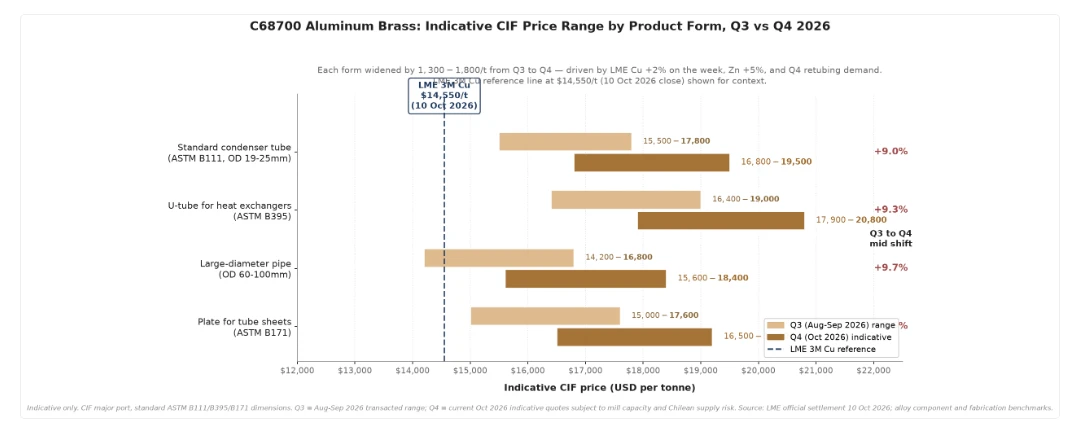
Indicative CIF price ranges for four C68700 product forms, Q3 (Aug-Sep 2026) transacted vs Q4 (Oct 2026) indicative. LME 3M Cu reference line at $14,550/t (10 Oct 2026 close) shown for context. Each form widened by $1,300-$1,800/t from Q3 to Q4.
| Product form | Q3 range (USD/t CIF) | Q4 indicative (USD/t CIF) | Q3→Q4 mid shift |
|---|---|---|---|
| Standard condenser tube (ASTM B111, OD 19–25 mm) | $15,500 – $17,800 | $16,800 – $19,500 | +8.6% |
| U-tube for heat exchangers (ASTM B395) | $16,400 – $19,000 | $17,900 – $20,800 | +8.7% |
| Large-diameter pipe (OD 60–100 mm) | $14,200 – $16,800 | $15,600 – $18,400 | +9.9% |
| Plate for tube sheets (ASTM B171) | $15,000 – $17,600 | $16,500 – $19,200 | +9.7% |
The shifts are not uniform. U-tubes widened the most because of additional bending-process scrap and longer lead times at the bending shops. Large-diameter pipe widened because fewer mills can produce it, and the Q4 retubing orders for shell-and-tube heat exchangers in the power sector are pulling capacity. Plate for tube sheets moves with tube pricing, since they are typically supplied in the same retubing package.
The reference line at $14,550/t (LME 3M Cu, 10 Oct 2026 close) shows how thin the raw-copper margin is once the alloy premium, fabrication cost, and freight are added. A standard condenser tube sells at roughly 1.15–1.34× the LME Cu number. That multiple is what has to widen further if the Chilean strike extends beyond two weeks.
The Chilean Wildcard
A major copper-gold mine in northern Chile began a historic first-ever strike on October 7, 2026, after contract negotiations with the union collapsed. The union has warned that, if the strike continues, the operation could begin production cuts within approximately two weeks.
Three things make this stoppage different from previous Chilean labor actions:
It is a copper-gold mine, not a pure copper asset. The mine's revenue mix means a strike decision weighs gold-price considerations differently than at a pure-copper operation. The bargaining dynamics are not symmetric with the September authorization vote at another major Chilean copper mine.
The concentrate is shipped to third-party smelters. A Chilean stoppage does not directly idle a captive smelter; instead, it removes concentrate from the spot market, which lifts TC/RC pressure on the remaining smelters and tightens global refined supply indirectly.
The timing overlaps with the Q4 retubing window. Power-plant and desalination buyers who have been waiting for a copper-price dip to enter the market are now competing with each other for delivery slots. If the strike extends, the bid for prompt tonnage intensifies.
What this means for a C68700 buyer: lock pricing for Q1 2027 delivery before mid-November. The combination of a tight Q4 retubing window, a live Chilean supply risk, and an LME Cu market that is already up 41% year-on-year is the kind of setup that historically resolves in a $200–$400/t step-up over four to six weeks, not a single sharp spike.
Q4 Procurement Decision Points
For buyers of C68700 tubes - whether for power-plant condensers, desalination evaporators, refinery bundles, or offshore HVAC - five decision points stand out for the rest of October:
Confirm ASTM B111 or B395 edition. The 2018 vs 2024 editions have different eddy-current and hydrostatic test acceptance criteria. A 2024-edition retubing specification will require updated mill certification and may exclude some older production lines.
Lock the Q1 2027 price now, even at a small premium. Mill lead times for C68700 condenser tube are already 10–14 weeks. A Q1 2027 delivery slot ordered in October secures the production calendar position; a December order risks being pushed to Q2.
Specify arsenic content as 0.02–0.06%. Do not accept "trace" or "balanced" arsenic descriptions. Arsenic is the dezincification inhibitor, and its minimum content must be on the MTC for any seawater or brackish-water service.
Ask for tube-sheet compatibility data. C68700 tubes are typically rolled into tube sheets of Muntz metal (C28000) or naval brass (C46400). Galvanic compatibility must be confirmed; otherwise, the tube-sheet becomes the corrosion point in the assembled bundle.
Pre-book inspection slots. Third-party inspection agencies are also at peak load in Q4. Reserving the inspection window now avoids the situation where tubes are ready at the mill but cannot ship because the inspector is unavailable.
FAQ
Q: Q1. Is C68700 the same as "aluminum brass" in old drawings?
A: Yes. C68700 is the modern UNS designation for what older specifications called "aluminum brass" or "arsenical aluminum brass." The arsenic addition is what makes it suitable for seawater service. If the drawing does not specify arsenic content, confirm the application before substituting.
Q: Q2. Can C68700 be used in freshwater systems?
A: Yes, and it often is - particularly where the operator wants a single alloy across mixed-service heat exchangers. The downside is cost: C68700 is more expensive than C44300 admiralty brass for clean freshwater, and C70600 Cu-Ni 90/10 is preferred for the most aggressive chloride service.
Q: Q3. What is the typical delivery time for C68700 condenser tube in Q4 2026?
A: Standard sizes (OD 19–25 mm) in mill quantities: 10–14 weeks for Q1 2027 delivery slots. U-tubes and large-diameter pipe: 14–20 weeks. Plate for tube sheets: 8–12 weeks if the same mill also supplies the tubes.
Q: Q4. Why did the price range widen rather than rise to a single number?
A: C68700 prices vary by form, dimension, temper, test protocol, and order quantity. A 1-tonne spot order for a non-standard dimension will quote well above a 50-tonne mill order for standard dimensions. The range captures the spread between these two ends of the market.
Q: Q5. Should buyers wait for a price dip?
A: The LME 3M Cu market is trading in a $14,200–$14,600/t range post-Chinese National Day holiday. The seasonal Q4 retubing demand and the Chilean supply risk both argue against waiting. The historical pattern is that Q4 copper peaks in late November or early December, not in October.


