

I. Material Overview
C10100 phosphorus deoxidized copper (also known as phosphorus deoxidized oxygen-free copper) is a high-purity copper alloy deoxidized by adding trace phosphorus (P), belonging to the subdivided type of oxygen-free copper. The designation follows the American ASTM standard system, with "C" for copper and copper alloys and "10100" for specific grade identification. The material effectively removes the oxygen residue in molten copper through phosphorus element, which significantly improves the resistance to hydrogen embrittlement and high-temperature processing performance, and at the same time, maintains excellent electrical and thermal conductivity characteristics, which is widely used in the fields of refrigeration equipment, vacuum devices, welded tubes and other areas that require strict requirements on material purity and process stability.
Second, the chemical composition and standards
According to ASTM B152/B152M standard, the chemical composition of C10100 is required as follows (mass percent)
Copper (Cu): ≥ 99.99% (total impurities ≤ 0.01%);
Phosphorus (P): 0.004%~0.012% (deoxidizer, residue strictly controlled);
Oxygen (O): ≤ 0.0005% (much lower than the oxygen content of ordinary copper violet);
Other impurities: such as iron (Fe), lead (Pb), sulfur (S), etc. are limited to trace levels.
Note: China's national standard in the corresponding grade for TP2 phosphorus deoxidation copper (GB / T 5231-2012), performance parameters and C10100 is basically the same.
Physical and Mechanical Properties
Physical properties
Density: 8.89~8.94 g/cm³ (almost the same as pure copper);
Melting point: 1083℃ (consistent with pure copper);
Conductivity: ≥98% IACS (International Annealed Copper Standard), slightly lower than pure copper but better than most alloys;
Thermal conductivity: about 380 W / (m-K), close to the level of pure copper.
Mechanical Properties (in annealed condition)
Tensile strength (Rm): 210~260 MPa (soft state);
Yield strength (Rp0.2): 40~60 MPa;
Elongation (A): 40%~50%, showing extremely high plasticity;
Hardness: HB 40~50 (soft state), up to HB 110 or more after cold working.
Cold working characteristics: cold rolling, drawing and other processes to enhance the strength (tensile strength up to 400 MPa), but need to avoid excessive processing resulting in a sudden drop in plasticity.
Material properties and core advantages
Anti-hydrogen embrittlement and high temperature stability
Phosphorus deoxidation process completely eliminates oxygen residue, avoiding brittle cracking when used in hydrogen environment (ordinary copper is prone to cracking due to hydrogen infiltration and formation of water vapor bubbles);
High-temperature reducing atmosphere (e.g. hydrogen furnace) still maintains structural stability, suitable for vacuum brazing components.
Welding and molding properties
Extremely low oxygen content avoids the formation of porosity during welding, which is suitable for high-frequency welding, laser welding and other precision joining processes;
Wide range of heat processing temperature (700~900℃), excellent ductility, can be processed into ultra-thin tubes or complex profiles.
Corrosion resistance and cleanliness
Corrosion resistance in pure water, non-oxidizing acid is better than ordinary copper;
High surface cleanliness, suitable for semiconductor equipment, ultra-pure fluid transportation system.
V. Typical Application Areas
Refrigeration and HVAC system
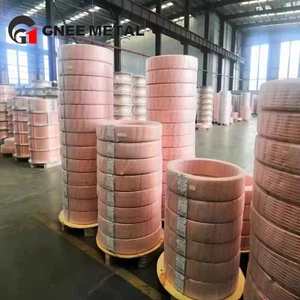
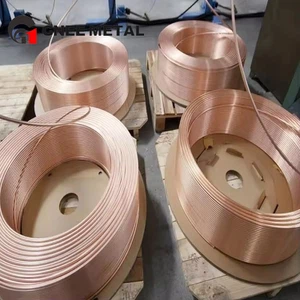
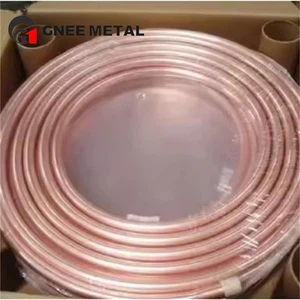
Air conditioner refrigerant copper tube, refrigerator evaporator coil;
Heat pump heat exchanger core.
Electronics and vacuum technology
Vacuum tube electrode, particle gas pedal cavity;
High purity gas transportation piping.
Energy and Chemical
Hydrogen energy equipment seals, fuel cell bipolar plate substrates;
Corrosion-resistant reactor linings.
Other fields
High-frequency communication waveguide, superconducting magnet cooling piping;
Food grade containers (need surface plating or passivation treatment).
VI. Processing and Treatment Technology
Heat treatment
Annealing: 450 ~ 650 ℃ heat preservation and then slow cooling to eliminate work hardening and restore plasticity;
No need for quenching or aging treatment, as there is no phase change strengthening mechanism.
Surface treatment
Electropolishing: Improve surface finish to Ra≤0.2μm, reduce fluid resistance;
Passivation: Phosphate or chromate conversion film to enhance oxidation resistance;
Plating protection: nickel or tin plating for food or high humidity environment.


