

What is H62 brass?
Brass is a binary alloy composed of copper and zinc, with a production history spanning thousands of years. It is highly favored for its excellent machinability, hardness, corrosion resistance, and aesthetic appeal.
H62/C28000/CuZn38 brass, containing 62% copper, possesses good mechanical properties, good hot and cold ductility, good machinability, ease of brazing and welding, and corrosion resistance. Furthermore, its low price makes it a widely used and common type of brass.
What is the chemical composition of H62 brass strip?
| Element | Content Range (%) | Requirement & Notes |
|---|---|---|
| Copper (Cu) | 60.5 – 63.5 | The primary element. Defines the alloy's core properties. |
| Zinc (Zn) | Balance | The secondary element. Typically ~36.5–39.5%. |
| Lead (Pb) | ≤ 0.08 | Very low. This makes H62 suitable for applications with lead-content restrictions (e.g., potable water, electronics). |
| Iron (Fe) | ≤ 0.15 | An impurity controlled to prevent excessive hardness. |
| Other Impurities | ≤ 0.5 | Total allowance for elements like Sb, Bi, P, etc. |
| Copper + Sum of Named Elements | ≥ 99.5 | Ensures material purity and consistency. |
Corrosion Resistance
The corrosion resistance of H62 brass is one of its most valued properties. The alloy exhibits good resistance to atmospheric corrosion, seawater corrosion, and various other environments. The α-phase is particularly resistant to corrosion, while the β-phase is slightly less so. The alloy's resistance to dezincification, a form of corrosion where zinc is selectively leached out of the alloy, is adequate for most applications, although it may require additional protective measures in highly aggressive environments.
Manufacturing Process of Brass-Alloy Products in General H62
The typical production process of alloys like H62 involves melting and mixing precise proportions of copper and zinc. First, the raw materials are weighed and melted together in the furnace. Once the mixture is fully hot and molten, it is stirred to ensure uniformity in composition. After that, the alloy is cast into molds forming billets or ingots, which are then cooled and further processed. Rolling, shaping, or machining are the final requirements of the product and are carried out according to the end-application specifications. The whole process ensures that the quality and characteristics of H62 brass are retained.
Applications of H62 Brass
|
Application Category |
Examples of Applications |
|---|---|
|
Electrical Components |
Connectors, terminals, circuit board components |
|
Mechanical Parts |
Springs, screens, radiator parts |
|
Building Materials |
Brass tile trim, brass strip, brass bar, brass transition strip, brass stair nosing |
Differences Between H59 and H62 Brass
| Key Parameter | H59 Brass | H62 Brass |
|---|---|---|
| Composition | 59% Copper | 62% Copper |
| Strength | Higher | Moderate |
| Hardness | Higher | Moderate |
| Malleability | Lower | Higher |
| Corrosion Res. | Lower | Higher |
| Wear Res. | Higher | Moderate |
| Applications | Load-Bear | Forming |
FAQs
Q: What are the compositions of H62 brass primarily?
A: 62% of H62 Brass is copper, with the rest being zinc. This alloy may also contain a small proportion of lead to improve machining characteristics.
Q: How does H62 brass compare to H59 brass?
A: Comparing H59 and H62 brass, H62 has a higher copper content and therefore generally offers better corrosion resistance and good plasticity; whereas H59 may have more lead content to enhance machinability.
Q: What affords H62 brass the capacity to undergo welding?
A: H62 brass can go into welding because it possesses very good plasticity, sufficient strength, and ductility, which retain structural integrity during welding.
Q: Can you name the properties responsible for H62 brass having multifarious applications?
A: Excellent corrosion resistance, good plasticity, and durability make H62 brass versatile for numerous applications, including atmospheric exposure.
Q: For what are H62 brass typically used?
A: H62 brass is used when both strength and ductility are required; for example, in manufacturing brass strips, soldering, and in situations that demand durability and corrosion resistance.
Q: How does the presence of trace elements like lead affect H62 brass?
A: Trace quantities of lead enhance the machinability of the brass without detrimentally affecting corrosion resistance or overall durability.
Q: Can H62 brass be made for special programs?
A: Yes, H62 Brass may be tailored to special applications by modifying the alloy composition, which could involve adjusting trace elements for better machinability or corrosion resistance.
Q: Why use H62 brass outdoors?
A: Due to its superior corrosion resistance and durability, H62 brass resin can withstand harsh weather conditions and therefore is used outdoors.
Q: What advantage does being an alpha-beta brass convey onto H62?
A: Being alpha-beta gives H62 a mixed solution strength and ductility, making it ideal for use in structural applications requiring both properties.
Q: How does H62 brass retain its properties under atmospheric conditions?
A: H62 brass retains its properties under atmospheric conditions because of its corrosion resistance, which prevents it from degrading upon exposure to moisture and other environmental parameters.
Our product range
1. Pure Copper (Sheet, Tube, Wire)
Primary Grades: T1 (C11000), T2 (C10100). We prioritize C11000 (T1) for its excellent conductivity.
Standards: ASTM B152 (Sheet), ASTM B75/B88 (Tube), ASTM B1/B3 (Wire), EN, JIS, GB/T.
Typical Sizes:
Tube: OD 6mm – 200mm.
Sheet: Thickness 0.5mm – 50mm.
Wire: Diameter 1.0mm – 10mm.
2. Phosphorus Deoxidized Copper (Tube, Sheet)
Primary Grades: TP1 (C12000 / CW023A), TP2 (C12200). Ideal for welding and plumbing.
Standards: ASTM B188, ASTM B75/B88, EN 12451, JIS H3300.
Typical Sizes:
Tube: OD 8mm – 150mm.
Sheet: Thickness 1.0mm – 30mm.
3. Brass (Strip & Coil)
Primary Grades: H96, H68, H62 (CuZn37 / C28000). We strongly recommend H62 for its excellent balance of strength and machinability.
Standards: ASTM B36, ASTM B134, EN 1652, JIS H3100.
Typical Sizes:
Strip/Coil: Thickness 0.1mm – 3.0mm, Width up to 600mm.
Get the complete product catalog
Our factory

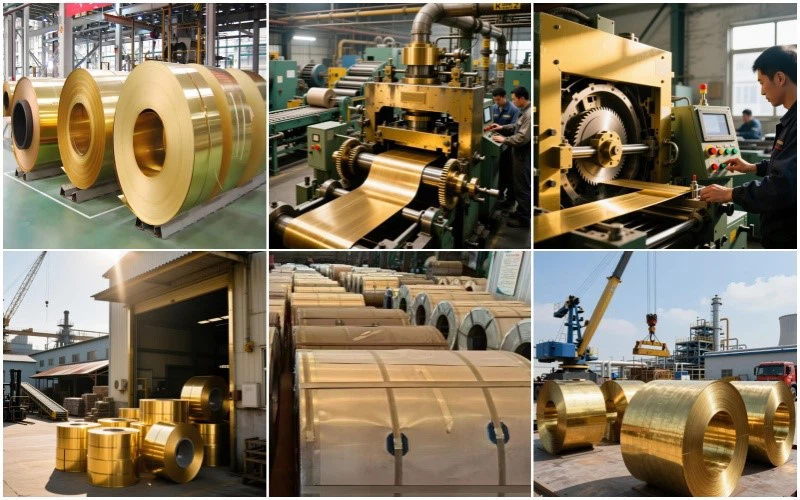
Our facility is equipped with industry-advanced continuous casting and rolling production lines, precision rolling mills, multi-pass drawing units, and automated forming equipment, enabling efficient and stable transformation from copper rods to finished products. Our core machinery allows us to flexibly manufacture a full range of grades-including pure copper (e.g., C11000/T1), phosphorus deoxidized copper (e.g., C12200/TP2), and brass (e.g., H62)-in the form of sheets, tubes, rods, strips, and wires. We also provide tailored processing services such as cutting, slitting, and precision finishing.


