

What is H68 brass?
H68, as a standard brass grade, is named based on its chemical composition and specific performance standards. Brass, as a copper-zinc alloy, is widely favored for its unique golden color and good mechanical properties. Specifically, H68 brass contains approximately 67%-70% copper (Cu) and 30%-33% zinc (Zn), a ratio that gives it unique physical and chemical properties. The zinc content in brass has a significant impact on its performance, and the copper-zinc ratio in H68 is carefully balanced to achieve optimal overall performance.
Physical and Mechanical Properties of H68 Brass
1. Physical Properties: H68 brass has good electrical and thermal conductivity, making it widely used in electrical and heat conduction applications. Simultaneously, its density is approximately 8.5 g/cm³, which is lower than other metals such as steel, helping to reduce the overall weight of products.
2. Mechanical Properties: H68 brass possesses moderate tensile strength, typically ranging from 200-400 MPa, allowing it to withstand certain external forces while also being easy to process and shape. Furthermore, it exhibits good ductility and plasticity, readily enabling the creation of various complex shapes through stamping, stretching, and other processes. More importantly, H68 brass exhibits excellent corrosion resistance, particularly in atmospheric and freshwater environments.
Main Application Areas of H68 Brass
1. Electrical Industry: Benefiting from its excellent electrical conductivity, H68 brass is widely used in the manufacture of conductors for wires and cables, as well as electrical connectors and sockets. In electrical engineering, the reliability and stability of brass have been thoroughly verified.
2. Hardware Products: Due to its excellent machinability and attractive golden appearance, H68 brass is frequently used to manufacture various hardware products, such as door locks, handles, and faucets. These products are not only practical but also possess a certain decorative quality, enhancing the aesthetics of homes and public spaces.
3. Machinery Manufacturing: In the machinery manufacturing field, H68 brass is often used as a material for transmission components such as bearings and gears. Its moderate mechanical properties and good wear resistance allow these components to maintain stable performance during operation, extending their service life.
4. Other Fields: In addition, H68 brass is widely used in musical instruments, art production, and chemical and medical fields. In musical instruments, brass's resonant properties make it an ideal material for making instruments such as trumpets and trombones. In art production, brass's golden luster and malleability provide artists with ample creative freedom. In the chemical and medical fields, brass's corrosion resistance makes it a preferred material for manufacturing valves, pipes, and other equipment.
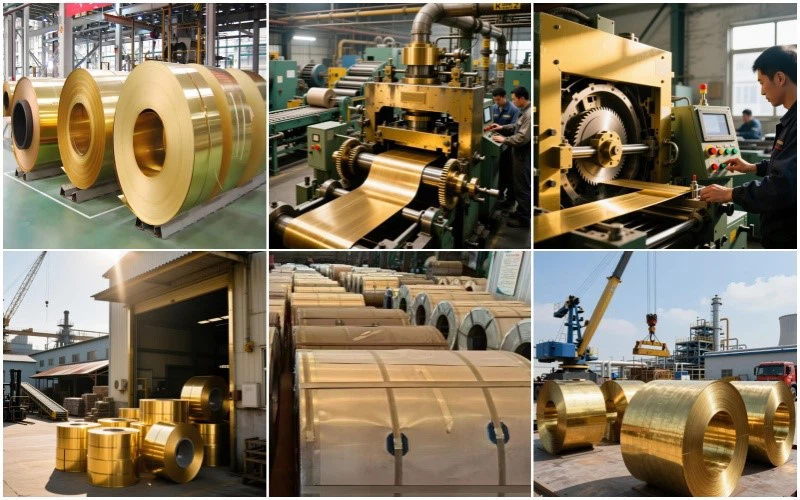
Purchasing and Maintenance of H68 Brass
When purchasing H68 brass products, consumers should carefully check the surface quality, dimensional accuracy, and for defects such as cracks and porosity. Understanding the manufacturer and warranty information is also crucial for ensuring product quality. During use, to maintain the luster of brass products and extend their service life, regular cleaning and maintenance are recommended. You can gently wipe the surface with a soft cloth and a suitable amount of detergent. Avoid using hard objects or strong corrosive detergents to prevent damage to the surface.
FAQ
| What is the European equivalent of H68 brass? The European standard equivalent of H68 brass is CuZn30 (also identified as CW505L). |
| What is the chemical composition of H68 brass? The typical composition of H68 brass is 67.0-70.0% copper, with the remainder being zinc and very low levels of impurities (lead ≤ 0.03%). |
| What are the key mechanical properties of H68 brass? In the annealed condition, H68 brass typically exhibits a tensile strength of about 300-400 MPa, excellent elongation (>45%), and good ultimate strength. |
| What is H68 brass primarily used for? H68 brass is primarily used for deep drawing, stamping, and forming complex parts such as cartridge cases (its common name is "cartridge brass"), radiator cores, electrical sockets, and decorative items. |
| How does the machinability of H68 brass rate? The machinability of H68 brass is rated at approximately 30% on the industry scale where free-cutting brass C36000 is 100%, meaning it produces long, ductile chips. |
| Can H68 brass be welded? Yes, H68 brass can be welded and brazed using appropriate techniques and filler metals (like silicon bronze or brass fillers), though it requires skill due to zinc's volatility. |
| What is the density of H68 brass? The density of H68 brass is approximately 8.53 grams per cubic centimeter (g/cm³). |
| Is H68 brass resistant to dezincification corrosion? H68 brass has moderate resistance to dezincification. For environments highly prone to this type of corrosion, specific inhibitor-added brasses like C44300 are often recommended instead of H68 brass. |
| What is the difference between H68 brass and H62 brass? The main difference is copper content. H68 brass (~68% Cu) is more ductile and better for cold forming. H62 brass (~62% Cu) is stronger and better for hot working and general hardware. |
| What tempers is H68 brass available in? H68 brass is commonly supplied in tempers such as annealed (soft), quarter hard, half hard, and hard to suit different forming and strength requirements. |
Our product range
1. Pure Copper (Sheet, Tube, Wire)
Primary Grades: T1 (C11000), T2 (C10100). We prioritize C11000 (T1) for its excellent conductivity.
Standards: ASTM B152 (Sheet), ASTM B75/B88 (Tube), ASTM B1/B3 (Wire), EN, JIS, GB/T.
Typical Sizes:
Tube: OD 6mm – 200mm.
Sheet: Thickness 0.5mm – 50mm.
Wire: Diameter 1.0mm – 10mm.
2. Phosphorus Deoxidized Copper (Tube, Sheet)
Primary Grades: TP1 (C12000 / CW023A), TP2 (C12200). Ideal for welding and plumbing.
Standards: ASTM B188, ASTM B75/B88, EN 12451, JIS H3300.
Typical Sizes:
Tube: OD 8mm – 150mm.
Sheet: Thickness 1.0mm – 30mm.
3. Brass (Strip & Coil)
Primary Grades: H96, H68, H62 (CuZn37 / C28000). We strongly recommend H62 for its excellent balance of strength and machinability.
Standards: ASTM B36, ASTM B134, EN 1652, JIS H3100.
Typical Sizes:
Strip/Coil: Thickness 0.1mm – 3.0mm, Width up to 600mm.
Get the complete product catalog
Our factory

Our facility is equipped with industry-advanced continuous casting and rolling production lines, precision rolling mills, multi-pass drawing units, and automated forming equipment, enabling efficient and stable transformation from copper rods to finished products. Our core machinery allows us to flexibly manufacture a full range of grades-including pure copper (e.g., C11000/T1), phosphorus deoxidized copper (e.g., C12200/TP2), and brass (e.g., H62)-in the form of sheets, tubes, rods, strips, and wires. We also provide tailored processing services such as cutting, slitting, and precision finishing.


