

What is H62 brass?
H62 brass strip is a common copper alloy material with many properties. In terms of physical properties, it has a pleasant golden-yellow color, making it aesthetically pleasing and often used in decorative applications. Its moderate density, approximately 8.5 g/cm³, allows it to strike a good balance between performance and weight in applications where weight is critical. Mechanically, H62 brass strip possesses high strength and hardness, exhibits good wear resistance, and can withstand a certain degree of external force without easily deforming or damaging. It is suitable for manufacturing parts that need to withstand significant pressure and friction, such as mechanical parts and hardware accessories.
h62 brass equivalent
| Standard System | Equivalent Designation | Key Notes & Composition |
|---|---|---|
| China (GB/T) | H62 | The original Chinese standard designation. |
| United States (UNS/ASTM) | C28000 | The primary and most critical international identifier. The UNS (Unified Numbering System) code is the global lingua franca for material specifications in trade and engineering. |
| European Union (EN/DIN) | CuZn37 | The most precise and commonly used European equivalent, indicating a nominal composition of ~63% Cu, 37% Zn. CuZn38 is also sometimes referenced due to the allowed composition range. |
| Japan (JIS) | C2800 | Essentially identical in composition to UNS C28000. The difference is typically just in the number of digits (JIS uses C2800, ASTM uses C28000). |
| International (ISO) | CuZn37 | Aligns with the European standard designation. |
Common Product Forms and Specifications
|
Product Form |
H62 Brass Specification Range |
Standard/Condition |
|
Plate |
Thickness 0.2-100mm, Width 305-1000mm |
Hot rolled (R), Soft (M), Hard (Y) |
|
Strip |
Thickness 0.1-3.0mm |
M, Y₂, Y, etc. |
|
Pipe |
Outer diameter 6-530mm, Wall thickness 0.5-50mm |
Cold worked or semi-hard state |
|
Bar |
Diameter 5-200mm, Length 2500-6000mm |
Drawn round, black surface round |
|
Wire |
Diameter 0.5-12.7mm |
Coiled or straight bars |
H62 Brass Material Properties
1. Physical Properties
H62 brass exhibits the following physical characteristics:
Density: ~8.5 g/cm³
Thermal Conductivity: ~120 W/m·K
Electrical Conductivity: ~27% IACS (International Annealed Copper Standard)
2. Mechanical Properties
H62 brass offers a combination of strength, ductility, and machinability. Its mechanical properties include:
Tensile Strength: 372–540 MPa
Yield Strength: 250–360 MPa
Elongation: ≥30% (depending on processing state)
Hardness: 85–120 Vickers (strip)
3. Processing Properties
Hot Working Temperature: 650–850°C
Annealing Temperature: 520–650°C
Cold Working: Excellent plasticity, suitable for bending, drawing, and stamping.
Machinability: Moderate (not as high as free-cutting brasses like 360 brass).
Weldability: Good brazing and welding performance.
H62 Brass Applications
1. Electronics and Electrical
Wires, cables, plugs, and sockets
Switch contacts and terminal blocks
Heat dissipation components
2. Hardware Products
Locks, handles, hinges, and valves
Faucets and decorative fittings
3. Automotive and Aerospace
Radiators, brake system components, and connectors
Air-conditioning compressor valve plates
4. Building and Construction
Door/window hardware, curtain wall structures
Decorative elements
5. Precision Machinery
Springs, gears, and bushings
Instrument housings and watch components
6. Marine and Shipbuilding
Components exposed to seawater, such as hull fittings
7. Crafts and Jewelry
Artistic sculptures and decorative objects
H59 vs H62 Comparison Table
| Property | H59 (Cu ≈ 59%) | H62 (Cu ≈ 62%) |
| Composition (Cu/Zn) | Lower Cu | Higher Cu |
| Microstructure | alpha + beta (more beta) | Primarily alpha (less beta) |
| Machinability (Chips) | Excellent (Short, Brittle) | Good (Longer, Curled) |
| Ductility (Elongation) | Lower | Higher |
| DZR Susceptibility | High Susceptibility | Moderate Susceptibility |
| Surface/Plating Consistency | Acceptable | Better |
| Material Cost | Lower | Slightly Higher |
| Typical Use | High-volume Lathe Parts | Water/Outdoor Contact, Aesthetic Parts |
FAQ
| Is H62 brass better than 360 brass? H62 Brass: Offers good strength, ductility, and corrosion resistance, making it suitable for forming and bending operations. 360 Brass: Known for its exceptional machinability due to the added lead, but it is slightly less ductile compared to H62. |
| What is the difference between H65 and H62 brass? H62 brass, with slightly lower copper content, is versatile and widely used in plumbing, electrical components, and hardware. In contrast, H65 brass boasts higher tensile strength, better corrosion resistance, and superior machinability, making it ideal for decorative items, musical instruments, and radiator cores. |
| What is the difference between H59 and H62 brass? Their primary differences lie in their composition; H59 contains slightly less copper, making it more malleable but less corrosion-resistant than H62, which contains higher levels of copper for increased durability and environmental resistance. |
| What is H62? H62 is a brass-zinc alloy containing 60.5–63.5% brass. It has good mechanical properties and electrical conductivity. Although cost-effective, it is susceptible to dezincification corrosion, making it suitable mainly for general structural parts. |
| What is the tensile strength of H62 brass? Tensile strength ≥ 330 MPa, elongation ≥ 10% (in the hard state), excellent cold/hot working performance. Suitable for processes such as stamping, drawing, forging, etc. |
| Is H62 brass machinability? More importantly, H62 brass has better machinability than many other brass alloys, which means that manufacturers can produce high-quality parts more efficiently, reducing waste and costs in the production process. |
Our product range
1. Pure Copper (Sheet, Tube, Wire)
Primary Grades: T1 (C11000), T2 (C10100). We prioritize C11000 (T1) for its excellent conductivity.
Standards: ASTM B152 (Sheet), ASTM B75/B88 (Tube), ASTM B1/B3 (Wire), EN, JIS, GB/T.
Typical Sizes:
Tube: OD 6mm – 200mm.
Sheet: Thickness 0.5mm – 50mm.
Wire: Diameter 1.0mm – 10mm.
2. Phosphorus Deoxidized Copper (Tube, Sheet)
Primary Grades: TP1 (C12000 / CW023A), TP2 (C12200). Ideal for welding and plumbing.
Standards: ASTM B188, ASTM B75/B88, EN 12451, JIS H3300.
Typical Sizes:
Tube: OD 8mm – 150mm.
Sheet: Thickness 1.0mm – 30mm.
3. Brass (Strip & Coil)
Primary Grades: H96, H68, H62 (CuZn37 / C28000). We strongly recommend H62 for its excellent balance of strength and machinability.
Standards: ASTM B36, ASTM B134, EN 1652, JIS H3100.
Typical Sizes:
Strip/Coil: Thickness 0.1mm – 3.0mm, Width up to 600mm.
Get the complete product catalog
Our factory

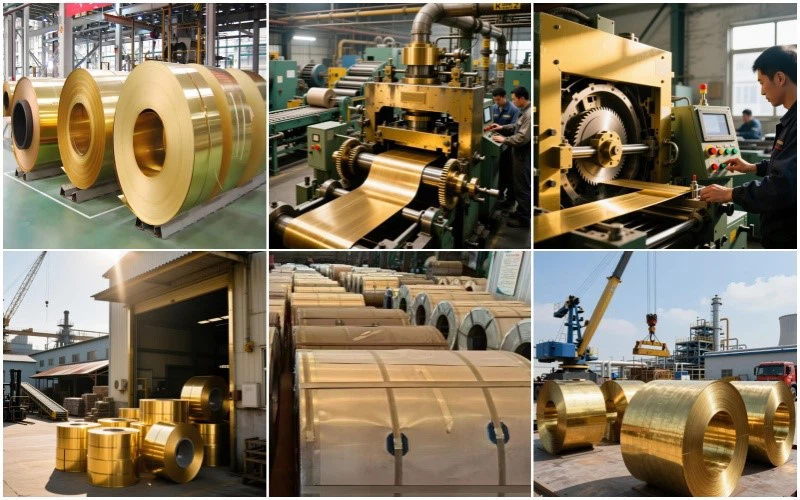
Our facility is equipped with industry-advanced continuous casting and rolling production lines, precision rolling mills, multi-pass drawing units, and automated forming equipment, enabling efficient and stable transformation from copper rods to finished products. Our core machinery allows us to flexibly manufacture a full range of grades-including pure copper (e.g., C11000/T1), phosphorus deoxidized copper (e.g., C12200/TP2), and brass (e.g., H62)-in the form of sheets, tubes, rods, strips, and wires. We also provide tailored processing services such as cutting, slitting, and precision finishing.


