

C44300 Admiralty Brass and C46400 Naval Brass are both copper-zinc-tin alloys widely used in marine and industrial applications. While they share similar base elements, their distinct compositions, mechanical properties, and corrosion resistance characteristics make them suitable for entirely different service conditions. Understanding these differences is critical for material selection in condensers, heat exchangers, and marine hardware.
Chemical Composition Comparison
The fundamental difference between C44300 and C46400 lies in their chemical makeup. Both are copper-zinc alloys with tin additions, but C46400 contains significantly more zinc and a small lead addition for machinability.
| Element | C44300 Admiralty Brass | C46400 Naval Brass |
|---|---|---|
| Copper (Cu) | 70.0 – 73.0% | 59.0 – 62.0% |
| Zinc (Zn) | Remainder (~27-28%) | Remainder (~37-39%) |
| Tin (Sn) | 0.9 – 1.2% | 0.5 – 1.0% |
| Arsenic (As) | 0.02 – 0.06% | - |
| Lead (Pb) | 0.07% max | 0.20% max (typically 0.1-0.2%) |
Key Composition Differences:
Zinc Content: C46400 contains approximately 38% Zinc, compared to only 28% in C44300. Higher zinc makes the alloy stronger but more susceptible to dezincification corrosion.
Arsenic Inhibitor: C44300 contains Arsenic (0.02-0.06%) as a corrosion inhibitor to prevent dezincification. C46400 does not contain this inhibitor.
Lead Addition: C46400 includes a small lead addition to improve machinability. C44300 has negligible lead and is more difficult to machine.
Mechanical Properties Comparison
The higher zinc content in C46400 provides greater strength and hardness compared to C44300. However, C44300 offers superior ductility, which is critical for tube expansion applications.
| Property | C44300 Admiralty Brass (O61 Annealed) | C46400 Naval Brass (Typical) |
|---|---|---|
| Tensile Strength | 310 – 380 MPa (45 – 55 ksi) | 380 – 607 MPa (55 – 88 ksi) |
| Yield Strength | 105 – 150 MPa (15 – 22 ksi) | 172 – 455 MPa (25 – 66 ksi) |
| Elongation at Break | 30 – 45% | 15 – 30% |
| Hardness (Rockwell B) | 30 – 60 HRB | 55 – 85 HRB |
| Machinability Rating | 30 | 30 – 40 |
Key Mechanical Differences:
Strength: C46400 Naval Brass is significantly stronger and harder than C44300 Admiralty Brass, making it suitable for structural components and fasteners.
Ductility: C44300 offers superior elongation, which is essential for tube rolling and flaring operations in condenser fabrication.
Machinability: C46400 has slightly better machinability due to its lead content, though both are considerably less machinable than free-cutting brass (C36000).
Corrosion Resistance Comparison
This is the most critical distinction between the two alloys and the primary factor in material selection.
| Corrosion Type | C44300 Admiralty Brass | C46400 Naval Brass |
|---|---|---|
| Dezincification Resistance | Excellent (Arsenic inhibited) | Moderate to Poor |
| Seawater Corrosion | Good in polluted/stagnant water | Good in clean, flowing seawater |
| Stress Corrosion Cracking | Susceptible to ammonia | Susceptible to ammonia |
| Erosion Resistance | Moderate | Better than C44300 |
| Sulfide Attack Resistance | Good | Poor |
Key Corrosion Differences:
Dezincification: C44300 contains Arsenic which forms a protective film that prevents zinc from leaching out in water service. C46400 lacks this inhibitor, making it vulnerable to dezincification in stagnant or polluted seawater. This is why C44300 is specified for condenser tubing while C46400 is not.
Sulfide Environments: C44300 performs well in oil refinery applications where sulfur compounds are present. C46400 is not recommended for such environments.
Applications
The property differences between C44300 and C46400 dictate entirely different application areas.
| C44300 Admiralty Brass Applications | C46400 Naval Brass Applications |
|---|---|
| Steam Condenser Tubes | Marine Propeller Shafts |
| Heat Exchanger Tubing | Valve Stems and Bodies |
| Oil Refinery Overhead Condensers | Pump Shafts and Impellers |
| Desalination Distiller Tubing | Marine Hardware and Fasteners |
| Feedwater Heater Tubes | Turnbuckles and Swivel Fittings |
| Evaporator Tubing | Welding Rod and Wire |
Application Principle:
C44300 is specified where corrosion resistance in water service and ductility for tube expansion are paramount.
C46400 is selected where higher strength and moderate corrosion resistance in flowing seawater are required for structural components.
Fabrication and Welding Comparison
| Process | C44300 Admiralty Brass | C46400 Naval Brass |
|---|---|---|
| Cold Working | Excellent | Good |
| Hot Working | Fair (649-788°C) | Good (649-871°C) |
| Annealing Temperature | 427-593°C | 427-593°C |
| Welding Suitability | Brazing, soldering, GTAW | Brazing, soldering, oxyacetylene |
| Machinability | Fair (Rating 30) | Fair (Rating 30-40) |
Cost Comparison
| Factor | C44300 Admiralty Brass | C46400 Naval Brass |
|---|---|---|
| Raw Material Cost | Higher (More Copper) | Lower (Less Copper, More Zinc) |
| Processing Cost | Moderate | Moderate |
| Overall Cost | Slightly Higher | Slightly Lower |
C46400 is generally less expensive than C44300 due to its lower copper content (~60% vs ~71%). However, the cost difference is often negligible compared to the cost of premature failure if the wrong alloy is selected.
Selection Guideline
Choose C44300 Admiralty Brass when:
The application involves heat exchanger or condenser tubing requiring roller expansion.
The service environment includes polluted, stagnant, or sulfide-bearing water.
Dezincification resistance is a primary requirement.
Compliance with ASTM B111 / ASME SB111 is specified.
Choose C46400 Naval Brass when:
The application requires high-strength structural components such as shafts, valve stems, or fasteners.
The service environment involves clean, flowing seawater rather than polluted stagnant conditions.
Machinability is moderately important.
The component will not be exposed to sulfides or conditions promoting dezincification.
FAQ
1. What is the ASTM standard for C46400 Naval Brass?
C46400 Naval Brass is covered under several ASTM specifications including ASTM B171 (plate and sheet for pressure vessels), ASTM B124 (forging rod and shapes), and ASTM B283 (forgings). Unlike C44300, C46400 is not specified for condenser tubing under ASTM B111.
2. C44300 vs C46400: Which resists dezincification better?
C44300 Admiralty Brass offers excellent dezincification resistance due to its Arsenic inhibitor (0.02-0.06%) . C46400 Naval Brass lacks this inhibitor and is vulnerable to dezincification in stagnant or polluted water, which is why it is not used for heat exchanger tubing.
3. Why is C46400 Naval Brass stronger than C44300 Admiralty Brass?
C46400 Naval Brass contains approximately 38% Zinc, compared to 28% in C44300. The higher zinc content acts as a solid solution strengthener, increasing tensile and yield strength but also making the alloy more susceptible to corrosion.
4. Can C46400 Naval Brass be used for condenser tubing?
No. C46400 Naval Brass is not recommended for condenser or heat exchanger tubing. It lacks the Arsenic inhibitor present in C44300, making it prone to dezincification in water service. ASTM B111 specifies C44300, not C46400, for seamless condenser tubes.
5. What is the annealing process for C46400 Naval Brass?
C46400 Naval Brass is annealed at 427-593°C (800-1100°F) , similar to C44300. This heat treatment relieves cold work stresses and restores ductility for further forming operations.
6. C44300 vs C46400: Which is easier to machine?
C46400 Naval Brass has slightly better machinability (rating 30-40) than C44300 (rating 30) due to its intentional lead addition. However, both are significantly harder to machine than free-cutting brass C36000 (rating 100).
7. Why does C46400 Naval Brass contain lead?
C46400 Naval Brass contains a small amount of lead (up to 0.20%) to improve machinability. The lead acts as a chip breaker during cutting operations. C44300 has only trace lead (0.07% max) and relies on its ductility for forming rather than machining.
8. What are the primary marine applications for C46400 Naval Brass?
C46400 Naval Brass is used for propeller shafts, valve stems, pump shafts, turnbuckles, and marine fasteners. Its higher strength and moderate seawater corrosion resistance make it suitable for structural components exposed to flowing seawater.
9. Is C46400 Naval Brass weldable?
C46400 Naval Brass is suitable for brazing, soldering, and oxyacetylene welding. Like C44300, it is not recommended for coated metal arc welding due to zinc volatilization, which causes weld porosity and weak joints.
10. C44300 vs C46400: Which costs more?
C44300 Admiralty Brass is generally slightly more expensive than C46400 due to its higher copper content (~71% vs ~60%). However, the cost difference is minimal compared to the risk of premature failure if the wrong alloy is selected for a specific service environment.
How Do We Package Copper Heat Exchanger Tubes for Global Delivery?
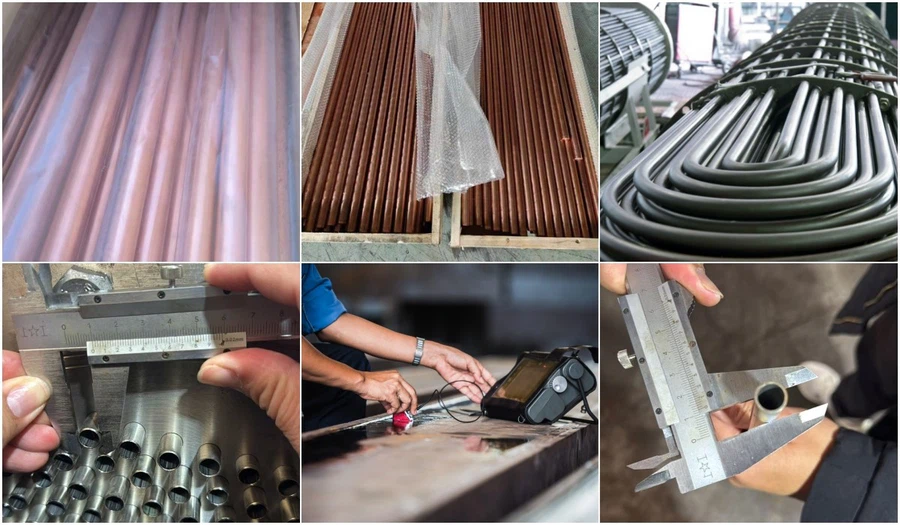
Poor packaging destroys even the best copper heat exchanger tube. As a professional copper heat exchanger tube factory serving copper heat exchanger tube USA, Europe, UAE, Saudi Arabia, and India, we follow military-grade export packaging standards to ensure zero damage during sea or air freight.
Our Standard Packaging Process:
| Packaging Stage | Material / Method | Purpose |
|---|---|---|
| Individual Tube Protection | Anti-rust VCI paper + plastic end caps | Prevents moisture, dust, and scratches on copper tube heat exchanger inner surfaces. |
| Bundling | Nylon straps + wooden spacers | Keeps copper heat exchanger tube OD 19mm, 1 inch, or 5/8 inch sizes organized and vibration-free. |
| Moisture Barrier | Thick PE film wrap (heat-shrunk) | Blocks humidity during long sea voyages to copper heat exchanger tube Germany or Saudi Arabia. |
| Outer Packing | Export-grade plywood cases or steel-banded wooden crates | Withstands stacking and rough handling. Each crate labeled with PO number, alloy (e.g., SB111 C70600), and quantity. |
| Documentation | Packing list + Mill Test Certificate (MTC) attached outside | Customs clearance support for copper heat exchanger tube stockist and distributor partners. |
For U-Bundle Orders: U tube heat exchanger and U tube bundle heat exchanger are placed in dedicated steel jigs inside the crate to prevent bending radius distortion.
Our Factory & Equipment
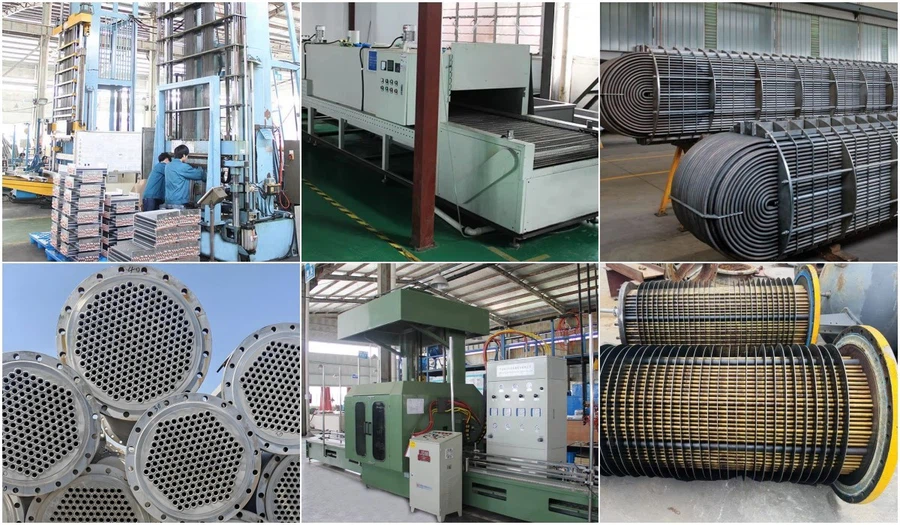
| Equipment Type | Specification / Capability | Quality Impact |
|---|---|---|
| Horizontal Continuous Casting Line | 10-ton capacity | Produces homogeneous copper alloy tube for heat exchanger billets with zero porosity. |
| Three-Roll Piercing Mill | Up to 60mm OD | Precision wall thickness control for heat exchanger tube wall thickness as low as 0.5mm. |
| Cold Drawing Bench | 5 draws in sequence | Achieves tight tolerances on copper heat exchanger tube length and heat exchanger pipe diameter. |
| Straightening & Cutting Line | CNC servo-controlled | Burr-free cutting for copper heat exchanger tube 3/4 inch and 1 inch to exact project lengths. |
| U-Bending Machine | CNC mandrel type | Produces u tube condenser and U tube bundle heat exchanger without kinking or ovality. |
| Eddy Current Tester | NDT (Non-Destructive Testing) | 100% inspection of C70600 tube and C71500 tube for pinholes or cracks per ASTM B111 pdf standards. |
| Hydrostatic Tester | Up to 200 bar | Validates heat exchanger tube expansion and tube rolling integrity. |
| Spectrometer | Optical emission (OES) | Confirms chemical composition of ASME SB111, EN 12451, and JIS H3300 grades on every batch. |
Our Certifications & Compliance:
ASTM B111 pdf and ASME SB111 pdf full traceability.
ISO 9001:2015 quality management system.
Third-party inspection accepted: SGS, BV, Lloyds, or TUV.
Copper heat exchanger tube life expectancy testing reports available upon request.
Get Fast Quote & Logistics Plan


