

Brass refers to a broad range of copper-zinc alloys with properties including ductility, strength, hardness, machinability, and corrosion resistance. UNS C44300 brass alloy, also known as Admiralty brass or Arsenical brass, is an inhibited copper-zinc-tin alloy designed for enhanced corrosion resistance in water service. GNEE supplies UNS C44300 products from Henan Province, China, meeting stringent international specifications.
Chemical Composition
The following table details the nominal chemical composition of UNS C44300 brass alloy.
| Element | Content (%) |
|---|---|
| Copper (Cu) | 71 |
| Tin (Sn) | 1 |
| Zinc (Zn) | 28 |
Physical Properties
Typical physical properties of UNS C44300 brass alloy.
| Property | Metric | Imperial |
|---|---|---|
| Density | 8.53 g/cm³ | 0.308 lb/in³ |
Mechanical Properties
Mechanical properties of UNS C44300 brass alloy.
| Property | Metric | Imperial |
|---|---|---|
| Tensile strength | 331 - 379 MPa | 48,000 - 55,000 psi |
| Yield strength (depending on temper) | 124 - 152 MPa | 18,000 - 22,000 psi |
| Elongation at break (in 0 mm) | 65% | 65% |
| Creep strength (@425°C, time 3.60e+6 sec / 797°F, time 1000 hr, 0.0001) | 0.370 MPa | 53.7 psi |
| Charpy impact | 82.4 J | 60.8 ft-lb |
| Fatigue strength (@1.00e+7 cycles) | 115 - 125 MPa | 16,700 - 18,100 psi |
| Elastic modulus | 117 GPa | 17,000 ksi |
| Poisson's ratio | 0.34 | 0.34 |
| Machinability (UNS C36000 = 100) | 30 | 30 |
| Shear modulus | 40.0 GPa | 5,800 ksi |
Thermal Properties
Thermal properties of UNS C44300 brass alloy.
| Property | Metric | Imperial |
|---|---|---|
| Thermal expansion co-efficient (@20-300°C / 68-572°F) | 20.2 µm/m°C | 11.2 µin/in°F |
| Thermal conductivity (@20°C / 68°F) | 110 W/mK | 763 BTU in/hr.ft².°F |
Equivalent designations and applicable specifications for UNS C44300 brass alloy include:
ASME SB111, ASME SB171, ASME SB359, ASME SB395, ASME SB543
ASTM B111, ASTM B135, ASTM B171, ASTM B359, ASTM B395, ASTM B432, ASTM B543
Fabrication and Heat Treatment
Machinability
The machinability rating of UNS C44300 brass alloy is 30, with free-cutting brass (UNS C36000) as the 100 baseline.
Welding
Suitable welding processes for UNS C44300 brass alloy include soldering, brazing, oxyacetylene welding, gas shielded arc welding, spot welding, and butt welding. Processes such as coated metal arc welding and seam welding are not recommended.
Hot Working
The hot forming capacity of UNS C44300 is rated as fair, with recommended hot working temperatures between 649 and 788°C (1200 and 1450°F) .
Cold Working
UNS C44300 brass alloy has an excellent cold working property.
Annealing
The annealing temperature range for UNS C44300 brass alloy is 427 to 593°C (800 to 1100°F) .
FAQ
1. What is UNS C44300 equivalent to?
UNS C44300 Admiralty Brass is equivalent to BSI CZ111 and ISO CuZn28Sn1. These designations share identical chemical and mechanical requirements and are fully interchangeable under ASTM B111 specifications.
2. C44300 vs C36000: Which has better machinability?
C36000 Free-Cutting Brass has a machinability rating of 100 and is designed for high-speed screw machine work. UNS C44300 Admiralty Brass has a rating of only 30, making it significantly harder to machine. The trade-off is that C44300 offers superior corrosion resistance in water service, which C36000 lacks entirely.
3. Which welding methods are suitable for UNS C44300?
UNS C44300 Admiralty Brass is suitable for brazing, soldering, oxyacetylene welding, and gas shielded arc welding. Coated metal arc welding (stick welding) and seam welding are not recommended due to zinc volatilization, which causes weld porosity and weak joints.
4. C44300 hot working vs cold working: Which is better?
UNS C44300 Admiralty Brass has excellent cold working properties, making it ideal for tube drawing and forming at room temperature. Its hot working capacity is only fair, requiring careful temperature control between 649-788°C to avoid hot shortness. For most fabrication, cold working is preferred.
5. What annealing temperature restores O61 temper in UNS C44300?
To restore the O61 annealed temper required for tube rolling, UNS C44300 Admiralty Brass should be annealed at 427-593°C. This relieves cold-work stresses and restores the ductility necessary for expansion into tube sheets.
6. Why is UNS C44300 specified over standard brass for condenser tubes?
Standard brasses without inhibitors suffer dezincification in seawater, becoming porous and weak. UNS C44300 Admiralty Brass contains Arsenic as an inhibitor, which blocks zinc leaching. This is why ASTM B111 mandates C44300 rather than generic brass for condenser service.
7. C44300 vs C70600: Which welds more easily in the field?
UNS C44300 Admiralty Brass is more challenging to weld than C70600 CuNi. C44300 requires careful heat control to prevent zinc fume generation and porosity. C70600 is more forgiving with standard GTAW (TIG) procedures, making it preferable for complex field fabrications involving extensive welding.
8. Does UNS C44300 require stress relief after cold drawing?
Yes. UNS C44300 Admiralty Brass tubes that undergo significant cold drawing must be annealed or stress relieved. Residual tensile stresses from cold work can lead to stress corrosion cracking (season cracking) if the material is exposed to ammonia or moist air in storage.
9. What ASME pressure vessel codes cover UNS C44300?
UNS C44300 Admiralty Brass is covered under ASME SB111 (seamless tubes) and ASME SB395 (U-bend tubes) for pressure vessel construction. Additional specifications include ASME SB171, SB359, and SB543 for tube sheets, plate, and welded applications.
10. In what refinery application is UNS C44300 preferred over welded stainless steel?
UNS C44300 Admiralty Brass is often preferred over stainless steel in crude unit overhead condensers where cooling water contains ammonia or hydrogen sulfide. Stainless steels are susceptible to chloride stress corrosion cracking under these conditions, whereas inhibited C44300 resists both sulfide attack and dezincification.
How Do We Package Copper Heat Exchanger Tubes for Global Delivery?
Poor packaging destroys even the best copper heat exchanger tube. As a professional copper heat exchanger tube factory serving copper heat exchanger tube USA, Europe, UAE, Saudi Arabia, and India, we follow military-grade export packaging standards to ensure zero damage during sea or air freight.
Our Standard Packaging Process:
| Packaging Stage | Material / Method | Purpose |
|---|---|---|
| Individual Tube Protection | Anti-rust VCI paper + plastic end caps | Prevents moisture, dust, and scratches on copper tube heat exchanger inner surfaces. |
| Bundling | Nylon straps + wooden spacers | Keeps copper heat exchanger tube OD 19mm, 1 inch, or 5/8 inch sizes organized and vibration-free. |
| Moisture Barrier | Thick PE film wrap (heat-shrunk) | Blocks humidity during long sea voyages to copper heat exchanger tube Germany or Saudi Arabia. |
| Outer Packing | Export-grade plywood cases or steel-banded wooden crates | Withstands stacking and rough handling. Each crate labeled with PO number, alloy (e.g., SB111 C70600), and quantity. |
| Documentation | Packing list + Mill Test Certificate (MTC) attached outside | Customs clearance support for copper heat exchanger tube stockist and distributor partners. |
For U-Bundle Orders: U tube heat exchanger and U tube bundle heat exchanger are placed in dedicated steel jigs inside the crate to prevent bending radius distortion.
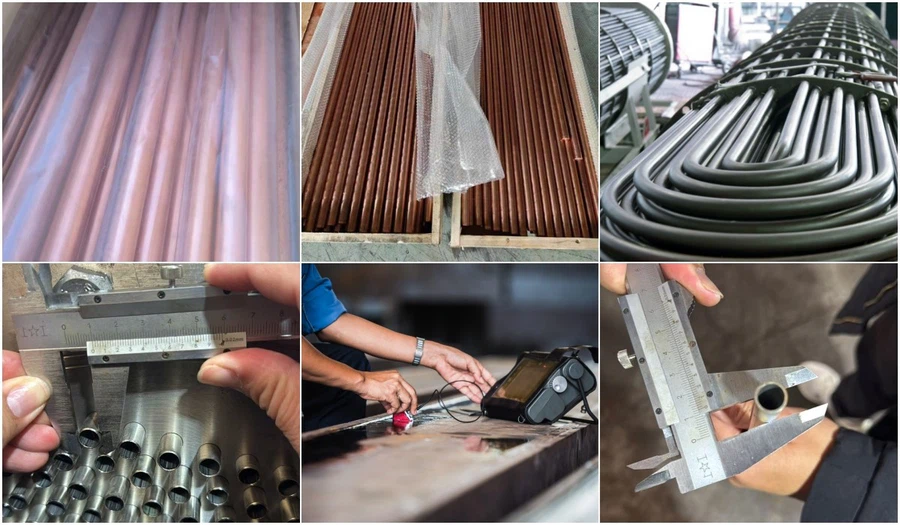
Our Factory & Equipment
| Equipment Type | Specification / Capability | Quality Impact |
|---|---|---|
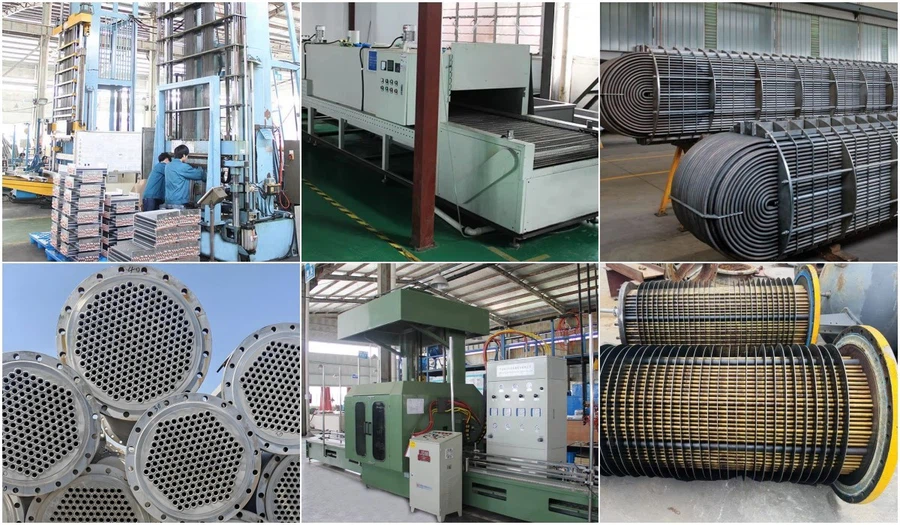
| Horizontal Continuous Casting Line | 10-ton capacity | Produces homogeneous copper alloy tube for heat exchanger billets with zero porosity. |
| Three-Roll Piercing Mill | Up to 60mm OD | Precision wall thickness control for heat exchanger tube wall thickness as low as 0.5mm. |
| Cold Drawing Bench | 5 draws in sequence | Achieves tight tolerances on copper heat exchanger tube length and heat exchanger pipe diameter. |
| Straightening & Cutting Line | CNC servo-controlled | Burr-free cutting for copper heat exchanger tube 3/4 inch and 1 inch to exact project lengths. |
| U-Bending Machine | CNC mandrel type | Produces u tube condenser and U tube bundle heat exchanger without kinking or ovality. |
| Eddy Current Tester | NDT (Non-Destructive Testing) | 100% inspection of C70600 tube and C71500 tube for pinholes or cracks per ASTM B111 pdf standards. |
| Hydrostatic Tester | Up to 200 bar | Validates heat exchanger tube expansion and tube rolling integrity. |
| Spectrometer | Optical emission (OES) | Confirms chemical composition of ASME SB111, EN 12451, and JIS H3300 grades on every batch. |
Our Certifications & Compliance:
ASTM B111 pdf and ASME SB111 pdf full traceability.
ISO 9001:2015 quality management system.
Third-party inspection accepted: SGS, BV, Lloyds, or TUV.
Copper heat exchanger tube life expectancy testing reports available upon request.
Get Fast Quote & Logistics Plan


