

Phosphorus-Deoxidized copper tubes – C12200 – are extensively used in sugar refineries for condensers and evaporators. Deoxidized copper is the standard material for transferring heat from steam to water or air because of their excellent resistance to corrosion by fresh water and their high thermal conductivities.
| Property | Specification |
|---|---|
| UNS No. | C12200 – BSI No. C107 – ISO Name Cu-DHP |
| Chemical Comp. (%) | Cu 99.9 / P 0.015 ~ 0.040 |
| ASTM Spec. | B 75, B 111, B 395 |
| ASME Spec. | SB 111, SB 395 |
| Applications | Condenser, evaporator & heat exchanger tubes; Air conditioning & refrigeration; Plumbing pipes & steam tubes. |
| Temper | H55 Light Drawn / H80 Hard Drawn / O61 Annealed |
Properties & Metrics
| **Property *** | Metric | English |
|---|---|---|
| Density | 8.94 g/cm³ | 0.323 lb/in³ |
| Tensile Strength | 221 ~ 379 MPa | 32 ~ 55 ksi |
| Yield Strength | 69 ~ 345 MPa | 10 ~ 50 ksi |
| CTE, linear | 17.7 × 10⁻⁶/°C (20 – 300°C) | 9.8 × 10⁻⁶/°F (70 – 570°F) |
| Specific Heat Capacity | 0.0920 cal/g-°C (20°C) | 0.0920 BTU/lb-°F (70°F) |
| Thermal Conductivity | 339 W/m-K (20°C) | 196 BTU/ft²/ft/h/°F (70°F) |
| Melting Point | 1083°C | 1981°F |
* Note: The information provided above includes typical values which are only for general reference. These values are not intended for exact specification, design or engineering purposes.
ASTM B75/B75M-20
Standard Specification for Seamless Copper Tube
This specification establishes the requirements for seamless round, rectangular, and square copper tube (UNS Nos. C10100, C10200, C10300, C10800, C12000, and C12200) suitable for general engineering applications.
The material of manufacture shall be billets, cast bars, or tube. The tube shall be manufactured by hot- and cold-working processes, shall be cold drawn to the finished size and wall thickness, and shall be supplied in cold-drawn or annealed temper condition.
The material shall conform to the chemical composition requirements prescribed for copper, phosphorus, and arsenic, as determined by chemical analysis, and to the mechanical property requirements including tensile strength, yield strength, Rockwell hardness, and straightening.
Requirements for grain size, electrical mass resistivity, and dimensions are specified.
The following test methods are detailed:
Grain size
Electrical resistivity
Tensile and yield strength
Hardness tests
Expansion test for round table
Microscopical examination
Test for hydrogen embrittlement
Nondestructive tests such as electromagnetic (eddy-current), hydrostatic, and pneumatic pressure tests
Tubes made from any of the following Copper UNS No. designations shall be supplied unless otherwise specified in the contract or purchase order:
| Copper UNS No. | Type of Copper |
|---|---|
| C10100 | Oxygen-free electronic |
| C10200 | Oxygen-free without residual deoxidants |
| C10300 | Oxygen-free, extra low phosphorus |
| C10800 | Oxygen-free, low phosphorus |
| C12000 | Phosphorus deoxidized, low residual phosphorus |
| C12200 | Phosphorus deoxidized, high residual phosphorus |
FAQ
Q1: What does "TP2" mean? Is it the same as C12200?
A: Yes, TP2 is the Chinese designation for C12200. TP2 is a grade defined under the Chinese standard GB/T 17791 for air conditioning and refrigeration copper tubes. It is a phosphorus-deoxidized copper with 99.9% minimum copper and 0.015-0.040% phosphorus – chemically identical to ASTM C12200. TP2 is widely used in HVAC applications in the Asian market.
Q2: What is the difference between ASTM B75 and ASTM B111 for C12200 tubes?
A: ASTM B75 is for general engineering applications – plumbing, general piping, and mechanical uses. ASTM B111 is specifically for condensers and heat exchangers – it has stricter dimensional tolerances, specific temper requirements for tube expansion, and additional testing requirements (eddy current, hydrostatic). For heat exchanger service, always specify ASTM B111.
Q3: Can TP2/C12200 tubes be used for seawater cooling?
A: Not recommended. C12200 (pure copper with phosphorus) has good corrosion resistance in freshwater and steam condensate, but in seawater, it is susceptible to pitting and erosion-corrosion, especially at flow velocities above 1.5 m/s. For seawater, select C70600 (90/10 copper-nickel) or C71500 (70/30 copper-nickel) .
Q4: What is the hydrogen embrittlement test mentioned in ASTM B75?
A: The hydrogen embrittlement test is required for oxygen-free coppers (C10100, C10200, etc.) but is also relevant for C12200. The test detects the presence of oxygen that could react with hydrogen in reducing atmospheres (like brazing/welding), causing internal cracking. C12200, being deoxidized, has good resistance to hydrogen embrittlement – this is a key advantage over C11000 (ETP copper).
Q5: What temper should I order for bending into U-tubes?
A: You must order O61 (annealed) temper. The H55 (light drawn) and H80 (hard drawn) tempers have higher strength but reduced ductility and are likely to crack during U-bending. The mechanical properties table shows tensile strength ranges – annealed tubes are at the lower end of the 221-379 MPa range, providing maximum formability.
Q6: Is ASTM B75 C12200 suitable for potable water systems?
A: Yes. C12200 is widely used for plumbing and potable water systems. It meets the requirements of NSF/ANSI 61 for drinking water system components and has excellent corrosion resistance to freshwater. However, always confirm with your local plumbing codes.
Q7: What is the thermal conductivity of C12200 compared to other heat exchanger materials?
A: C12200 has excellent thermal conductivity at 339 W/m-K (196 BTU/ft²/ft/h/°F). For comparison:
Admiralty brass (C44300): ~111 W/m-K
90/10 Copper-nickel (C70600): ~45 W/m-K
316 Stainless Steel: ~16 W/m-K
Titanium Grade 2: ~17 W/m-K
This makes C12200 a top choice when maximum heat transfer is the priority and corrosion conditions are mild.
Q8: What is the difference between JIS H3300 C1220T and ASTM B111 C12200?
A: C1220T is the JIS equivalent of ASTM C12200. The chemical composition is essentially the same (Cu ≥ 99.9%, P 0.015-0.040%). The key differences are in:
Temper designations (JIS uses O, 1/2H, H; ASTM uses O61, H55, H80)
Dimensional tolerances (JIS offers "Ordinary Class" and "Special Class"; ASTM has its own tolerance tables)
Grain size requirements (both have similar ranges for annealed tempers)
For most heat exchanger applications, they are interchangeable, but always confirm which standard is specified in your project documents.
Q9: What non-destructive testing (NDT) is required for ASTM B111 C12200 tubes?
A: ASTM B111 requires eddy current testing (ET) per ASTM E243 as the primary NDT method. Additional tests may include:
Hydrostatic testing (minimum 7000 psi fiber stress, not exceeding 1000 psi unless specified)
Pneumatic testing (by agreement)
Ultrasonic testing (UT) (by agreement)
Always request the mill test certificate confirming which NDT methods were applied.
Q10: Is C12200 suitable for high-temperature applications?
A: Yes, within limits. C12200 maintains good mechanical properties up to approximately 200°C (400°F) . Above this temperature, creep and oxidation become concerns. The melting point is 1083°C (1981°F), but for continuous service, keep temperatures below 200-250°C. For higher temperature applications (300-400°C), consider nickel alloys or specify the HR50 (drawn, stress-relieved) temper for better creep resistance.
How Do We Package Copper Heat Exchanger Tubes for Global Delivery?
Poor packaging destroys even the best copper heat exchanger tube. As a professional copper heat exchanger tube factory serving copper heat exchanger tube USA, Europe, UAE, Saudi Arabia, and India, we follow military-grade export packaging standards to ensure zero damage during sea or air freight.
Our Standard Packaging Process:
| Packaging Stage | Material / Method | Purpose |
|---|---|---|
| Individual Tube Protection | Anti-rust VCI paper + plastic end caps | Prevents moisture, dust, and scratches on copper tube heat exchanger inner surfaces. |
| Bundling | Nylon straps + wooden spacers | Keeps copper heat exchanger tube OD 19mm, 1 inch, or 5/8 inch sizes organized and vibration-free. |
| Moisture Barrier | Thick PE film wrap (heat-shrunk) | Blocks humidity during long sea voyages to copper heat exchanger tube Germany or Saudi Arabia. |
| Outer Packing | Export-grade plywood cases or steel-banded wooden crates | Withstands stacking and rough handling. Each crate labeled with PO number, alloy (e.g., SB111 C70600), and quantity. |
| Documentation | Packing list + Mill Test Certificate (MTC) attached outside | Customs clearance support for copper heat exchanger tube stockist and distributor partners. |
For U-Bundle Orders: U tube heat exchanger and U tube bundle heat exchanger are placed in dedicated steel jigs inside the crate to prevent bending radius distortion.
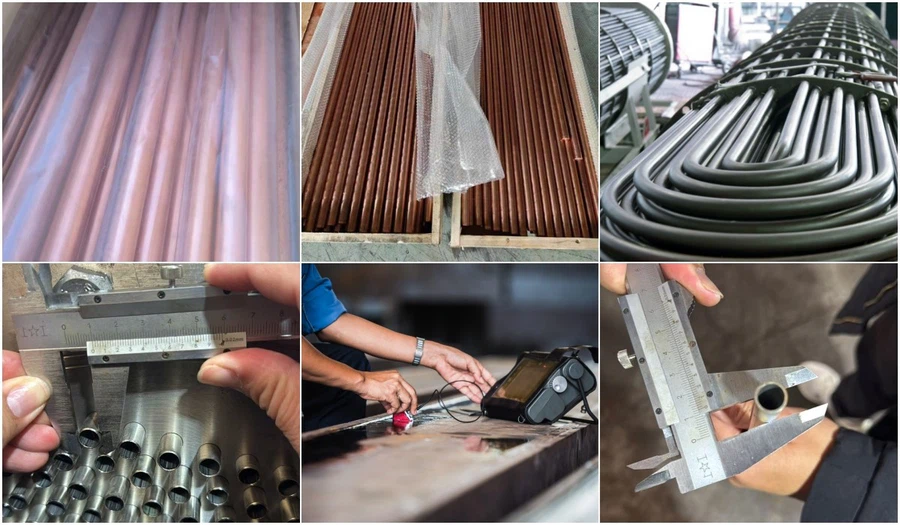
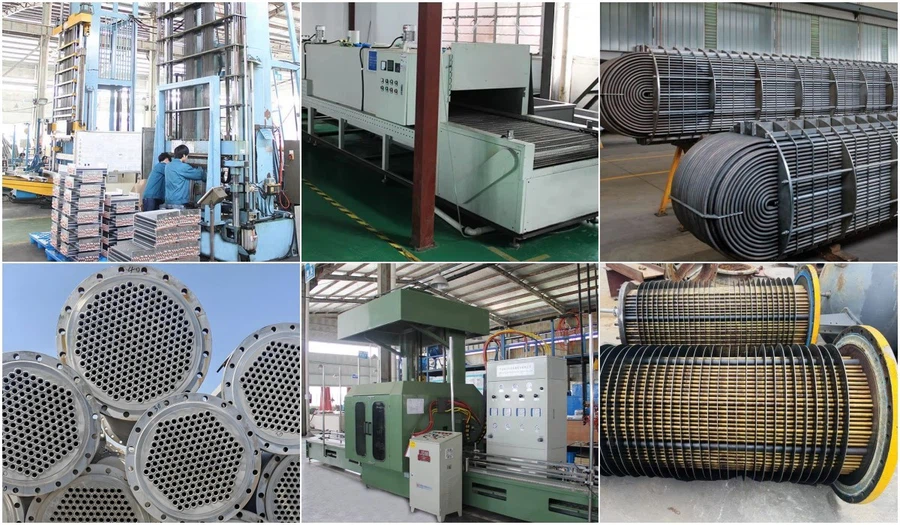
Our Factory & Equipment
| Equipment Type | Specification / Capability | Quality Impact |
|---|---|---|
| Horizontal Continuous Casting Line | 10-ton capacity | Produces homogeneous copper alloy tube for heat exchanger billets with zero porosity. |
| Three-Roll Piercing Mill | Up to 60mm OD | Precision wall thickness control for heat exchanger tube wall thickness as low as 0.5mm. |
| Cold Drawing Bench | 5 draws in sequence | Achieves tight tolerances on copper heat exchanger tube length and heat exchanger pipe diameter. |
| Straightening & Cutting Line | CNC servo-controlled | Burr-free cutting for copper heat exchanger tube 3/4 inch and 1 inch to exact project lengths. |
| U-Bending Machine | CNC mandrel type | Produces u tube condenser and U tube bundle heat exchanger without kinking or ovality. |
| Eddy Current Tester | NDT (Non-Destructive Testing) | 100% inspection of C70600 tube and C71500 tube for pinholes or cracks per ASTM B111 pdf standards. |
| Hydrostatic Tester | Up to 200 bar | Validates heat exchanger tube expansion and tube rolling integrity. |
| Spectrometer | Optical emission (OES) | Confirms chemical composition of ASME SB111, EN 12451, and JIS H3300 grades on every batch. |
Our Certifications & Compliance:
ASTM B111 pdf and ASME SB111 pdf full traceability.
ISO 9001:2015 quality management system.
Third-party inspection accepted: SGS, BV, Lloyds, or TUV.
Copper heat exchanger tube life expectancy testing reports available upon request.
Get Fast Quote & Logistics Plan


