

Copper alloy ASTM B111 C12200 L type finned tube is a type of heat exchanger tube made of a copper alloy known as C12200. This alloy is a high-purity copper with a minimum copper content of 99.9%.
The L type finned tube refers to the shape of the fin attached to the outer surface of the tube. The L-shaped fins increase the surface area of the tube, which improves the heat transfer efficiency.
These tubes are typically used in applications where high heat transfer rates are required, such as:
Air-cooled heat exchangers
Process heaters
Other industrial heat exchangers
Why Copper Alloy for Finned Tubes?
Copper alloy is a popular material for finned tubes because of its:
Excellent thermal conductivity
Good corrosion resistance
Copper alloy L type finned tubes can be manufactured in a variety of sizes and configurations to meet specific application requirements. The number, size, and spacing of the fins can be adjusted to optimize heat transfer efficiency and pressure drop characteristics.
Fin Design – L Type
The finned tube is used in heat exchangers to increase the surface area available for heat transfer. The fins are typically made of aluminum or copper and are attached to the outer surface of the tube by a process called finning.
The L type fin design provides a larger surface area for heat transfer compared to other fin designs. The "L" shape refers to the foot of the fin, which is shaped like the letter L and wraps around the base tube, providing good mechanical attachment and thermal contact.
Chemical Composition – ASTM B111 C12200
| Element | Min (%) | Max (%) |
|---|---|---|
| Copper (Cu) | 99.90 | – |
| Phosphorus (P) | – | 0.015 – 0.040* |
| Iron (Fe) | – | 0.050 |
Mechanical Properties (Annealed Temper)
| Property | Value |
|---|---|
| Tensile Strength (annealed) | 206 MPa |
| Yield Strength (annealed) | 128 MPa |
| Elongation (in 2 inches) | 40% |
| Hardness (Brinell) | 55 |
These properties indicate good ductility, making the tube suitable for bending, flaring, and tube expansion during heat exchanger assembly.
ASTM B111 Specification
ASTM B111 is a specification for copper and copper-alloy seamless condenser tubes and ferrule stock. It covers a range of alloys, including C12200, which is used in the manufacturing of the L type finned tube.
The specification outlines requirements for:
Chemical composition
Mechanical properties
Dimensions
Tolerances
The copper alloy ASTM B111 C12200 L type finned tube meets the requirements outlined in this specification.
Typical Product Inquiry Dimensions
| Parameter | Value |
|---|---|
| Base Tube Material | ASTM B111 C12200 |
| Fin Material | Copper C12200 |
| Tube Length (mm) | 1650 |
| Fin Length (mm) | 1550 |
| Fin Tube Quantity (Pieces) | 1568 |
| Base Tube Outer Diameter (mm) | 25.4 |
| Base Tube Thickness (mm) | 1.22 |
| Fin Height (mm) | 9.55 |
| Fin Thickness (mm) | 0.35 |
| Fin Pitch | 9 FPI (fins per inch) |
Key Features and Advantages
High heat transfer efficiency: L-shaped fins increase surface area significantly
Good mechanical attachment: The L-shaped foot wraps around the tube for secure attachment
Material compatibility: Both tube and fin can be made from C12200 copper, eliminating galvanic corrosion concerns
Customizable: Fin height, thickness, pitch, and tube dimensions can be adjusted per application
Standard compliance: Manufactured to ASTM B111 specification
Applications
Copper alloy L type finned tubes are used in:
Air-cooled heat exchangers
Process heaters
Industrial heat exchangers
HVAC systems
Condensers and evaporators
FAQ
Q1: What is an L type finned tube?
A: An L type finned tube has fins with an L-shaped foot that wraps around the base tube. The fin is formed by wrapping a metal strip (typically copper or aluminum) around the tube, and the L-shaped base provides mechanical locking and good thermal contact.
Q2: Why use C12200 copper for finned tubes?
A: C12200 copper offers high thermal conductivity (approximately 340-360 W/m·K), good corrosion resistance in fresh water and many industrial environments, and excellent ductility for forming. It is also weldable and brazeable due to its phosphorus deoxidized chemistry.
Q3: What is the difference between L type, LL type, and KL type fins?
A: L type fins have an L-shaped foot. LL type fins have a longer foot that wraps further around the tube. KL type fins have a knurled base tube with the fin embedded. L type is the most common for copper tubes in non-corrosive environments.
Q4: Can the fin material be different from the tube material?
A: Yes. While both tube and fin are often copper, fins can also be aluminum. However, dissimilar metals may introduce galvanic corrosion risk. Using C12200 for both tube and fin eliminates this concern.
Q5: What is the maximum operating temperature for copper L type finned tubes?
A: For continuous service, C12200 copper is typically limited to 200°C (400°F). The fin attachment method (L type) may have a lower temperature limit depending on the differential expansion between tube and fin.
Q6: How is fin pitch specified?
A: Fin pitch is typically specified in fins per inch (FPI) or millimeters between fins. Common ranges are 4 to 16 FPI. The example above shows 9 FPI. Closer pitch increases surface area but also increases air-side pressure drop and risk of fouling.
Q7: What is the typical fin height range?
A: Fin heights typically range from 6mm to 16mm (0.25 to 0.63 inches), depending on the application and tube diameter. The example shows 9.55mm fin height.
Q8: Are L type finned tubes suitable for corrosive environments?
A: C12200 copper has good corrosion resistance in fresh water and many industrial atmospheres. For seawater or highly corrosive environments, consider finned tubes made from cupronickel (C70600, C71500) or with protective coatings.
Q9: What standards apply to L type finned tubes?
A: The base tube is typically manufactured to ASTM B111 (seamless condenser tube). The finning process itself is often performed to industry standards such as those from the Tubular Exchanger Manufacturers Association (TEMA).
Q10: How do I request a quote for copper alloy L type finned tubes?
A: Please provide the following information: base tube OD and wall thickness, tube material, fin material, fin height, fin thickness, fin pitch (FPI or mm), tube length, fin length, and quantity. Contact us with your specifications.
How Do We Package Copper Heat Exchanger Tubes for Global Delivery?
Poor packaging destroys even the best copper heat exchanger tube. As a professional copper heat exchanger tube factory serving copper heat exchanger tube USA, Europe, UAE, Saudi Arabia, and India, we follow military-grade export packaging standards to ensure zero damage during sea or air freight.
Our Standard Packaging Process:
| Packaging Stage | Material / Method | Purpose |
|---|---|---|
| Individual Tube Protection | Anti-rust VCI paper + plastic end caps | Prevents moisture, dust, and scratches on copper tube heat exchanger inner surfaces. |
| Bundling | Nylon straps + wooden spacers | Keeps copper heat exchanger tube OD 19mm, 1 inch, or 5/8 inch sizes organized and vibration-free. |
| Moisture Barrier | Thick PE film wrap (heat-shrunk) | Blocks humidity during long sea voyages to copper heat exchanger tube Germany or Saudi Arabia. |
| Outer Packing | Export-grade plywood cases or steel-banded wooden crates | Withstands stacking and rough handling. Each crate labeled with PO number, alloy (e.g., SB111 C70600), and quantity. |
| Documentation | Packing list + Mill Test Certificate (MTC) attached outside | Customs clearance support for copper heat exchanger tube stockist and distributor partners. |
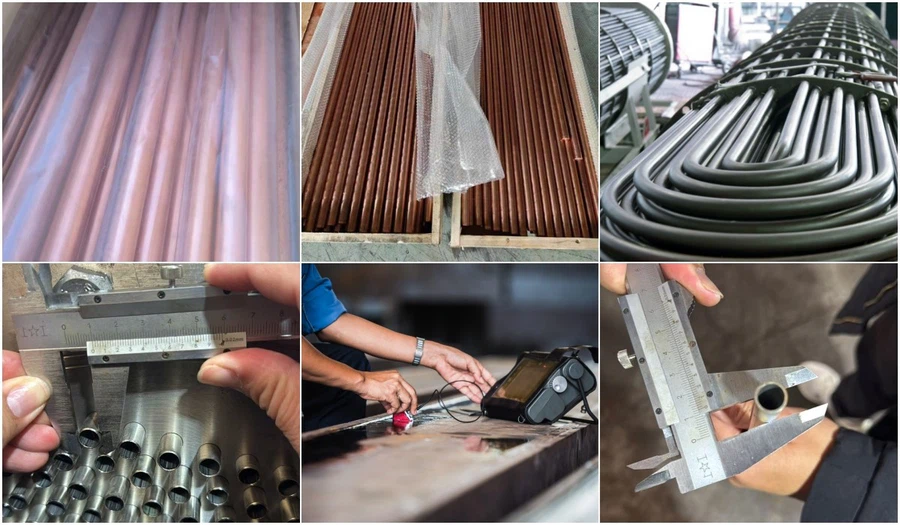
For U-Bundle Orders: U tube heat exchanger and U tube bundle heat exchanger are placed in dedicated steel jigs inside the crate to prevent bending radius distortion.
Our Factory & Equipment
| Equipment Type | Specification / Capability | Quality Impact |
|---|---|---|
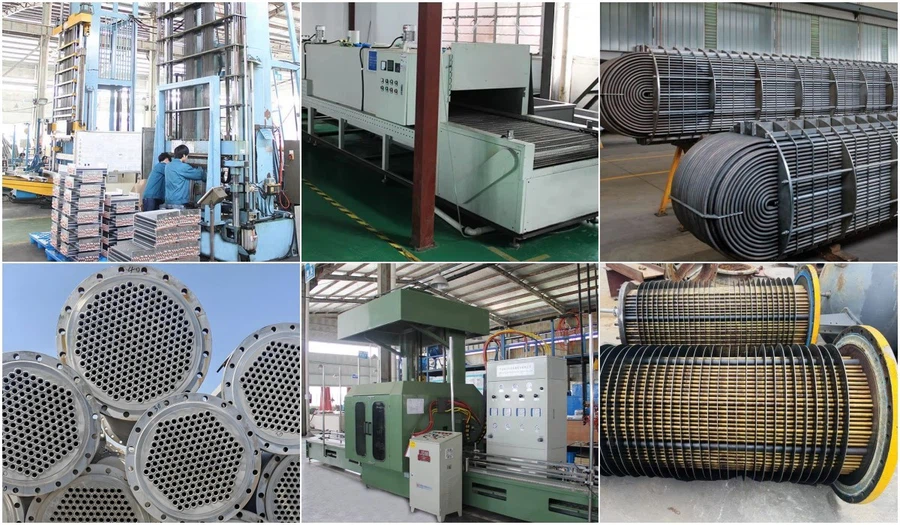
| Horizontal Continuous Casting Line | 10-ton capacity | Produces homogeneous copper alloy tube for heat exchanger billets with zero porosity. |
| Three-Roll Piercing Mill | Up to 60mm OD | Precision wall thickness control for heat exchanger tube wall thickness as low as 0.5mm. |
| Cold Drawing Bench | 5 draws in sequence | Achieves tight tolerances on copper heat exchanger tube length and heat exchanger pipe diameter. |
| Straightening & Cutting Line | CNC servo-controlled | Burr-free cutting for copper heat exchanger tube 3/4 inch and 1 inch to exact project lengths. |
| U-Bending Machine | CNC mandrel type | Produces u tube condenser and U tube bundle heat exchanger without kinking or ovality. |
| Eddy Current Tester | NDT (Non-Destructive Testing) | 100% inspection of C70600 tube and C71500 tube for pinholes or cracks per ASTM B111 pdf standards. |
| Hydrostatic Tester | Up to 200 bar | Validates heat exchanger tube expansion and tube rolling integrity. |
| Spectrometer | Optical emission (OES) | Confirms chemical composition of ASME SB111, EN 12451, and JIS H3300 grades on every batch. |
Our Certifications & Compliance:
ASTM B111 pdf and ASME SB111 pdf full traceability.
ISO 9001:2015 quality management system.
Third-party inspection accepted: SGS, BV, Lloyds, or TUV.
Copper heat exchanger tube life expectancy testing reports available upon request.
Get Fast Quote & Logistics Plan


