

These are the two most common copper nickel alloys on the market. Both handle seawater well. But one costs less. The other lasts longer in aggressive water. Picking the wrong one means paying too much upfront or retubing too early.
This comparison helps you decide based on your water chemistry, budget, and expected service life.
What are the key differences between C70600 and C71500?
| Property | C70600 (90/10) | C71500 (70/30) |
|---|---|---|
| Copper % | 88.0 – 90.0 | 69.0 – 71.0 |
| Nickel % | 9.0 – 11.0 | 29.0 – 33.0 |
| Iron % | 1.0 – 1.8 | 0.4 – 1.0 |
| Manganese % | ≤1.0 | ≤1.0 |
| Seawater corrosion resistance | Excellent | Superior |
| Ammonia stress corrosion cracking | Moderate resistance | Excellent resistance |
| High velocity erosion (above 3.5 m/s) | Poor | Acceptable |
| Crevice corrosion resistance | Good | Better |
| Biofouling resistance | Excellent | Excellent |
| Thermal conductivity (W/m·K) | 45 | 29 |
| Tensile strength (MPa) | 310 min | 380 min |
| Yield strength (MPa) | 105 min | 150 min |
| Elongation (%) | 30 min | 30 min |
| Hardness (HRB) | 40 – 65 | 60 – 85 |
| Relative cost per meter | 1.0x | 1.5 – 1.6x |
| Typical service life in clean seawater | 20 – 30 years | 30 – 40 years |
| Typical service life in polluted seawater | 10 – 15 years | 20 – 25 years |
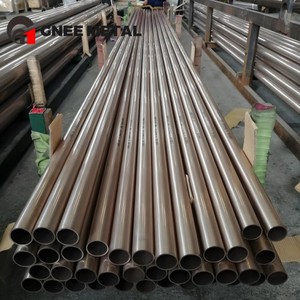
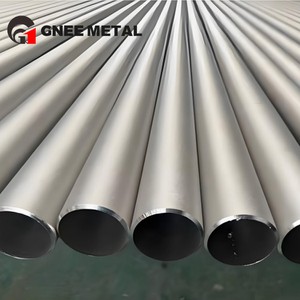
Which alloy has better seawater corrosion resistance – C70600 or C71500?
C71500 has better seawater corrosion resistance, especially in aggressive conditions. But for clean seawater, both perform well.
| Seawater condition | C70600 | C71500 |
|---|---|---|
| Clean, 2.0 m/s, 25°C | 20–30 years | 30–40 years |
| Clean, 3.0 m/s, 25°C | 15–25 years | 25–35 years |
| Polluted (low sulfides) | 10–15 years | 20–25 years |
| Polluted (high sulfides) | 5–10 years | 15–20 years |
| With ammonia >2 ppm | Stress corrosion cracking risk | No cracking |
| Stagnant seawater | Pitting risk | Lower pitting risk |
| High temperature (above 200°C) | Good | Better |
Real world examples:
A power plant with clean seawater used C70600 for 28 years before first retube.
A chemical plant with polluted seawater switched from C70600 (failed at 7 years) to C71500 (still running at 15 years).
Conclusion: For clean seawater, C70600 is good enough. For polluted or aggressive seawater, pay extra for C71500.
Which alloy handles ammonia better – C70600 or C71500?
C71500 is far better. This is one of the main reasons to upgrade.
| Ammonia level | C70600 | C71500 |
|---|---|---|
| Below 1 ppm | Safe | Safe |
| 1 – 2 ppm | Moderate risk | Safe |
| 2 – 5 ppm | High risk of SCC | Safe |
| 5 – 10 ppm | Very high risk, do not use | Low risk |
| Above 10 ppm | Do not use | Moderate risk – consider titanium |
Why C71500 wins:
Higher nickel content (30% vs 10%) makes the alloy more resistant to ammonia-induced stress corrosion cracking. The nickel stabilizes the grain boundaries against attack.
If your cooling water has:
Ammonia from fertilizer plants or chemical processes → Choose C71500
Ammonia from sewage contamination → Choose C71500
Ammonia-based water treatment chemicals → Choose C71500 or change treatment
Which alloy handles high flow velocity better – C70600 or C71500?
C71500 resists erosion at higher velocities. C70600 erodes above 3.5 m/s.
| Water velocity (m/s) | C70600 | C71500 |
|---|---|---|
| 1.0 – 2.0 | Excellent | Excellent |
| 2.0 – 3.0 | Excellent | Excellent |
| 3.0 – 3.5 | Acceptable, minor wear | Excellent |
| 3.5 – 4.0 | Erosion begins | Acceptable, minor wear |
| 4.0 – 4.5 | Significant erosion | Erosion begins |
| Above 4.5 | Severe erosion, do not use | Significant erosion |
Why C71500 wins:
Higher strength (380 MPa vs 310 MPa tensile) and harder surface resist mechanical wear from flowing water, sand, and debris.
If your system has:
Pump discharge with velocity above 3.5 m/s → Choose C71500
Sand or debris in water → Choose C71500
Frequent startups causing velocity spikes → Choose C71500
Which alloy has better thermal conductivity – C70600 or C71500?
C70600 has much better thermal conductivity. This is C70600's biggest advantage over C71500.
| Alloy | Thermal conductivity (W/m·K) | Heat transfer relative to C70600 |
|---|---|---|
| C70600 | 45 | 1.00x (baseline) |
| C71500 | 29 | 0.64x |
What this means for heat exchanger design:
For the same heat duty, C71500 requires approximately 55–60% more surface area than C70600.
Example:
A condenser with C70600 needs 1,000 tubes
The same condenser with C71500 needs about 1,550 tubes
| Design impact | C70600 | C71500 |
|---|---|---|
| Number of tubes | Baseline | +55% |
| Shell diameter | Baseline | +20% |
| Total heat exchanger cost | Baseline | +30–40% |
| Pumping power (pressure drop) | Baseline | Higher (more tubes) |
If your priority is:
Heat transfer efficiency and compact size → Choose C70600
Corrosion resistance at any cost → Choose C71500 and accept lower thermal performance
What is the cost difference between C70600 and C71500?
C70600 costs less upfront. C71500 costs 50–60% more per meter.
| Scenario | C70600 | C71500 |
|---|---|---|
| Upfront tube cost for 1,000 meters | $1,000 | $1,550 – $1,600 |
| Expected life in clean seawater | 25 years | 35 years |
| Expected life in polluted seawater | 12 years | 22 years |
| 20-year cost in clean water (material only) | $1,000 | $1,550 |
| 20-year cost in polluted water (material only) | $2,000 (one retube) | $1,550 (no retube) |
| Downtime cost per retube | $10,000 – $50,000 | $0 |
Cost conclusion:
Clean seawater → C70600 is cheaper over 20 years
Polluted seawater → C71500 is cheaper over 20 years (no retube needed)
Zero downtime tolerance → C71500 despite upfront cost
When should you choose C70600 over C71500?
Choose C70600 for most clean seawater applications. It is cost effective and performs well.
Best applications for C70600:
Coastal power plant condensers with clean seawater
Shipboard cooling systems (not ammonia contaminated)
Desalination plant heat exchangers (low temperature sections)
Offshore platform firewater systems
Brackish water with good flow control
Any application where budget is tight and water is clean
When C70600 is not enough:
Ammonia in cooling water above 2 ppm
Flow velocity consistently above 3.5 m/s
Polluted or sulfidic seawater
Service life requirement above 25 years in aggressive water
Zero tolerance for tube failure (nuclear, critical processes)
When should you choose C71500 over C70600?
Choose C71500 when water is aggressive, ammonia is present, or you cannot afford downtime.
Best applications for C71500:
Chemical plant coolers with ammonia in water
Power plants using polluted estuary or harbor water
Offshore platforms with high velocity seawater
Nuclear power plant condensers (safety critical)
Desalination brine heaters (high temperature, high salinity)
Any application where retubing is extremely expensive or impossible
When C71500 may be overkill:
Clean, open ocean seawater with good flow
Freshwater or low chloride water
Short project life (less than 10 years)
Very tight budget
FAQ
What is the main difference between C70600 and C71500?
C70600 has 10% nickel and costs less. C71500 has 30% nickel, costs 50–60% more, and resists ammonia and high velocity better. Use C70600 for most seawater jobs. Upgrade to C71500 if you have ammonia or very high flow.
Can I replace C70600 tubes with C71500 in an existing heat exchanger?
Yes, but check three things. First, tube sheet material and expansion procedure – C71500 is stronger. Second, thermal performance – C71500 needs more surface area. Third, galvanic compatibility – both are close, but check with your engineer.
Does C71500 last twice as long as C70600?
Not in clean seawater. In clean water, C71500 lasts about 30–40 years vs 20–30 years for C70600 – roughly 30–40% longer. In polluted water with ammonia, C71500 can last 3-4x longer because C70600 fails from SCC.
Which alloy is easier to bend and expand – C70600 or C71500?
C70600 is easier. It has lower strength (310 vs 380 MPa) and higher ductility (both 30% elongation, but C70600 is softer). C71500 requires more force for bending and expansion. Both need stress relief after U-bending.
Does C71500 have better biofouling resistance than C70600?
No, they are similar. Both release copper ions that prevent marine growth. C70600 actually has higher copper content (90% vs 70%), so some studies show slightly better biofouling resistance. The difference is small.
What mill certificate should I ask for to verify C70600 vs C71500?
Ask for EN 10204 Type 3.1 or 3.2. Check nickel content – 9–11% for C70600, 29–33% for C71500. Also check iron – 1.0–1.8% for C70600, 0.4–1.0% for C71500. Wrong nickel or iron means wrong alloy.
Can I weld C70600 and C71500 together?
Yes, use AWS A5.7 ERCuNi filler metal. Both alloys weld well to each other. The same welding procedure works for both. No special filler needed for dissimilar welding.
What happens if I use C70600 in ammonia service by mistake?
Stress corrosion cracking within 6–24 months. Tubes crack along grain boundaries without warning. No wall thinning. Tubes snap when bent. The only fix is complete retube with C71500 or titanium.
How to tell C70600 from C71500 visually?
Color is not reliable. C70600 is salmon pink. C71500 is lighter, almost silver-pink. But lighting affects what you see. Use PMI (XRF gun) for positive identification – 10 seconds confirms nickel content.
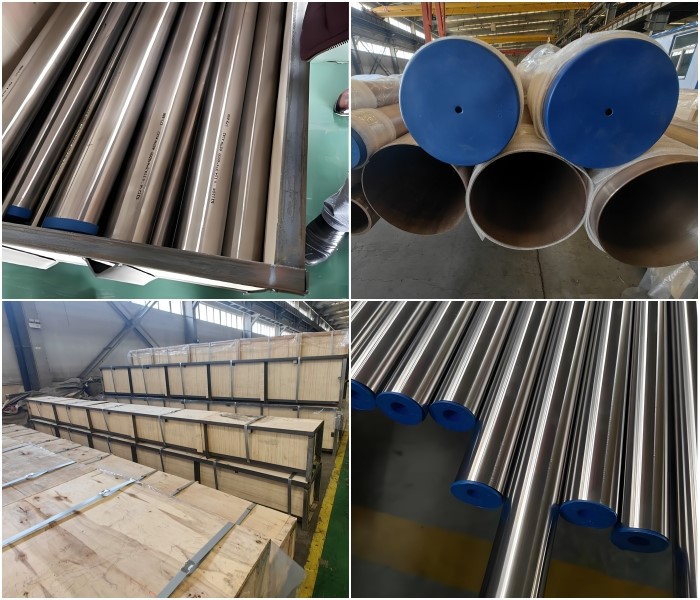
Packaging
Export shipment (ocean freight)
Plastic end caps + polybag individual wrap
Wooden crates (ISPM15 fumigated, no bark)
Moisture barrier paper inside crate
Desiccant bags (5–10 per cubic meter)
Steel spools for coil tubing
Label in English and Chinese
Packing list taped inside and outside crate
Special requirements available
Color coding by alloy (green for C70600, yellow for C71500)
Anti-rust oil coating (for high humidity destinations)
Shrink wrap for small quantities
Custom wood crates for project deliveries
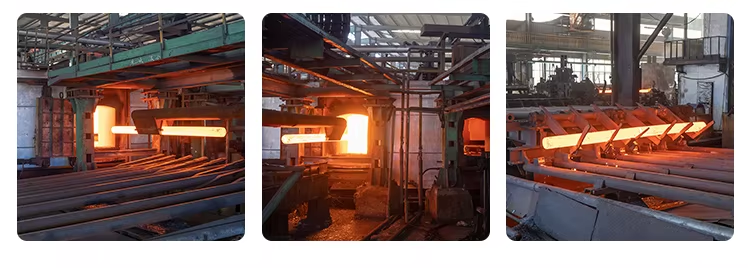
Our Production Equipment
| Equipment | Specification | Quantity |
|---|---|---|
| Horizontal extrusion press | 1500T | 1 |
| Horizontal extrusion press | 2500T | 1 |
| Cold drawing bench | 10m length | 6 |
| Cold drawing bench (heavy wall) | 6m length | 4 |
| Roller straightener | OD 6–50mm | 3 |
| Rotary straightener | OD 50–90mm | 1 |
| Annealing furnace (controlled atmosphere) | 650–800°C | 3 |
| Cut-off machine (automatic) | OD 6–90mm | 2 |
| U-bending machine | OD 12–38mm | 2 |
| End facing and deburring | All sizes | 2 |
| Eddy current tester | 100% ECT | 3 |
| Hydrostatic tester | 4 stations | 1 |
| PMI gun (XRF) | In-process verification | 2 |
| Ultrasonic thickness gauge | Portable | 4 |
Our Copper Product Range
| Product form | Common alloys | Standards | Typical applications |
|---|---|---|---|
| Tube (seamless) | C70600, C71500, C12200, C44300, C68700 | ASTM B111, ASME SB111 | Heat exchangers, condensers, marine piping |
| Pipe (seamless) | C12200, C70600, C71500 | ASTM B88, ASTM B466 | Water lines, fuel lines, shipbuilding |
| Rod / bar | C11000, C36000, C46400, C63000 | ASTM B16, ASTM B124 | Valve stems, fittings, marine hardware |
| Wire | C11000, C16200, C19400 | ASTM B1, ASTM B3 | Electrical conductors, welding wire |
| Strip / coil | C11000, C19400, C26000, C26800, C52100 | ASTM B152, ASTM B465 | Terminals, springs, transformer windings |
| Plate / sheet | C10100, C11000, C12200, C70600, C71500, C46400 | ASTM B152, ASTM B171 | Tube sheets, baffles, heat exchanger plates |


