

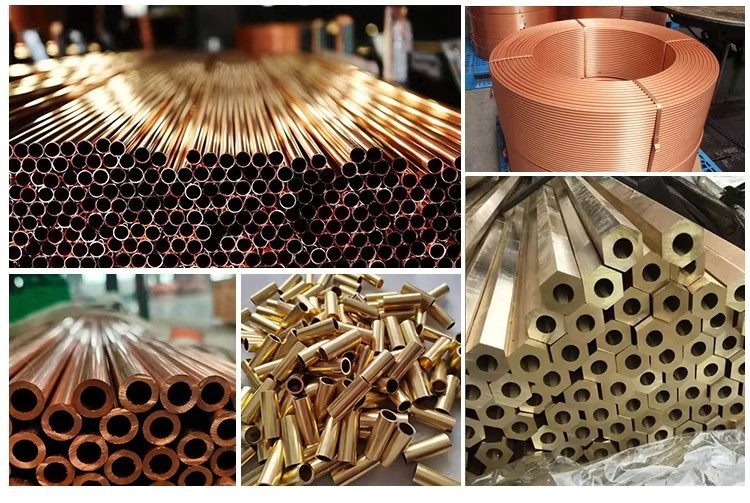
C68700 aluminum brass was popular decades ago. C70600 copper nickel replaced it in most seawater applications. However, C68700 still appears in freshwater and some brackish water systems. Buyers need to know the difference.
What are the key differences between C70600 and C68700?
| Property | C70600 (90/10 copper nickel) | C68700 (aluminum brass) |
|---|---|---|
| Copper % | 88.0–90.0 | 76.0–79.0 |
| Nickel % | 9.0–11.0 | 0 |
| Zinc % | ≤0.05 | 20.0–23.0 |
| Aluminum % | 0 | 1.8–2.5 |
| Iron % | 1.0–1.8 | ≤0.06 |
| Arsenic % | 0 | 0.02–0.10 |
| Seawater corrosion | Excellent | Poor |
| Freshwater corrosion | Excellent | Good |
| Brackish water | Excellent | Moderate |
| Dezincification risk | None | High (without arsenic) |
| Ammonia resistance | Moderate | Poor |
| Biofouling resistance | Excellent | Good |
| Thermal conductivity (W/m·K) | 45 | 100 |
| Cost | Medium | Low |
| Typical service life – seawater | 20–30 years | 2–8 years |
Why does C68700 suffer from dezincification but C70600 does not?
Dezincification is selective removal of zinc from brass. C70600 has no zinc, so it never dezincifies.
In C68700, zinc corrodes preferentially in certain water conditions. The zinc dissolves away, leaving behind porous, weak copper. The tube loses strength and develops pinhole leaks.
Conditions that cause dezincification in C68700:
Stagnant or low flow water (below 0.5 m/s)
High water temperature (above 60°C)
Low pH (below 6.0) or high pH (above 9.0)
Chlorides present (seawater or brackish water)
| Water condition | C68700 dezincification risk | C70600 risk |
|---|---|---|
| Freshwater, flowing | Low | None |
| Freshwater, stagnant | Moderate to high | None |
| Brackish water | High | None |
| Seawater | Very high | None |
| Temperature above 60°C | High | None |
What dezincification looks like on C68700:
Tube surface turns dark brown or reddish
Soft, chalky appearance when scratched with a knife
Loss of metallic ring when tapped
Pinhole leaks without visible wall thinning
Prevention for C68700:
Maintain flow above 1.0 m/s
Keep water temperature below 60°C
Use arsenic-inhibited C68700 (modern standard)
But in seawater – even inhibited C68700 fails within 5 years
Which alloy handles seawater better – C70600 or C68700?
C70600 handles seawater. C68700 does not. This is the single biggest difference between these two alloys.
| Seawater condition | C70600 expected life | C68700 expected life |
|---|---|---|
| Clean seawater, 2.0 m/s, 25°C | 20–30 years | 5–8 years |
| Polluted seawater, 1.5 m/s | 10–15 years | 2–4 years |
| Stagnant seawater | Pitting risk within 2–5 years | Rapid dezincification within 1–2 years |
| High velocity (above 2.5 m/s) | Safe up to 3.5 m/s | Erosion begins above 2.0 m/s |
| Seawater with sand or debris | Good erosion resistance | Poor – soft surface erodes quickly |
Real world data:
A coastal power plant switched from C68700 to C70600. Tube life increased from 6 years to 25+ years.
A desalination plant using C68700 retubed every 4 years. After switching to C70600, no retube was needed for 15 years.
Conclusion for seawater: Use C70600. C68700 is not suitable for any permanent seawater installation.
Where is C68700 still a good choice instead of C70600?
C68700 is acceptable for freshwater and some brackish water applications. It should never be used in seawater.
Good applications for C68700:
Freshwater cooling towers
River or lake water heat exchangers
HVAC condensers on the freshwater side
Low chloride industrial cooling water (below 500 ppm Cl)
Low temperature service (below 60°C)
Bad applications for C68700 (use C70600 instead):
Any seawater contact
Brackish water (estuaries, coastal rivers, 500–5,000 ppm Cl)
High temperature cooling water (above 60°C)
Stagnant water systems
Water with ammonia or sewage contamination
| Water type | Chloride level | Recommended alloy |
|---|---|---|
| Freshwater | Below 500 ppm | C68700 or C70600 (both acceptable) |
| Brackish | 500 – 5,000 ppm | C70600 preferred |
| Brackish to saline | 5,000 – 20,000 ppm | C70600 required |
| Seawater | Above 20,000 ppm | C70600 or C71500 |
Which alloy is more resistant to erosion – C70600 or C68700?
C70600 has better erosion resistance. C68700 erodes at lower flow velocities.
| Water velocity (m/s) | C70600 | C68700 |
|---|---|---|
| 1.0 | No erosion | No erosion |
| 1.5 | No erosion | No erosion |
| 2.0 | No erosion | Mild erosion possible |
| 2.5 | No erosion | Erosion begins |
| 3.0 | Acceptable, minor wear | Significant erosion |
| 3.5 | Erosion begins | Severe erosion |
| 4.0 | Severe erosion | Failure within months |
Why C70600 wins:
The nickel-iron matrix in C70600 is harder and more resistant to mechanical wear. C68700 has high zinc content (20–23%), which makes it softer and easier to erode.
If your system has any of these conditions, choose C70600:
High flow pumps delivering over 2.5 m/s
Sand or debris particles in the water
Frequent startups and shutdowns (transient velocity spikes)
Long pipe runs with turbulence at elbows
What is the 20 year cost difference between C70600 and C68700?
C70600 costs more upfront but lasts longer. C68700 is cheaper initially but requires frequent replacement.
Assumptions: 19mm OD x 1.24mm wall tube, seawater service, 20 year operation, no other major failures.
| Cost factor | C70600 | C68700 |
|---|---|---|
| Tube cost per meter | $1.00 | $0.65 |
| Expected life in seawater | 25 years | 5 years |
| Number of retubes needed in 20 years | 0 | 3 |
| Total tube material cost (20 years) | $1.00 per meter | $2.60 per meter |
| Downtime cost per retube | $0 | $10,000 – $50,000 depending on system |
| Labor cost for installation | 1x (initial) | 4x (initial + 3 retubes) |
Winner on cost: C70600. Higher upfront price, but lower lifetime total cost.
How to identify C70600 vs C68700 on site?
| Method | C70600 (90/10 copper nickel) | C68700 (aluminum brass) |
|---|---|---|
| Visual color | Salmon pink | Yellow-gold (brass color) |
| Magnet test | Very weakly magnetic | Non-magnetic |
| PMI (XRF gun) | 9–11% Ni, <0.1% Zn | 20–23% Zn, 1.8–2.5% Al |
| File test | Tough, resists filing | Softer, files easily |
| Acid test (drop of nitric acid) | Green-blue reaction | Blue reaction with fizzing |
Most reliable identification method:
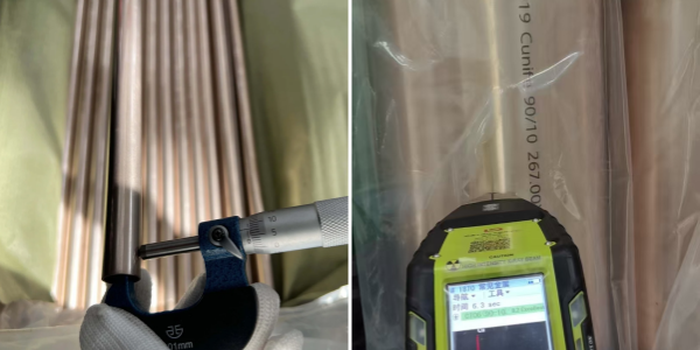
PMI with an XRF gun. Takes 10 seconds. Confirms nickel (C70600) or zinc and aluminum (C68700).
FAQ
Can C68700 be used in seawater for a short time?
Short term (a few months) maybe. Long term (years) no. Even 12 months of continuous seawater exposure causes significant dezincification on C68700. For any permanent seawater installation, use C70600.
What is the advantage of C68700 over C70600?
Lower upfront material cost and higher thermal conductivity (100 vs 45 W/m·K). For freshwater applications with no corrosion risk, C68700 works well and costs less. For seawater, that cost advantage disappears after the first retube.
Does C70600 ever suffer from dezincification?
No. C70600 contains no zinc. Dezincification is chemically impossible. This is why copper nickel replaced brass alloys in seawater applications.
Why do some old power plants still use C68700?
Because they were designed and built 30–50 years ago before C70600 became widely available. Many have since retubed with C70600. Those still using C68700 typically retube every 5–8 years.
What is the maximum water temperature for C68700?
60°C for continuous service. Above 60°C, dezincification accelerates rapidly. C70600 handles up to 315°C. For hot water or steam condensate cooling, C70600 is the clear choice.
Can I weld C68700 tubes like C70600 tubes?
C68700 is weldable but less common. Use aluminum bronze filler metal. C70600 welding is more straightforward with standard ERCuNi filler. For field repairs, C70600 is easier and more reliable.
What does the aluminum in aluminum brass actually do?
Aluminum helps form a protective oxide film on the tube surface. This improves corrosion resistance over regular brass (like C44300 Admiralty brass). Arsenic is also added to inhibit dezincification.
How do I convert an existing C68700 system to C70600?
Direct replacement is possible. Same OD and wall thickness works. C70600 is slightly stronger, so tube sheet expansion may need adjustment. Thermal performance changes – C70600 has lower conductivity, so more tubes or larger shell may be needed for the same heat duty.
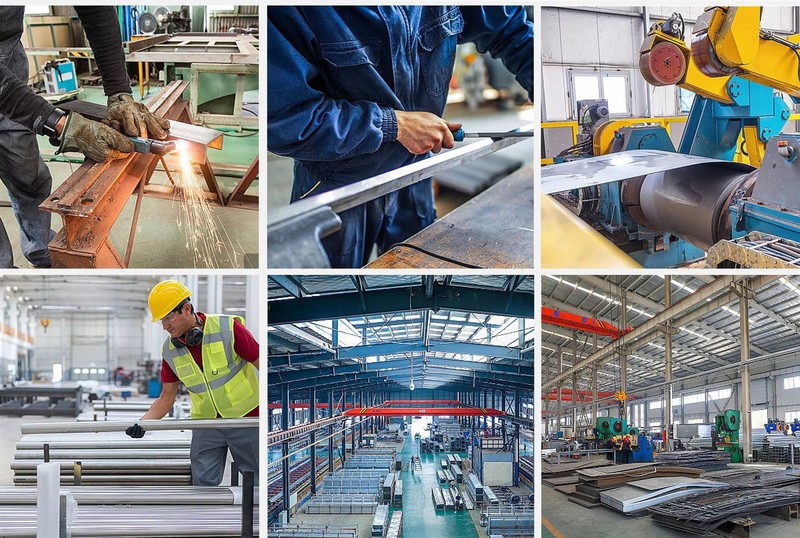
Our Production Equipment
| Equipment | Specification | Quantity |
|---|---|---|
| Horizontal extrusion press | 1500T | 1 |
| Horizontal extrusion press | 2500T | 1 |
| Cold drawing bench | 10m length | 6 |
| Cold drawing bench (heavy wall) | 6m length | 4 |
| Roller straightener | OD 6–50mm | 3 |
| Rotary straightener | OD 50–90mm | 1 |
| Annealing furnace (controlled atmosphere) | 650–800°C | 3 |
| Cut-off machine (automatic) | OD 6–90mm | 2 |
| U-bending machine | OD 12–38mm | 2 |
| End facing and deburring | All sizes | 2 |
| Eddy current tester | 100% ECT | 3 |
| Hydrostatic tester | 4 stations | 1 |
| PMI gun (XRF) | In-process verification | 2 |
Testing and Packaging
Testing methods
Eddy current test (ECT) to ASTM E243 – 100% of tubes
Hydrostatic test up to 20 MPa – 100% of tubes
PMI (XRF) for alloy verification – every heat
Tensile and hardness test – per heat
Flattening and expansion test – per heat
Microscopic grain examination – per heat
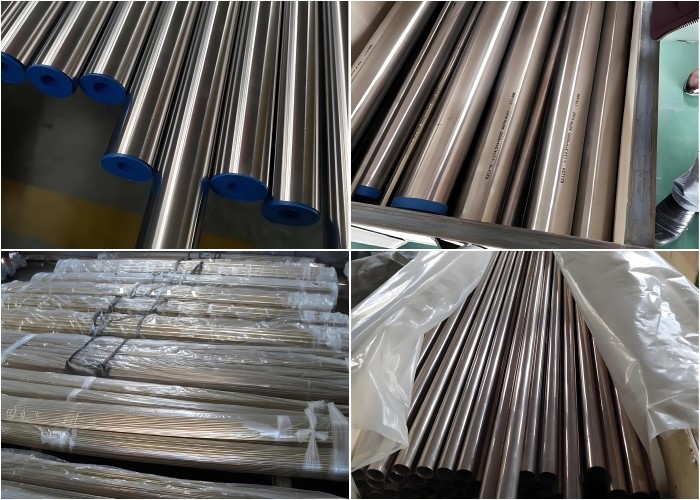
Packaging standards
Plastic end caps on both ends
Individual polybag wrapping
Wooden crate (ISPM15 fumigated) for export
Moisture-proof paper + desiccant
Label with heat number, size, quantity
Our Copper Product Range
| Product form | Common alloys | Standards | Typical applications |
|---|---|---|---|
| Tube (seamless) | C70600, C71500, C12200, C44300, C68700 | ASTM B111, ASME SB111 | Heat exchangers, condensers, marine piping |
| Pipe (seamless) | C12200, C70600, C71500 | ASTM B88, ASTM B466 | Water lines, fuel lines, shipbuilding |
| Rod / bar | C11000, C36000, C46400, C63000 | ASTM B16, ASTM B124 | Valve stems, fittings, marine hardware |
| Wire | C11000, C16200, C19400 | ASTM B1, ASTM B3 | Electrical conductors, welding wire |
| Strip / coil | C11000, C19400, C26000, C26800, C52100 | ASTM B152, ASTM B465 | Terminals, springs, transformer windings |
| Plate / sheet | C10100, C11000, C12200, C70600, C71500, C46400 | ASTM B152, ASTM B171 | Tube sheets, baffles, heat exchanger plates |


