

C70600 is a copper-nickel alloy material, also known as white copper. The material is composed of 90% copper and 10% nickel. It has good electrical conductivity and strength, as well as good cold and hot processing properties and welding properties. This material is commonly used to make ship parts, condenser tube sheets, strips and sheets for weatherstripping, etc.
| Parameter | Specification |
|---|---|
| Material | Copper-Nickel Alloy (C70600) |
| Length Range | 500 ~ 15,000 mm |
| Outer Diameter (OD) | 10 ~ 325 mm |
| Wall Thickness (WT) | 1 ~ 25 mm |
Key Applications
Power Plant Heat Exchangers
Desalination Systems
Petrochemical Facilities
Marine Engineering
Primary Advantages
Superior Corrosion Resistance
Excellent Heat Transfer
High Durability
Reliable Performance in Harsh Environments
Ideal for critical infrastructure requiring maximum reliability and performance in marine and industrial settings.
C70600 Properties
| Alloy | Product | Temper | Section size(mm) | Length (mm),max. | |
| OD. | WT. | ||||
| BFe10-1-1 C70600 | Drawn pipes | M,Y2,Y | 10~160 | 1~8 | OD.≤50 L1000~7000OD.>50 L500~6000 |
| BFe10-1.6-1 | Copper Nickeltubes and Pipes for Marine shipbuilding | M | 10~159 | 1.0~3.5 | 2000~6000 |
| BFe10-1.6-1 | 10~194 | 1.0~3.5 | 6000 | ||
| >194~325 | 3.0~5.5 | Negotiated | |||
| BFe10-1-1,BFe10-1.6-1,C70600,7060X | 10~368 | 1.0~5.5 | 4000~6000 | ||
| 22-160 | 3-10 | ||||
| BFe10-1-1 C70600 | Condenser andHeat Transfomerpipes | M | 10~160 | 1~4.5 | 500~6000 |
| Y,Y2 | 10~76 | 1~4.5 | <15000 | ||
| BFe10-1-1 | Extruded pipes | R | 70~250 | 10~25 | 500~3000 |
| C70600 ,C7060X | C70600 ,C7060X Negotiated | ||||
C70600 Chemical Composition
| Alloy | Chemical Composition | ||||||||||||
| Cu | Ni+Co | Fe | Mn | Pb | P | S | C | Si | Zn | Sn | impurities | co | |
| BFe10-1-1 | Rem | 9.0-11.0 | 1.0-1.5 | 0.5~1.0 | 0.02 | 0.006 | 0.01 | 0.05 | 0.15 | 0.3 | 0.03 | 0.7 | |
| BFe10 -1.5 -1 | Rem | 10.0-11.0 | 1.0-2.0 | 0.50-1.0 | 0.01 | ― | 0.05 | 0.05 | 一 | ― | 一 | 0.6 | |
| C7060 | Rem | 9.0-11.0 | 1.0-1.8 | 0.2-1.0 | 0.02 | 0.5 | |||||||
| C70600 | Rem | 9.0-11.0 | 1.0-1.8 | 1.0 | 0.05 | 1.0 | |||||||
| CuNil0FelMn | Rem | 9.0-11.0(Ni) | 1.0-2.0 | 0.50-1.0 | 0.02 | 0.02 | 0.05 | 0.05 | 0.5 | 0.03 | 0.2 | 0.1 | |
| Temper | Tensile Strength Rm/ (N/mm2) | Elongation A/ % min | HV | HB |
| M | ≥290 | 30 | 75~110 | 70~105 |
| Y2 | ≥310 | 12 | 105 | 100 |
| Y | ≥480 | 8 | 150 | 145 |
C70600 Features
Copper-nickel alloy is excellent in corrosion resistance, mainly used in desalination evaporator, central air conditioning condenser, ship air cooler, petrochemical cooler, power plant steam turbine condenser.
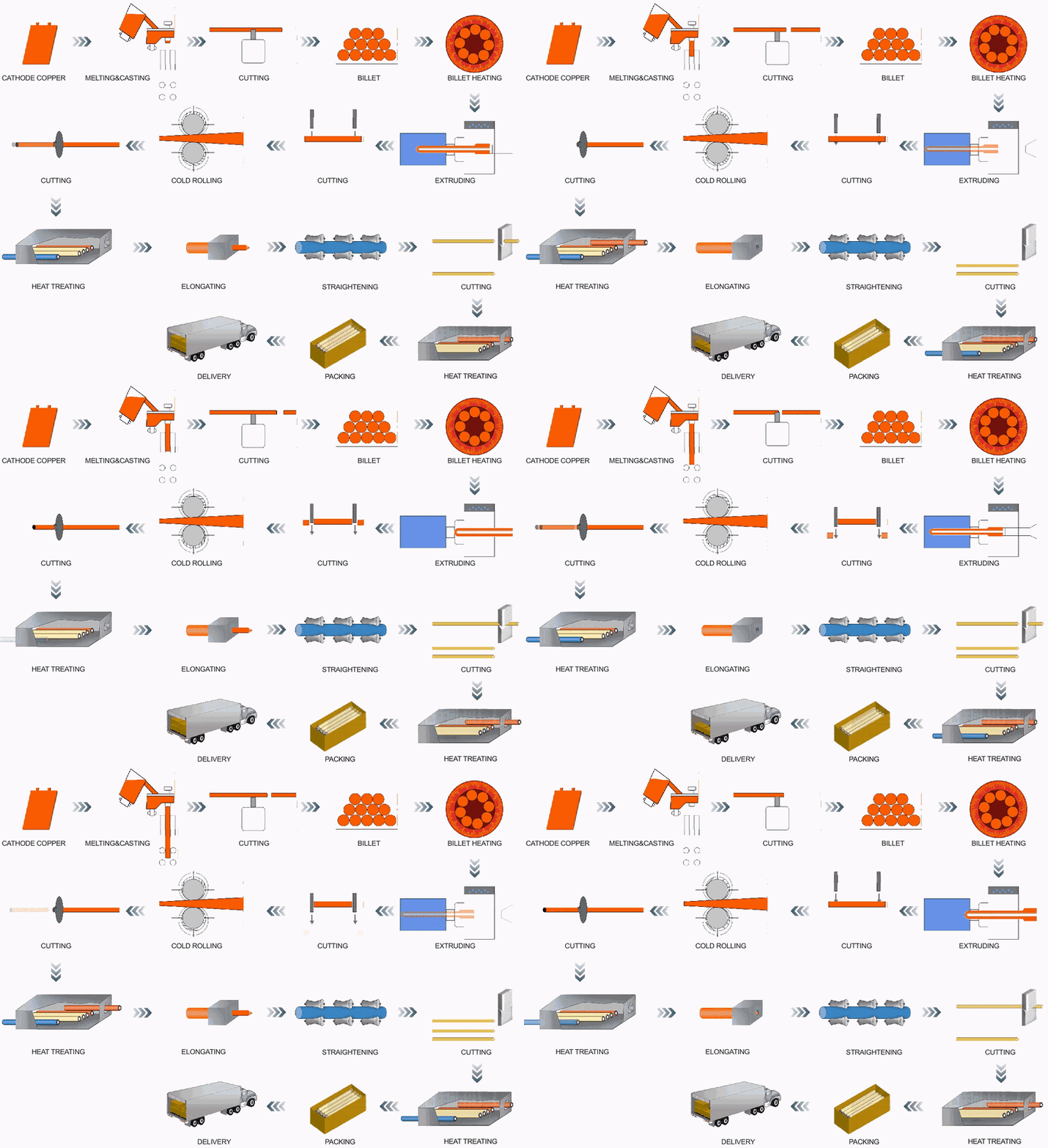
The production process of Drawn pipe/tube (big)

Production process of C70600 Drawn pipe/tube
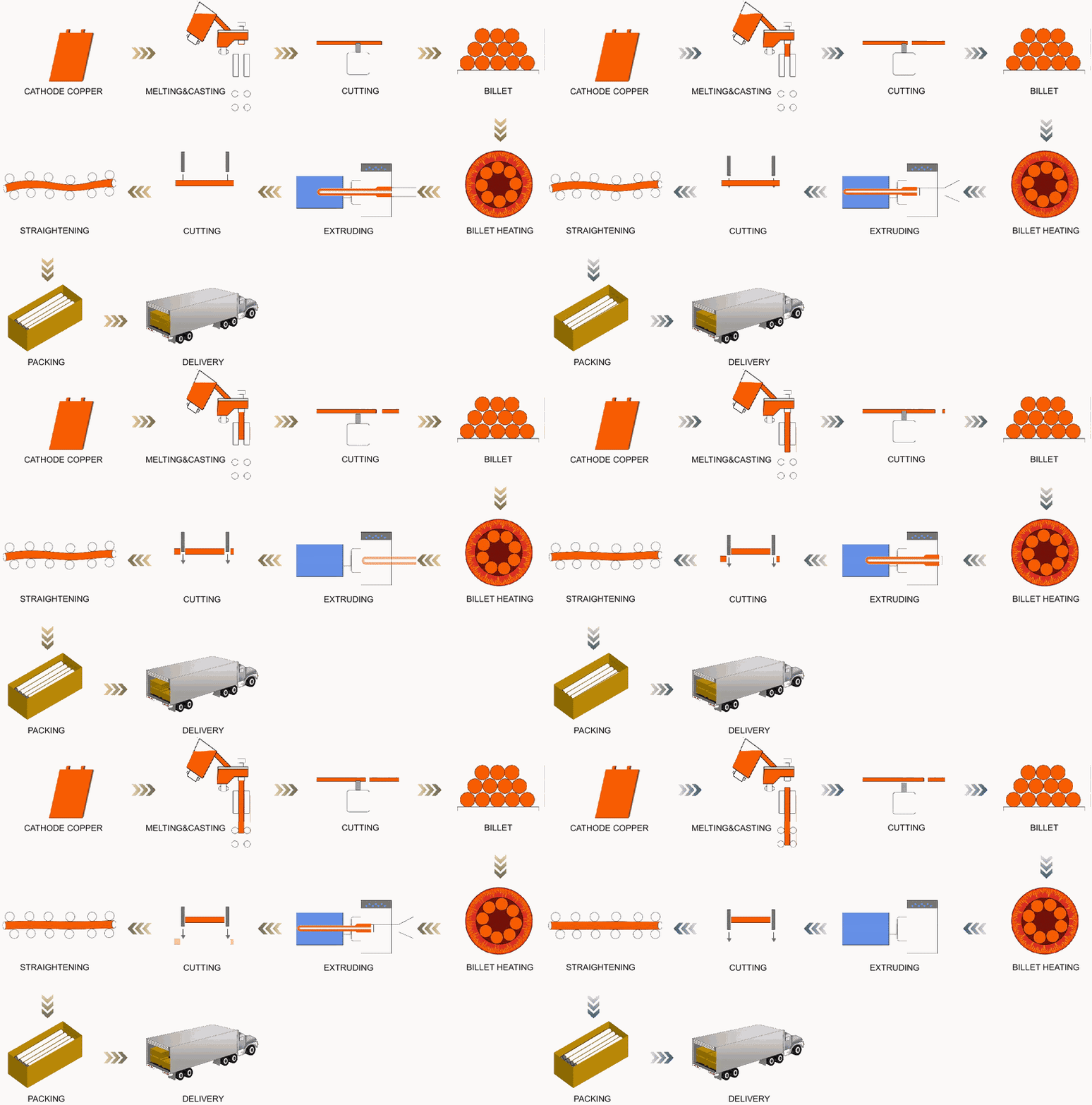
Manufacturing process of C70600 Extruded pipe/tube
FAQ
Q1: What is the difference between ASTM B111 C70600 and ASTM B466 C70600?
A: ASTM B111 C70600 is specifically for seamless condenser and heat exchanger tubes with tighter tolerances and eddy current testing. ASTM B466 C70600 is for seamless pipe used in general seawater piping systems.
Q2: What is the chemical composition of ASTM B111 C70600 tube?
A: ASTM B111 C70600 contains approximately 90% copper, 10% nickel, plus iron (1.0-1.8%) and manganese (≤1.0%). The iron addition is critical for seawater corrosion resistance.
Q3: What is the maximum operating temperature for ASTM B111 C70600 condenser tube?
A: ASTM B111 C70600 tube can operate continuously up to 300°C (572°F) in heat exchanger service. Above this temperature, strength decreases significantly.
Q4: What is the difference between C70600 (90/10) and C71500 (70/30) copper nickel tube?
A: C70600 (90/10) contains 10% nickel and is more cost-effective for general seawater service. C71500 (70/30) contains 30% nickel, offering higher strength and better erosion resistance at water velocities above 3.5 m/s.
Q5: Does ASTM B111 C70600 tube require post-weld heat treatment?
A: No, ASTM B111 C70600 typically requires no post-weld heat treatment. Stress relief annealing at 593-650°C may be used for U-bend tubes or heavily welded sections.
Q6: What filler metal should be used for TIG welding ASTM B111 C70600 tube?
A: For TIG welding ASTM B111 C70600 tube, use AWS A5.7 ERCuNi filler metal. It matches the 90/10 composition and provides good corrosion resistance.
Q7: What is the maximum seawater velocity for ASTM B111 C70600 tube?
A: ASTM B111 C70600 tube can handle seawater velocities up to 3.5 m/s (11.5 ft/s) without erosion corrosion. Above this, consider C71500 tube.
Q8: Is ASTM B111 C70600 tube resistant to biofouling?
A: Yes, ASTM B111 C70600 tube has excellent inherent resistance to biofouling. Marine organisms do not readily attach to the copper-nickel surface, reducing maintenance costs.
Q9: What is the thermal conductivity of ASTM B111 C70600 tube?
A: ASTM B111 C70600 tube has a thermal conductivity of approximately 40-50 W/mK at room temperature, which is adequate for heat exchanger and condenser applications.
Q10: What is the yield strength of annealed ASTM B111 C70600 tube?
A: Annealed (O61 temper) ASTM B111 C70600 tube has a typical yield strength of 105-170 MPa (15-25 ksi) and elongation of 42-50%.
Q11: Can ASTM B111 C70600 tube be used for desalination plants?
A: Yes, ASTM B111 C70600 tube is extensively used in desalination plants for heat recovery sections, evaporators, and brine heaters due to its seawater corrosion resistance.
Q12: Is ASTM B111 C70600 tube susceptible to stress corrosion cracking?
A: No, ASTM B111 C70600 is immune to chloride stress corrosion cracking and has the highest resistance to ammonia stress corrosion among copper alloys.
Q13: What is the difference between ASTM B111 C70600 and ASTM B111 C44300 (admiralty brass)?
A: ASTM B111 C70600 has superior corrosion resistance in seawater, especially at higher velocities and against biofouling. Admiralty brass (C44300) has higher thermal conductivity but is less resistant to biofouling and impingement attack.
Q14: What is the density of ASTM B111 C70600 tube?
A: ASTM B111 C70600 has a density of 8.94 g/cm³ (0.323 lb/in³).
Q15: What are the standard tests for ASTM B111 C70600 tube?
A: ASTM B111 C70600 tube is tested for chemical composition, tensile strength, yield strength, elongation, flattening, expansion (for annealed tube), and either eddy current (ASTM E243) or hydrostatic test.
Q16: Can ASTM B111 C70600 tube be bent into U-bends?
A: Yes, annealed (O61) ASTM B111 C70600 tube can be bent into U-bends. After bending, stress relief annealing is recommended to prevent springback and reduce residual stresses.
Q17: What is the melting point of ASTM B111 C70600 tube?
A: ASTM B111 C70600 has a melting point range of 1090-1125°C (1994-2057°F) – liquidus at 1125°C, solidus at 1090°C.
Q18: Is ASTM B111 C70600 tube suitable for sour seawater service (H₂S)?
A: ASTM B111 C70600 tube is susceptible to pitting in contaminated water containing hydrogen sulphide. For sour service, consider C71500 or super duplex stainless steel.
Q19: What is the machinability rating of ASTM B111 C70600 tube?
A: ASTM B111 C70600 has a machinability rating of 20 (UNS C36000 free-cutting brass = 100). Use sharp carbide tools and ample coolant.
Q20: What are the equivalent European standards to ASTM B111 C70600?
A: The European equivalents to ASTM B111 C70600 are DIN 2.0872, EN 12449 CW352H, and CuNi10Fe1Mn.
Quality Inspection for ASTM B111 C70600 Tube
GNEE inspects ASTM B111 C70600 tube through a 6-step process:
Chemical analysis – Spectrometer verification of Cu, Ni, Fe, Mn
Tensile testing – Ultimate tensile, yield strength (0.5% offset), elongation
Flattening test – Tube flattened to specified gap without cracking
Expansion test (annealed tube) – Expanded over tapered mandrel
Non-destructive testing – 100% eddy current (ASTM E243) or hydrostatic
Dimensional & visual – OD, ID, wall thickness, length, surface finish

Packaging for ASTM B111 C70600 Tube
ASTM B111 C70600 tube is packaged for export:
Ends: Plastic caps on both ends
Protection: VCI paper wrap or rust-prevention oil
Bundling: Hexagonal bundles with steel strapping (3-5 straps)
Overwrap: Woven polypropylene or PE shrink film
Crating: Wooden crates or pallets (ISPM-15 compliant)
Labeling: Alloy (C70600), standard (ASTM B111), dimensions (OD x WT x length), heat number, PO number
Bundle weight: 2000-2500 kg max | Tube length: 1m – 12m (custom up to 15m)

Factory Equipment
GNEE manufactures ASTM B111 C70600 tube using:
| Equipment | Purpose |
|---|---|
| Induction furnace (30T) | Melting and alloying Cu, Ni, Fe, Mn |
| Horizontal continuous caster | Producing hollow billets (80-200mm dia) |
| Extrusion press (2500T) | Forming tube shells |
| Cold drawing bench (5-150mm) | Precision tube drawing (multiple passes) |
| Bright annealing furnace | Heat treatment in protective atmosphere (no scaling) |
| 6-roll straightening machine | Correcting bends and ovality |
| Eddy current tester | 100% non-destructive testing (ASTM E243) |
| Hydrostatic tester | Pressure testing for pipe |
| Universal testing machine | Tensile and yield testing |
| Spectrometer (ARL iSpark) | In-house chemical analysis |
Certification: ISO 9001:2015 | Capacity: ~500 tons/month for C70600 tube

Product Range
GNEE supplies all copper and copper alloy products across these categories:
| Category | Typical Grades | Forms Available |
|---|---|---|
| Pure Copper | C10100, C10200, C11000, C12200 | Tube, pipe, bar, plate, sheet, wire, strip, busbar |
| Copper-Nickel | C70600, C71500, CuNi30Fe | Tube, pipe, bar, plate, sheet, fitting, flange |
| Brass | C26000, C36000, C37700, C44300, C46400, C48500, C68700 | Tube, bar, plate, sheet, strip, wire |
| Phosphor Bronze | C51000, C52100, C52400, C54400 | Bar, plate, sheet, strip, wire |
| Aluminum Bronze | C61400, C62300, C63000, C63200, C95400, C95500 | Bar, plate, tube, forging |
| Silicon Bronze | C65100, C65500, C66100 | Bar, tube, wire |
| Beryllium Copper | C17200, C17500 | Bar, rod, wire, strip |
| Tin / Leaded Bronze | C90300, C90500, C93200, C93700 | Cast bar, bearing stock |
| Nickel Silver | C74500, C75200, C75400, C77000 | Bar, plate, sheet, strip |


