

C68700 aluminum brass tube can be welded, brazed, bent, and expanded – but each operation requires specific parameters. Wrong techniques cause cracking, dezincification, or weld failure. This guide covers recommended practices for shipyards, fabricators, and maintenance crews.
Cutting C68700 Tubes – Blade Type and Speed
Correct cutting prevents heat damage and burrs. Use a fine-tooth band saw (18-24 TPI) at low speed.
Recommended cutting parameters:
| Parameter | Value |
|---|---|
| Saw type | Band saw or cold saw (no abrasive saws) |
| Teeth per inch (TPI) | 18-24 (for wall thickness 2-5 mm) |
| Cutting speed (m/min) | 60-80 |
| Feed rate | Light, constant pressure |
| Coolant | Water-soluble oil (flood coolant) |
What to avoid:
Abrasive cut-off wheels – generate heat that damages the aluminum oxide film
High-speed friction saws – cause localized melting and burrs
Dry cutting on thick walls (>5 mm) – leads to work hardening
After cutting: Deburr inside and outside. Use a countersink tool or fine file. Remove all sharp edges – they concentrate stress during expansion.
GNEE note: If you see blue/black discoloration at the cut edge, the tube overheated. Cut 10 mm past the discolored area.

Customer Visit & Project Reference – India
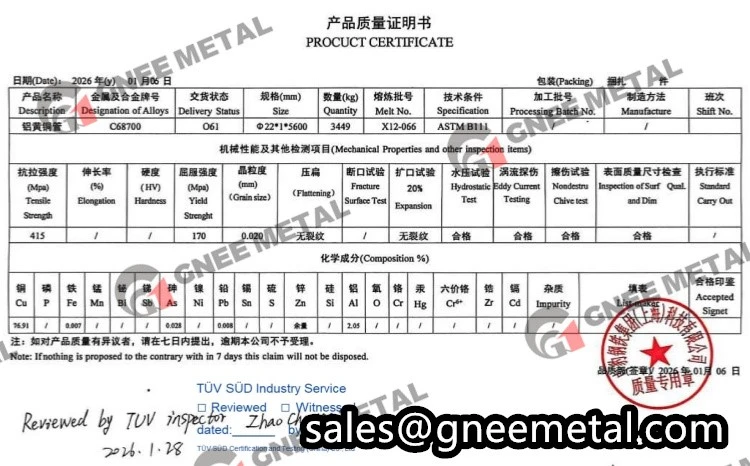
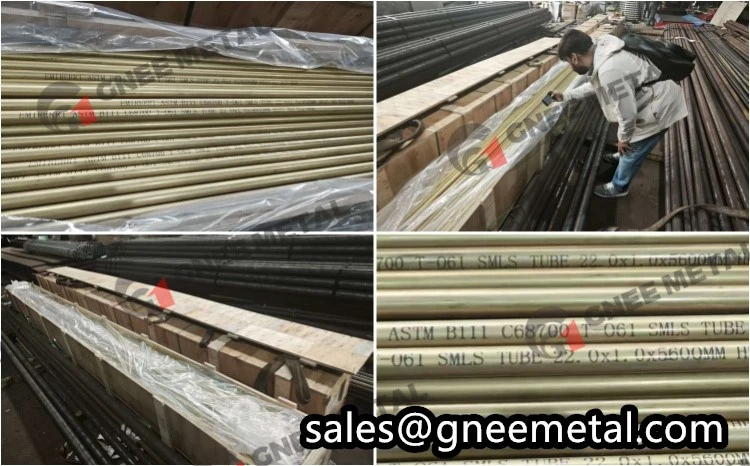
We successfully supplied ASTM B111 C68700 aluminum brass tubes to a customer in India for shell & tube condenser applications. During the project, the customer visited our facility for production inspection and quality verification. All tubes were manufactured in accordance with ASTM B111 requirements and delivered with complete Material Test Certificates (MTC), ensuring full heat number traceability and verified chemical and mechanical properties.
Bending C68700 Tubes – Minimum Radius and Mandrel Use
C68700-O60 (annealed) bends easily. C68700-H80 (hard drawn) cracks on tight bends.
Minimum bend radii (centerline):
| Tube OD (mm) | C68700-O60 (annealed) | C68700-H80 (hard drawn) |
|---|---|---|
| 12 mm | 36 mm (3D) | Not recommended |
| 25 mm | 75 mm (3D) | Not recommended |
| 50 mm | 150 mm (3D) | 250 mm (5D) – marginal |
| 75 mm | 225 mm (3D) | Not recommended |
Bending guidelines:
Use a mandrel bend for OD > 25 mm or wall thickness < 2.5 mm
Lubricant: Heavy-duty drawing compound (not general oil)
Speed: Slow and constant – 10-15 seconds per 90° bend
Springback: C68700 has 2-3° springback. Overbend by 3°.
Common bending defects and causes:
| Defect | Cause | Fix |
|---|---|---|
| Wrinkles on inside radius | No mandrel or mandrel too small | Use correct mandrel size |
| Flattening (>10% diameter loss) | Radius too tight | Increase bend radius to 4D |
| Cracking on outside radius | H80 temper or no lubrication | Switch to O60 temper |
| Thinning (>20% wall loss) | Too fast bend speed | Reduce speed by 50% |
GNEE recommendation: Always order C68700-O60 for any tube that needs bending. The cost difference is minimal. H80 should only be used for straight piping.
Expanding C68700 into Tube Sheets – Condenser and Heat Exchanger Installation
C68700-O60 expands reliably. C68700-H80 or aged cracks under expansion.
Expansion procedure (for tube sheets):
| Step | Action | Parameter |
|---|---|---|
| 1 | Clean tube hole in tube sheet | Remove oil, rust, burrs |
| 2 | Insert C68700-O60 tube | Tube end extends 2-3 mm past tube sheet |
| 3 | Select expander | Rolling expander with 5-7 rollers |
| 4 | Lubricate | Light machine oil on expander |
| 5 | Expand | 15-20% wall reduction (not more) |
| 6 | Check | No visible cracks, tube firmly seated |
Wall reduction calculation: (Original wall thickness – Final wall thickness) / Original × 100 = 15-20%.
Example: 2.0 mm original wall. Reduce to 1.6-1.7 mm after expansion.
What goes wrong:
Under-expansion (<10% reduction) – Tube leaks, not seated
Over-expansion (>25% reduction) – Tube cracks near tube sheet
Wrong temper – H80 cracks immediately
Dirty tube holes – Incomplete seal, leaks later
GNEE field data: Properly expanded C68700-O60 tubes hold pressure up to 10 MPa (tested). Improper expansion fails at 3-4 MPa.
Welding C68700 – GTAW (TIG) Parameters
C68700 is weldable but not recommended for original fabrication. Use welding only for repairs.
Why avoid welding C68700 when possible:
Zinc vaporizes during welding (white smoke – toxic)
Weld zone loses dezincification resistance
Post-weld heat treatment required (many shops skip this)
Cracking risk if filler metal is wrong
If welding is necessary – GTAW (TIG) parameters:
| Parameter | Value |
|---|---|
| Filler metal | C68700 filler rod (not brass, not silicon bronze) |
| Shielding gas | Argon 100%, 15-20 L/min flow |
| Tungsten electrode | 2% ceriated, 2.4 mm diameter |
| Amperage | 80-120 amps (depending on wall thickness) |
| Voltage | 10-14 volts |
| Pre-heat | 150°C (for wall >5 mm) |
| Interpass temperature | Max 350°C |
| Post-weld heat treatment | 300°C for 1 hour (required) |
Welding steps:
Clean weld area with stainless steel brush (dedicated – not used on other metals)
Bevel tube ends to 70° included angle for wall >3 mm
Pre-heat to 150°C (use temperature sticks)
Weld with C68700 filler, argon purge inside tube
Immediately post-heat to 300°C for 1 hour – no exceptions
Slow cool in air (not water quench)
Passivate in 10% nitric acid for 30 minutes
GNEE warning: Do not weld C68700 without post-weld heat treatment. Welded but not heat-treated tubes fail within 6-12 months in seawater. Heat-treated tubes last 5+ years (but still shorter than seamless).
Brazing C68700 – Preferred Joining Method
Brazing is preferred over welding for C68700. Lower heat means less zinc vaporization and no post-weld heat treatment required.
Brazing parameters:
| Parameter | Value |
|---|---|
| Brazing alloy | Silver-based (AWS BAg-5, BAg-7, or BAg-24) |
| Flux | White flux (borax-based) for silver alloys |
| Brazing temperature | 620-760°C (lower than welding) |
| Joint gap | 0.05-0.15 mm |
| Heating method | Oxy-acetylene with soft flame (not carburizing) |
Brazing steps:
Clean tube and fitting (remove oil, oxide)
Apply flux to both surfaces
Assemble with 0.1 mm gap
Heat evenly until flux becomes clear
Apply brazing rod – capillary action draws into joint
Cool in air (no quench)
Remove flux residue with warm water and brush
GNEE recommendation: For all seawater applications, braze C68700 to C68700 or to naval brass fittings. Brazed joints resist dezincification better than welded joints.
Machining C68700 – Turning, Drilling, and Threading
C68700 machines well but work-hardens quickly. Use sharp tools and constant feed.
Turning parameters:
| Operation | Tool Type | Speed (m/min) | Feed (mm/rev) | Depth of cut (mm) |
|---|---|---|---|---|
| Rough turning | Carbide (C2 grade) | 60-90 | 0.15-0.30 | 1.5-3.0 |
| Finish turning | Carbide (C2 or C3) | 90-120 | 0.05-0.10 | 0.3-0.8 |
| Cut-off | Carbide blade | 40-60 | 0.05-0.10 | – |
Drilling parameters:
| Drill size | Speed (RPM for 25mm tube) | Feed (mm/rev) | Lubricant |
|---|---|---|---|
| <3 mm | 2,000-3,000 | 0.02-0.05 | Soluble oil |
| 3-10 mm | 1,000-1,500 | 0.05-0.10 | Soluble oil |
| 10-20 mm | 500-800 | 0.10-0.15 | Soluble oil |
Threading (tapping):
Use spiral point taps (not straight flute)
Tap drill size: For M6 thread, use 5.0 mm drill (75% thread engagement)
Lubricant: Heavy cutting oil (not general machine oil)
Speed: 5-10 m/min (very slow)
GNEE note: C68700 work-hardens if tool rubs instead of cutting. Use constant feed. Never let tool dwell in the cut.
Common Fabrication Mistakes and Solutions
| Mistake | Consequence | GNEE Solution |
|---|---|---|
| Cutting with abrasive wheel | Heat damage, oxide film destroyed | Use band saw or cold saw |
| Bending H80 temper | Cracking on outside radius | Order O60 temper for bending |
| Expanding H80 or aged | Tube cracks at tube sheet | Use O60 temper only |
| Welding without pre-heat | Cracking in heat-affected zone | Pre-heat to 150°C |
| No post-weld heat treatment | Weld zone fails in 6-12 months | 300°C for 1 hour required |
| Using brass filler rod | Weld dezincifies rapidly | Use C68700 filler only |
| No deburring after cut | Stress concentration, crack initiation | Deburr inside and outside |
| Over-expanding (>25%) | Tube splits near tube sheet | Stop at 20% wall reduction |
| Storing outdoors before fab | White rust, dezincification starts | Dry indoor storage <60% humidity |
FAQ
Q1: Can I weld C68700 to 316L stainless steel?
A: Yes, but use C68700 filler and isolate galvanically.
Welding C68700 to 316L creates a galvanic couple. After welding, apply a dielectric coating over the weld area. For critical systems, use a flanged joint with insulating gasket instead of welding. Never weld C68700 directly to carbon steel – the steel will corrode rapidly.
Q2: What filler metal should I use for C68700 TIG welding?
A: Use C68700 filler rod only – not brass, not silicon bronze, not C70600.
Standard brass filler (C27000) dezincifies rapidly. Silicon bronze (C65500) creates a brittle weld. GNEE sells C68700 filler rod (2.4 mm diameter) in 5 kg packs. Minimum order: 5 kg. Lead time: 7 days.
Q3: Why does my C68700 tube crack when I expand it into the tube sheet?
A: Most likely you are using H80 or aged temper instead of O60.
Check your purchase order. If you ordered C68700-H80, the tube is too hard to expand. Solution: Return to GNEE for exchange to C68700-O60. If you have O60 and still cracking, reduce expansion to 15% wall reduction (not 20%).
Q4: Do I need to post-weld heat treat every C68700 weld?
A: Yes – no exceptions for seawater service.
300°C for 1 hour minimum. Without heat treatment, residual stresses cause stress corrosion cracking within 6-12 months. With heat treatment, welded joints last 5+ years. GNEE can perform post-weld heat treatment at our China facility before shipping.
Q5: What is the best way to bend C68700 tube without a mandrel?
A: Fill the tube with fine sand or cerrobend (low-melt alloy).
For one-off bends, pack the tube with dry sand, seal both ends, and bend around a form. For production, use a mandrel bender. Never bend C68700 empty without a mandrel – flattening exceeds 10% diameter loss.
Q6: Can I solder C68700 instead of brazing or welding?
A: No – soft solder (tin-lead) does not bond well to aluminum brass.
The aluminum oxide film prevents solder wetting. Use silver brazing (minimum 45% silver) for strong, corrosion-resistant joints. GNEE recommends AWS BAg-5 or BAg-7.
Q7: How do I remove white rust (zinc oxide) from C68700 tubes before fabrication?
A: Soak in 10% citric acid for 30 minutes, then rinse with freshwater.
Do not use hydrochloric or sulfuric acid – they attack the base metal. After cleaning, passivate in 10% nitric acid for 15 minutes. If white rust covers more than 10% of surface area, reject the tube.
Q8: Does GNEE offer pre-fabricated C68700 assemblies (bent tubes, expanded tube sheets)?
A: Yes – GNEE (China) offers custom fabrication services.
We can bend, expand, weld, and braze C68700 to your drawings. Minimum order for fabricated assemblies: 500 kg. Lead time: 4-6 weeks. GNEE provides pressure test certificates for all fabricated assemblies.
100% Inspection Per ASTM B111 / C68700 – Customer Witnessed
Every lot of C68700 material undergoes a multi-step inspection protocol:
1) Chemical composition verified by Oxford Spectrometer (meeting ASTM B111/B135).
2) Mechanical properties tested via 300kN universal tester for tensile strength (≥370MPa) and hardness (80-110 HRB).
3) Dimensional accuracy checked by laser micrometer and pneumatic gauge.
4) Anti-corrosion validation includes mercurous nitrate test and dezincification depth analysis (≤200μm per ASTM B858).
5) Non-destructive testing – 100% eddy current or ultrasonic flaw detection.
We provide traceable mill test certificates (MTC) for each shipment, with third-party inspection (SGS/BV) available upon request.


Export-Ready Packing – Anti-Rust & Wooden Case
After passing inspection, all tubes are packed according to export standards and customer-specific requirements. The packing process is documented below to ensure traceability and damage-free delivery.
Packing steps shown in video & images:
1. Tube cleaning & drying
2. Plastic end caps on both ends
3. VCI anti-rust paper wrapping
4. Bundle strapping with moisture barrier film
5. Plywood wooden case (ISPM-15 compliant) with foam padding
6. Labeling with ASTM grade, lot number, and inspection stamp


Our Factory & Equipment
Our C68700 (Aluminum Brass) production line is equipped with Germany-derived continuous extrusion presses, high-precision tandem cold rolling mills, and online solution heat treatment furnaces. The automated casting system ensures homogeneous distribution of aluminum and arsenic elements, while the in-line eddy current testing devices monitor surface defects in real time. With CNC-controlled straightening and cutting machines, we can supply C68700 tubes and rods in custom lengths (±0.5mm tolerance), supporting OD from 6mm to 219mm for condenser and heat exchanger applications.

Copper & Copper Alloy Products – Supply Range
| Product Form | Common Alloys / Grades | Size Range | Standards | Typical Applications |
|---|---|---|---|---|
| Tube / Pipe | C12200, C11000, C68700, C70600, C71500, C44300, C27000 | OD: 4mm – 219mm Wall: 0.5mm – 20mm Length: up to 15m |
ASTM B68, B75, B111, B280, B359, B466 | Heat exchangers, condensers, HVAC, plumbing, oil coolers |
| Plate / Sheet | C11000, C12200, C26000, C26800, C52100, C68700 | Thk: 0.5mm – 50mm Width: up to 1200mm Length: up to 4000mm |
ASTM B152, B169, B103, B465 | Electrical parts, roofing, gaskets, industrial panels |
| Rod / Bar | C11000, C26000, C36000, C46400, C48500, C63000 | Dia: 3mm – 120mm Length: 1m – 6m (or custom) |
ASTM B16, B124, B138, B150, B453 | Valve stems, shafts, fasteners, machined components |
| Wire | C11000, C16200, C17500, C26000, C52100, C64700 | Dia: 0.1mm – 12mm Coil weight: up to 100kg |
ASTM B1, B2, B3, B197, B206, B624 | Welding electrodes, electrical conductors, springs, mesh |
| Strip / Foil | C11000, C19400, C26000, C26800, C52100, C70250 | Thk: 0.05mm – 3.0mm Width: 5mm – 600mm |
ASTM B36, B465, B694, B888 | Connectors, terminals, battery tabs, shielding, stamping parts |
Check Today's Stock & Lead Time


