

UNS C12200 is a commercially pure copper that is phosphorus deoxidized, with high residual phosphorus. It is also known as DHP copper. It is widely used for the manufacture of seamless copper water tubes in accordance with ASTM B88. GNEE's UNS C12200 seamless copper tubes are mainly intended for general plumbing and the conveyance of other similar fluids.
Tube Types Based on Wall Thickness
| Type | Wall Thickness | Typical Application |
|---|---|---|
| Type K | Thickest | Underground water mains, high-pressure systems |
| Type L | Medium | Residential and commercial hot/cold water |
| Type M | Thinnest | Low-pressure residential applications |
Selection of tube type is determined by internal or external fluid pressure, installation and service conditions, and local requirements. Means of joining (soldering, flaring, or compression) or bending are also factors that affect selection.
Advantages of Copper C12200 Tubes for Plumbing
1. Antimicrobial & Antifungal
Copper has natural antimicrobial properties because copper ions disrupt the cell membranes and DNA of bacteria, fungi, and other microorganisms, effectively killing them. Studies have shown that copper surfaces can kill more than 99.9% of bacteria within a few hours, including many antibiotic-resistant strains. This makes UNS C12200 copper tubes particularly advantageous for drinking water systems.
Fungi, such as mold, thrive in moist environments, but copper's antimicrobial action extends to these organisms as well. The copper ions released from the tube surface inhibit the growth and reproduction of fungi, preventing mold formation inside the pipes.
2. Corrosion Resistance
The corrosion resistance of UNS C12200 copper tubes is attributed to copper's stable chemical nature. In most water conditions, a protective layer of copper oxide or copper carbonate forms on the surface, preventing further corrosion. This makes copper tubes highly durable in various water environments, including slightly acidic and slightly alkaline conditions.
In UNS C12200, a small amount of phosphorus is added for deoxidation, which enhances corrosion resistance, particularly in environments with sulfides or other corrosive agents.
3. Excellent Physical & Mechanical Properties
| Property | Advantage for Plumbing |
|---|---|
| High thermal conductivity | Reduces heat loss in hot water systems |
| Strength at elevated temperature | Maintains stability in hot water piping |
| Moderate mechanical strength | Withstands common pressures and stresses |
| Good ductility and formability | Easily bent, shaped, cut for complex layouts |
| Easy joining | Simple soldering or compression fittings |
| Damping properties | Reduces vibration impact on plumbing |
| Low thermal expansion | Minimizes leaks from temperature changes |
GNEE's UNS C12200 copper tubes can withstand a working pressure of 4.0 MPa at 65°C (approximately 580 psi at 149°F). Once put into use, they will not crack or leak, and their lifespan will match that of the building.
FAQ
Q1: C12200 vs C11000 – what's the difference?
A: C12200 contains 0.015-0.04% phosphorus for deoxidation, making it resistant to hydrogen embrittlement during welding or brazing. C11000 (electrolytic tough pitch) contains oxygen and will crack if welded in a reducing atmosphere. C12200 has 85% IACS electrical conductivity; C11000 has 100% IACS. For plumbing and HVAC where brazing is required, C12200 is the correct choice. For high-conductivity electrical applications with no welding, C11000 is better.
Q2: C12200 vs C10200 – which is better?
A: C10200 is oxygen-free copper with 99.95% minimum copper and 0.001% oxygen maximum, giving it 100% IACS conductivity. It is used for high-vacuum electron tubes and specialized electrical applications. C12200 contains phosphorus and has 85% IACS conductivity, but it costs significantly less. For plumbing, HVAC, and general engineering, C12200 is the industry standard. C10200 is unnecessary overkill for water or refrigerant lines.
Q3: ASTM B88 Type L vs Type M?
A: Type L has a thicker wall (for 1/2" OD: 0.049" wall thickness) and is rated for higher pressure. It is the standard choice for residential and commercial hot and cold water lines. Type M has a thinner wall (1/2" OD: 0.032" wall thickness) and is approved only for low-pressure residential applications. Many local plumbing codes do not permit Type M for hot water or for underground use. Type L is safer for most jobs.
Q4: What is Type K copper tube used for?
A: Type K has the thickest wall (1/2" OD: 0.065" wall thickness) and is used for underground water mains, service entrances, and high-pressure systems. It provides extra protection against corrosion from soil conditions and external loads from backfill. Type K is also specified for fire sprinkler systems and hospital medical gas lines. It costs more than Type L but lasts longer in aggressive environments.
Q5: Can C12200 tubes be used for drinking water?
A: Yes, C12200 is approved by NSF/ANSI 61 for potable water systems. Copper's natural antimicrobial properties kill 99.9% of bacteria within hours, including Legionella and E. coli. Unlike plastic pipes, copper does not leach chemicals into drinking water. However, water with pH below 6.5 can cause copper to leach, requiring pH adjustment or a corrosion control program.
Q6: Does C12200 need dielectric unions with steel pipe?
A: Yes. When copper and steel are directly connected, galvanic corrosion occurs because the two metals have different electrical potentials. The steel pipe will corrode rapidly, often within 1-2 years. A dielectric union (plastic or rubber isolation) or a brass fitting between copper and steel prevents this galvanic reaction. Never connect copper directly to galvanized steel or black iron.
Q7: Can C12200 tubes be bent without special tools?
A: Only if the tube is annealed (soft temper). Hard drawn C12200 tube will crack or kink if bent without annealing first. For field bending of soft copper, use a hand tube bender or bending spring. Minimum bend radius for soft copper is typically 4-6 times the tube diameter. For tight bends, fill the tube with sand or use a mandrel bender to prevent collapsing.
Q8: How to solder C12200 copper tubes correctly?
A: Clean the tube end and fitting inside with a brush or emery cloth until shiny. Apply flux to both surfaces. Assemble the joint and heat with a torch until the flux bubbles. Apply lead-free solder to the joint edge; capillary action will pull it in. Wipe off excess solder. Use only lead-free solder (95% tin/5% antimony or tin-silver) for drinking water systems per Safe Drinking Water Act.
Q9: What causes pinhole leaks in C12200 water pipes?
A: Pinhole leaks are usually caused by formicary corrosion, which occurs when copper reacts with organic acids from decomposed wood, adhesives, or cleaning products. Other causes include aggressive water (pH below 6.5, high chloride, or high dissolved oxygen) and improper grounding of electrical systems. To prevent pinholes, maintain water pH between 6.5-8.5 and avoid leaving flux residue inside joints.
Q10: C12200 tube lifespan in plumbing systems?
A: In normal municipal water conditions (pH 6.5-8.5, moderate hardness), C12200 copper tubes last 50-70 years for domestic water lines. For well-maintained closed-loop hydronic heating systems, lifespan often exceeds 80 years. Copper's protective oxide layer continuously reforms as long as water chemistry remains stable. Poor water quality or improper installation can reduce lifespan to 10-20 years.
Q11: Can C12200 tubes freeze and crack?
A: Yes. When water freezes inside a copper tube, it expands by about 9% and generates pressure up to 40,000 psi, far exceeding the tube's burst strength. The tube will split, usually along a straight line. Unlike plastic pipe (PEX), copper cannot expand to accommodate ice. To prevent freezing, insulate pipes in unheated spaces, allow faucets to drip during cold weather, or use heat tape.
Q12: What is DHP copper?
A: DHP stands for "Deoxidized High Phosphorus." It is the exact same material as UNS C12200. The phosphorus content (0.015-0.04%) removes oxygen during melting and improves corrosion resistance. DHP is the common name for C12200 in European and Asian markets. If you see DHP copper tube, it is equivalent to ASTM B88 C12200 and can be used interchangeably.
How Do We Package Copper Heat Exchanger Tubes for Global Delivery?
Poor packaging destroys even the best copper heat exchanger tube. As a professional copper heat exchanger tube factory serving copper heat exchanger tube USA, Europe, UAE, Saudi Arabia, and India, we follow military-grade export packaging standards to ensure zero damage during sea or air freight.
Our Standard Packaging Process:
| Packaging Stage | Material / Method | Purpose |
|---|---|---|
| Individual Tube Protection | Anti-rust VCI paper + plastic end caps | Prevents moisture, dust, and scratches on copper tube heat exchanger inner surfaces. |
| Bundling | Nylon straps + wooden spacers | Keeps copper heat exchanger tube OD 19mm, 1 inch, or 5/8 inch sizes organized and vibration-free. |
| Moisture Barrier | Thick PE film wrap (heat-shrunk) | Blocks humidity during long sea voyages to copper heat exchanger tube Germany or Saudi Arabia. |
| Outer Packing | Export-grade plywood cases or steel-banded wooden crates | Withstands stacking and rough handling. Each crate labeled with PO number, alloy (e.g., SB111 C70600), and quantity. |
| Documentation | Packing list + Mill Test Certificate (MTC) attached outside | Customs clearance support for copper heat exchanger tube stockist and distributor partners. |
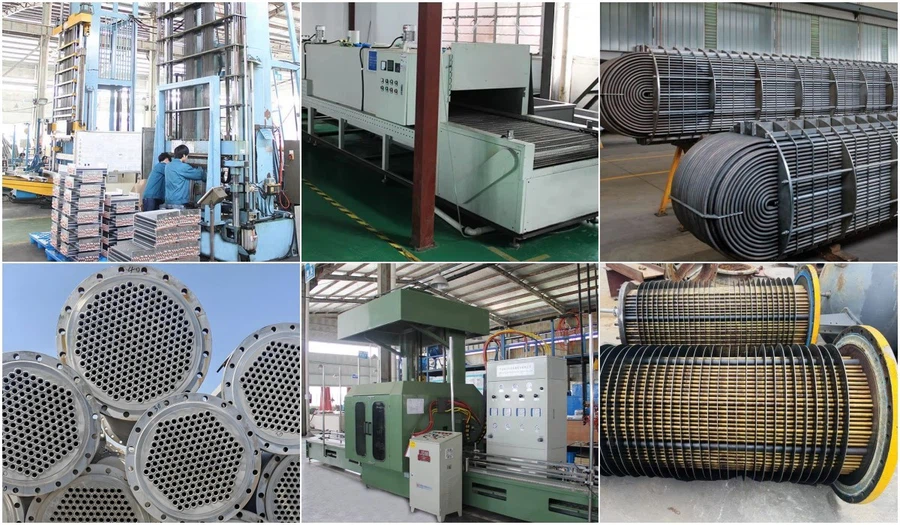
For U-Bundle Orders: U tube heat exchanger and U tube bundle heat exchanger are placed in dedicated steel jigs inside the crate to prevent bending radius distortion.
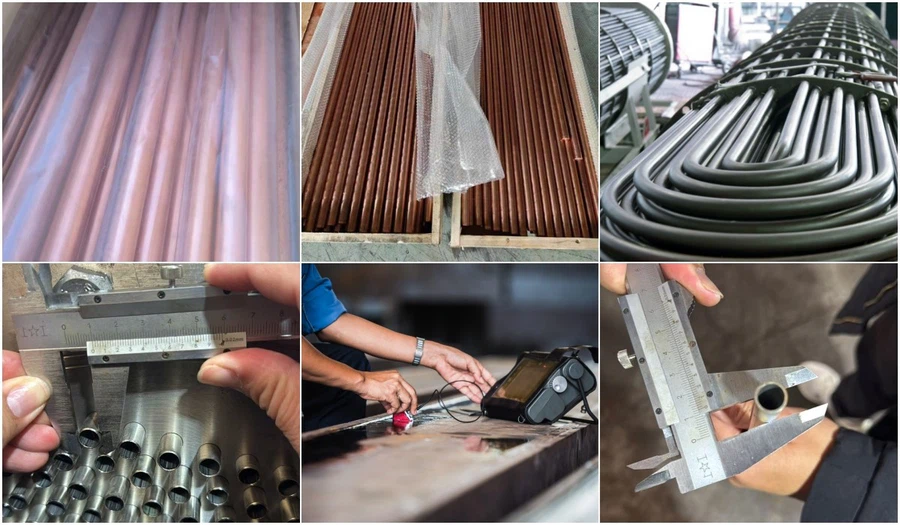
Our Factory & Equipment
| Equipment Type | Specification / Capability | Quality Impact |
|---|---|---|
| Horizontal Continuous Casting Line | 10-ton capacity | Produces homogeneous copper alloy tube for heat exchanger billets with zero porosity. |
| Three-Roll Piercing Mill | Up to 60mm OD | Precision wall thickness control for heat exchanger tube wall thickness as low as 0.5mm. |
| Cold Drawing Bench | 5 draws in sequence | Achieves tight tolerances on copper heat exchanger tube length and heat exchanger pipe diameter. |
| Straightening & Cutting Line | CNC servo-controlled | Burr-free cutting for copper heat exchanger tube 3/4 inch and 1 inch to exact project lengths. |
| U-Bending Machine | CNC mandrel type | Produces u tube condenser and U tube bundle heat exchanger without kinking or ovality. |
| Eddy Current Tester | NDT (Non-Destructive Testing) | 100% inspection of C70600 tube and C71500 tube for pinholes or cracks per ASTM B111 pdf standards. |
| Hydrostatic Tester | Up to 200 bar | Validates heat exchanger tube expansion and tube rolling integrity. |
| Spectrometer | Optical emission (OES) | Confirms chemical composition of ASME SB111, EN 12451, and JIS H3300 grades on every batch. |
Our Certifications & Compliance:
ASTM B111 pdf and ASME SB111 pdf full traceability.
ISO 9001:2015 quality management system.
Third-party inspection accepted: SGS, BV, Lloyds, or TUV.
Copper heat exchanger tube life expectancy testing reports available upon request.
Get Fast Quote & Logistics Plan


