

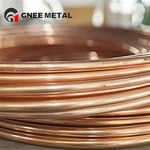
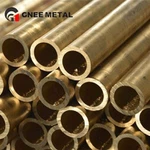
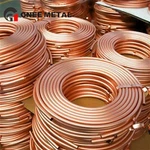
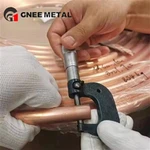

Hard Brass Tube
Henan Gnee New Material Co., Ltd. is one of the most professional manufacturers and suppliers of hard brass tube in China, specialized in providing high quality copper products with competitive price. Welcome to buy discount hard brass tube for sale here from our factory. Customized orders are welcome.
Gnee group is a supply chain integrated enterprise including metal plate, coil, profile, outdoor landscape design and processing.Gnee is becoming the most professional international steel supply chain company in china central plains with explicit strategic framework, integrated governance structure, firm management foundation, abundant fund and human power.
Why Choose Us?
High quality
Our products are manufactured or executed to very high standards, using the finest materials and manufacturing processes.
Professional team
Our professional team collaborate and communicate effectively with one another, and are committed to delivering high-quality results. They are capable of handling complex challenges and projects that require their specialized expertise and experience.
Rich experience
Dedicated to strict quality control and attentive customer service, our experienced staff is always available to discuss your requirements and ensure complete customer satisfaction.
24h online service
We try and respond to all concerns within 24 hours and our teams are always at your disposal in case of any emergencies.

C11000 copper pipe is a very common piping material with good thermal and electrical conductivity. It is widely used in various industrial and civil fields, such as construction, water supply system, heating system and so on.

In the air conditioning system, the copper tube serves as a channel for the transmission of refrigerant and other substances, and its high thermal conductivity can rapidly transmit substances from one part to another, thus realizing the effect of rapid cooling or heating.

C11000 Ac Copper Pipe Common Piping Material
C11000 ac copper pipe common piping material,is an essential component in a wide range of building and industry sectors, especially for plumbing, heating, and refrigeration.

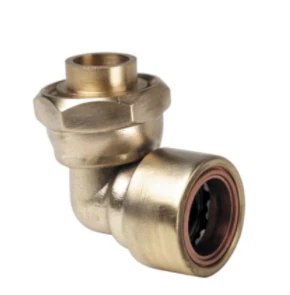
Primaflow Copper Pushfit Bent Tap Connector
Copper push fit components are durable and easy to install, the push-fit system is suitable for hot and cold water applications and no tools are required for installation as components are reusable.

Brass does not easily corrode or deform from water or heat, hence offering good corrosion resistance from water and heat. Brass can also resist attack from salt water, minerals, and peat soils contained in water. Brass also has many similar advantages of copper, with higher wall thickness.

Red PVC Coated Hard Copper Tube
Pvc coating on copper tubes protects the tube against aggressive environment, harsh conditions, accidental damages, and abrasion by providing extra resistance to the tube. It also helps reduce heat loss and prevents corrosion which increases the life span of tubes. It is available in various colors which is helpful in service type identification according to different applications of water and gas services or any other general usage for safety or aesthetic reasons.

Standard Seamless TP2 Copper Tube Pipe
Application copperare of goood heat conductibility.They are of widely used for heat exchangers,radiators,coolers,electro-heat-up pipe,air conditioner and refrigerators,oil transportation ,brake pipes,water pipesand gas pipes for construction.Etc.

ASTM B111 Copper Alloy Seamless Tube
This specification establishes requirements for seamless tube and collar blanks of copper and various copper alloys in specified diameter ranges for surface condensers, evaporators, and heat exchangers. The specified copper and copper alloys are uns nos. C10100, c10200, c10300, c10800, c12000, c12200, c14200, c19200, c23000, c28000, c44300, c44400, c44500, c60800, c61300, c61400 , c68700, c70400, c70600, c70620, c71000, c71500, c71520, c71640 and c72200.

ASTM B280 Air Conditioning Pipe
Astm b280 covers the requirements for seamless uns c10200, c12000, or c12200 copper alloy tubes for connection, repair, or replacement of air conditioning or refrigeration units in the field. Material in the form of billets, bars, or tubes shall be used to produce uniform and consistent wrought structures by hot or cold working. Each tube shall be cold drawn to final size and wall thickness.
A brass tube or brass pipe is a metal pipe with a large diameter and a thin wall. In some applications, it also serves as a cooling mechanism or an exchangers. Even though copper has a higher degree of flexibility than steel or iron, brass tubing can be made from other metals. For example, it is commonly used for plumbing in houses, businesses, and other buildings.
Brass pipes are easy to install
Brass presents a visually pleasing aesthetic compared to alternative metals such as copper or steel. Its golden hue adds a touch of elegance and sophistication to any space or structure employing brass piping applications.
Brass pipes easy to customize
Brass pipes are relatively easy to work with compared to other metals such as copper or steel. Their malleability allows for straightforward bending and shaping, making them ideal for customized piping applications that require specific forms and configurations.
Brass pipes are fire resistance
Another noteworthy advantage of brass pipes is their resistance to fire. They exhibit slower ignition properties compared to alternative materials, providing an added safety feature.
Brass pipes are cost effective
Brass pipes provide a cost-effective solution in the long run. While they may come with a higher initial price tag due to their durability and visual appeal, their longevity and minimal maintenance requirements translate into cost savings over time.
Properties of Brass Tubes
Brass tubes for furniture are highly ductile and malleable, which means they can be easily bent and shaped without breaking. They also have excellent thermal conductivity, ideal for heat exchangers and radiator components. Brass tubing is highly resistant to corrosion and can withstand exposure to salt water, making it best suited for marine and coastal environments. They have a rich golden-yellow colour, which adds a warm and inviting ambience to the furniture. Brass tubes are also very strong and durable, making them ideal for furniture applications that require stability and structural support.
Bronze
It is easy to mistake bronze for brass because the two metals have almost similar reddish tint. Even so, be careful not to mistakenly use one instead of the other for certain applications. Bronze is an alloy of copper and tin. Sometimes, other metals like manganese and phosphorous are added to improve its quality. The result is a reddish brown metal that has a higher melting point than brass. While bronze is hard, it is also brittle so it doesn't do well in applications that involve tension. This metal is rather useful in making sculptures and other decorative items, such as mirrors and chandeliers.
Copper
Copper is one of the first metals discovered by man. Known for its high corrosion resistance and electrical conductivity, it has been used for a wide range of applications, including electronics and electrical systems. This metal has antibacterial properties, too, and is easily identifiable by its darker reddish hue. Pipes and tubes made from copper are mostly used in the agriculture and healthcare industries where they function as water purifiers, mainly due to their antimicrobial properties. However, some are seen used as decorative elements in upscale interiors.
Brass
Of all copper alloys, brass is probably the most versatile. An alloy of copper and zinc, this metal boasts a distinctive gold-like color. As such, it's been used as a more affordable alternative to gold when making decorative elements. There are around 60 different types of brass, each having a unique copper-zinc ratio. If you're looking for a harder or tougher brass tube, find one with a higher zinc content.
Now that you know the basic properties of copper, bronze, and brass, it should be easier to choose which material your new bathroom fixtures should be made of. When it comes to aesthetic appeal and cost, brass has the upper hand. You have to take note though that brass easily tarnished when exposed to moisture, so if you are to put it in frequently moist areas like the bathroom, be ready to do the hard cleaning and polishing tasks.

Storage Method for Brass Tubes
We should set up the storage place for brass tubes to maintain a temperature between 15℃ to 35℃ and avoid water resources. The environmental humidity should be slightly lower than normal. If the water vapor is too concentrated, such as during the rainy season in the southern region, some moisture-proof agents can be added to maintain natural ventilation in the warehouse.
Avoid exposing brass tubes to chemicals that can corrode or affect the tubes, such as acidic or alkaline materials.
If black spots resembling rust appear on the surface of an air conditioning brass tube, they can be removed with a cotton thread or a non-water sponge. Do not use food oil or lubricant to clean the tube, like insulated copper tube.
If a brass tube has cracks or severe rust in the warehouse, it should be stored separately, in an isolated and dry location, to minimize exposure to gases that might interact with the tube and cause chemical changes.
Different models and batches of brass tubes should be stored separately, with standardized storage conditions. The surface of brass tubes may contain electrolyte solutions, so they should be kept in a warehouse away from materials that produce sulphur rubber.
Application of Hard Brass Tube
Brass pipe has many advantages. It has the high strength of general metal, and it is easier to bend, twist, crack and break than general metal. It also has certain frost resistance and impact resistance. Therefore, once the copper pipe in the water supply system in the building is installed, it is safe and reliable to use, even without maintenance.
Brass tube also has the characteristics of hard texture, corrosion resistance, high temperature resistance and high pressure resistance, which can be used in a variety of environments. Compared with this, the disadvantages of many other pipes are obvious. For example, the galvanized steel pipe used to be widely used in residential buildings in the past is very easy to rust. If it is not used for a long time, there will be problems such as yellow running water and small water flow.
There are also some materials whose strength will decrease rapidly at high temperature, which will cause unsafe risks when used in hot water pipe. The melting point of copper is as high as 1083 ℃, so the temperature of hot water system is negligible for copper pipe. Now it is generally used as electrical copper tube, refrigeration copper tube, high-pressure copper tube, corrosion-resistant copper tube, connection copper tube, water channel copper tube, electric heating copper tube and industrial copper tube.

Where brass is used
Brass has a high machinability; it can easily be manipulated to form your desired shape or style. For crafters who are skilled at engraving brass, this metal is often added onto medals, plaques, trophies, and name plates. Even with simple hand tools, one can easily etch designs onto the metal. Brass is also known to be non-magnetic, making it a vital component for clock-making and the manufacturing of electrical parts for circuits.
The versatility of brass tubing
Brass is not only sold in the form of flat sheets, such as those used for engraving, but also as brass tubing. With varying diameters, wall thicknesses, and lengths available, this type of tubing may be integrated into several projects for interior design and fabrication. Appliances and furniture can be given a new life when brass tubes are added as trims. Brass tubing is also used for lamps and other light fixtures.
Brass and its physical limitations
As brass tubing is known to have a significant amount of zinc in it, there is always the possibility for the metal to exhibit signs of dezincification. In this process, the zinc content corrodes, reducing the strength of the alloy. Dezincification occurs when the metal is exposed to environments that have varying ph levels, whether they are acidic or alkaline. As zinc get separated from the copper of brass, it leaves behind a reddish or pinkish color.
Notes for cleaning brass items
Since brass is widely used for ornamental purposes, it should also be properly cared for even when it's on display. Avoid using conventional household cleaners that contain high levels of ammonia, as the chemical can make the brass weaker and lead to corrosion cracking. Mild brass polishing compounds are best for this purpose.
Certifications

Our Factory
Gnee group is a supply chain integrated enterprise including metal plate, coil, profile, outdoor landscape design and processing.Gnee is becoming the most professional international steel supply chain company in china central plains with explicit strategic framework, integrated governance structure, firm management foundation, abundant fund and human power.


FAQ
Hot Tags: hard brass tube, China hard brass tube manufacturers, suppliers, factory, copper, flexible C12500 copper tubing, C24000 copper pipe, soft C27000 copper tubing, C21000 flexible copper tubing, flexible C28000 copper tubing, copper C23000 plumbing
You Might Also Like


Send Inquiry